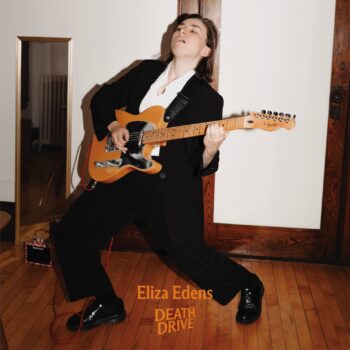
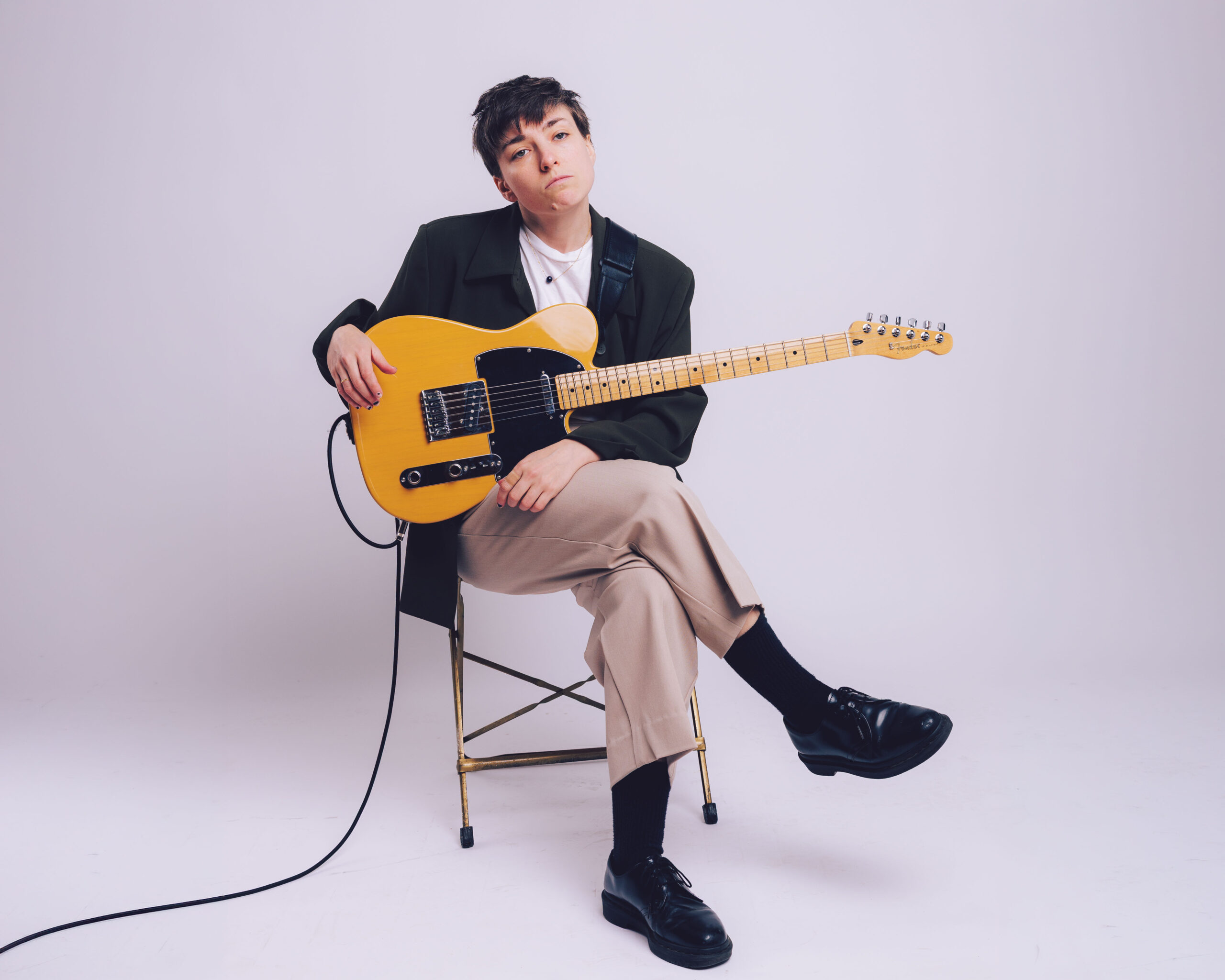
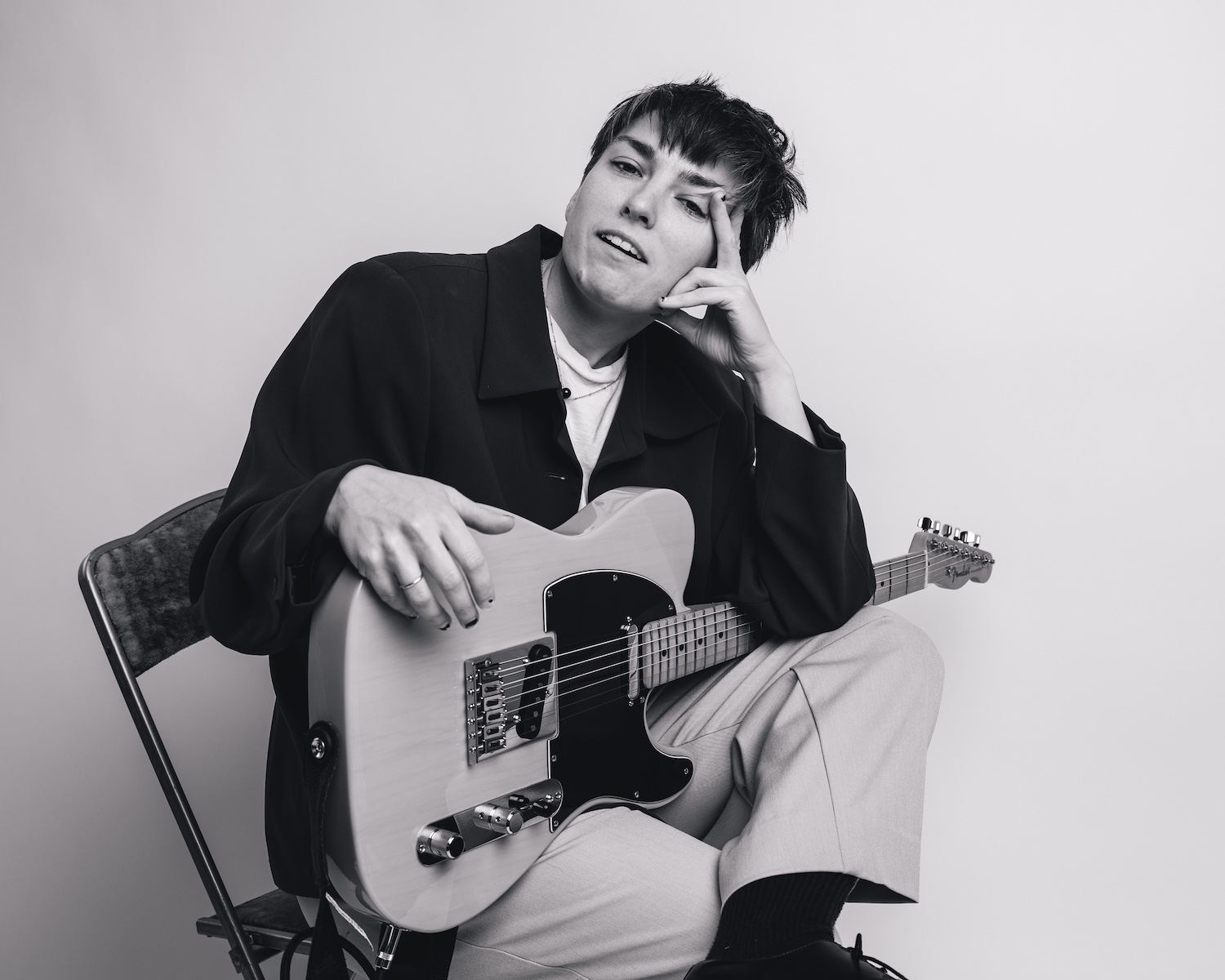
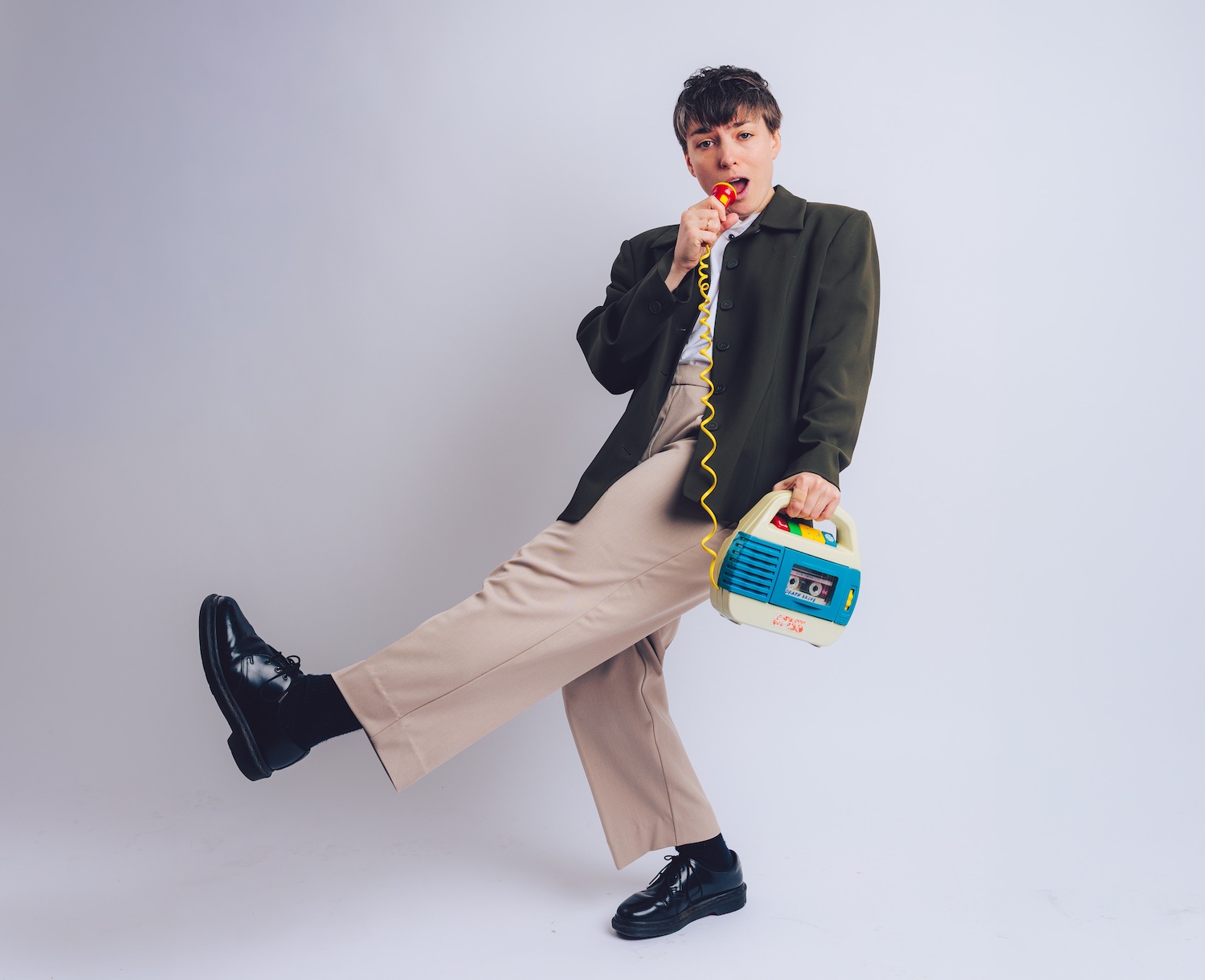
Brooklyn-based singer/songwriter Eliza Edens channels grief, desire, and a newfound appetite for risk into “Death Drive,” a charged indie rock rush that embraces life’s unruly impulses while opening the door to their boldest, most liberated era yet.
 follow our Today’s Song(s) playlist


Stream: “Death Drive” – Eliza Edens
It’s all just so silly when you really think about how impermanent things are, so maybe we should just… accept the mess?
* * *
Recklessness has a seduction all its own – the rush of giving in, blowing off steam, letting the mess show.
Sometimes the impulse that threatens to undo us is also the one that reminds us how fiercely we want to be alive.
Eliza Edens barrels straight into that contradiction on “Death Drive,” a propulsive indie rock rush that stares down our capacity for chaos and wonders what might happen if we stopped hiding from it. Guitars charge forward, Edens sings with spirited abandon, and the whole track moves with an almost irresistible momentum – charismatic and aching, playful around the edges yet wired with real emotional weight.
“Isn’t it funny how we look alive but we’re unravelin’ inside,” Edens sings, landing on the tension that gives “Death Drive” its pulse. We carry our damage, our appetites, our terrible ideas; we keep moving anyway. Edens makes that collision sound thrilling – a song about accepting the unruly parts of ourselves and finding a strange, liberating kind of life inside the wreckage.
Mom always knew how to
charm the face off strangers
Even when she had dementia
men would wanna bring her home
Isn’t it funny how we look alive
but we’re unravelin’ inside
Wanna get tangled up
I wanna love my death drive
Released September 1st via First City Artists, “Death Drive” is the charged and churning title track off Edens’ forthcoming album Death Drive, out October 30th. The Berkshires-born, Brooklyn-based singer/songwriter has spent the better part of a decade following their instincts through folk, indie rock, and increasingly adventurous full-band arrangements; when Atwood Magazine premiered the single “Leash” earlier this year, we celebrated its “bold and breezy indie rock” sound and the freedom Edens found in embracing life’s darker impulses.
“Death Drive” pushes that door even further open, channeling early-2000s pop-punk urgency into a darkly funny reckoning with recklessness, survival, and the turmoil we carry beneath the surface. Edens calls the new album their first true pop record – grittier, more direct, and more dynamic than the work that came before it, with a newfound appetite for risk driving both the writing and the performance.
That appetite emerged during one of the most emotionally volatile periods of Edens’ life.
As their mother’s years-long battle with dementia neared its end, Edens was also exploring their queerness for the first time – grief and desire arriving side by side, each intensifying the other. The pain was enormous, but so was the sense of possibility beginning to open around it.
“It was an intense time,” Edens recalls. “As I was watching my mom fade, I was also embracing a more reckless and bold side of myself in terms of identity.”
The album’s title gave Edens a language for those opposing forces. Drawing on Freud’s concept of the death drive – the pull toward risk, destruction, and release – Death Drive embraces the impulses we’re often taught to suppress. For Edens, the idea became both literal and psychological: Their mother was moving slowly toward death while they were moving toward a version of themself that had spent years waiting to emerge. Grief didn’t cancel desire. Desire didn’t erase grief. The two sharpened each other until joy itself became more vivid.
“Grief and desire are two edges of the same sword I suppose – they are both an emotional buildup of wanting,” Edens explains. “They speak to each other intimately on this record by providing contrast – the sad songs are sadder and the happier songs are more joyful. Many of the songs are happy-sad too.”
“Death Drive” embodies that friction beautifully. The track has tremendous forward motion, but Edens never lets it fly completely off the rails. The guitars push and jab; the rhythm urges them onward; their vocal carries a scrappy, almost singalong immediacy. Yet underneath all that movement is restraint – a held breath inside the sprint. The song keeps flirting with release without surrendering entirely to it, creating a delicious pressure between the impulse to accelerate and the instinct to keep one hand firmly on the wheel.
The lyrics move with that same push and pull, jumping between episodes that vary wildly in scale but share the sensation of being knocked off balance.
Edens remembers crushing a rib while skiing as a kid – “Dad said I’m glad you didn’t die” – then skips ahead to 2020, a move to New York, and a long-distance breakup delivered over FaceTime. “Couldn’t dance it off at the bar,” they sing, letting heartbreak enter the same breathless continuum as physical danger. The song doesn’t flatten those experiences into equivalence; it collects them as different encounters with instability, moments when control gives way and Edens has to reckon with whatever remains.
When I was a kid I crushed a rib while skiin’
Dad said I’m glad you didn’t die
Maybe I was flirtin’ with the limit
but baby that’s how you win it
Wanna get tangled up
I wanna love my death drive
The refrain answers those memories with bravado: “Maybe I was flirtin’ with the limit but baby that’s how you win it.” It lands as half-joke, half-credo, playful enough to shout along with but pointed enough to keep the chorus from becoming pure release. Then “Wanna get tangled up / I wanna love my death drive” folds attraction into the danger itself. “Tangled” carries pleasure and entrapment in the same word; Edens hasn’t merely survived chaos here, but admits to being drawn toward its charge.
By the final verse, even certainty itself starts to wobble. “I heard that Christians stopped believin’ in hell / And that presidents always lie,” Edens sings, widening the song beyond autobiography into a world where received truths are unstable too. One line lands like absurdist hearsay, the next like a weary truism, and together they extend the song’s central unease: Relationships rupture, bodies break, institutions disappoint, and still that restless appetite persists.
That balance is crucial because Edens isn’t romanticizing self-destruction. They’re examining its allure. The song’s bright, scrappy surface keeps those memories from hardening into solemnity, allowing Edens to revisit danger without making danger the whole point. Edens wrote and fully demoed the track in a single day while thinking about the concept, reaching back to the early-2000s pop-punk they loved as a kid – Simple Plan and Green Day among them – and eventually building the final arrangement with their collaborators.
“For the arrangement and singing style, I wanted to harken back to early 00s pop-punk which I grew up on like Simple Plan or Green Day (my favorite bands at age 12),” Edens says. “For the guitar solo, I was inspired by a Renny Conti song that has a repetitive, mostly single-note solo. I love taking a reference like that and putting a new twist on it.”
That directness suits a lyricist newly uninterested in hiding behind too much abstraction.
Where “Leash” played with character and metaphor, “Death Drive” comes closer to the bone. Edens calls it “a little more fearless,” and you can hear that fearlessness in the way the song lets humor sit beside mortality without apologizing for either.
The opening verse proves it. “Mom always knew how to charm the face off strangers / Even when she had dementia men would wanna bring her home” carries a comic spark, but dementia sits plainly at its center. Edens preserves their mother’s magnetism inside the lyric instead of reducing her to the illness that was taking her away, allowing affection, absurdity, and loss to occupy the same memory.
Its most devastating lyric arrives almost casually: “Isn’t it funny how we look alive but we’re unravelin’ inside.”
Behind that line is one of the song’s most personal memories. Edens was partly thinking about their mother, whose dementia had progressed significantly by the time an older man approached Edens at one of their house shows and remarked on how “cool” she seemed. Even as her cognition faded, Edens remembers an aura that remained unmistakably hers. The encounter struck them as funny, sad, and strangely beautiful – another reminder that what appears intact from the outside may conceal a very different reality within.
“Even though she wasn’t fully cognitively there, she had this beautiful aura still which lasted until the end,” Edens recalls. “So it’s about how appearances are usually always deceiving.”
And suddenly the unruliness at the center of “Death Drive” reads differently. The song’s desire to love that destructive impulse isn’t an endorsement of ruin so much as an argument for making peace with our capacity for it. Edens keeps returning to acceptance: The body’s appetite, the mind’s chaos, the vices and contradictions that can’t simply be reasoned away. To recognize them is to recognize ourselves more completely.
Year was 2020, moved to New York City
Was in an LDR
Dumped me over FaceTime
Couldn’t dance it off at the bar
Yeah I got so mangled up
But I knew my death drive
“It’s all just so silly when you really think about how impermanent things are, so maybe we should just… accept the mess?” Edens says. “Accept the recklessness and inherent chaos – the death drive. That’s what I mean by wanting to love my death drive – it’s maybe a bit about self-acceptance in a way.”
The closing couplet distills that acceptance into its starkest form: “Wanna know it’s gonna end / Wanna love my death drive.” Edens puts mortality and appetite in the same breath. Knowing there is an ending doesn’t extinguish the desire to get tangled up in living; it intensifies it.
That word – love – changes the proposition. “Death Drive” begins in danger but keeps reaching toward compassion. Its grit has buoyancy. Its darkness comes streaked with humor. Even the music’s propulsion carries an undercurrent of control, as though Edens is testing how close they can get to the edge without disappearing over it.
The song’s self-directed music video pushes that tension into a literal landscape of decay. Filmed among dilapidated vintage automobiles at an antique car lot near Edens’ Berkshires hometown, it moves from a dreary therapy session into a junkyard dance party, surrounding Edens with machines that remain beautiful even as they fall apart. The video culminates in Edens smashing an acoustic guitar with a baseball bat – a gleefully destructive burst of catharsis that gives the song’s psychological push and pull a physical release. “I wanted the video to reveal how alluring destruction can be,” they explain. The image could hardly fit the music better: Rust, movement, humor, mortality, and a person dancing among the remnants.

After so much mourning, levity became a form of survival.
Edens has already written extensively from grief, including on 2022’s We’ll Become The Flowers and the spare voice-memo collection it’s your birthday & you’re gorgeous. Eventually, carrying that sadness into every part of their creative life became exhausting. They wanted music they could inhabit physically onstage rather than another nightly return to mourning.
“I was already running a grief marathon, and I didn’t want to also have sad music to sing, promote, and perform night after night on tour,” Edens says. “I was fully expressing my sexual identity for the first time in my life, and finally felt happy since I wasn’t repressing anymore!”
The shift demanded a different kind of songwriting. After years of challenging themself through intricate guitar approaches and the self-seriousness Edens admits once shaped their process, they began stripping away rules that had stopped serving them. Simpler chord progressions became liberating. Genre boundaries loosened. Music could hit the body before the intellect had time to intervene.
“Just wanting fun and simplicity when life felt sad and too complicated,” Edens says.
I heard that Christians stopped believin’ in hell
And that presidents always lie
I might be flirtin’ with the limit
but baby that’s how you win it
Wanna get tangled up
I wanna love my death drive
That may be the clearest invitation into Death Drive. Edens hasn’t abandoned the searching songwriter behind their earlier records; they’ve given that artist more room to misbehave. Grief remains embedded in the music, but now it exists alongside sex, humor, pop instinct, physicality, and the thrill of following an idea wherever it leads. The resulting freedom sounds earned.
“I’m an artist that follows creative whims in the moment and will go to great lengths to realize my vision,” Edens tells Atwood. “I do still feel limitless, and now I feel more interested in risk.”
“Death Drive” makes that risk audible. It’s restless without becoming reckless in its construction, emotionally exposed without collapsing beneath its own gravity. Edens gives mortality a beat, lets grief share space with appetite, and finds liberation in admitting that control was never absolute in the first place.
If the title track is our clearest window into the album arriving October 30th, Death Drive promises an Eliza Edens freer to chase contrast wherever it leads – an artist embracing scale, immediacy, and surprise while remaining rooted in the emotional precision that has always made their writing cut deep. For the first time, Edens says, their silliness is fully present in the lyrics and production. This revelation may be just as important as any stylistic shift: After years spent writing through loss, they’re allowing themself to have fun inside the complexity.
Wanna know it’s gonna end
Wanna love my death drive
Wanna get so tangled up
Wanna love my death drive
And that’s the real pulse beneath “Death Drive” – a handful of brutally simple evergreen truths.
Life unravels. Bodies fail. Desire arrives at inconvenient times. We make reckless choices, carry private chaos, and keep searching for ways to live more fully – all while knowing none of this lasts forever. Edens doesn’t solve that contradiction. Rather, they grab hold of it and floor the accelerator.
Death Drive is set to release October 30 via First City Artists. Below, Atwood Magazine catches up with Eliza Edens to unpack the title track’s brushes with danger, the grief and desire that shaped Death Drive, the creative risks redefining their songwriting, and the liberation of making the biggest, boldest record of their career.
In the end, Edens follows recklessness all the way back to its source: The fierce, unruly desire to be alive.
— —
:: stream/purchase Death Drive here ::
:: connect with Eliza Edens here ::
— —
Stream: “Death Drive” – Eliza Edens
A CONVERSATION WITH ELIZA EDENS

Atwood Magazine: Eliza, when we spoke earlier this year around “Leash,” you talked about feeling “limitless” in your writing and less pigeonholed into any one genre or vibe. Now that Death Drive is coming into focus, how do you understand the artist you are today?
Eliza Edens: I’m an artist that follows creative whims in the moment and will go to great lengths to realize my vision. I do still feel limitless, and now I feel more interested in risk.
Death Drive arrives nearly two years after it’s your birthday & you’re gorgeous. How do you feel this album compares to your past LPs?
Eliza Edens: This is the first album that I would call a pop record. It’s a lot more gritty, less “pretty,” and more lyrically direct than anything I’ve ever made. Death Drive feels like a more dynamic and confident record. It’s big and epic compared to others.
it’s your birthday & you’re gorgeous was truly just a collection of voice memos recorded on my phone – mostly guitar and voice. It cost barely anything to make, but felt urgent to release. My other two studio records were very much fingerpicked acoustic records with a few adventurous forays into other genres. Quiet music. It was time for a change.
Death Drive was born during an incredibly intense time, as you were losing your mother to dementia while also exploring your queerness for the first time. How did grief and desire begin to speak to each other inside these songs?
Eliza Edens: It’s funny you ask that, because some friends I’ve shown the record to can’t tell if certain songs are about my mom or about desiring a past lover. Grief and desire are two edges of the same sword I suppose – they are both an emotional buildup of wanting. They speak to each other intimately on this record by providing contrast – the sad songs are sadder and the happier songs are more joyful. Many of the songs are happy-sad too. It feels like an accurate reflection of how I felt grief expanded my capacity to feel joy during this intense time. I had never felt joy more clearly because I was that much more grateful for the moments when I felt happy. So, grief and desire dovetail on the record to make it all more resonant.
The album takes its name from Freud’s theory of the “death drive,” this instinct toward recklessness and self-destruction as a way of releasing tension. What drew you to that idea as a frame for the record?
Eliza Edens: As I was trying to figure out a title for the record during the mixing phase, my producer Dexter actually suggested that I call it Death Drive because the idea perfectly encompasses everything the album touches on – a literal drive towards death (ie. watching my mother slowly die) but also the Freudian meaning of it (embracing my more reckless side and letting my queerness blossom). It fit perfectly. Also it’s alliterative and has a nice ring to it which I think is important with album titles.
You’ve described that period as one where you were watching your mom fade while embracing a more reckless and bold side of yourself. How did that collision change the way you were writing?
Eliza Edens: I wanted to have more fun writing and performing my music on stage! When someone you love in your life is dying for years on end, the waves of sadness just start to feel unbearable. I was already running a grief marathon, and I didn’t want to also have sad music to sing, promote, and perform night after night on tour. I was fully expressing my sexual identity for the first time in my life, and finally felt happy since I wasn’t repressing anymore! So those circumstances combined to create a desire to write music that was felt more in the body than in the brain.
For many years starting out in music, I had this very self-serious complex of trying to prove myself with not using cowboy chords in my songs and using obscure open tunings à la Joni Mitchell. I threw it out the window because the approach wasn’t serving me anymore. This record has the first song with a 1, 4, 5, 6 chord progression that I’ve written probably since I was 15. It took a lot of letting go to get there. But yeah, just wanting fun and simplicity when life felt sad and too complicated.
The title track “Death Drive” feels like it sharpens the playful darkness we heard on “Leash” into something even more charged. What’s the story behind this song?
Eliza Edens: I was reading a Substack post by one of my all-time favorite songwriters Laura Marling about the concept of the death drive and it struck me as a fascinating topic – the idea that we all have our vices and reckless sides. I was writing a song per day at the time and decided to try and write about the concept and just have fun with it. I decided to rehash several situations that felt related to the concept – near death or traumatic incidents. I wrote it and fully demo-ed it all out in my room that day. For the arrangement and singing style, I wanted to harken back to early 00s pop-punk which I grew up on like Simple Plan or Green Day (my favorite bands at age 12). For the guitar solo, I was inspired by a Renny Conti song that has a repetitive, mostly single-note solo. I love taking a reference like that and putting a new twist on it. I recorded it a couple months later with my collaborators, and they took my arrangement to the next level. I especially love Jacob Drab’s guitar-playing on the final track – he has the magic touch.
I'm absolutely moved by the lyric, “Isn’t it funny how we look alive but we’re unravelin’ inside.” What were you trying to capture there, and how does that lyric connect to the idea of wanting to “love” your death drive?
Eliza Edens: It’s basically just the idea that someone can look put-together on the outside but be a hot mess on the inside, and yet many people try to hide their mess with such fervor. It’s all just so silly when you really think about how impermanent things are, so maybe we should just… accept the mess? Accept the recklessness and inherent chaos – the death drive. That’s what I mean by wanting to love my death drive – it’s maybe a bit about self-acceptance in a way.
That line also follows a line about my mom that was inspired by an actual encounter where she was at a house show of mine and even though she was 5+ years into her journey with dementia, this older guy came up to me and said “Is that your mom? She’s really cool,” like almost in a flirty way. Even though she wasn’t fully cognitively there, she had this beautiful aura still which lasted until the end. I just thought it was humorous that this guy was sort of into my mom because she was very sick by that point. So it’s about how appearances are usually always deceiving.

The “Death Drive” video brings a playful, evocative visual language to a pretty heavy psychological idea. What did you want the video to reveal about the song and the album’s world?
Eliza Edens: I wanted the video to expand the story of the song a bit more and add some humor and lightness to it. We filmed most of it at a vintage auto shop in upstate NY close to where I’m from in MA. I loved how beautiful all the cars were even though they were totally falling apart – beauty in decay. It was a perfect backdrop to the whole video and concept for the album. I wanted the video to reveal how alluring destruction can be.
Earlier this year, “Leash” opened the door to more edge, directness, and playfulness in your songwriting. How does “Death Drive” build on that shift?
Eliza Edens: “Leash” lived in a more abstract lyrical world. “Death Drive” has almost no metaphorical language or hidden meanings. It’s pretty straight-up, a bit funnier, and has even more duende. It’s a little more fearless – which hints more at the whole energy of the full record.
This album seems to live at the white-hot intersection of pain and pleasure, grief and appetite, recklessness and self-recognition. How did you want the music itself to hold those contradictions?
Eliza Edens: The music holds those contradictions by being less confined by genre. I used to think that songs on albums should all sound relatively similar, but on this record I embraced the stylistic variety of music that influences me. I love everything from classical to traditional folk to pop, experimental, hip-hop, freak-folk, Brazilian jazz. I’m an omnivorous listener. So I just let myself do whatever felt good in terms of writing and didn’t hold myself to one genre. My favorite albums all have contrast and contradictions, subject-wise and genre-wise.
What does Death Drive reveal about you that you don’t think any of your previous records could have revealed?
Eliza Edens: I am quite a silly person and always have been, but this is the first album that really exposes that in its lyrics and production style.
— —
:: stream/purchase Death Drive here ::
:: connect with Eliza Edens here ::
— —
Stream: “Death Drive” – Eliza Edens
— — — —
Connect to Eliza Edens on
Facebook, 𝕏, TikTok, Instagram
Discover new music on Atwood Magazine
© Emilio Herce
 © Emilio Herce
:: Today’s Song(s) ::
follow our daily playlist on Spotify
:: Stream Eliza Edens ::