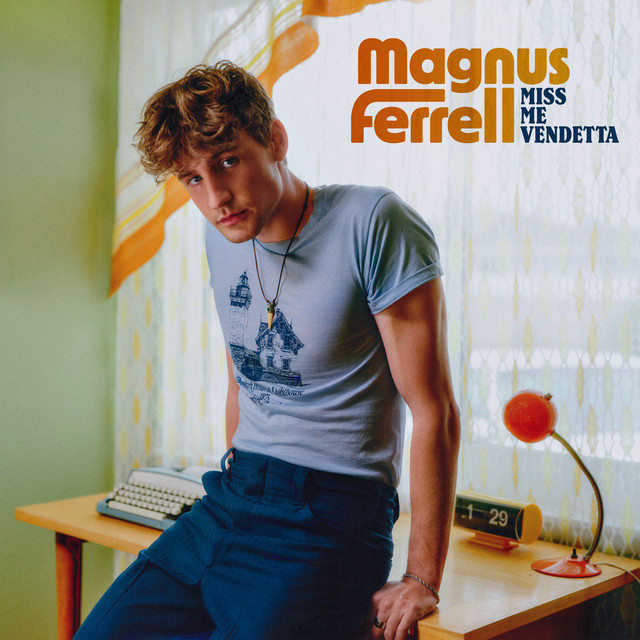
Following the release of his latest single, “Miss Me Vendetta,” Magnus Ferrell talks about his musical journey, process of creation, and why he won’t let imposter syndrome stop him.
Stream: “Miss Me Vendetta” – Magnus Ferrell
We’ve been calling it “groove therapy” – it’s me sharing my love for music with everyone, and whatever you feel when you listen, that’s the whole point.
* * *
They say shadows are some of the hardest things to overcome.
Not literally, as a shadow is nothing more than the mere absence of light, but figuratively, shadows can engulf like an abyss of never-ending expectation. As you run, you endure a silently deafening chase of transcending the shadows that roam aimlessly, in pursuit of consuming your identity. Many spend their lives trying to outrun these shadows, but what if the real challenge is learning to live with them? What if those shadows are not obstacles, but foundations?
For 21-year-old musician Magnus Ferrell, son of acclaimed actor and comedian Will Ferrell, these shadows aren’t something to hide from. They are part of who he is. Rather than distancing himself from his father’s legacy, Magnus embraces it, allowing his music to reflect both the influence and the independence of his journey. He’s not here to prove that he’s not his father’s son; in fact, he’s proud to be. Instead, he’s determined to show that his love for music transcends any expectations tied to his family name.
Ferrell’s first real exposure to music began with a set of keys and a disdain for the instrument. Yet soon, that resistance turned into a natural fluency in melody and composition – one that continues to shape his artistic identity.
Under his mom’s direction, he learned to play the piano at the age of five and grew to love it by the age of 12, but the tenutos and staccatos decorating his sheets continued to frustrate him. By 14, he had discovered jazz piano and was completely captivated by the freedom it invited. For Ferrell, it turned strict structure into spontaneous expression.
“My teacher would make me transcribe pianists and really famous solos from artists like Miles Davis, Oscar Peterson, and Bill Evans,” Ferrell shared regarding his then-budding love for the genre, a glint of something alive flickering in his eyes as he spoke. “Those transcriptions made me really dive into it. It helped improve my playing, but also became part of the music I make.”
From that moment forward, it was clear he had found his calling. He leaned into it entirely and let it carry him with every high and low note through life as both his compass and his release. It was a rhythm he could trust when words fell short. He experimented with different sounds, weaving together melodies and genres that spoke to the depths of his experience.

Yet, it wasn’t until three years ago that Ferrell started putting out his own music.
He had just enrolled at the University of Southern California, his father’s alma mater, and alongside his “arch nemesis” turned longtime friend turned college roommate turned musical collaborator, Gabe Yaron, would post covers and independent music on the internet.
What started as a passion project quickly blossomed into something much greater. Weeks later, Ferrell was discovered by a music label, marking the beginning of his professional journey. His sound resonated far beyond just an internet presence. With several singles and EPs to his name, and over 581,000 Spotify streams, each play stands as a testament to the deep love he carries for his craft – something you can hear in his music. Whether it’s the infectious grooves and droning beats of “I Can’t Stop Thinking About It,” or the smooth, soulful cadence of “Life or Death” that blends polished bass with the vulnerability of his lyrics, Ferrell’s music is a compelling fusion of emotion and rhythm. It’s this experimentation with his sound that draws listeners in – inviting them to feel, move, and connect with every note he sings.
His most recent release, “Miss Me Vendetta,” is the latest in a string of emotionally energetic tracks that showcase his evolving artistry. The song feels both timeless and contemporary, unfolding with a steady hypnotic beat that almost resembles something you’d hear on the radio in 2010 – youthful like Bruno Mars and sonically immersive like Grouplove. He sings of the complicated dance between love and heartbreak, yet mostly concerns himself with the alluring nature of human taunting. Ferrell’s vocals glide effortlessly over the rhythm, balancing cheeky confidence with subtle vulnerability. The song is an assured leap forward in his creative journey and one that reflects his sincerity and embrace of being unapologetically fun.
Much hasn’t changed in his approach to music. We’re on a video call, he in Sweden as evening drapes the sky, me in California beneath a wash of golden sun. He’s swaddled in a knit sweater and tucked into a dimly lit room, yet his presence and enthusiasm for what we are to discuss is enough to brighten the call.
— —
:: stream/purchase Miss Me Vendetta here ::
:: connect with Magnus Ferrell here ::
— —

A CONVERSATION WITH MAGNUS FERRELL

Atwood Magazine: How did your early experiences with music shape the way you connect with your art today?
Magnus Ferrell: Yeah, I mean, all those experiences gave me such a solid foundation. I was able to just play what I felt was really important to me, to work through things on an instrument. And I don’t want to sound like some crazy prodigy or anything; it’s more that I have this tool to process emotions and ideas. I think that’s pretty uncommon, especially in the commercial music world. So, I’m honestly really thankful to have this extra training that I didn’t necessarily need, but that’s become invaluable.
How has working with your longtime friend, Gabe Yaron, shaped your creative voice?
Magnus Ferrell: You know, it’s been really great for me, and I’m so fortunate to have someone who’s been in my corner. We motivate each other in different ways because we both have our strengths and weaknesses, and together, those almost cancel out the weaknesses and amplify our strengths. Being able to work with someone so effortlessly is something I’m truly grateful for. I don’t know if I’d have the same motivation or be in the same place if I hadn’t met him. I’m not sure I would have started so early and found this love for music. Finding someone who’s really in your corner and not spreading yourself too thin by trying to work with a million different people has been super important for me.
How do you hope people perceive the artist you’re becoming and the path you’re carving for yourself, beyond the shadow of your father’s influence?
Magnus Ferrell: Yeah, the whole dad thing is interesting to me because I’m not someone who’s going to pretend it’s not a thing. Most definitely, it is. I’m not going to hide it. But at the same time, it can also feel pretty unrelated since he’s in a completely different field. If I were trying to become an actor, I think my path would be very different. But because I’m doing music, I can thankfully separate myself a bit. And obviously, I’ve had an amazing life and opportunities I wouldn’t have without him, but those opportunities had to be earned through the work I’d already done. There were plenty of chances that didn’t happen because my music wasn’t good enough or I wasn’t ready. So, it’s been both a blessing and a curse.
What I hope for is to prove myself by earning it. By putting out music and putting in the work. I know it’s going to take time; it’s not something that’s going to happen overnight. It’s not like after one single people will say, ‘Oh, he’s earned his status now.’ But I have a strong belief in my work ethic, the people around me, and the music itself. I know it’s a process, and it’s going to take time.
Can you walk us through the creation of “Miss Me Vendetta”?
Magnus Ferrell: We always try our best to write about real stuff – or at least base it on real experiences. This song was mainly inspired by an ex. It’s always about an ex, right? But this one was about an ex who was saying not-so-nice things about me and my body, a year and a half after we’d broken up. I was just like, “What are you doing?” It was kind of ridiculous.
We could have written a sad, heavy, heartfelt piano ballad if we wanted to, but that didn’t feel true to how I felt. I wasn’t hurt. It was more like, ‘What?’ So I decided to respond with something almost funny, kind of making fun of the situation. It’s like saying, “You miss me, that’s why you’re saying this stuff.” Being petty isn’t great, but sometimes it’s a good way to work through things.
Do you see this song as marking a new era for you, a departure from what you’ve done before?
Magnus Ferrell: I’d say the new stuff still has similarities to the older material, but I’m definitely more confident in it now. This is the first time I’ve released a song that I wasn’t sick of by the time it came out, and that’s because of the process – really giving the song its full journey, working through it, and falling in love with it again. That’s the approach we’re taking with every new release now.
Luckily, the process is getting a bit shorter because we’re starting further along. We know which mistakes to avoid. It’s been really cool to see real progress in real time. Sometimes you realize, “Oh, I got better after that last song.” Like, something we were stuck on before, we’ve completely fixed it with the new one. I’m just excited to dive into this new era and see where it takes us.
How would you describe this next era?
Magnus Ferrell: We’ve been calling it “groove therapy,” which feels like a good way to describe it. It’s me sharing my love for music with everyone, and whatever you feel when you listen, that’s the whole point. If you feel something, then I’m doing my job right. If not, then maybe I’m just not the artist for you. But this is how I get my feelings out.
Music motivates us to live our lives more fully – not that we’re out there living just to write songs, but it definitely pushes us to have experiences. The better the experiences, the more real stuff we bring into the studio. Whether we’re happy, sad, or anywhere in between, at least we’re feeling something. And if you can express that and let it all out, well that’s what really matters.
Are there any songs or artists that you find yourself going back to when you're in the process of making music?
Magnus Ferrell: Yeah, I mean, every song has different reference points, if that makes sense. Like, for example, “Miss Me Vendetta” had its own vibe, but the next single we’re working on, “Blurred Lines” is a huge reference. We’re also digging into deeper influences like Stevie Wonder, Babyface, and even Bobby Brown. Just little things that feel cool and different, stuff that isn’t really happening right now.
There’s this track by Leon Thomas that was a huge inspiration. I was driving Gabe crazy trying to figure out the drums. He was literally banging his head against the wall trying to figure out how they made that sound. We’re just pulling from whatever fits us right now. Also Bruno Mars, the whole “24K Magic” era, Silk Sonic, that kind of stuff is always killer. It’s about blending in these weird, unexpected elements that people might not recognize but definitely feel.

You’re about to play Summer Bash ‘25 in New York. How do you feel going into it? What can you tell us about the set that you’ve prepared for it?
Magnus Ferrell: I know I’m doing something, but I don’t know what yet. But to see Julia Michaels and Lewis Capaldi is just absurd. I looked up to those people. Gabe and I would talk – because we’re nuts – we just talk music all the time. We talk about Julia Michaels. About Lewis Capaldi. I remember seeing a clip of [Lewis] on maybe the Graham Norton show or some British radio show and they asked, “How can we listen to your new single?” He was like, “Oh, don’t bother. Don’t even bother.” I thought that was hilarious! I want to approach my music with that charisma. Even Julia Michaels – how she writes and how legendary she is…I just have total imposter syndrome.
How are you working your way through imposter syndrome?
Magnus Ferrell: My logic can get in the way of myself sometimes. It’s kind of what my brain perceives as logic like, “Oh yeah, you haven’t had a hit yet, so what are you even doing?” That’s the voice in my head. But then I have to remind myself how much work I’ve actually put in and how much time I’ve spent on this. It doesn’t even feel like work to me because it’s so much fun. I think about it all the time. I dream about it and I wake up wondering, ‘What do I have to do today? What am I writing next? When will I get back in the studio?’
So really, it’s about reminding myself of the effort I’ve made and just continuing to do the work. The more I practice, prepare, and take care of my body, the better I feel. Then, when I get on stage, I focus on letting go of everything else and letting my practice and preparation show through in the performance.
Looking ahead ten years, what do you hope you’ll remember most about this moment in your life?
Magnus Ferrell: It’s funny you ask that because I was actually thinking about it a few days ago. I still have this sense that so much could go wrong, and I think that really electrifies everything. You never know what the next day will bring for your music career. It’s so unpredictable. It’s as silly as the nervousness of posting a new video, not knowing how many views it’ll get. Or the nerves before playing a showcase for a label. Or going on a high school tour, where your negative brain tells you the kids won’t know who you are, but then the other side says, “No, screw that, go have fun.”
That feeling of uneasiness, I’ve started to see it in a positive light. I hope I remember that, and carry it with me throughout my career, no matter how successful or not I become. It makes the small victories feel so much sweeter right now.
— —
:: stream/purchase Miss Me Vendetta here ::
:: connect with Magnus Ferrell here ::
— —
Stream: “Miss Me Vendetta” – Magnus Ferrell
— — — —
Connect to Magnus Ferrell on
Facebook, 𝕏, TikTok, Instagram
Discover new music on Atwood Magazine
© Thomas Falcone
 © Thomas Falcone
:: Stream Magnus Ferrell ::