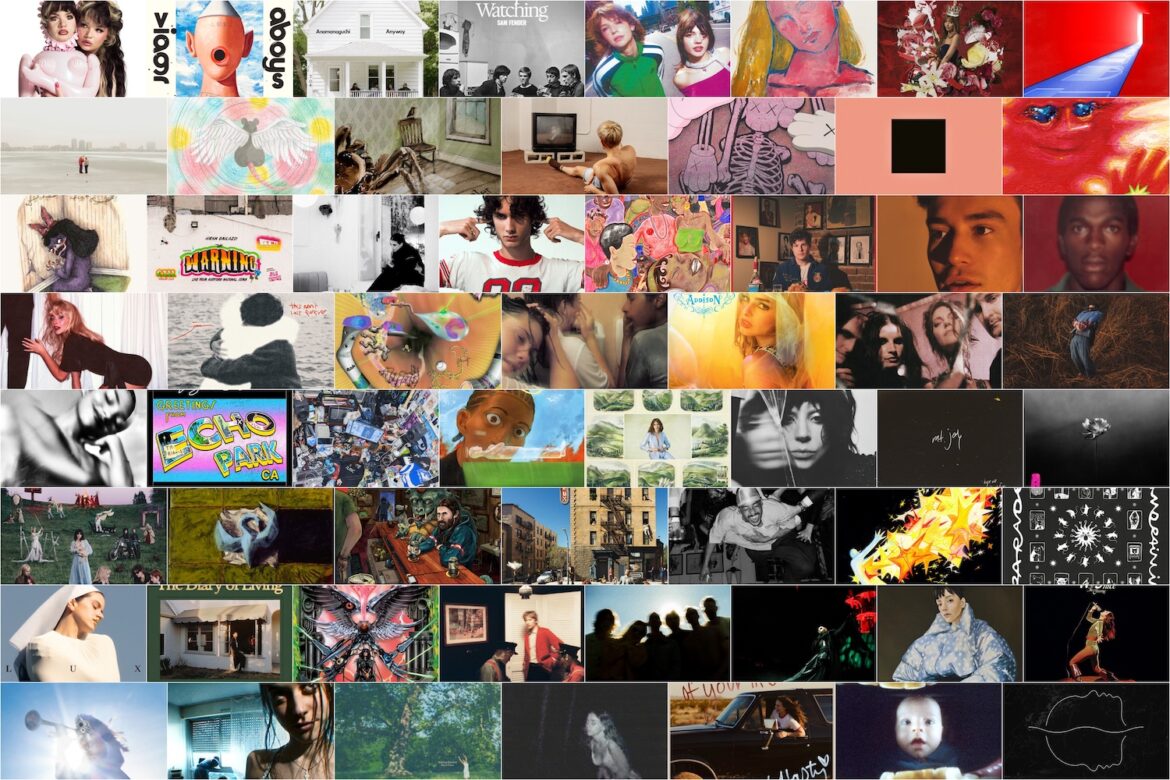
Adam Melchor, Addison Rae, Alicia Clara, Anamanaguchi, Balu Brigada, Bartees Strange, Billie Marten, Black Country, New Road, Bon Iver, Brian Dunne, Clipse, Daniel Caesar, Dijon, Djo, Dove Ellis, flipturn, Galen Tipton & Shmu, Geese, Greg Freeman, Hannah Cohen, Jack Garratt, Jacob Collier, joan, Kat Hasty, Kokoroko, Lady Gaga, Lily Allen, Little Simz, Lola Young, Machine Girl, Mae Martin, McKinley Dixon, Mei Semones, Men I Trust, Michael Seyer, Mt. Joy, Ninajirachi, Of Monsters and Men, Oklou, Olivia Dean, Pacifica, Petey USA, Pink Pantheress, Racing Mount Pleasant, Rosalía, Ryan Cassata, Sabrina Carpenter, Sam Fender, Samia, Sharon Van Etten, sombr, Spiritbox, The Head and the Heart, The Last Dinner Party, The Warning, Viagra Boys, Violet Orlandi, Wednesday, Wolf Alice, Young Miko

From all of us here at Atwood Magazine, we wish you a happy and healthy new year!
In 2025, albums mattered again. Not just as collections of songs, but as worlds you could step into and stay awhile – lived-in documents shaped by real time, real feeling, and real intention. The records released this year asked for our time and patience, and rewarded that attention – unfolding slowly or hitting all at once, each one designed to be played front-to-back, returned to, and carried with you. In a year that often felt fractured and overwhelming, such records offered continuity – a place to rest, to reckon, to feel something all the way through.
Across genres and scenes, artists leaned into the album form with renewed purpose. Some delivered joy and radiance, like Olivia Dean’s seductive masterpiece The Art of Loving or Sabrina Carpenter’s uncompromising Man’s Best Friend. Others embraced tension, chaos, and confrontation – from Lady Gaga’s explosive Mayhem to Geese’s feral, unhinged Getting Killed. There were records that felt intimate and interior, like Dijon’s Baby or Daniel Caesar’s Son of Spergy, and others that reached outward, expansive and searching – like Bon Iver’s spellbinding and soul-soaked SABLE, fABLE, Sam Fender’s spirited People Watching, Samia’s stark and searching Bloodless, or Djo’s sharply focused The Crux. Together, they painted a portrait of a year defined by contrast: Comfort and unrest, clarity and confusion, hope and ache living side by side.
Just as reaffirming was the power of debut albums this year – full-length statements that didn’t hedge their bets or play small, but arrived with conviction, identity, and something to say. Across genres and throughout the world, emerging artists stepped fully into the spotlight, using the album form as a declaration rather than a trial run. From the intimate clarity of Alicia Clara’s Nothing Dazzled and the radiant, genre-blurring confidence of Mei Semones’ Animaru, to the aching romanticism of Racing Mount Pleasant’s self-titled debut and the darkly cinematic self-reclamation of Violet Orlandi’s Birdeater, these records proved that first chapters can still feel fully formed. And then there was Dove Ellis: Arriving under the wire with Blizzard, a late-year release so assured and emotionally arresting it immediately reoriented the conversation – not just as one of 2025’s most striking debuts, but as a defining introduction that all but guarantees his place as a 2026 Artist to Watch. Together, these debuts weren’t just beginnings; they were statements of belief – in craft, in patience, and in the enduring power of the album as a space to tell a full story.
Atwood Magazine’s mission has always been to celebrate music across genres, communities, and lived experience, and this year that meant honoring albums that felt intentional – records made with care, conviction, and something to say. From massive pop statements to deeply personal indie releases, from artists cementing legacies to those stepping into their own for the first time, these albums reminded us why the long form still matters. They weren’t built for quick hits or background noise – they were meant to be felt.
As the year comes to a close, our staff took a step back to honor the songs, albums, concerts, and artist discoveries that had the greatest impact on our lives. These are our favorites – the records that stayed with us the longest, shaped our listening, soundtracked our days, and gave form to what this year felt like.
Without further ado, Atwood Magazine is proud to present our curated list of 2025’s Albums of the Year, in alphabetical order by artist. Please join us in celebrating 2025’s contributions to the music world!
Mitch Mosk, Editor-in-Chief
,
 Atwood’s 2025 Music of the Year

The Best Albums of 2025
Click on the artist’s name to skip right to their entry!
Adam Melchor, Addison Rae, Alicia Clara, Anamanaguchi, Balu Brigada, Bartees Strange, Billie Marten, Black Country, New Road, Bon Iver, Brian Dunne, Clipse, Daniel Caesar, Dijon, Djo, Dove Ellis, flipturn, Galen Tipton & Shmu, Geese, Greg Freeman, Hannah Cohen, Jack Garratt, Jacob Collier, joan, Kat Hasty, Kokoroko, Lady Gaga, Lily Allen, Little Simz, Lola Young, Machine Girl, Mae Martin, McKinley Dixon, Mei Semones, Men I Trust, Michael Seyer, Mt. Joy, Ninajirachi, Of Monsters and Men, Oklou, Olivia Dean, Pacifica, Petey USA, Pink Pantheress, Racing Mount Pleasant, Rosalía, Ryan Cassata, Sabrina Carpenter, Sam Fender, Samia, Sharon Van Etten, sombr, Spiritbox, The Head and the Heart, The Last Dinner Party, The Warning, Viagra Boys, Violet Orlandi, Wednesday, Wolf Alice, Young Miko
The Diary of Living
by Adam Melchor
There’s something quietly radical about calling an album The Diary of Living. Not a snapshot of love, heartbreak, or some curated, social media-ready slice of experience – but a full, messy, complicated reckoning with what it means to be here right now, alive, carrying memory and meaning in every breath. For singer/songwriter Adam Melchor, his second studio album is more than a creative step forward – it’s the sound of someone finally stepping into himself. The songs on The Diary of Living don’t just share stories; they embody them. They remember. They hurt. They heal. And above all, they live.
This is Melchor at his most vulnerable and honest – singing not only for himself, but for the friends he’s lost, the family he loves, and the person he’s become. There’s no veneer, no filter here. Just a man and his voice, guitar, and feeling – raw, unflinching, and full of heart. Across ten breathtaking tracks, the LA by-way-of New Jersey artist invites us deep into his world, handing us the keys to his soul in the process. From the soul-stirring folk anthem, “Room on Your Shoulder” – an achingly beautiful collaboration with Mt. Joy’s Matt Quinn and Sam Cooper – to the heartfelt “Dead Right,” the searing elegy “Suburban Siddhartha,” and the unapologetically human “The Hopefuls,” The Diary of Living proves an album, and then some: It’s a manifesto. A homecoming. A practice. A promise. – Mitch Mosk
Not everyone is going to understand Addison Rae, and you know what? That’s probably for the best. For the longest time, Addison Rae felt like pop music’s best-kept secret — I still remember my friend driving around to a bootleg version of “I got it bad.” With Addison, this artist officially cemented herself as one of today’s most exciting performers. The 2025 release is ditsy and plain fun in a way that seems effortless but was obviously painstakingly curated to match her stage persona. It begs the question: if you were young, rich, successful, and living in LA, what would that sound like? What would that feel like? It would feel like “Summer Forever,” Addison firmly answers. – Julia Dzurillay
Nothing Dazzled
by Alicia Clara
Sonics ebb and flow with textured riffs, gloomy piano, and a hint of chirping crickets – all while a soft voice glides just above the soundwaves. Alicia Clara first made her way into my headphones just prior to her visit to the Lone Star State for SXSW. Her debut record, Nothing Dazzled, came just a few months ago and I have yet to stop myself from constantly revisiting it. Not only is the Montreal-based musician an amazing singer, instrumentalist, producer, etc… but as someone who has sat down with her twice this year I can attest her presence is just as warm as her music feels. The indie-rock/ambient-pop fusion of Nothing Dazzled is a more than refreshing find in an oversaturated soundscape. – Marissa DeLeon
Anamanaguchi is a well-read, highly intelligent band, but they know one thing in particular: rock and roll is fun. Loud guitars, hyperkinetic drums, and shouting vocals is fun. And nowhere is this more evident than in their brilliant new album, Anyway. Written in the legendary American Football House, the group sound like they’re having the most fun possible, and that is exactly what makes this album so good. Their video game-indebted sounds are wedded with the gorgeous energy of rock and roll, and the result is one of the most electric records of the year. “Sparkler” and “Fall Away” kick the listener in the face and never lets up, “Darcie” is a gorgeous Weezer-like pop rock song-and-dance, “Rage (Kitchen Sink)” and “Valley of Silence” are spacey and out-there, and “Buckwild” truly describes itself. The variety and dynamics on display from the group are incredibly impressive, and make for an interesting listen practically every time. These songs are for the geeks who air-guitared to mid-90s alternative rock only a few years after their minds were blown by the SNES and Sega Genesis, and those feelings are what Anamanaguchi put to music so well here. This is a living, breathing record, one that blocks out the world and only does what it wants to do–have fun. – David Diame
For me, Portal is easily one of my albums of the year, because Balu Brigada have created something that feels both emotionally huge and sonically refreshing in a way I can’t stop returning to. From singles like “So Cold,” “Backseat,” and “What Do We Ever Really Know?,” the duo blend indie-rock punch with sleek alt-pop production, adding grittier textures that give the whole record this reflective, almost nostalgic calm beneath all the groove. It’s the kind of album that’s adventurous without losing its heart, full of songs that feel lived-in, thoughtful, and endlessly replayable, and I just love how it manages to be catchy, moody, and quietly powerful all at once. – Danielle Holian
Bartees Strange has never been one to color inside the lines. Across his first two albums – 2020’s Live Forever and 2022’s Farm to Table – he has carved out a singular space in music, one where genre distinctions blur and dissolve in service of something deeper, rawer, and truer to his ever-evolving artistry. His latest album, Horror, is his boldest statement yet: An unflinching exploration of personal fears, artistic ambition, and the haunting weight of self-doubt. If Live Forever was an introduction and Farm to Table a snapshot of an artist in motion, Horror is the sound of Bartees Strange fully in command of his craft – pushing himself to new emotional and sonic extremes.
At its heart, Horror isn’t just about fear – it’s about transformation, a process that unfolds in both its lyrics and its sound. The title Horror isn’t about ghosts or ghouls; it’s about the specters of insecurity, loneliness, and artistic erasure that loom large in Strange’s mind. Across the album’s sprawling soundscape – melding Parliament-Funkadelic grooves with Fleetwood Mac lushness, Isley Brothers riffs with the precision of Steely Dan – he navigates these fears head-on, turning them into something powerful. Highlights include the vulnerable self-examination of “17,” the self-actualization of “Backseat Banton,” the sonic ambition behind tracks like “Too Much” and “Lovers,” and the deep introspection of “Baltimore,” “Sober,” the restless search for belonging on “Lie 95.” Through it all, one thing is clear: Bartees Strange isn’t just making music – he’s making space for himself, his fears, and his ever-growing ambitions. Horror is an album of uncertainty, catharsis, inner power, and the human experience; of confronting what haunts you and coming out stronger on the other side. – Mitch Mosk
Billie Marten’s Dog Eared finds her in a lush, soul-stirring sonic space that feels both expansive and intimately close – an album that breathes, glows, and settles gently into the body. It’s achingly human music, tender and charming, heartfelt and warm, shaped by lived-in moments rather than grand gestures. Across these songs, Marten sounds deeply assured, letting softness lead without ever losing emotional weight, allowing feeling – pure, unguarded feeling – to be the record’s guiding force.
That approach crystallizes most beautifully on “Feeling,” a song that resonated with me instantly and profoundly. It lives in that suspended moment just before dusk, when the world exhales and everything turns golden and still. Hearing it live – just Marten, her guitar, and a room full of hearts quietly breaking open – was genuinely arresting, and the recording carries that same delicate grace. Built from sensory memory and gentle repetition, “Feeling” unfolds like a whisper, its warmth and vulnerability inseparable. I don’t want to cry my eyes out… I was hoping for a minute not to care – lines like these don’t demand attention, they invite it, lingering long after the final note fades.
That quiet magic extends across Dog Eared as a whole. Recorded live with a close-knit circle of musicians, the album feels communal without ever being crowded, rooted in rhythm, texture, and trust. Marten isn’t reinventing herself here so much as stepping fully into who she already is, embracing nuance, space, and emotional clarity. Dog Eared doesn’t rush or reach; it listens, it notices, it feels. And in doing so, it becomes one of the most gently affecting albums of the year – a record to return to when you need something that understands how tenderness and strength can coexist.
Forever Howlong
by Black Country New Road
It’s rare to see a band undergo a massive metamorphosis and come out the other side virtually intact, but that’s exactly what Black Country, New Road pulled off on Forever Howlong. They were once a band that indie music sites hailed in the late 2010s and early 2020s as “the next big step in rock and roll,” an off-beat septet with saxophones and violins blending idiosyncratic post-punk with manic, barely-holding-it-together lyricism. And yet, after their key songwriter left, the band sounds perfectly content to leave much of it behind for a sprawling, majestic sound that defines their third studio album together. Many other bands would have trouble making an album after a line-up shake-up only for it to get looked back on as the “growing pains” record, but Forever Howlong sounds self-assured—confident, even—in how different its approach is.
Black Country, New Road opt for a Music From Big Pink-like communal sound, where the sextet rotate instruments around to tell stories about wonderous fantasies and crushing realities. A big part of this change is thanks to the songwriting, now being split amongst three band members, with the arrangements being fleshed out by bright baroque pop ingredients like twinkling harpsichords and silky three-part harmonies. With songs ranging from pure-sounding twee as in “Besties” or “Goodbye (Don’t Tell Me),” multi-part fantasias like “For the Cold Country” and “Socks,” or introspective confrontations with reality like “Mary” or “Forever Howlong,” there is a true sense of cohesion across the album’s 11 tracks. And that’s because wherever the songs go, the band follows them together, with each element perfectly complimenting another for a stacked, focused sound. This band has released an album that feels properly realized, a true album era-like achievement of everything that they wished to explore. Any trepidation or anxiety that the members had about restructuring themselves from the inside out is absent from Forever Howlong, where they sound more unified and determined to make a true group effort than ever before. – David Diame
Bon Iver’s music has always had soul, but never quite like this. With SABLE, fABLE, Justin Vernon and company channel love, healing, and human connection into a radiant, revelatory, and radical reinvention. Steeped in warmth and spiritual renewal, the band’s fifth studio album is a soulful, hopeful, and heartfelt odyssey – a luminous tapestry of intentionality, sweet sound, raw intimacy, and fearless, boundary-pushing sonic exploration.
Achingly tender and beautiful inside and out, SABLE, fABLE marks a distinct, dramatic rebirth for the Bon Iver project, now in its 19th year. At once intimate and expansive, it reflects on where we’ve been and imagines where we might go, bathed in golden, soul-kissed light. Personal standouts like the breathtakingly graceful “From,” the seductively smile-inducing “Everything Is Peaceful Love,” the gently cathartic “Day One,” the softly stirring “S P E Y S I D E,” and the stunning finale “There’s a Rhythmn” showcase the band at their most emotionally resonant and creatively unbound – delivering offerings of presence, patience, and profound connection. – Mitch Mosk
Brian Dunne opens his fifth studio album with a line so simple and unadorned, that you might not notice the layers of history and raw emotion lying at its core. “I’ve been trying to have a good life”: It’s a heartfelt sigh, a candid confession, a generational mirror. It’s also the quiet thesis of Clams Casino, a record rooted in the uneasy, uncertain middle of American life in 2025 – a world where the middle-class is disappearing, the dream feels more distant than ever, and wanting “a good thing” can feel both righteous and increasingly fraught. What happens after the bad guys win? Dunne sings from the crossroads with clarity and heart, tracing the small ruptures and larger reckonings of a generation learning, slowly and painfully, how to get by.
Clams Casino sounds like street-level heartland rock sharpened for 2025 – punchy and plainspoken, built on two guitars, bass, drums, and flickers of synth that hit like neon against concrete, marrying Springsteen and Tom Petty’s melodic drive with a modern, restless urgency that keeps the songs feeling wired, alive, and emotionally immediate.
In these songs, wanting more becomes its own moral puzzle, survival carries its own contradictions, and the search for ‘success’ – whatever that means to you – is both tender and fraught. Clams Casino is Dunne’s most unflinching and deeply human work yet – from the restless class-pride/class-shame tug-of-war of “Clams Casino” and the breath-of-relief, moving-to-the-suburbs sprint of “Rockland County,” to the wounded-then-wry perseverance of “Play the Hits” and the internet-era malaise softened by hard-won connection on “Some Room Left,” each track on the album sketches a portrait of people trying, quietly and earnestly, to have a good life in a world that keeps moving the goalposts. At its core, Clams Casino is a portrait of a generation coming of age in the wreckage of a rigged American dream – learning, with honesty and exhaustion and hope, how to keep living when wanting a good life has never felt more complicated. – Mitch Mosk
I had given up on getting a new Clipse album. But sixteen years later, Pusha T and Malice have returned with Let God Sort Em Out is a guns blazing, cold-blooded reminder of the duo’s well-deserved place in hip-hop. With its references to drug lore, rap rivalries, and devil-may-care extravagance, the album is indeed “culturally inappropriate.” Boasting features from Kendrick Lamar, Tyler the Creator, TheDream, and Nas, Clipse demonstrates how each guest sharpens their vision, deftly avoiding a project that is bursting at the seams. “Chains & Whips” is the bread and butter of the duo, providing an ear-piercing electric guitar and lethal verses that will make the hair on the back of your neck stand up. “So Be It” is Pharrell’s showpiece of the record; his production manages to make Talal Maddah and the booming of the 808 sound like a perfect pair. – Nasim Elyasi
Son of Spergy is the perfect embodiment of the saying: “Like father, like son.” This album follows Daniel Caesar, as he finds himself following in his father’s footsteps. His father, Norwill Simmonds (also known as Spergy) is highlighted throughout the entire album. Whether it’s his vocals in “Baby Blue,” the album cover, or even the mention of Caesar inheriting his fathers traits in “Sins Of The Father.”
However, it’s important to note that Caesar refers to two different kinds of fathers in this album. It’s evident that he mentions his biological father, but his heavenly father holds such an integral part of the album as well. Caesar talks about his struggle with sin, and navigates through his role as a son to two fathers. Son of Spergy is unlike anything the artist has ever released, yet it feels like his most vulnerable, making it a notable album of 2025. – Miranda Urbanczyk
Dijon’s highly anticipated new album was one that had people sitting on their hands in anticipation. After a whirlwind last quarter of touring, looking back at the artist’s sophomore LP is already like reflecting on an old favourite. Baby was conceptualised around the artist’s first foray into fatherhood, the music mirroring the world around him – rushing by at top speed while his voice and love sits at the core: steady, introspective, vulnerable. Redefining melody, genre, and production, Dijon’s strength has always lay in his ability to craft a sound that was all his own, Baby is no different. – Rachel Leong
Off the heels of the “End of Beginning” viral success, Djo stunned the world with his fourth album, The Crux. Starting with the dreamy, melancholic “Lonesome Is A State of Mind,” followed straight by the pop anthem “Basic Being Basic,” Djo decorates the album with synths and warmth that create a unique and exciting listening experience from start to finish.
With Fleetwood Mac-esque guitar plucking, “Potion” is a standout. It’s light and fleeting, but it gives a breath of fresh air before diving back into the sounds of “Delete Ya.” The album feels like it was recorded in a different time, and I mean that in the best way. With true instruments, true artistry, and a true band, albums like this in today’s day and age, music built out of pure love for the craft, can be rarer and rarer to find.
“Charlie’s Garden” has a Beatles flare that is welcomed. We end with a ballad in “Crux,” closing off the album in a peaceful, beautiful moment before building to a bellowing and gorgeous outro. This album is perfect. You can put it on and never skip. – Kelly Dorogy
Coming in under the wire on December 5th, Irish singer/songwriter Dove Ellis’ debut album has stolen my top placement for best album of 2025. At times interior and churning, and others bursting forth with energy, each song is connected by a masterful lyricism and an arresting, vulnerable voice. – Hannah Burns
Burnout doesn’t always look like shutting down. Sometimes it looks like pushing harder – chasing the next show, the next song, the next high, the next version of yourself until you don’t recognize the person in the mirror. That’s the pulse running through flipturn’s Burnout Days, a record that dances in the tension between exhaustion and exhilaration, recklessness and resolve. The beloved band’s sophomore album finds the Floridian five-piece at their most exposed and electrifying – a smoldering indie rock fever dream full of grit and gold, forged in the pressure cooker of life on the road and lit up with intention, intimacy, and sweat.
Where their first record chronicled the rise – the excitement of arrival, the rush of the chase – this one lives in the comedown. It’s an album steeped in introspection and upheaval, created in the quiet after the noise, as the band confronted success, exhaustion, and what it means to keep moving forward. Written during a retreat to the mountains of North Carolina and recorded on the edge of the Texas desert, Burnout Days doesn’t just pick up where Shadowglow left off – it cracks that world open as flipturn go deeper, darker, and more daring than ever before.
Highlights abound on the journey from album opener “Juno” – a pulsing, autobiographical track about life in a touring van and the tempting allure of “toxic positivity” – to the album’s dramatic closing number, “Burnout Days.” The sun-kissed melodies and sweaty beats of lead single “Rodeo Clown” make it an instant favorite to this day – the beachy reverie helps set the tone for the album through a story about “escaping reality and putting on a happy face” in light of hardships and setbacks. “Sunlight,” the album’s third single, is another brightly burning standout – a reckoning with familial trauma and unchecked bad habits that ebbs and flows with dynamic passion, eventually rising to a fever pitch in the form of a grungy, gritty, guitar-fueled climax. From end to end, Burnout Days is a masterpiece in lyrical and musical nuance, emotional honesty, and immersive atmosphere.
Burnout Days is the kind of second record most bands dream of making. It builds upon the foundation flipturn laid on Shadowglow with sharper songwriting, deeper emotional excavation, and a bold sonic identity that refuses to settle. These songs don’t just match the heart and urgency of their debut – they surpass it. What results is a cohesive, cathartic triumph: A record that meets burnout head-on and finds beauty in the ashes. With Burnout Days, flipturn prove that they’re not just growing; they’re soaring.
And yet, for all its polish and punch, Burnout Days is ultimately a deeply human record – one that honors the mess and the magic of being alive. That sense of shared experience pulses through every beat, every lyric, every breath. – Mitch Mosk
dewCLAWS
by Galen Tipton & Shmu
Galen Tipton composes music like Picasso paints a portrait: structure is merely a suggestion, not a rule. Shmu, on the other hand, thrives on internet weirdness, lurking amongst deep-web oddities while crafting some of today’s freshest, most eclectic electronic music. Neither artist is known for restraint, but dewCLAWS is the result of a match made in heaven – two artists opening the floodgates of their minds to unleash a sugar-rush of glitch pop euphoria.
Much of the album bumps like a chaotic, inter-dimensional mind-screw – like hallucinating synesthesia on 2X speed. Tipton and Shmu draw from the zaniest corners of hyperpop and EDM to craft unfathomably dense textures of sound in an album bursting at the seams with jubilation. Not only is dewCLAWS a technical marvel, but a creative one as well. Beneath the jittery, overstimulating surface lies a sense of unfiltered, childlike freedom few can hope to achieve. The result is one of the most vibrant musical experiences we have heard in a long time. Buckle up, it’s an absolute blast. – Jake Fewx
2025 was Cameron Winter’s year. His solo album, Heavy Metal, earned him an ardent cult following who – reliably and obediently – thronged to the latest Geese record. Getting Killed, the third record by the Brooklyn band, more than deserves the large audience it has captured. Winter may be the band’s most popular profile, but Dominic DiGesu, Emily Green, and Max Bassin round out the group of the most prolific twenty-somethings creatives today.
If you heard these songs separately, you would never place them next to each other. There is the hypocrisy-hating, down-with-the-system guitar line of “Taxes,” the heart-wrenching plea of “Au Pays Du Cocaine,” and the brittle guitar pickings of “Cobra.” Yet, the band never takes their finger off the pulse, maintaining a force that charges forward with confidence, and excess.
Album closer, “Long Island City Here I Come” is an explosion of narrative chaos and steely momentum. Bassin’s drums shake the earth with a buffalo thunder while DiGesu and Green anchor the song with a frantic constriction. Reminiscent of “Bob Dylan’s 115th Dream” with its rhythmic blitz and allusive humor, this album closer modernizes the same absurdity, making it almost believable.
Call it Geese fever, Mad Geese disease – whatever it is, it is highly contagious and worth catching. Whether Winter is picking apart the pieces of Americana or recalling Greek mythology – he pens with the authority of someone who has everything to play with and nothing to prove. Getting Killed bleeds with an undeniable brilliance. – Nasim Elyasi
We’re in a golden era for quirky singers making songs about oddballs they met along their travels. Greg Freeman’s Burnover is a captivating listen, and it grows on each repeated investment. You’ll either be captivated by Freeman’s voice and presentation, or you’ll learn to lean into the excentric storytelling. Guitars sound fuzzy or hazy, and there’s a few truly standout guitar solos. There’s no shortage of music in this style – rough voiced alternative country – but Burnover lands itself at the top of that movement. Each individual song will imprint nostalgia in the mind. – Andrew Lamson
Earthstar Mountain
by Hannah Cohen
Hannah Cohen has always made music with feeling. From the dreamy melancholy of 2015’s Pleasure Boy to the rich, bittersweet warmth of 2019’s Welcome Home, her songs have long inhabited that liminal space between yearning and peace, reflection and release. But on Earthstar Mountain – Cohen’s first album in six years – the New York-born, Catskills-based artist reaches new levels of clarity, presence, and personal depth.
Named for a rare star-shaped mushroom she found growing on the land she now calls home, Earthstar Mountain is a deeply rooted collection of songs written amidst the trees and trails of the Hudson Valley, shaped by her surroundings and lived experience. From the lush, spiritually cleansing “Mountain” to the sun-soaked “Summer Sweat,” the album is a tribute to nature and the slow churn of time, to grief and love, to the lives we build and the seasons that shape us. Written and recorded in between running sessions at Flying Cloud Recordings – the residential studio she co-founded with her partner, Sam Evian – it’s as immersive as the forest it was born in. – Mitch Mosk
Jack Garratt has never been one to think small. An award-winning singer, songwriter, multi-instrumentalist, and producer who built his reputation on bending genres and pushing technology to its limits, Garratt has spent the past decade reinventing what one person can do onstage and on record. He is, in every sense, a trailblazer – equal parts wizard and confessor, spectacle and sincerity. But with his third album Pillars, Garratt has made something different altogether. He hasn’t just pushed himself; he’s torn down his own walls.
Pillars is the most daring, unguarded, and triumphant music of his career. A kaleidoscopic, confessional, and cathartic record, it explodes with joy and vulnerability in equal measure: playful and aching, funky and fragile, colorful and candid. It begins with a whisper and a promise: “It’ll all be alright in the end / So don’t try to fight it, friend / ‘Cause if it ain’t alright, it just ain’t the end.” Garratt sings these lines with raw tenderness over delicate piano chords and glitching production, before the song bursts into color and sound. It’s a powerful entry point – a reminder of resilience, of hope, of hard-won renewal – and it sets the scene for everything to come.
From the explosive affirmations of “Manifest” to the aching confessions of “Love Myself Again” and the radiant joy of “Two Left Feet,” Pillars proves that pop can be daring, cathartic, messy, and deeply human all at once. It’s the work of an artist at the height of his craft and the depth of his courage, inviting us to dance, to feel, and to believe in all versions of ourselves. Jack Garratt has never sounded more alive and inspired, vulnerable and human than he does on Pillars – an album that meets listeners where they are, reminding us we don’t need to be fixed to be loved, and that even in our brokenness we can let loose, connect, and begin again. – Mitch Mosk
The Light for Days
by Jacob Collier
The intimacy that comes through Jacob Collier’s performance is something to die for – and on The Light for Days we’re treated to this in spades. Leading with just vocals and finger style guitar, Collier’s performance – even through the recording – almost makes you lean in, as if getting close enough will whisk you away into his world completely. Stacked vocals, lyricism evoking dreamscapes, and crisp guitar melodies lead this record, guiding you through orange and pastel hues of otherworldliness and escapism. – Rachel Leong
this won't last forever
by joan
joan’s second LP is built for that exact moment when the sky threatens and the floor still begs you to move – when everything feels fragile, fleeting, and impossibly beautiful all at once. Out of a season that blurred hope and fear, the Arkansas duo of Alan Benjamin Thomas and Steven Rutherford turn life’s heaviest questions into something cinematic and alive, channeling the deep pulses of ‘80s dance and synthpop with an irresistible, timeless, modern warmth and sheen. They dive headlong into body-moving, heart-scouring sound on this won’t last forever, a beautifully radiant reckoning with impermanence and presence – a record about looking up, loving well, and learning to live in the grey.
Musically, this won’t last forever draws from the deep wells of ‘80s dance and synth-pop – echoes of Duran Duran, Depeche Mode, New Order, and The Cars shimmer through its neon-lit atmosphere – but it’s filtered through joan’s distinctly modern lens. The duo weave glossy textures and pulsing basslines with an intimate, human core, creating songs that feel as confessional as they are cinematic. In spirit, they stand shoulder-to-shoulder with contemporaries like Valley and The 1975: Artists who blur nostalgia and presence with catchy hooks and bold melodies, pairing glossy production with unflinching heart. The result is a collection of songs that moves as much as it heals – euphoric, reflective, and deeply alive.
Heartfelt and intentional, album opener “this won’t last forever” perfectly sets the scene – it’s intimate and irresistible, grounding the record in reflection while reaching for release. From there, joan let emotion and motion collide. Tracks like “body language” and “lucid dreaming” burst with kinetic energy, translating catharsis into pure, unrestrained movement. “supernatural” rises and unravels in slow, cinematic waves; “heartbodymindsoul” burns bright with feverish devotion; and closing track “space” ends the journey on its own spellbinding high. “Call it a dream, I see you in my sleep / Call me your moon, I revolve around you / Call me insane, I’m in love with your space,” Thomas sings in the finale – a fitting exhale for a record that holds the light and the dark, the certainty and the unknown, all in the same breath.
Together, all these songs trace a full-bodied arc – from late-night introspection to daybreak release – with sequencing that breathes, surging and settling so every high has consequence. The hooks stick, the lines linger, and the drum-machine pulse and glistening keys wrap human-scale stories in widescreen light. Threaded through it all, this won’t last forever isn’t resignation, but permission: feel it fully, let it pass, and move again. By the time “space” dissolves, you’re lighter, charged, and a little more present – the storm still on the horizon, the dance still in your bones. – Mitch Mosk
The Time of Your Life
by Kat Hasty
Country music prides itself on authenticity, especially now that artificial intelligence has rigged the Billboard charts. Kat Hasty might’ve found fame through TikTok, but this year, the West Texas native proved just how far she’ll go to stick by her roots. “So if I’m mean, I get it from my mama,” she boasted on the boot-stomping, knee-slapping opener from her first proper studio album. While blessed with all the sass and songcraft of Miranda Lambert or a young Taylor Swift, Time of Your Life owes more to the people and places who’ve built her.
Despite her own far-fetched stipulations, after a stint on Music Row, Hasty did, in fact, move back to Midland. From an intra-band romance to land-hungry corporations, other tracks on Time of Your Life unpacked why she left home, but “The Family Business” returned the former Uber Driver to her flesh and blood. “I grew up in the back of a ’92 Ford / Daddy had cars on the lawn since the day I was born.” The production’s homespun charm only brought out the newfound appreciation in her sweet Southern drawl, though now that she’s no longer strapped with a shoestring budget, her origin story was brought to life by a killer group of players. Amidst heat waves of electric guitar and fiddle that swung like a rusty screen door, you could practically smell the red dirt that’s raised one of this generation’s true rising stars. – Will Yarbrough
Tuff Times Never Last
by Kokoroko
While the UK may not be renowned for its sunshine, Kokoroko’s influence on the region’s burgeoning jazz scene brings an undeniable heat. Following their debut full-length album Could We Be More (2022), Kokoroko’s sophomore release, Tuff Times Never Last, blends funk, soul, and bossa nova (and more!), anchored in the jazz rhythms listeners have come to associate with the band. Seamlessly genre-blending from side A to side B, the album is a true celebration: its grooves are irresistible, and its lyrical repetitions create a hypnotic embrace.
Take the album’s opener, “Never Lost,” for example: “With you, my dear, my dear / My dreams are never, ever lost.” Set against a rich backdrop of strings and horns, the song’s lyricism holds the listener’s hand with as much warmth as the golden hue of its summer-like beats. Beyond its mastery of upbeat grooves, Kokoroko also showcases its vocal prowess on “My Father in Heaven”: through a melodic display of keys, listeners are soothed by the band’s vocal prowess, simulating a languid, almost heavenly state. Whether enjoyed on a beachfront or amid the bucolic fields of Britain, Tuff Times Never Last simulates the warmth of home and serves a reminder of brighter days, no matter the backdrop. – Kayleigh Schweiker
Lady Gaga has done it all throughout her remarkable career. But she’s arguably never made a single album as good as Mayhem before. I’m happy to debate that one with my fellow music heads, but regardless, it’s awesome to see a star 15+ years removed from her initial emergence still make music this enjoyable, danceable, and innovative all at once. As a longtime fan who rocked out to “Bad Romance” and “Poker Face” at plenty of high school dances back in the day, I’m overjoyed to see Gaga cruising through the veteran phase of her career with such command all these years later. – Josh Weiner
Sometimes, when life hands you a break-up rife with infidelity, scandal, and betrayal, the only appropriate way to respond is with a top-charting album after a 24-year musical hiatus. I thank the stars that Lily Allen took this approach at the close of her four-year relationship with David Harbour, giving listeners a public home for their own outrageous romantic traumas in West End Girl.
All of the facets that made Lily Allen a dominating force of the early aughts are emphasized and reflected in West End Girl. Listeners are reminded of the brutal rawness and vulnerability that define Allen’s lyricism, and equally reminded of her signature wit — the same cutting overtones of “Smile” (2006) echo through West End Girl tracks “P***y Palace,” “4chan Stan,” and beyond. Just as willingly, listeners welcome back Allen’s innate ability to translate pain and heartbreak into a dance-pop anthem. Take, for example, ‘Nonmonogamummy’: featuring electronic reggae producer Specialist Moss, Allen grapples with inner conflict as her partnership steers non-monogamous in what is a perfectly-crafted synth pop, reggae-influenced groove. Though as much as the album lays bare the details of Allen and Harbour’s relationship, it leaves listeners with a simple question: who the f**k is Madeline? If you know, you know. – Kayleigh Schweiker
There were a lot of strong rap releases throughout 2025, but personally I’ll submit that the best one of them all was none other than the engrossing Lotus by Little Simz. The London MC was a tour de force throughout this record, delivering many impressive bars and tossing in dashes of vitriol (“Thief”) and humor (“Young”) from one track of the next. “I speak a lot of French: Oui! Oui! Oui!” she amusingly raps on the latter track. Who knows how strong her French skills really are (that claim seemed like something of a bonne blague) but her MC skills certainly are in fine form, and Lotus shines brightly as a result. – Josh Weiner
I'm Only F**king Myself
by Lola Young
Lola Young’s I’m Only F**king Myself is fearless from the first second – unapologetic, uncompromised, and unfiltered in a way that feels both bracing and addictive. This is Young at her most alive: raw yet polished, tender yet charged, an album that hits hard on impact and leaves a lasting mark long after it’s over. Where so many records about desire and self-destruction soften their edges, this one leans all the way in, letting contradiction do the talking. It’s messy, sharp, vulnerable, and powerful – exactly because it refuses to tidy itself up.
The highlights arrive fast and keep coming. Lead single “One Thing” sets the tone with blistering confidence, while the aching, feverish pull of “d£aler” exposes the darker undercurrent beneath the bravado. “Walk All Over You” soars with sweetly dynamic release, balancing softness and strength in equal measure, and “Post Sex Clarity” lands like a quiet reckoning, its stacked vocal harmonies sending a genuine shiver down the spine. Throughout, Young’s voice remains the anchor – acrobatic, raspy, and emotionally precise – carrying songs that feel just as built for cathartic singalongs as they are for solitary late-night listens.
She’s been a longtime personal favorite of mine for exactly this reason: Lola Young is as prolific as she is profound, writing lyrics that cut straight to the nerve without losing their melodic pull. On I’m Only F**king Myself, she strikes gold again, delivering a near-perfect collection of stories, hooks, and emotional gut-punches that feel lived-in rather than performed. It’s an album that doesn’t ask for permission, doesn’t look away, and doesn’t flinch – a bold statement from an artist who knows exactly who she is, and isn’t interested in sanding down the truth to make it easier to swallow. – Mitch Mosk
PsychoWarrior: MG Ultra X
by Machine Girl
Turning brains into mush for over a decade, Machine Girl delivers yet another D&B masterwork with PsychoWarrior: MG Ultra X. Dawning a sword and a sick set of battle armor, Machine Girl embodies the grittier side of their punk ethos in an album that roars with power.
If last year’s MG Ultra felt like a pulsating rave, PsychoWarrior is like crashing out in the thick of a rebellious, anarchistic mob. Serrated bass crashes through the texture like broken glass. Breakbeats ring in your ears like the spray of a machine gun, and primal vocals scream in your face in one confrontational track after another.“From bongrips to sludgedrips / Schizo in small sips,” Machine Girl is bold and unapologetically aggressive, carving a lane to victory amidst a cybernetic warzone that is as chaotic as it is electrifying. – Jake Fewx
When I first heard they were releasing an album I didn’t know what to think. They’re stand-up is first class and I love their TV shows, but serious songs? I’m not sure. Add in I that didn’t love first single “Good Dream” and I was concerned. Turns out I had no need. Across it’s 30 minute run time, I’m a TV is fast paced and breezy, deeply emotional while maintaining their trademark wry self-awareness. It’s a really impressive debut that has lost none of it’s lustre, despite being a February release.
Album stand-out “I love you so much” is one of those songs that every listen offers more. It’s heartbreaking, the long silence “I love you so much, Just say the word” is as awkward as it is powerful. It’s a great snapshot of the album as a whole: Beautifully earnest and catchy as hell. Like everything they have done with their career, I’m a TV is a slam dunk, and I truly can’t wait to see what’s next. – Ollie Crook
Magic, Alive!
by McKinley Dixon
After such a firecracker of an album that was Beloved! Paradise! Jazz!?, McKinley Dixon’s fifth effort Magic, Alive! is a genuinely magnificent, sprawling piece of art, with the paint splatters of jazz fusing perfectly on the canvas of his words and flow. His jazz-rap style is at its apex on this album, where furious saxophones and grooving drums are his ride to communicate ideas that are both refreshingly whimsical and deeply poignant. Magic, Alive! frames itself in the context of childhood, evoking memories like mothers calling for their children to come back or sneaking out to hang with friends, and it uses that for a wild concept about bringing the dead back to life at the touch of one’s hands. Its playful concept is best served as a sincere collage of regret, hurt, and a deep longing to both keep the past alive and to move on unburdened.
This album’s highest marks come from the sublime production from Yamaha and Sam Koff, and its attention to detail blends perfectly with Dixon’s glowing poetry. The instrumentation and beats can sound warm when he’s wistful, low-key when he’s being sly, abrasive when he’s playfully braggadocious, and scintillating when he’s in awe of life itself. From the chaotic noises of “Crooked Stick” to the jazz-funk sunshine of “We’re Outside, Rejoice!,” the orchestral beauties of “Listen Gentle” and “Could’ve Been Different,” and the duality of the sky-high melodies and deep grooves that trade with each other on “Magic, Alive!,” Dixon and his production style are a perfect match for each other. His guest list is also a fantastic lineup, bringing in everyone from alternative hip hop icon Blu and indie star Shamir, folk singer-songwriter Anjimile and punk rock poet Sarah Tudzin, with a whole host of others. All of them help enhance an album that is equal parts playful, moving, and beautiful. McKinley Dixon is an artist in the truest sense of the word, as Magic, Alive! brings in such a strong prism of emotions for an experience that sounds uniquely him. – David Diame
There’s such a heartwarming, pleasant feeling about Mei Semones’s first studio album Animaru that it feels almost impossible not to fall in love with it. It’s both immediate in its infectiousness and musically acrobatic at the same, as her songs run through indie pop melodies, J-rock and math rock electricity, bossa nova shuffles and a sing-songy jazz sensibility –typically making up a single minute of any given song on the album. On Animaru, Semones asserts herself in all of her stripes – the young girl practicing classical piano, the pre-teen obsessed with rock, the high schooler exploring jazz, the college Berklee music school graduate – and blends it all in one direct, compact presentation of an album. Semones’s work is inviting and open to everybody, and yet it all feels uniquely hers, with anybody being hard-pressed to find someone who sings in English, Japanese, and jazz scatting.
While it’s very much an album for her, the jazzy quartet of Noah Leong (viola), Claudius Agrippa (violin), Noam Tanzer (bass), and Ransom McCafferty (drums) alongside her turn the record into a real dynamic piece of work, as the five of them perform each and every track to perfection. They all traverse so many different styles, from the rowdy and dynamic “I Can Do What I Want” through the clever, gentle “Sasayaku Sakebu” and graceful “Dumb Feeling.” Semones herself caps off all the songs with calm, cool and collected lyricism, that can assert her individuality at one moment (“Animaru,” where she declares that she lives for herself) and delve into fantastical thought (“Donguri,” a mostly Japanese-sung track where she plays among woodland creatures) the next. She gives special shoutout to her sister on “Zarigani” and special shoutout to her guitar on “Tora Moyo,” the instrument that forms the backbone of the record with her immense technical prowess on the instrument. Semones keeps her friends and family close (her mother even designed the album cover) on a record where she invites listeners in and keeps the pressures of life out, devising something that feels so personal and so friendly all at once. Animaru fulfills the true ideal of a debut album, in that regard, as Mei Semones demonstrates just exactly what makes her world so captivating just by being wholly herself. – David Diame
No one’s had a busier 2025 than Men I Trust. The Canadian indie pop artists released Forever Live Sessions Vol. 2, followed close behind by the two albums of the same “genus” – Equus Asinus and Equus Caballus. While Equus Asinus zeroes in on the band’s languid, dreamy sound, Equus Caballus is more energetic… or at least energetic in the context of the Men I Trust universe. There are reimagined versions of fan-favorites “Ring of Past,” “Husk,” and “Billie Toppy.” A personal favorite is the bopping “Where I Sit,” with lyrics about overcoming difficult moments. It’s introspective and easy to listen to and sonically cohesive and exactly what you want from a Men I Trust album. – Julia Dzurillay
Michael Seyer defines his boyhood through Boylife, an album truly representative of the musician. The title track begins the journey the artist takes the listener on, as he gives them perspective into his growth from a boy to a man. Boylife is a record that’s taken a lifetime to make, overflowing with precious life lessons and recollections. Not only is this LP distinct, it’s the first project under Michael’s fresh record label, Seyerland. – Miranda Urbanczyk
Mt. Joy’s fourth album is a tempest – a big, beautiful mess of sound and feeling colliding in spectacular fashion. Hope We Have Fun is fierce, intense, emotionally charged, exhilarating and exciting and cathartic and catchy and comforting all at once: It aches in every direction. Fragile yet ferocious, the album captures Mt. Joy nearly a decade into their career, at the peak of their powers and unafraid to lay it all bare. These 13 songs are at once a culmination and a reckoning – a reflection of the band’s journey from self-releasing songs on SoundCloud to selling out Madison Square Garden, delivered with the intimacy of a whisper and the force of a roar.
There’s something deeply human about Hope We Have Fun. Maybe it’s the raw vulnerability of “God Loves Weirdos,” a soft-spoken stunner that finds beauty in the quiet, fleeting connections between gas stations and green rooms. Maybe it’s the churning, charming electricity of “In the Middle,” Mt. Joy’s standout collaboration with rising star gigi perez. Maybe it’s the fever dream of “Scared I’m Gonna F** You Up” – just 70 seconds long, but explosive enough to leave a lasting mark. Even tracks like “More More More,” which I wrote about earlier this year, feel newly alive in context – haunted and heartbroken, yet searching for release. This record pulses with life.
As the band themselves put it, these songs speak to everything from “road-worn intimacy to post-tour depression, spiritual longing, and the sacred act of making music with people you love.” And that’s exactly how it feels. This is Mt. Joy not just making music, but making meaning – together. The highs are dizzying, the lows devastating, and in between it all is the joy, the doubt, the mess of being alive.
It’s called Hope We Have Fun, but make no mistake: Mt. Joy didn’t just make a fun record – they made a full, fearless one. And it’s one I’ll be spinning for a long time. – Mitch Mosk
I Love My Computer
by Ninajirachi
Ninajirachi’s I Love My Computer is full of songs I have longed to listen to my entire life. Long-time lovers of online dance music and their adjacent cultures will immediately feel at home across the record. “iPod Touch” and “Delete” contain choruses you will never forget, while tunes like “CSIRAC” and “All I Want” will captivate you with their melody. It’s truly rare to find a dance album this focused, and Nina’s range of sound will create legions of new fans. Albums like I Love my Computer are benchmarks in dance, and stands ten toes down announcing Ninajirachi as the producer to watch. – Andrew Lamson
All is Love and Pain in the Mouse Parade
by Of Monsters and Men
Some lost, we stay, we wait… all is love and pain, mouse parade – and in that line, Of Monsters and Men build an entire world: heartbreak and hope sharing the same room, generations stacked like floorboards, community as both shelter and mirror. All Is Love and Pain in the Mouse Parade is their most intimate and heartfelt record yet, and also their most communal – a perspective-shifting homecoming that understands love and pain as inseparable forces, shaping one another as they echo across time.
The Icelandic band’s fourth studio album (and first since 2019’s FEVER DREAM) feels sewn together like letters passed between versions of themselves – written over years, held onto, revisited, and finally shared. You can feel the quiet reset in the music: days in their Reykjavík studio, friends drifting in to play, parents stopping by, routines rebuilt, babies born – the small, grounding rituals that restore closeness and chemistry after a decade on the treadmill. As Nanna Bryndís Hilmarsdóttir puts it, “With this record, we’re kind of coming home a little bit again… returning to our roots in a way, and returning to this sense of home.”
That sense of home hums through the songs themselves – in the yearning glow of “Ordinary Creature,” the cheeky melancholy of “Tuna in a Can,” the smoldering pulse of “The Block,” and the fragile, familial hush of “Mouse Parade,” often performed with all five members gathered around a single microphone, backs to the audience, faces turned toward one another. It’s a record that turns the mundane into myth and the personal into something panoramic, until the Mouse Parade stops being a metaphor and becomes a living philosophy: a band, a family, a lineage, a circle of voices choosing to meet in the middle and say – softly, plainly, together – all is love and pain. – Mitch Mosk
As Bjork famously said in 1997, “If there is no soul in electronic music, it’s because no one put it there.” Cut to twenty-eight years later and Oklou’s debut record, choke enough, a feat of lush, electronic romanticism in response to the barking madness of the digital age. Marylou Mayniel is a classically trained producer, songwriter, and DJ with a capacity to make companions of the contrary. choke enough is heavily influenced by baroque music, known for its thunderous basso continuo and flitty ornamentations, and electronic music, known for its infinite combinations of tone and noise. This culminates in a charming juxtaposition between a symphonic, pastoral sound and a buzzy, futuristic resonance – “family and friends” harbors a 2010 hip-hop sensibility, “harvest sky” glistens with the sweat of a European club hit, and “blade bird” is evokes the folk laments of ’60s. Despite these shifts, Oklou’s fingers do not leave the spindle, she twists her diaphonous silk into a sweeping, eurythmic tapestry, making for one of the most enthralling listens of the year. – Nasim Elyasi
The Art of Loving
by Olivia Dean
Olivia Dean returns in full bloom on The Art of Loving – a breathtakingly beautiful collection of songs that feels, to me, like an instant classic. Dean’s voice is a thing of warmth and wonder – every breath she takes sends shivers down the spine, filled with a glistening golden glow. She has a way of finding word combinations that feel timeless and ingenious at once; everything she sings sounds effortless, yet deeply intentional.
Take “So Easy (To Fall in Love),” one of the album’s most irresistible moments: “There’s no need to hide if you’re into me, ’cause I’m into you quite intimately, and maybe one night could turn into three, well, I’m down to see.” It’s playful and coquettish, witty and sincere all together – the kind of lyric that instantly invites a smile, the kind of melody that lingers long after it ends. Dean makes us feel the rush, the thrill, the joy of falling head over heels in real time – her emotive delivery equal parts sweet charm and seductive curiosity, full of tiny turns of phrase that turn the head – and the heart – upside down. She captures that fragile, hopeful moment before love becomes real, when everything still feels light, possible, and beautifully uncertain.
Where her debut album Messy explored vulnerability through self-discovery and reflection, The Art of Loving turns its gaze outward – toward connection, intimacy, and the slow, deliberate work of care. Musically, it’s rich with warmth and texture: A lush blend of soul, pop, and subtle orchestral grandeur that feels at once timeless and alive. Each song glows with Dean’s signature sincerity – her voice the thread that binds it all together, a vibrant vessel of both heart and heat, carrying us gently through the ever-shifting shades of what it means to love and be loved.
Together, these songs form a vivid mosaic of modern love – imperfect, intoxicating, and alive with the push and pull between holding on and letting go. Produced with longtime collaborator Zach Nahome, The Art of Loving feels like the work of an artist in full command of her craft, unafraid to bare her soul in pursuit of something true. A bold, enchanting, emotionally charged masterpiece, Dean’s sophomore effort finds her wholly and truly embracing love in all its tender, tangled, transformative forms. – Mitch Mosk
Pacifica’s In Your Face! sees the Buenos Aires duo sharpening their sound, leaning into something grittier with snarling guitars and punchy, garage-rooted instincts while letting moments of vulnerability crack through the bravado. It’s a record fueled by emotional whiplash, covering themes of love, resentment, impulse, regret, turning moments of humor and messiness into something loud, relatable, and immediate. The result is an album which balances sharp emotional honesty with a reckless energy.
That balance is clear on one of the tracks “Indie Boyz.” The riff-heavy song captures the hazy blur of nights spent chasing feeling over meaning. In Your Face! doubles down on Pacifica’s knack for pairing sharp emotional observations with addictive hooks, whether they’re delving into toxic dynamics or leaning headfirst into self-sabotage. It’s a bold, brash, and unapologetic release, presenting the sound of a band trusting their instincts and running with it. – Joe Beer
I saw Petey USA play an intimate, no-frills co-headline set with Medium Build at Levon Helm Studios this past spring, and I haven’t stopped thinking about it since. There was something so raw, so endearing, and so unfiltered about his performance – like someone narrating their inner monologue in real time, equal parts spiraling and spiritually grounded. That same ethos spills out all over “The Yips,” the riotous, neurotic, darkly funny title track off his new album The Yips – a record that feels like a lifeline for anyone who’s ever felt just slightly too human to function.
“I’ve got the yips, read my lips, I used to run this town, then I got sick… Could someone rub some mud over my eyes?” Petey laments over glitchy synths and Gary Numan-esque grooves, introducing us to the fictional dive bar that houses the album’s world. The song is paranoia and self-deprecation, exorcism and satire – a barstool therapy session with a sax solo swirling like smoke in the air. But more than anything, it’s a perfect thesis for The Yips, the album, as a whole: A record that sees Petey leaning in and leaning back at the same time, offering both a self-aware shrug and a desperate plea for help.
Produced by Chris Walla (yes, that Chris Walla), The Yips might be Petey USA’s most eclectic and emotionally ambitious album to date – yet it also feels like his most grounded. From the unshakeable churn of “The Milkman” to the subtle ache of “Breathing the Same Air” and the invigorating fervor of “Model Train Town,” he builds a communal portrait of real people in real moments, each song like a different table at the same dive. As Petey puts it: “I’m just singing about being there for your friends.” But these songs go further – they’re about being there for yourself, too, even if you don’t have the roadmap.
And so when Petey wails “I want to quit, I want to quit, I want to quit” but resolves “I swear to God I won’t pass it on to my kids,” it lands like a gut punch. The anxiety is generational, but so is the hope. In that sense, The Yips isn’t just an album – it’s a mission statement, a coping mechanism, and a group hug disguised as a concept record. Petey USA might just be the voice of a generation: One that’s “hypercritical but objectively incapable,” painfully self-aware, and trying like hell anyway. – Mitch Mosk
When I saw Pink Pantheress, it was love at first purse. Three years later, I am even more obsessed with her charming cheekiness thanks to her latest mixtape, Fancy That. Clocking in at just twenty minutes, the project is a lightning bolt of UK DnB, masterful transitions, and flirty lyrics. PinkPantheress brings a modesty to dance music, allowing the groove to murmur, not scream. This is precisely what makes this mixtape so addictive. Fancy That is cohesive and casual, with feather-light vocals floating above pulsing production, slowly pulling you from one dance floor to another. With a wink and a shrug, PinkPantheress makes the night feel warm and endless, and you will never want to leave. – Nasim Elyasi
Racing Mount Pleasant
by Racing Mount Pleasant
“Do you still see yourself as you were that night?” Racing Mount Pleasant’s self-titled record seems to be dedicated to recreating the pain in your chest you get when you’re faced with longing, the kind that leads to disappointment. It’s not hard to label this as one of the most romantic albums of the year. The record bounces back and forth on its subject in a will-they-won’t-they balancing act. While they face consistent comparison to other orchestral groups like Black Country, New Road and Arcade Fire (the latter being hard to avoid, considering they’re unafraid to cite them as influential), their ability to run with the big dogs cannot be underestimated. It’s perfectly crafted chamber rock and a stunning debut record (under this name, at least). If this is the foundation on which they’re building their musical career, we can only eagerly anticipate what is to come next. – Juls Patterson
In an interview prior to the official release of Rosalía’s LUX, the Catalunya-born singer-songwriter admitted that she is “asking listeners to do a lot” by listening to the album. In a way, this is truth — LUX strips back the upbeat pop and reggaeton rhythms that defined Rosalía’s previous album, Motomami (2022); it forgoes many of the sticky, infectious choruses listeners have come to her with associate; it doesn’t share the same sunny dancefloors, soundtracks, or settings that house her earlier discography.
LUX trades in digestibility for abstraction. Drawing on the singer/songwriter’s operatic background and multilingual prowess (13 languages!), LUX incorporates symphonic elements with intentional electronic textures and obscure religious references to deliver a transcendental commentary on faith, success, and loss. LUX can be felt at the listener’s core – not just for its high-drama orchestral riffs and hypnotic lyrical repetition (elements that shape lead single “Berghain” and reverberate throughout the record) – but for its probing examination of personal sacrifice and salvation. It challenges: what are we willing to give up in an effort to gain? LUX is an unmissable punctuation within Rosalía’s artistic evolution (and I do hope that that translates to the stage, as I did just empty out my coin purse to see her tour LUX live.) – Kayleigh Schweiker
Greetings From Echo Park
by Ryan Cassata
It’s very rare that an album comes along that is so complete, so fully realized in it’s themes and direction that all you can do is sit back and say “wow.” Ryan Cassata’s Greetings From Echo Park is one of those records. While naming your album after Springsteen’s debut is a bold move, it offers a really apt comparison: It’s a sprawling look at trans life, at the many joys and highs that come with living your authentic life while never neglecting to shine a light on the struggles too. Ultimately it’s a story-filled romp through genres and stories, straight to Cassata’s heart.
Rare is the album that makes you laugh, cry and anthemically sing, but then again rare is the beauty of Greetings From Echo Park. – Ollie Crook
Man's Best Friend
by Sabrina Carpenter
For me, Man’s Best Friend is easily my album of the year because it hits that perfect balance of sharp songwriting, irresistible pop craft, and pure personality. Sabrina Carpenter’s mix of sincerity, sarcasm, and fearlessly playful confidence feels like pop at its most alive, and every track reminds me why I love what she’s doing right now. The album feels like she’s fully in control, vulnerable when she wants to be, wickedly funny when she needs to be, and always delivering hooks that stick with me long after the music stops. It’s the kind of record that makes you feel like you’re in on the joke and the emotion at the same time, and I’ve had it on repeat because it just keeps getting better the more I listen. – Danielle Holian
Sam Fender’s People Watching is the sound of an artist stepping fully into his power – expansive, cohesive, and emotionally fearless, a record that feels less like a collection of songs and more like a living document of who he is right now. As radiant as it is dynamic and heartfelt, it’s an album I’ve consistently returned to this year, the same way I’ve found myself slipping into a Sam Fender phase every spring and summer since Seventeen Going Under. His music has always felt life-giving – an invigorating injection of sweet sonic adrenaline – and even when he’s staring straight into darkness, there’s a stubborn current of light running beneath it.
They say your third album is the one where you fully realize your artistic vision, and People Watching makes a compelling case for that old myth: where Hypersonic Missiles and Seventeen Going Under sometimes felt like collections of great songs, this one carries a greater mission or purpose, a cohesion that makes these tracks feel like they belong to a cinematic universe of their own. Fender is, as ever, a fantastic storyteller of the everyday, rendering societal and inner conflict on a macro and micro scale with a clarity that hits hard because it’s so recognizably human – a mature yet still hungry portrait of a 30-year-old artist fully in his prime.
And when the record lands its emotional punches, it really lands. “Chin Up” remains the beating heart for me – raw hope, unfiltered and hard-won, the kind of naked honesty that keeps resonating long after the twentieth listen: I will try to keep my chin up. “Crumbling Empire” still haunts, brooding and intoxicating, an unsettling mirror held up to late-stage collapse – not just Fender’s Britain, but the crumbling corners of my own New York, too. The spirited “Rein Me In” – a song I’ve lived with for months now, in both its original form and its radiant reworking with Olivia Dean – is all charm and churn, tender and restless, the kind of track that sneaks up on you and refuses to let go. All in, People Watching feels like Fender unlocking a new level of his artistry – and whatever happens next, I’m coming along for the ride. – Mitch Mosk
Self-exploration is conceited, messy, and often annoying to those around you. Samia realizes the consequences of looking inward through thirteen wistful and indelible tracks in her third record, Bloodless. With a newfound clarity in her songwriting, Samia is concerned more with broader brushtrokes than pointillistic details. Samia’s storytelling is as endearing as it is disturbing, both in its nods to inside jokes between her friends and in flashes of a watershed memory. Album closer “Pants,” is a heavy, cavernous culmination of the record’s themes, filling the void of physicality with a leaden identity crisis. – Nasim Elyasi
Sharon Van Etten & The Attachment Theory
by Sharon Van Etten
Sharon Van Etten’s flair for dynamic melodies and full-band synergy took a full moment in the spotlight this year, with Sharon Van Etten & The Attachment Theory. Delicious ‘80s synths fuse with rich instrumentation, a project fully conceptualised and performed with Van Etten and her band. For the very first time, Van Etten pondered on this frame of collaboration – and what arrived was an artistic approach that was brand new. A meditation of life, living, love, but layered with new sounds and a sense of freedom in between the bars. An absolute standout of Van Etten’s so far – The Attachment Theory shows the artists bounds never stop expanding with her. – Rachel Leong
sombr’s I Barely Know Her is the rare debut that feels instantly inevitable – endlessly catchy, quietly wrecking, and built to loop, balancing catchy and cathartic, charm and churn, radiance and ache in the same breath. “back to friends” and “undressed” don’t just set the tone – they define it, the kind of breakout singles that make you realize an artist has already learned how to turn private hesitation into public singalongs. And “undressed,” still my favorite, crystallizes his gift with one plainspoken gut-punch: I don’t wanna get undressed for a new person all over again. It’s exhaustion and longing in a single sentence – dreamy on the surface, bruised underneath.
What makes I Barely Know Her stick, though, is how effortlessly it keeps that emotional thread pulled tight across the record. The production glistens, the melodies land clean, and the writing keeps slipping straight into those quiet thoughts you don’t usually say out loud – the ones that live in the body after the relationship ends, when intimacy becomes memory and starting over feels like work. Even at its softest, sombr knows how to make ache feel immediate, and he does it without overselling it – the pain lands harder precisely because the songs move with such ease.
And then the deeper cuts hit their own kind of spell: “12 to 12” is pure momentum, “we never dated” carries that same hazy pull, and closer “under the mat” feels like the lights going out after a long night you didn’t want to end. For a debut, it’s remarkably sure of itself – not because it’s trying to be monumental, but because it understands the power of small, repeatable truths, sung sweetly enough that you don’t notice the knife until it’s already in. – Mitch Mosk
This has been the year, like no other, of Spiritbox for me. I was able to see them twice in concert, and seeing them perform songs from “Tsunami Sea” live has both heartened and steeled me against the hardships and harsher realities that have come up for me. “Tsunami Sea” is an album about isolation, about mental health, about the pressure to achieve perfection, but also about being marginalized, misunderstood and misrepresented. With these themes, vocalist Courtney LaPlante has captured an experience of growing up that feels highly-tailored and personalized to my own experiences growing up in an isolated island environment. I also mentioned this point in our “Best Concerts of 2025” segment, and called “Tsunami Sea” a formative album, something that I feel represents a significant period in my life but also represents myself in perpetuity. These songs will never not feel relevant to who I am.
But let us not mistake the contributions of Mike Stringer (guitar), Josh Gilbert (bass) and Zev Rose (drums), because without them, there is no Spiritbox. Stringer’s djent-leaning riffs and Gilbert’s backing vocals/harmonies are particular stand-outs next to LaPlante’s cleans and screams; they are less supporting her than standing right there at the water’s edge with her, watching the waves ripple on the shore, deciding to wade out together into the impending rip. In this vein, “Ride The Wave,” the album’s closing track, captures this kind of feeling. It’s about the narrator unable to get out of their own way and deciding to surrender to that pull, and deciding if staying afloat is worth the effort, hearing words of support and deciding whether or not to even receive them. This song captures all the things that are so enticing about Spiritbox: heaviness, haunting melodic cleans, guttural screams, water-focused imagery, and alternative sensibility melding perfectly with their metal foundations. Long live “Tsunami Sea.” – Kendall Graham
Aperture
by The Head and the Heart
Open your ears, open your eyes, open your heart, and take it all in: The good, the bad, the joy, the ache, the love – everything this incredible life has to offer. Fifteen years into their storied career, The Head and the Heart’s folk-laced music continues to be as fresh and fun as it is free-spirited and philosophically profound. Their sixth studio album Aperture is “an invitation to wake up in the present moment recognizing that it is all we have, in all its contradictions of beauty and pain, joy and despair, unfathomable vastness and impermanence,” per band member Matty Gervais. In practice, that translates to rich, warm harmonies, radiant melodies, thought-provoking lyrics, invigorating instrumentals, and instantly memorable singalongs – all delivered with the passion and seasoned strength of professionals who, despite their years of doing this, continue to find inspiration in themselves and in their everyday.
What’s perhaps most striking about Aperture is its range: While some songs unpack intimate reflections on identity, purpose, and life’s greater meaning through a familiar, sun-kissed sound, The Head and the Heart spend a great deal of this record trying on new clothes – both musical and topical. Highlights range from the heartrending “Pool Break” and the euphoric, life-affirming “Jubilee” to the feel-good reverie “Fire Escape,” the quietly cathartic “Finally Free,” and the urgent, visceral, emotionally charged “Cop Car” – a song that finds Jonathan Russell singing in a way that he’s never sung before. True to their name once again, The Head and the Heart have used both their heads and their hearts to create one of this year’s best albums – an electrifying, exhilarating folk rock journey into our shared humanity that meets the present moment with passion, tenacity, vulnerability, and above all else, hope. – Mitch Mosk
From the Pyre makes a compelling case for Album of the Year because it captures The Last Dinner Party at the height of their ambition, sharpening everything that made their debut exciting while pushing their sound into darker, more cinematic territory. With Markus Dravs’ expansive production and Alan Moulder’s precise mixing, the album elevates their baroque-pop and art-rock identity into something grand, cohesive, and unmistakably their own. – Cassandra Fong
Live from Auditorio Nacional, CDMX
by The Warning
The Warning’s 25-track live album from this year was recorded from a performance they gave at the Auditorio Nacional in Mexico City, not all that far from their home city of Monterrey, Mexico. The Warning are a three-piece rock band made up of the three Villarreal sisters, Daniela “Dany,” (guitar, lead vocals) Paulina “Pau” (drums, vocals) and Alejandra “Ale,” (bass, backing vocals) and they are absolutely one of my favorite bands of the past few years. Something in their synergy is magnetic and undeniable (must be the family bond), and hearing that translated into a live concert format was one of the highlights of my year. I feel like it’s not so often that live versions of songs can so closely compete with their studio versions, but the majority of songs on this album have done exactly that. The attention to detail and the raw, visceral energy The Warning pours into each of their instruments results in an album that celebrates what is so special and connecting about rock music, and more to the point, live music.
The live version of “Sharks” (from their third studio album, last year’s “Keep Me Fed”) encapsulates in under four minutes those previously-mentioned celebrations. Pau starts off asking the crowd if they’re ready to jump, and from the raucous response in the recording, it sounds like they are. The song refers to the music industry’s tendency to chew up and spit out those who find themselves woefully unprepared to face its casual cruelty and predation, but The Warning is ready to face the blood in the water, ready to thrash with their own teeth bared. – Kendall Graham
The Swedish natives, Viagra Boys, from Stockholm return with their fourth studio album, viagr aboys, featuring Linus Hillborg (guitar), Elias Jungqvist (keyboardist), Henrik Höckert (bass), Sjödén (drums), Oskar Carls (saxophone), and American lead singer Sebastian Murphy, blend post-punk energy for their 11 tracks. The entirety of the album is filled with satire, saturated guitar riffs, and grungy stage mannerisms, as portrayed in their recent Coachella live performances in the Spring of 2025. For those who are looking to bite into the gritty taste of “cigarettes for breakfast” and the symbolic spirit they weave throughout their discography. In that case, you won’t be disappointed with a daily dose of recovery, courtesy of a track like “Pyramid of Health,” on repeat. The Viagra Boys delve into the essence as they serve a taste to fans, commenting on capitalism, conspiracy theories, and the ironic narrative of selling their scorching fever to tastemakers. – Ashley Littlefield
On Birdeater, Violet Orlandi steps fully into her own shadow, delivering a ten-track record that feels less like a collection of songs and more like a dark emotional journey told through sound. The São Paulo born artist blends alt-rock with very tactile and human lyrics, embracing live instrumentation and performance-led recording to let every breath, crack, and surge of emotion shine through. The result is an album that feels cinematic yet deeply intimate, informed by Orlandi’s love of cult cinema and horror but rooted firmly in lived experience. Songs unfold like scenes, heavy with tension, as she explores pain and self-reclamation with a subtle but unflinching confidence.
One of the album’s standout tracks is “Only Holy Water.” Sonically, the track moves with a dark, ritualistic intensity, pairing ominous atmospheres with Orlandi’s commanding vocal presence as it blurs the line between devotion and destruction. Lyrically, it toys with religious symbolism and erotic power dynamics to examine a relationship so consuming it feels possessed. References to prayer, sin, and exorcism aren’t used for shock value, but as metaphors for emotional dependency and surrender. In the context of Birdeater, “Only Holy Water” encapsulates Orlandi’s greatest strength, highlighting her ability to transform vulnerability into something confrontational, beautiful, and fiercely self-aware. – Joe Beer
Bleeds is one of those records that I will never forget where I was when I first heard it. Driving through I-94, buzzing with a bittersweet mix of energy and wistfulness after witnessing the last house show at a closed venue, and blasting the record on the way back home. And I say that because this record sounds like what that house show felt like. It was raw, home-spun, euphorically poignant, and most importantly, sincere. I think the authenticity is what gives Wednesday yet another smash of a record; beneath the walls of distorted guitars and the elegant pedal steels is a genuine look at life according to frontwoman Karly Hartzman, with all of the major and the minor details that make places and people what they are. Hartzman reflects on old gossip mills with old friends on “Townies,” gets wasted and high watching Phish concerts and The Human Centipede on “Phish Pepsi,” surrenders to the feelings she tried to suppress on “The Way Love Goes,” and utterly rips herself from the inside out on “Wasp.”
Bleeds, like the best of Hartzman’s work, holds the devil in its details, and it cannot be exorcised. The band puts together these stories, rips them apart, and reassembles them into ways that only the human memory can do. Within these songs’s souls are the people, places, and moments that have made them. And the band lives in these songs; they mope around gargantuan grunge riffs and sweet country touches, often within minutes of each other, as they rip through all their collective emotions like deranged teenagers in their parent’s garage on a weekend. Hartzman, MJ Lenderman, Ethan Baechtold, Colin Miller, and Xandy Chelmis sound so effortlessly tight on this record, with their instruments bouncing off of each other as if they’re in direct conversation. The album’s title is incredibly apt; it bleeds itself dry, with nothing to hide from the listener. And that’s what makes it such an excellent album. For 36 minutes, you’re friends with Wednesday, and you know exactly what their world is like. – David Diame
An infectious keyboard leads way for Ellie Roswell’s vocals (in the lead single “Bloom Baby Bloom”) the voice we have all loved and missed dearly these past four years. In their first album release post a four year hiatus – the quartet are back and better than ever with The Clearing. The album itself is a bit different than former album releases, but still embodies the overall spirit the band has carried from the start.
While “Bloom Baby Bloom” is upbeat and inspiring, “Play It Out” is a more somber, and raw addition to the album. Ellie’s voice backed by soft piano playing, hits especially hard as you truly sit and listen to the emotional lyrics regarding the aspirations she has for life. In a way, it truly encompasses what a lot of us on our respective life journeys have all felt once, twice, or even hundreds of times. – Jada Moore
Young Miko is revered by fans for her commitment to being unapologetically herself, on and off the stage. Her latest album Do Not Disturb is an intimate approach to vulnerability about her own experiences and feelings, putting it all out on the page. Do Not Disturb feels like a journey through YM’s repertoire of genres, styles, and abilities as she flows effortlessly between drum and bass, R&B, and afrobeats alongside the trap and reggaeton for which she’s known. The sole collaboration with Eladio Carrión on “Traviesa” highlights the deeply personal and introspective nature of the release. And it’s true, the album feels largely cathartic, showcasing the complicated emotions Miko was going through while writing the album. From wishing the best to a former lover while still missing them on “Ojalá” to the juxtaposition of regret and gratefulness on “Algo Casual,” there’s no disputing that this LP means a lot to Young Miko. It seems she’s really gotten her flowers this year, from opening for Billie Eilish to a sold out stint at Coliseo de Puerto Rico. Do Not Disturb feels like a thoughtful next step to Young Miko’s career, but where she’ll go from here remains to be seen (and highly anticipated). – Alex Killian
Connect to Atwood Magazine on
Facebook, 𝕏, Instagram
Discover new music on Atwood Magazine
Atwood Magazine’s
Music of the Year
2025