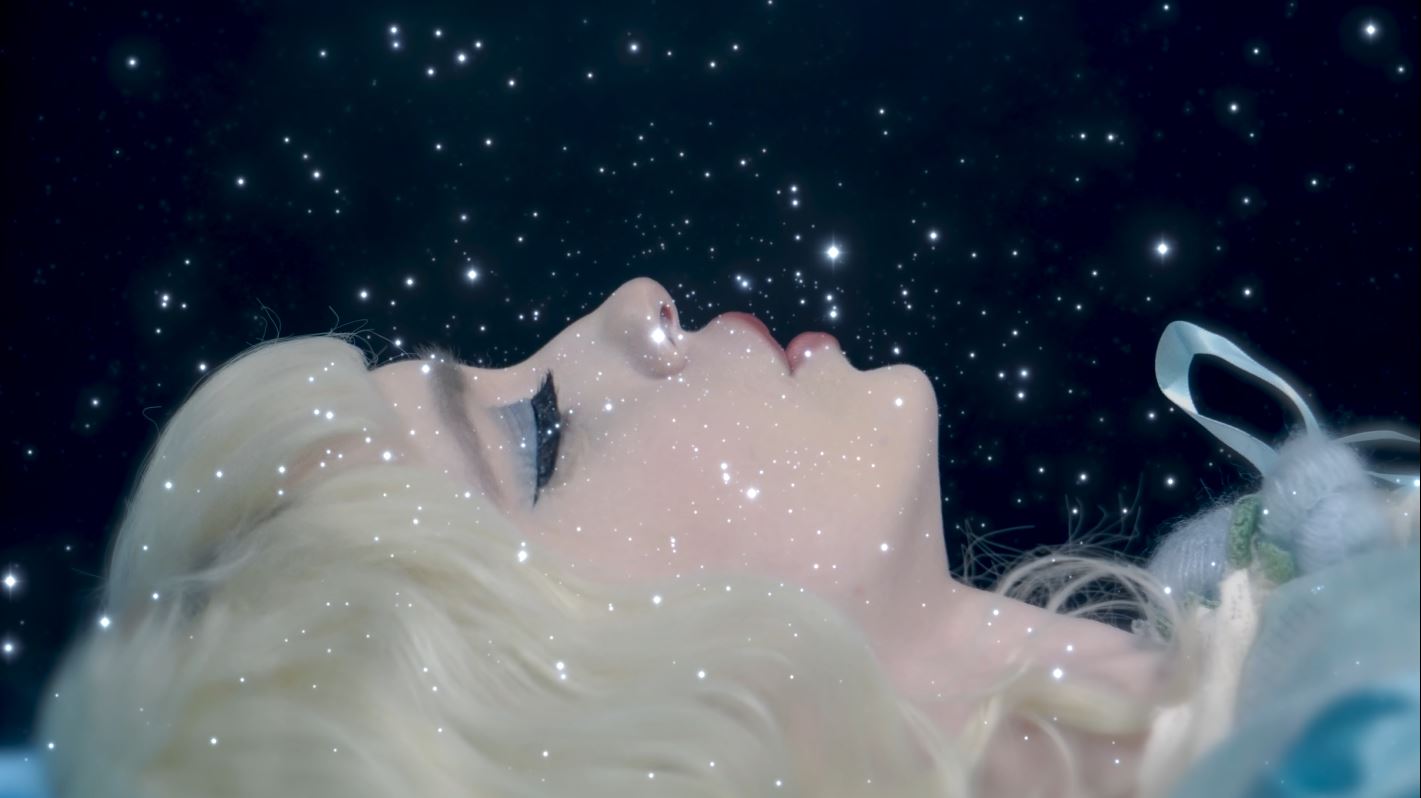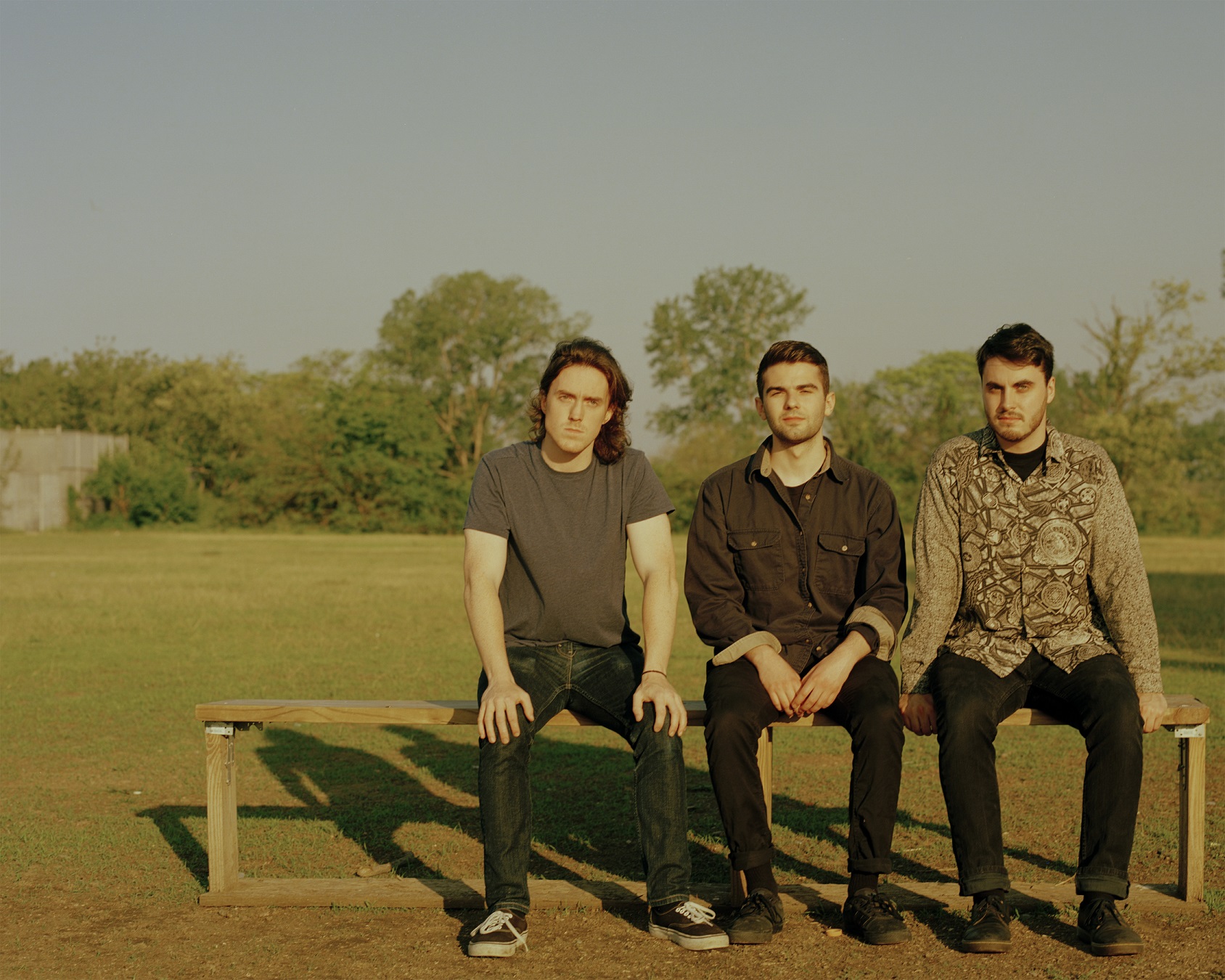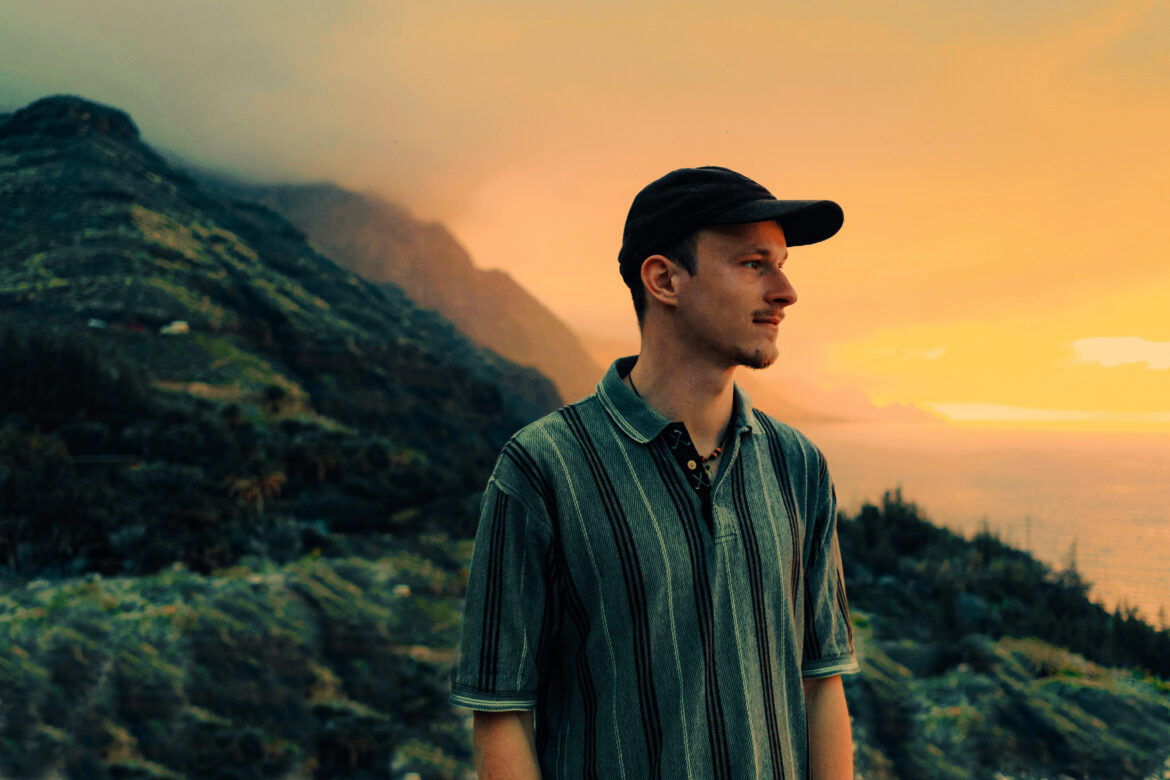
Experienced producer Fejká is back with a new album with the floral title ‘Azur,’ the latest product of his dual fascination with the natural world and the EDM-sphere.
Stream: ‘Azur’ – Fejká
“I really want to establish a community with like-minded people and support good music and have a good time,” says Fejká, a seasoned EDM-maker who recently launched a new label called Coexist, which supports local musical production and community events.
It’s great that he’s giving emerging artists a chance to shine, since once upon a time, someone gave him a chance as well. Born Brian Zajak, Fejká spent much of his upbringing in Stuttgart, Germany experimenting with various creative passions– photography, filmmaking and skateboarding among them. Electronica production eventually joined the list, as Fejká started producing a number of tracks using at-home software as a teenager. One notable individual to take note was Christian Löffler, a German techno star who was so impressed when Fejká sent him one of his early recordings, “Moonlight,” that he invited Fejká to join him at his own Ki Records.

Fejká remained with the label for many years, releasing some of his early full-length projects such as Reunion and Hiareth with them. Out now, Azur serves as his debut release with the newly inaugurated Coexist label. The 10-track project offers a substantial platform for Fejká’s extensive experience in the electronica-making business, and his dual passions for music and nature are also proudly represented throughout.
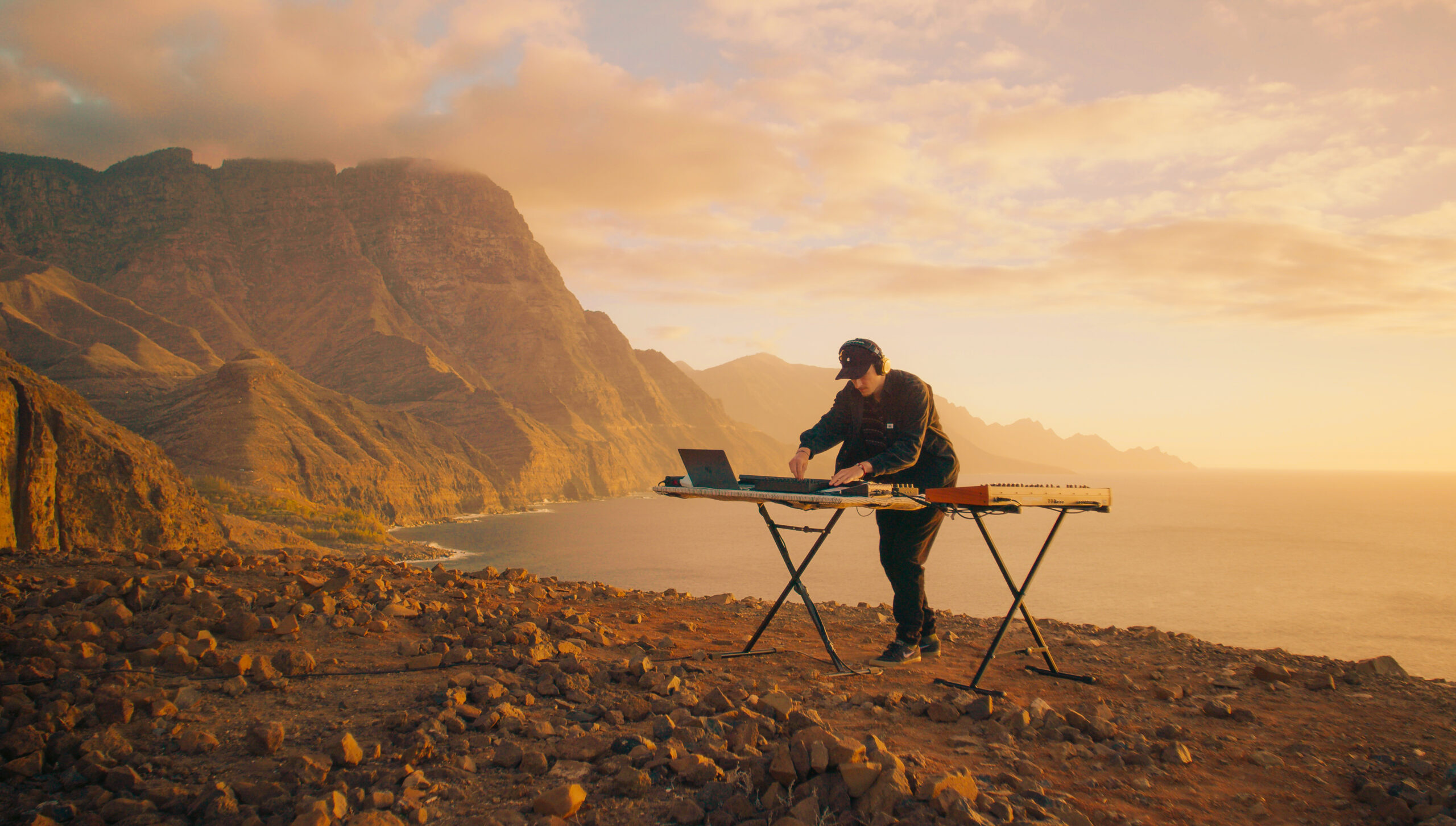
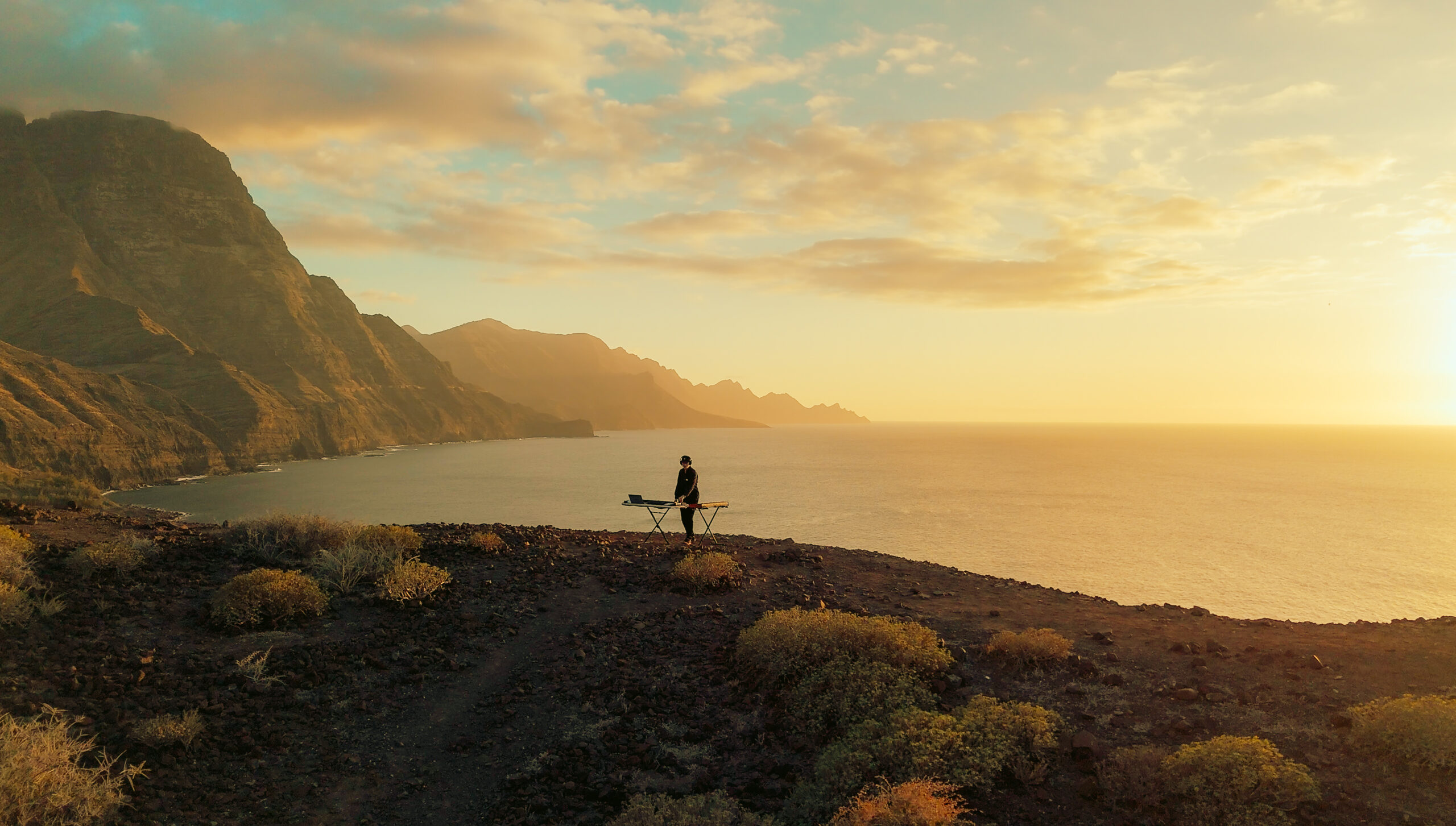
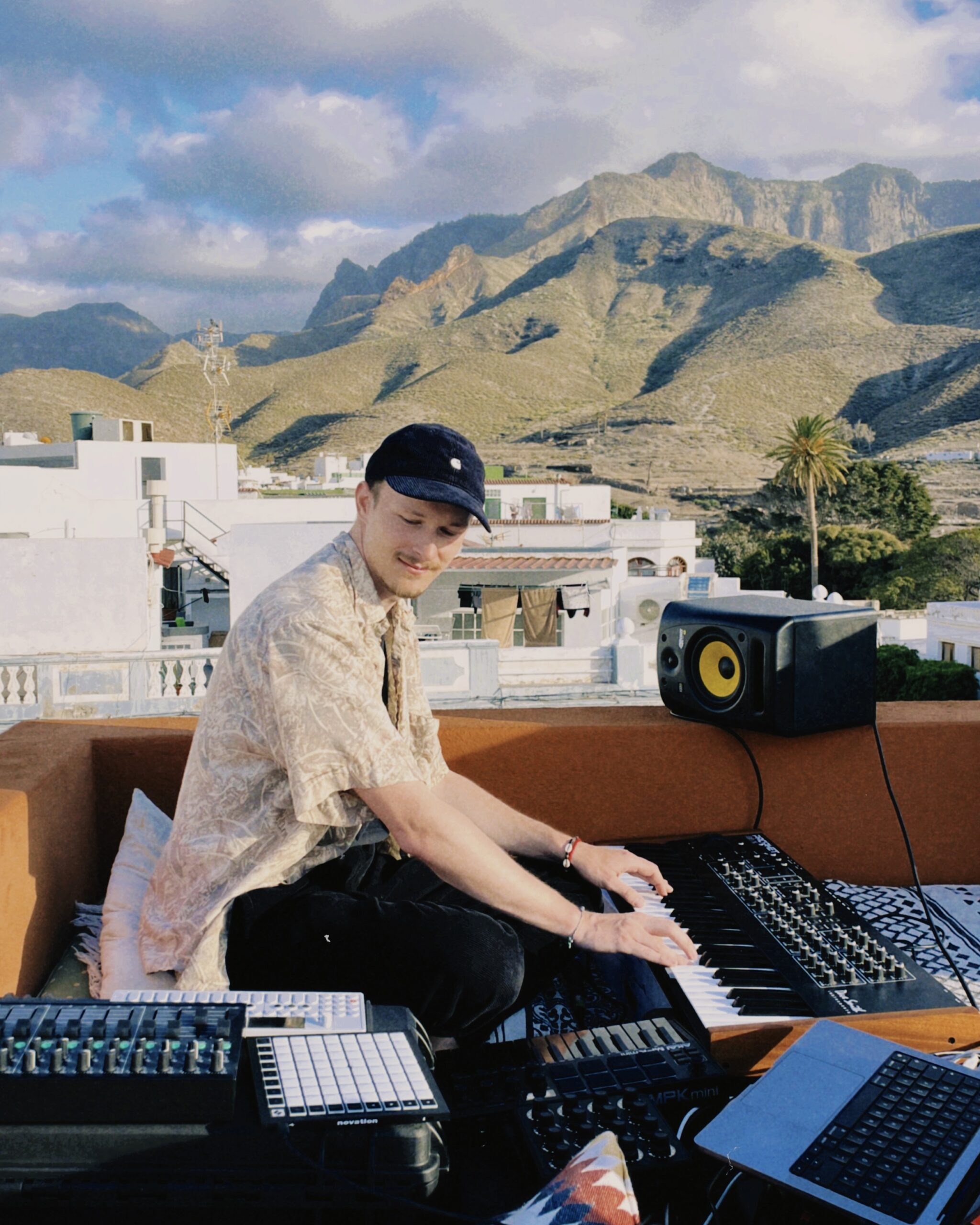
Having grown up on the edge of the Black Forest in Germany, Fejká is a longtime avid hiker, and the blue azur flower that he encountered on one of his hikes has now inspired his new album’s title. He has also traveled to the Canary Islands often and completed much of Azur there as well. The islands’ magnificent scenery inspired the grandiose sounds of Azur, and it also served as the gorgeous backdrop to the music video for the track “Maara,” which showcases Fejká in his element, working the keyboard at the edge of the Spanish cliffs, donning a sly grin of contentment the whole while.
Here, Fejká shares his impressions of the Azur album, the accompanying tour he’s currently on, the Coexist label he just started, and more with Atwood Magazine.
— —
:: stream/purchase Azur here ::
:: connect with Fejká here ::
— —
A CONVERSATION WITH FEJKÁ

This interview has been lightly edited for purposes of length and clarity.
Atwood Magazine: How did you get started with all of this? How did you decide that being a DJ/producer would be the right fit or calling for you?
Fejká: I think my fascination for creativity was already there pretty early. I can remember doing photography already when I was 12 years old. But I think it really started when I turned 16, because this was the time when I got my first laptop and started exploring the Internet, especially YouTube. I just realized that there’s so much more stuff than what I’m listening to on the radio. At the time, I was listening to Linkin Park, Gorillaz, Foo Fighters and stuff like that. There were plenty of songs on the radio that I liked, but at some point I started to dive deeper into electronica music. I think it started with Liquid Drum & Bass, actually. At first, I was listening to some kind of Drum & Bass stuff, and then Skrillix started and I was more and more fascinated by, basically, electronic music in general. And I think it was kind of like a journey, and finally I found myself feeling really comfortable with melodic and deep-sounding electronic music.
It was a time in Germany which was very special, actually, because there was a kind of big deep house rise. Many artists were exploding when it comes to this genre, and especially this type of music being on the charts for the first time ever. There was a big movement as well, and it was the time when I started going out, going to parties and such. And then, one friend who I knew from skateboarding brought me to a kind of rave, and I was basically fascinated by this whole other atmosphere connected to this music I was listening to as a teenager. So, yeah, I just basically asked my parents if I could get a demo version of this software called Ableton Live. They said “Yes,” so I just got it for Christmas when I was 16 and I just started making beats, I guess.
And the thing is, it didn’t really last so long until I reached out to Christian Löffler with this very first song that I wrote. This song is called “Moonlight,” and I wrote it while walking back from a party which I really enjoyed. I grew up very close to the Black Forest, and there was a full moon that night. Just before entering my house, I just watched the moon and got so fascinated by it that just went back up to my room and just started producing. I just really did this song in one night. It was like complete tunnel vision, basically, and it was the first real recording which I liked from myself.
A few weeks later, I just sent it to Christian Löffler, who was one of my favorite German artists doing deep house music. And I was pretty lucky that he replied, because I didn’t really expect him to reply. I was just like a teenager, 16 or 17 years old… But yeah, he replied, and a long journey started at this point. He invited me to join his label, where I’ve stayed now for almost 10 years. After that, I started my first DJ gigs, I started playing live, I released an EP and two albums with his label, I started to become an international artist, and the whole thing started to evolve from this point on. So, that’s like an overview of it all.
How did your passion for music video production develop alongside the music itself? And how are you able to spot a location and say to yourself, “Oh wow, this would be a great place to film a new music video,” as you did at the cliffs of the Canary Islands on one of your latest clips, “Maara”?
Fejká: My interest in visual art has been very strong for a long time. As I mentioned earlier, I started doing photography when I was around 12, and then I started filmmaking by shooting some music videos. As for when do you see a location and say “This is it” – I feel like sometimes, when I produce a song, I have a vision and I just feel like some locations appear in my mind. You could produce a track and somehow just know if it’s more modern territory track, if it’s more melancholic in style, or if it has a more upbeat and euphoric vibe.
I have had a deep relationship with the Canary Islands for years. It was the first place that I really traveled to outside of mainland Europe with my parents, over 10 years ago, and it really had some nice vibes. I have returned multiple times and was always super blown away by the nature there. In time, it just felt sort of natural to shoot a music video there, because I had already spent so much time on the Canary Islands to produce music and to spend time with friends. So, the whole album started to evolve on the Canary Islands, and I knew that, of course, that if we were going to shoot a music video for it, it would have to be on the Canary Islands. So, I was hiking a lot – I like hiking – and at some point, I just saw the spot and thought, “This is it. I want to shoot a video here. This is the perfect place.”
What sort of artistic development do you think you achieved with this record?
Fejká: For me, music was always split into two worlds, something like a body and a soul. I really like listening to super electronic and techno at night, but then during the daytime, I listen to a lot of indie, soft, neo-classical music, and I always wondered how it was possible that my music style was so diverse that I kind of felt attracted to both worlds. It’s like Day/Night, Dream/Dance, Slow/Fast – I feel like there are parallels and dualities in most of these topics, and at some point, I realized that my music is also reflecting that.
I like to produce super smooth music, and then when I play it out loud, I like to produce versions that are harder and more intense, with a harder tempo that has a more energetic vibe. At some point, I had to decide which of these was more my definitive style. But then, I realized that I don’t actually have to decide because it’s kind of my identity to have both of these sides, and this is when I had the idea of founding this label which refers to this type of duality. There’s music which can be listened to during daytime and there’s really a soul in it, and then there’s going to the club and feeling the rhythm and the tempo. I also feel attracted to it in some other way, in a more magnetic way. So, it’s also more about breaking rules a little bit. I really want to do something new.
Now that you’ve founded your own label, what’s it like to be running that project and to be responsible for other people’s music, not just your own?
Fejká: It has always been a dream and a passion of mine to support artists who really deserve it and create great music. I’m super happy to finally have a platform so I can offer my network, label and distribution. It’s like starting a family. I feel the music business can sometimes be really harsh – it’s all about who has the highest numbers and the best tracks. I feel like there’s some kind of missing part, especially the community part. I really want to establish a nice community with many new artists who inspire each other.
One thing that is really important to me is also to explore dualities in all different forms, not only within music, but also between humanity and nature, for example. There are so many things that you can find when you are trying to find polarities and dualities in life in general. I had this “Clap Event” series that I started a year-and-a-half ago. Now with Coexist, I am starting a second event which is just before the Clap Event, but which is more directed towards neoclassical, EDM and experimental music. And once the first one is ending, the Clap Night is starting.
So, I’m kind of combining both communities, like the concert people who buy tickets for the sunset concert, and then the Clap Event people who just want to party. There’s a very interesting social potential, like mixing up those two different crowds and promoting both types of music. It’s all about exploration. I’m just starting out with this vision, but it’s more like a journey. There will be so much more in the future, apart from label events and releases. I really want to establish a community with like-minded people, support good music and have a good time. That’s it.
Speaking of good music, you have a new album out, Azur. What do you see as the driving concept of this album, and how were you able to flesh it out during production?
Fejká: The concept developed while I was producing the first tracks on the Canary Islands. I had a big feeling of relief back then, which I had been really missing in the years before, especially during lockdown and the letdowns it caused for many artists who just wanted to grow. I just released my first album, and then basically the lockdown started and I was super frustrated about it. I had a big support tour for Christian Löffler planned, and then everything got cancelled. And then there was other stuff, like breakups and my mother getting breast cancer but surviving, and everything was coming together. It was a really tough time.
Once it was finally possible to travel again, I just met my friends on the Canary Islands again. We had such a great time – so many positive feelings and a lot of peaceful vibes, a lot of friendship vibes deepening the connection with each other, introspection and reflection with myself and my feelings. It was just, in general, a super nice time.
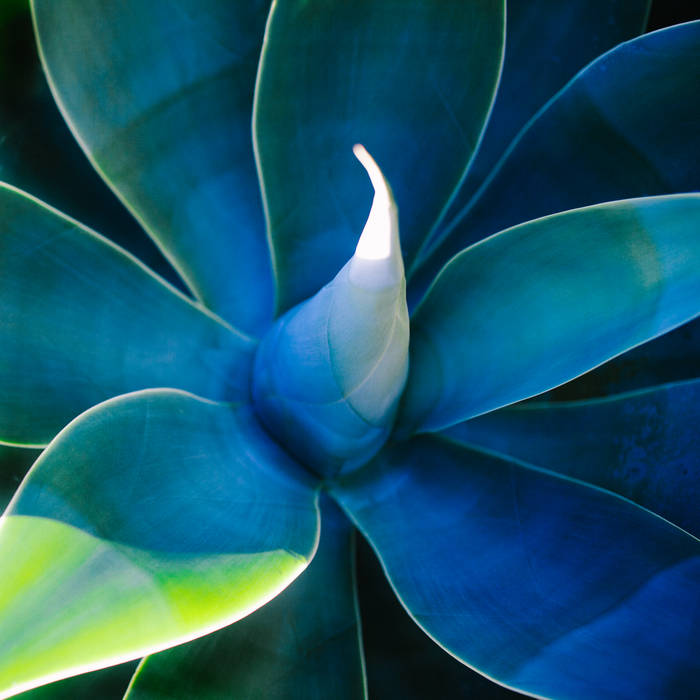
At some point, I was hiking, and hiking is one of my favorite rituals out there. And I discovered this garden plant that had such a fascinating color – a super light blue or azur color. This was really interesting to me because sometimes when you see those little things in your everyday life, you’re super happy about them and you appreciate them like crazy. This is sometimes the most peaceful moment for me, and I started looking at this plant and realizing everything and what it’s all about: just being in the moment and being happy.
At this point, I started referring to this blue azur color every time I produced a song or continued the album process because the color was so present in my mind. The color blue is also a very special color when it comes to our minds. We sleep so much better when we listen to a podcast that talks about blue as opposed to any other color. Just imagining this color already has a positive impact on your mind. The seas and the sky also have blue colors, and at some point I had a good relation with nature when it comes to that. It just felt natural to me to combine everything into this chapter and see azur not like a color but more as a feeling of synesthesia. This word also plays a big part when it come to the album concept– just being in the moment and appreciating things and getting inspired, especially after having had a bad time before.
Now that the album’s finished, do you have any favorite beats or lyrics off of it? What are you especially excited to share with your fans about it?
Fejká: The message I told you about earlier, I want to convey that to my fans as well, especially in a time where everything is so chaotic, and people start to maybe have a tough time dealing with the current situation out there in general. This album is kind of like a safe territory for me as a musician. It would be so nice, and I would be so happy, if people would also enjoy it in that way, like I enjoyed my tracks while I produced them. Now, having the release in spring just before the summer felt to me like the perfect release date to transpose this feeling to the audience and to just give them something they can listen to and feel comfortable and happy in some way, but in a deep way, not in a cheesy way. I feel like it’s something I want to give back to my fans.
Along with the album release date comes the tour. You’re going to be going to a lot of spots around Europe, which is awesome. What are you most looking forward to about getting that tour launched and being able to do your live act all over the continent?
Fejká: I’m really happy to have this real connection with the audience again, because living every day on the Internet, checking emails, seeing likes and replying to messages and stuff sometimes makes me lose the connection of, like, what is this really about and all. And then, once you start playing these concerts and you see that three or four hundred people popped up to buy tickets for my show on a Monday evening or something – then, you realize that this really matters to them. They’re right in front of you, and you feel that connection with the crowd. So, this is something that I am really looking forward to, especially in some cities which have been the real highlights of my past tours. On the last tour, for instance, London, Krakow and Paris [were] cities which I really liked.
One thing that is new this time is that I really want to further explore my original country, Poland. I was born in Germany and my parents are basically Polish. They moved to Germany when they were basically my age. And the older I get, the more I felt like I basically want to explore these connections more and more, because I basically grew up without any family in Germany. It was just me and my parents – no siblings, no aunties or anything – because everyone else was in Poland.
At some point, it’s become a new focus for me to explore the Polish culture and electronic scene as well. I play a lot of festivals in Poland now and am giving interviews in Polish for the first time very soon. This is something that I am also looking forward to. And it started to become a really nice thing for me when I made this collaboration with Marie Jangerer, who is this internationally well-known Polish musician. From then, I just felt like, “Oh wow, it’s such a beautiful country,” and I just realized that I had never spent that much time in Poland, even though it’s my country of origin. The older I get, the more I want to explore. But yeah, the tour is going to be great, I’m really looking forward to it.
It says you’re a retired skateboarder. Do you ever get the itch to get back on your board and try it again?
Fejká: Yes, sometimes I do it, but I never really had a lot of talent for skateboarding. At some point, I’d just done it for so long that I started to roll down some stairs and stuff. When it became dangerous, I was like, “OK, I don’t know if I want to risk so much of my health by jumping down these stairs.” For a real skater, maybe it sounds wimpy, but I know so many pro skaters who are now walking super slowly and have pain issues and stuff just because they wanted to be the coolest guy on skates.
I still love it – I was on my board just two days ago – but mostly just to move from A to B and then maybe sometimes do a trick, but not to be a pro anymore. It also started to change when I moved into a new town for studying. I lost all of my skating buddies from my home area and there wasn’t really a skater scene anymore. I also started making music, so I got a new hobby. But I feel like I should do more sports, maybe, too.
— —
:: stream/purchase Azur here ::
:: connect with Fejká here ::
— —
— — — —
Connect to Fejká on
Facebook, 𝕏, TikTok, Instagram
Discover new music on Atwood Magazine
© Helena Majeswka
 © Helena Majeswka
:: Stream Fejká ::