Throughout the year, Atwood Magazine invites members of the music industry to participate in a series of essays reflecting on art, identity, culture, inclusion, and more.
•• •• •• ••
Today, Human Potential’s Andrew Becker reflects on the life and legacy of his close friend and visionary artist, L. Skell, who passed away last year. A former drummer for Dischord Records’ Medications and Brooklyn provocateurs Screens, Becker performs and records under the moniker Human Potential, a project that blends pop instincts with surreal storytelling and sonic experimentation. Beyond music, Becker is also an award-winning filmmaker known for marrying meticulous craft with eccentric and imaginative narratives. Through both mediums, his work consistently explores the strange intersections of art, memory, and modern life.
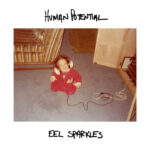
Human Potential’s latest album ‘Eel Sparkles,’ out now via What Delicate Recordings, finds Becker pushing further into the playful yet disorienting sonic universe that defines the project. Pulling strategically from the pop song canon while leaning deeper into experimental textures, the record juxtaposes glam flourishes, distorted marimba, punk-funk rhythms, and warped pop melodies into a kaleidoscopic listening experience. Tracks like “Sun-E Corporation Teenage Anthem,” “Practice Songs for the Unloved,” and the new single “The Sightseer” showcase Becker’s ability to blur the lines between pop structure and surrealist collage, pairing infectious hooks with an off-kilter sense of humor.
Throughout ‘Eel Sparkles,’ Becker’s lyrics move freely between the absurd and the philosophical, weaving tales of ghost arsonists, cinematic antiheroes, strange animals, and cultural detritus into a vivid stream of consciousness. The result is a record that feels both mischievous and deeply intentional – a playful meditation on modern spectacle and imagination that invites listeners into Becker’s strange and imaginative world while never losing sight of the pop instincts at its core.
•• ••
AN ELEGY FOR L. SKELL
by Andrew Becker
Early on the morning of September 3rd, 2025, my cell phone brusquely and impolitely buzzed me to life.
A call… at this hour… what the fuck.
I roused myself and reluctantly reached for my phone. As my eyes focused, the incoming number became legible… Ventura County? Hmmmm.
“Hello?“
A rather pleasant female voice responded to my gruff greeting, asking if she could speak to Andrew Becker.
“Yes. This is he.”
She was calling from the Ventura County Medical Examiner’s Office. Hmmmm.
“I’m sorry to bother you this early, but do you know Jeffrey Lynn Driskell?”
“Ummmm. Yes. Wait… why… oh… fuck… no…”
Solemnly, she informed me that the body of my long-time friend, record label co-founder, and objective musical savant Lynn Driskell aka L. Skell, had been found deep in the Los Padres National Forest north of Ojai, California. The cause of death was unclear. Details were scant.
I wasn’t shocked. Nor was I entirely surprised. In fact, I had kind of been readying myself for this exact call for a while. Over the course of the past 25 years, there were times that I resigned myself to believing that Lynn was gone and that I’d never see him again. But years of doom scenario prep did little to mitigate the devastation and sadness I immediately felt. My insanely gifted, extraordinarily complicated and genuinely wonderful friend was dead.
I met Jeffrey Lynn Driskell, later to be known periodically as L. Skell or Eldridge Skell or Captain, in 2002. Two friends and I were desperately looking for someone to join our nascent musical project… a vocalist, ideally… and maybe someone that could contribute instrumentally as well. We saw an ad Lynn had posted in the Washington D.C. City Paper seeking musical collaborators. Though I don’t remember what it said, we were all intrigued. We corresponded and set up a date to get together and play.
I distinctly remember the night we first met him… a chilly night in October. Washington, D.C. was unseasonably cold and mired in horrifying unease surrounding the “D.C. Sniper,” who was arbitrarily shooting people across the Tri-State area from the trunk of his car. It was an unsettling time.
When Lynn walked into our Northern Virginia practice space that night, his presence was striking. He was 6’4”, handsome, and wore a vintage, dark blue and black 70’s Shearling coat. He looked cool. I thought it was a good sign. We exchanged pleasantries and got on with the music.
I sat down at the drums while Lynn strapped on his guitar and tuned up. Then we launched into a song my friends and I had been writing. Lynn paused for a second, seemingly absorbing the chords… melodies… structure. Then he opened his mouth to sing. What emerged was a voice that was many things all at once… confident, emotionally resonant, weird and beautiful. We were taken aback. As we played through the night, there seemed to be a tacit acknowledgement that this guy, Lynn, was uniquely talented. And really, we knew he was destined for things much more interesting beyond our silly indie-rock band.
After practice, he gave us a demo tape of songs that he had been recording on his own. Simply put, they were amazing. I remember my friend Steakman and I listening to an early version of “Here Come The Red Teeth” (which would later appear on his full-length LP). It was fucked up and odd and elegant in a way we’d never heard. We looked at each other as if to say, “Who the fuck is this dude? And how did he write this shit… by himself?”
Lynn and I became good friends during the five years we lived in Washington, D.C. He was unlike anyone I knew. He grew up in rural Louisiana, stopping in Louisville after college, before making his way to D.C. He was wickedly smart and wildly funny. He and I and small coterie of other weirdos formed an intimate group of friends that reveled in each other’s absurdity. We developed a shorthand where we could make each other laugh with a word, a look or a gesticulation. Nights could be spent guffawing at the dumbest of jokes just as easily as they could be sitting in an apartment, stoned and motionless, watching the “Cremaster Cycle” on mute while Lynn scored the film by playing Italian experimental band Starfuckers’ meter-flouting album “Infrantumi”.
Starfuckers was just one of the many obscure musical references that comprised Lynn’s milieu. While most of us in our early 20s were generally toiling in the traditional indie rock fields, Lynn possessed a breadth of musical knowledge that no one else, that we knew, seemed to have at that age. He introduced me to the Canterbury bands (This Heat, Art Bears, Henry Cow), the Brazilian iconoclasts (Gilberto Gil, Tom Ze, Gal Costa), the outsider freaks (Harry Partch, Moondog, The Residents) the left-field popsters (Lizzy Mercier-Decloux, Shoukichi Kina, Albert Marcouer). Perhaps most pivotally, he was responsible for my inaugural viewing of The Birthday Party’s incendiary rendition of “Junkyard” on Dutch television… a video that completely changed the way I thought about music and live performance. How he absorbed all this knowledge in small town Louisiana we didn’t quite understand, but were glad he did… and that he was passing it on.
Lynn was also very complicated. There were times when his kindness and humor could be suddenly supplanted with a foreboding darkness. He clearly struggled with his mental health, though he would never talk about it. In fact, it was hard to get him to reveal much about himself at all.
At times, he had a tenuous relationship with the very idea of being alive, expressing exasperation with the futility of human existence. He seemed to bounce around between apartments often… living almost itinerantly with no desire for any semblance of stability or modern comforts.
He also suffered migraines and would occasionally be rendered incapacitated, a condition that no doubt compounded his psychological battles. Sometimes he would disappear for weeks only to reappear as if nothing had happened. He was mysterious and enigmatic. Some would say he was a tortured artist. Though hackneyed, it was a trope that could genuinely be applied to him.
Eventually, Lynn cobbled together a large ensemble of misfits to play his songs and took the group into the studio to record a proper album. The result was “Sookie Jump” by “Eldridge Skell’s The Rude Staircase” – a collection of 11 weirdo-pop oddities that, in my opinion, is a masterpiece.

The songs on “Sookie Jump” were dense, meticulously composed, positively insane in the best way possible… and real goddamn catchy! Not only that, but Lynn had written nearly every part of every song himself… the interweaving vocal harmonies for multiple voices, the horns, theremin, synth, guitar… all of it. It was as if he had arrived on earth a fully formed artist with an uncompromising vision and a singular concept of sound. Without seeming histrionic, it seemed like he was forging a new direction in which pop songs could travel. We were all blown away that Lynn was able to create this weird universe by himself.
The lyrics (the ones I could make out) encompassed his whole personality, the good, the bad and the ugly. There was a love song that painted an idyllic picture of floating in a boat and listening to a woman sing in the shower (“Here Come the Red Teeth), a delightful tune about being incessantly sick (“Cranes”) and a jaunty ditty declaring “mouths are open sores” (“March of the D-9 Caterpillar”). This was clearly the medium in which he could truly express himself … all the terrible things that befell him as well as the simple pleasures that he was maybe too guarded to convey.
“Sookie Jump” impacted me in a way that no record had before. Maybe it was because Lynn was my friend… my peer… but it imbued me with a confidence to demand more out of my own music… to be fearless. It sparked an idea that invoked one burning question:
”I wonder if I could create my own universe someday?”
The album moved me so much that Lynn and I decided to start a label together, What Delicate Recordings, to release it. When it came out, “Sookie Jump”, like most records, made a very small ripple in the voluminous mid-2000s indie-rock ocean. The album was irritating to many. Insufferable to some. Polarizing to say the least. In the end, it was passionately embraced by a handful of devoted freaks and then summarily consigned to the dustbin of history. Lynn claimed that he didn’t care. He didn’t expect any acclaim or accolades. I didn’t really believe him. After “Sookie Jump”’s release he made a few feeble attempts at recording new material. But it felt like the spirit he once wrote with had been vanquished.
Soon after I left D.C. to move up to Brooklyn, Lynn left the city as well. First, he went back to Louisiana, then to Philadelphia then eventually up to Brooklyn as well, where I persuaded him to produce a record for my then band, Screens. During production, Lynn lived with his girlfriend who soon ended up heading west to go to school. I had no idea she had moved until one day, while we were mixing, he revealed that he had been living in a tent on the roof of a building in Bed-Stuy. He knew he could have just asked if he could stay with me, but he didn’t. It wasn’t his way. At times he almost seemed to relish this ascetic lifestyle. Around this time, there were stories of him wandering off into the woods without a tent and sleeping there under the rain, with no shelter at all. It didn’t seem so much monastic as it did self-punitive. It was confusing, but not surprising. Luckily, I was able to cajole him into crashing on the couch at my apartment while we finished mixing. Then one day in 2012, he was just gone. Disappeared.
Over the course of the next several years, I would occasionally scour obituaries for his name, fearing that he had taken his own life. I never found any news about him. I contacted a person on social media who I thought might be his mother to see if she knew of his whereabouts. I never heard back. I sent emails to the many different email addresses he had created for himself. Crickets. Eventually I stopped searching. I figured, if he’s alive, maybe he doesn’t want to be found. Maybe he wants to be left alone. I should honor that.
Years later, after I had moved to Los Angeles, Lynn responded to one of my emails… one that I had sent about 3 or 4 years earlier. He was back in Louisiana after years traveling around Central and South America and working odd jobs on boats. In between, he’d been spending time attending ayahuasca ceremonies. He intimated that these psychedelic retreats offered him a way to better understand his mental health struggles. Cool. I was glad that maybe he was getting a handle on things.
Our correspondence continued periodically over the next year. Then one day, I threw out the idea of having him come out to Los Angeles to help me produce a new record for Human Potential, the solo project I had started years earlier. Much to my surprise, he was interested. I was excited to reconnect.
For the next several months, he lived at my house while we worked on the new material. He seemed happy in a way I had never really experienced… like he was a different person. It was almost strange… yet simultaneously relieving… heartening.
He even started recording his own music again, which was just as idiosyncratic and colossally weird and amazing as ever. Maybe he’d finally wrestled his demons into submission. Great!
But as the months turned from summer to fall, something changed. He started staying in his room more and more. Eventually, he barely left. When he did, he seemed preoccupied… like his mind was somewhere else entirely. The joy that he arrived in L.A. with had vanished.
Occasionally I was able to coax him out of his room to go for a hike… or to go eat a hamburger… or watch a movie. When I could, I would try to talk to him about what was happening… what he was feeling. I offered to give him my therapist’s number. But, as much as I tried, he told me nothing and wouldn’t accept any help.
Eventually, he moved out and found his own place to live. Always coy, he wouldn’t tell me where he was staying. But he did tell me that he was forging ahead with a new career – acting. Apparently, he was lining up quite a bit of background work, being cast as a goon or a cop, primarily. It was an unexpected turn, but things seemed to be looking up, and again, he seemed almost happy.
The last time I saw him, he was outfitting his car with a loft on which he could sleep when he journeyed out of town. That night we made plans to go see Swans play at the Lodge Room in Highland Park the following month. It would never come to pass. Lynn would be found dead just a few weeks later.
The autopsy report cited his cause of death as “accidental,” revealing basically no information at all. The only thing we know is that he was found close to a hot spring about 10 miles up in the forest from the nearest trail head. His body had been there for some time and was essentially, unidentifiable. In the end, he died as mysteriously as he lived. As a mutual friend put it, it was “Classic Lynn.”
Lynn had a profound impact on my life that I’m only now beginning to fully grasp the measure of. Beyond the friendship we formed and the many laughs we shared, he instilled in me the idea that you could do anything you want. All you needed was the drive and imagination to make something… anything. He was a fearless artist… and his music gave me the courage to even conceive of doing a solo music project. For what it’s worth, Human Potential stands as a testament to him.
Since he’s been gone, I’ve found a batch of demos he made tucked away in my iTunes library. These little surprises feel like short visits from the beyond… leaving me simultaneously joyful and sad. Eventually, I hope to release them so those that availed themselves of Lynn’s music have a few more peculiarities to enjoy. I also have songs that he and I collaborated on that I plan to release in the near future.
Ultimately, music is what brought Lynn and I together and is the thing that keeps me with him now. His songs are the next best thing to having him here with us, I suppose… vestiges of a true genius that inspired me and a small group of others. Only now, they exist in different context… compositions comprising an otherworldly soundtrack masterminded by a dear friend who could only sing the demons he could never speak.
Goodnight, Captain. – Andrew Becker, Human Potential
•• ••
:: stream/purchase Eel Sparkles here ::
:: connect with Human Potential here ::
•• ••
•• •• •• ••
Connect to Human Potential on Instagram
Discover new music on Atwood Magazine
📸 © courtesy of the artist
Eel Sparkles
an album by Human Potential