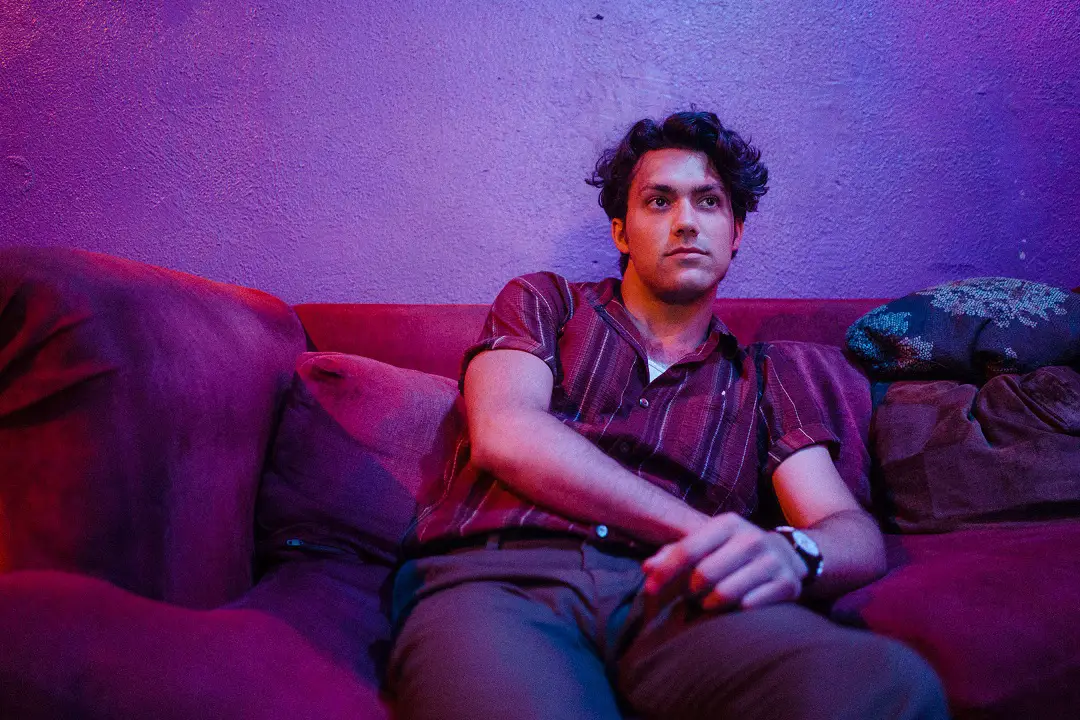
Spoken word brings music to life, adding depth, drama, and raw humanity across genres and generations. From Lord Huron and Kendrick Lamar to Woody Guthrie and Britney Spears, this essay traces the emotional and cultural resonance of spoken word in music, exploring how artists throughout time have used narration, monologue, and lyrical speech to deepen storytelling and forge visceral connections with listeners.
by guest writer Randall Cornish
Stream: “Who Laughs Last” – Lord Huron ft. Kristen Stewart
As a music lover, maybe you’re like me.
Sometimes a recording just grabs you and won’t let go. That’s what happened when I heard the single, “Who Laughs Last,” by the band Lord Huron, released in January, 2025.
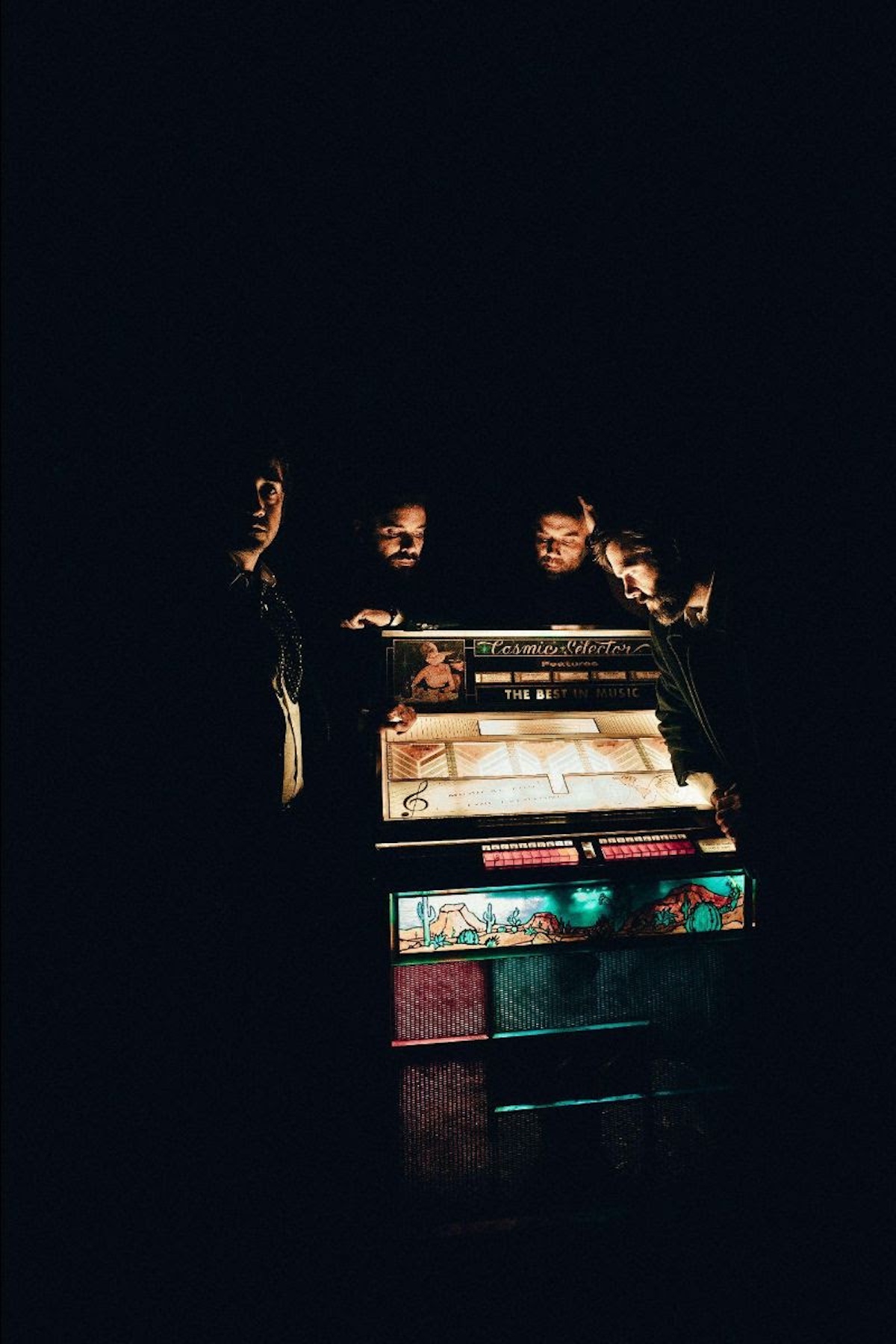
Taken off the band’s recently-released album The Cosmic Selector Vol. 1, the song is relentlessly propulsive, evoking film noir and pulp fiction from the 1930s through the 1950s as it explores dark themes such as pessimism, fatalism, and menace.

Oddly enough, it wasn’t the music or the singing that really got to me, although both are superb. What captivated me so intensely was a spoken-word monologue that weaves its way in and out of the recording’s soundscape.
The monologue is performed by Kristen Stewart, perhaps most well-known for her role as Bella Swan in the five “Twilight” movies, from 2008 to 2012.
Her delivery is that of a desperate person on a scary road trip, unable to avoid what lies ahead and not sure what’s real or a hallucination. The words she speaks are imbued with mystery and horror, in the manner of Edgar Allan Poe’s œuvre.
With dramatic poignancy, Stewart says:
“Above me shone a terrifying number of stars, spelling out the cold indifference of the universe. I tried to stare at the road ahead. I saw a huge storm far off on the horizon, dark and crawling with lightning… I found no solace on the radio, nothing but crackpots and static, UFOs and white noise, scripture and garbled frequencies.”
Her talking is perfectly integrated with the music and singing, so the monologue enhances the song, turning it into a masterpiece of storytelling.
It made such an impression on me that I wondered, what other recordings include a combination of music and talking?
Turns out nearly every genre has some, including jazz, folk, country, pop, rock, blues, rap, and hip-hop.
During the Super Bowl LIX halftime show in February 2025, when performer Kendrick Lamar announced, “the revolution is about to be televised,” he was making a reference to a song by jazz musician Gil Scott-Heron, released in 1971.
In “The Revolution Will Not Be Televised,” Gil Scott-Heron recites a satirical poem over a bed of progressive jazz. In rapid fire, the poem alludes to everything from President Richard Nixon to the cartoon character, Bullwinkle, to Coca-Cola:
“The revolution will not go better with Coke. The revolution will not fight germs that may cause bad breath. The revolution will put you in the driver’s seat.”
Earlier, in 1967, folk musician Arlo Guthrie released his own satirical song, called “Alice’s Restaurant.” While strumming his guitar, Arlo tells a story about one Thanksgiving when he and a bunch of friends got in trouble for littering.
The incident catches up with him when he gets drafted into the military and has to report to an induction center before being shipped off to boot camp. The song defiantly turns into a protest against the Vietnam War when Arlo is asked if he has ever been arrested:
“I’m sitting here on the Group W bench because you want to know if I’m moral enough to join the army, burn women, kids, houses and villages, after being a litterbug?”
Arlo’s dad, folk musician Woody Guthrie, most well-known for his song, “This Land Is Your Land,” also did a bunch of songs that included the spoken word, such as, “Talking Hard Work,” released in 1940.
“I was born working and I worked my way up by hard work. I ain’t ever got nowhere, but I got there by hard work.”
Woody often promoted the idea that each and every one of us is connected by virtue of us all being part of the same mosaic that is America. He famously had the words, “This machine kills fascists,” printed on his guitar, to further his belief that the power of music can be used to fight injustice.
Bob Dylan did not like being called one, but he surely was influenced by folk musicians, especially Woody Guthrie and Pete Seeger, as depicted in the 2024 film, A Complete Unknown, featuring actor Timothée Chalamet.
In a talking blues style, one of Bob Dylan’s most auto-biographical – and most cynical – songs is “Talkin’ New York,” released in 1962. Accompanied by guitar and harmonica, Dylan tells the story of how he traveled from Minnesota to New York City, hoping to break into the music business:
“I walked down there and ended up in one of them coffee-houses on the block. I get on the stage to sing and play. Man there said, ‘Come back some other day. You sound like a hillbilly. We want folksingers here.’”
Country music is not far removed from folk, and one of the most recent gems that includes a combination of music and talking is, “You Look Like You Love Me,” by country music artist Ella Langley, released in 2024, where she talks about the bar scene from a woman’s point of view:
“Well, I saw him walk in with his cowboy hat and I thought to myself, I could use some of that.”
In 1969, Johnny Cash released “A Boy Named Sue,” recorded live at San Quentin State Prison in California. He used a combination of music and the spoken word to tell a story about a man’s father who named him “Sue,” before abandoning him, so he would learn to stand up for himself.
Years later, when he inadvertently runs into his father at a tavern, they get into a fight, but they seem to come to a resolution:
“Well, I got all choked up and I threw down my gun. I called him my pa, and he called me his son.”
I don’t want give a spoiler alert – but there’s a twist at the end of the story!
In his country song, “You Never Even Called Me by My Name,” from 1975, David Allan Coe uses spoken words in a meta, self-referential way – they’re both part of the song and detached.
In other words, Coe breaks the fourth wall, an imaginary wall between the singer and his audience, by directly addressing the listener, in order to explain how the song he was just singing came about:
“Well, a friend of mine named Steve Goodman wrote that song and he told me it was the perfect country and western song. I wrote him back a letter and I told him it was not the perfect country and western song because he hadn’t said anything at all about mama, or trains, or trucks, or prison, or getting drunk.”
Britney Spears, in her song, “Piece of Me,” uses spoken words to talk about what it’s like for her to be a pop star. By talking instead of singing, her message seems more intimate.
Released in 2007, Spears addresses incursions into her private life by journalists bent on spreading gossip and turning her into a sensation. Exasperated, she enjoins:
“Well get in line with the paparazzi who’s flippin’ me off, hopin’ I’ll resort to startin’ havoc and end up settlin’ in court.”
Rock musician Jim Morrison of The Doors was a poet before the band was formed and after he died, the band recorded a posthumous album that featured Morrison reciting some of his poetry over new music created by the others.
The album covers some of Jim Morrison’s favorite themes, from rebellion and freedom, love and loss, sex and violence, and the search for meaning in life. “An American Prayer,” is one of the songs on the album, replete with Morrison’s archetypal dark thoughts:
“We have assembled inside this ancient and insane theatre to propagate our lust for life and flee the swarming wisdom of the streets.”
Some blues songs also include a combination of music and talking. One of the most moving twelve-bar blues songs to do so is, “Red House,” by Jimi Hendrix, released in 1967.
Interspersed with magnificent guitar licks, Hendrix tells the story of a man who finds out the woman he loves has left him:
“Wait a minute, something’s wrong, Lord have mercy, this key won’t unlock this door. Something’s goin’ on here. I have a bad, bad feeling that my baby don’t live here no more.”
Blues musician B.B. King loved to talk about his guitar, which he fondly named “Lucille.” He brings “her” to life in his classic song, “Lucille,” from 1968. The song exudes so much affection it reminds some of us why we love music so much:
“You know, if I could sing pop tunes like Frank Sinatra or Sammy Davis Junior, I don’t think I still could do it, ‘cause Lucille don’t wanna play nothing but the blues and I think I’m, I think I’m pretty glad about that ’cause don’t nobody sing to me like Lucille.”
Unlike the previous genres mentioned, rap and hip-hop always feature talking. Poetic lyrics are usually recited over music or at least a rhythmic beat. They often address social issues or ways to overcome adversity.
In the 1980s and ’90s, rivalry raged between East Coast and West Coast hip-hop artists, but some musicians tried to put a stop to it.
“We’re All in the Same Gang,” by the West Coast Rap All Stars, came out in 1990. With plenty of rhymes and flow, the song is a collaborative effort by various recording artists, including J.J. Fad, the female rap group, along with Dr. Dre, Ice-T, and MC Hammer, who says:
“It’s gotta stop, we don’t need all the violence. Peace in the hood and a moment of silence. We got together not for ego or fame. We got involved ‘cause we’re all in the same gang.”
These days, rap and hip-hop are two of the most-streamed genres of music on Spotify, Pandora, and Apple Music, which just goes to show there’s a huge audience that enjoys music that talks!
— —
Randall Cornish taught graphic design for 21 years at various colleges and universities. In his retirement he enjoys drawing with soft pastels and writing essays, short stories, and poetry. He lives by the ocean with his two cats in Encinitas, California.
— —
— — — —

Connect to us on
Facebook, 𝕏, Instagram
Discover new music on Atwood Magazine