I spent the day with Yuzuko DeGrottole, a hospice musician, for a window into the emotionally cathartic work of end-of-life music therapy.
by guest writer Bella Bromberg
Editor’s Note: Names have been changed to protect the individuals’ privacy.
On a Tuesday in early June, water dribbled from a Mediterranean fountain encircled by foliage in the courtyard of an assisted living facility on Long Island.
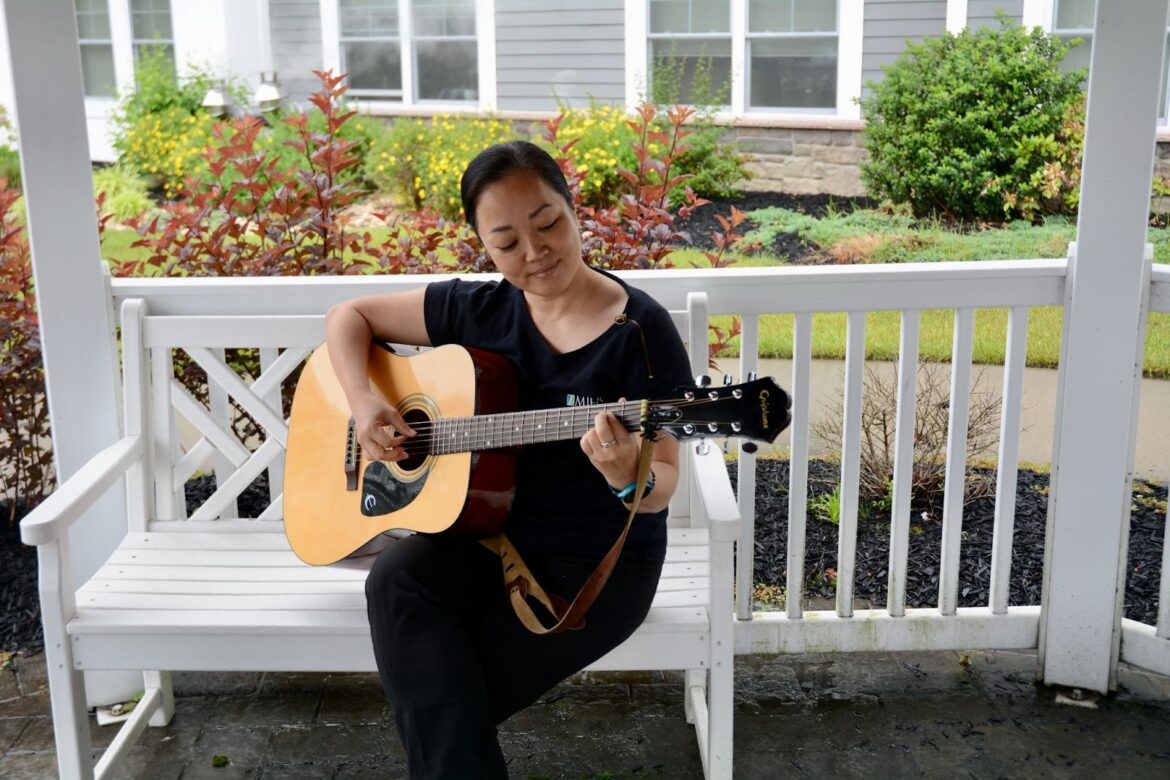
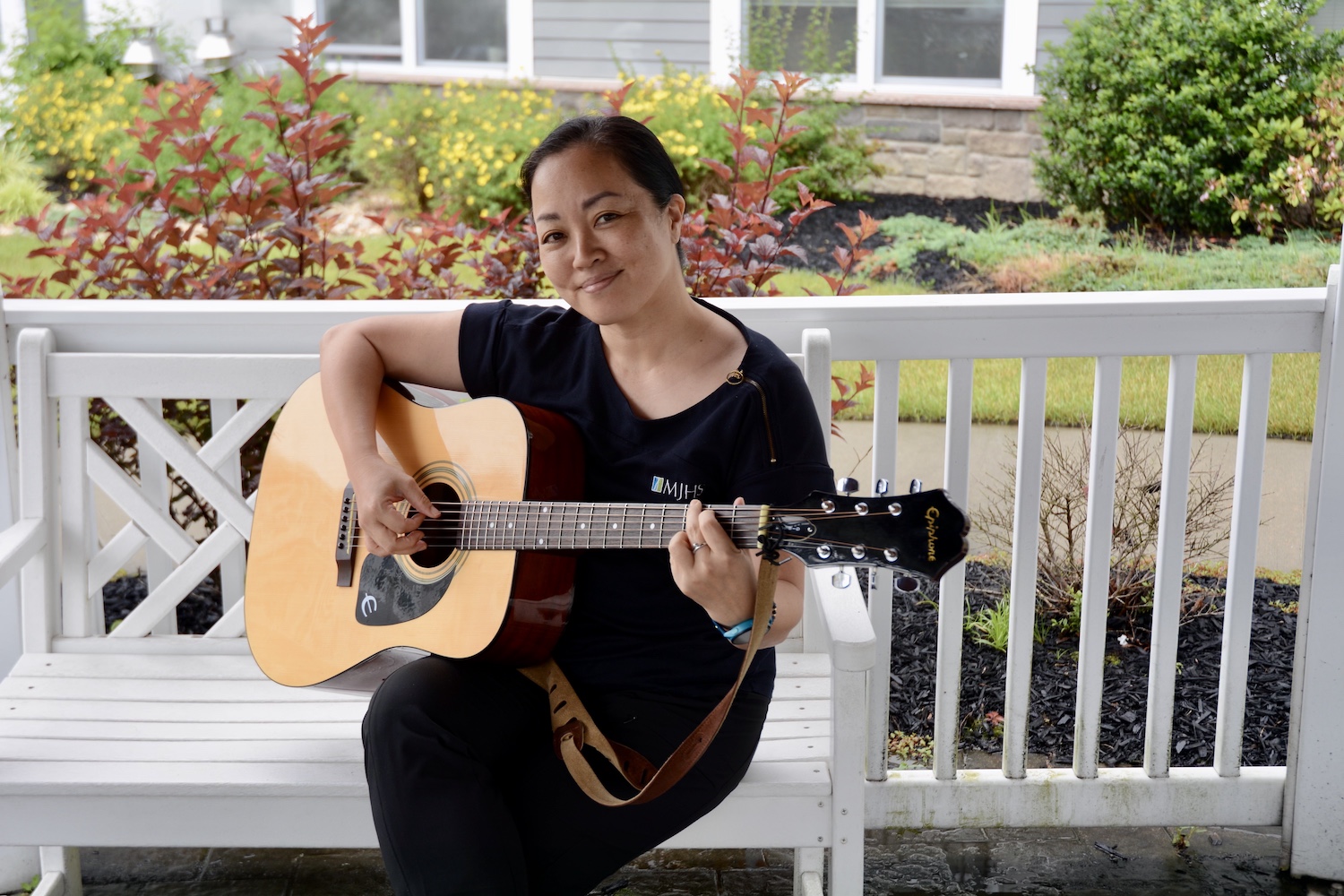
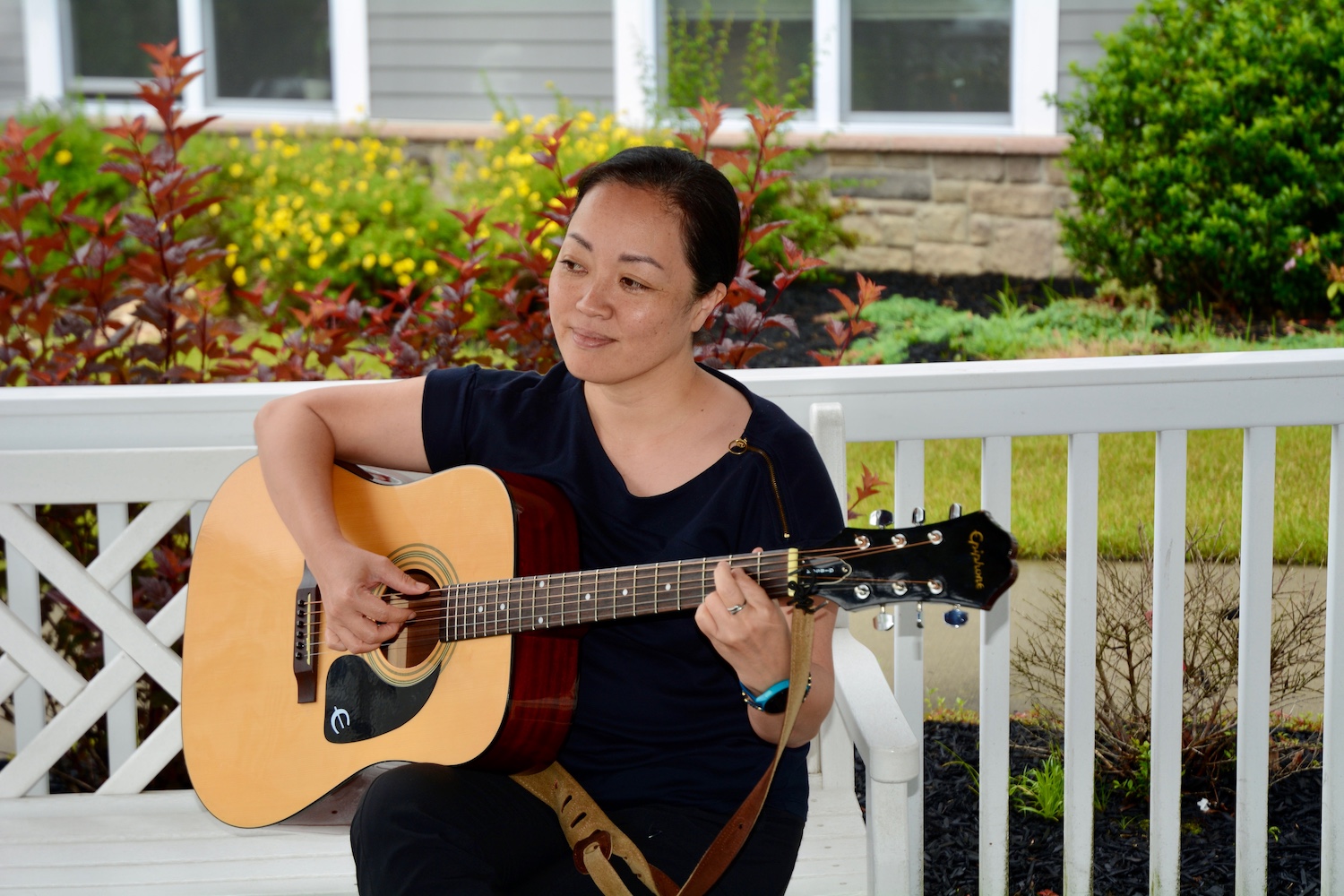
At 10:30 a.m., Yuzuko DeGrottole, 46, strolled through its doors. Strapped to her back: A black guitar bag. In a satchel draped over her arm: An iPad containing lyrics to hundreds of songs. DeGrottole, originally from Japan, came to the U.S. in 2003 to study music therapy and earned a master’s degree at New York University. For over 15 years, she has worked as a licensed music therapist, performing primarily for hospice patients, encouraging them to sing along. In the Bistro, the facility’s social and dining area, the smell of fresh buttered popcorn wafted through the air. DeGrottole spotted her patient, a lively centenarian named Lois, seated in a wheelchair.
Lois provided an update on her son, who has a “good job” in the city and is expecting twins. DeGrottole gasped: “That’s what I have! Twins. Two daughters.”
“And he’s handsome and good-looking,” Lois added. “He promised to name one of the twins after me. But in the Jewish tradition, you don’t really name a child after a dead person, only a live person.” Lois chuckled. “But I’ll make an exception!” The two laughed. Atherosclerotic cardiovascular disease, a buildup of plaque in the wall of her arteries, along with rapid, unexplained weight loss, qualifies her for hospice. She enrolled in late May.
Nonetheless, Lois’s vitality impresses DeGrottole. “I don’t know how you keep yourself in such great shape,” DeGrottole said. “They should study you in a museum!” Lois waved off the compliment but grinned.
She wore a bright green scarf and an animal-print sweater. Black rectangle-framed glasses rested on her nose, hearing aids in her ears. Her fingernails bore a rose-gold polish; her daughter recently painted them and returns weekly to refresh the color.
“The only thing I really need help with is going to the bathroom,” Lois said. “Last night, I had to wait one hour for someone to come.” DeGrottole sighed and shook her head in solidarity.
“You’re a superwoman,” she said.
After nearly a half-hour of chitchat, DeGrottole zipped open her guitar case. “Let’s play something!”
“I’m singing in the rain, just singing in the rain,” she began crisply. “What a glorious feeling, I’m happy again.”
Lois smiled brightly and sang along in a husky voice. She knew the first verse exactly, then mumbled along to the rest, swaying.
“I’m laughing at clouds, so dark up above. The sun’s in my heart and I’m ready for love,” DeGrottole sang, seamlessly transitioning from low to high vocal registers before striking the final chord.
“Now you gotta get your umbrella out and dance,” Lois joked. DeGrottole, holding an invisible umbrella, bopped around in her chair.
“You’re born in 1925, right?” DeGrotolle asked.
“1924.”
“So, when you were a teenager, it was, like, 1940. Who was a superstar when you were a teenager?” DeGrotolle asked. Patients connect best to tunes they learn between 14 and 18, the age range when they start listening to songs outside of parental purview, DeGrottole later explained.
“Frank Sinatra,” Lois said wistfully. “He had a certain style.”
“Do you want to hear “All of Me,” “Fly Me to the Moon,” or “Stranger in the Night?”” DeGrottole asked.
“Fly Me to the Moon,” Lois said. “Though I don’t know if I know all the words.”
DeGrottole passed Lois the iPad lyrics.
With a honeyed voice and subtle vibrato, DeGrottole began, slapping the side of her guitar to keep time. Lois sang-spoke the lyrics, eyes glued to the tablet.
“I’m so happy,” Lois said. “I think I like you the best of all the people who come to see me.”
* * *
The Certification Board for Music Therapists currently lists 8,949 board-certified music therapists in its U.S. directory, 765 of them based in New York, the greatest number in any state.
Although the data on music therapy at end of life is incomplete, relying on practitioners’ voluntary self-reporting, the American Music Therapy Association reports that about a quarter of its 2000 members worked with hospice organizations in 2022. Internationally, the Certification Board for Music Therapists says that about seven percent of members provide end of life services in 2025, a modest but steady climb from five percent in 2013.
“Over the past decade, we have noted a consistent uptick in registrations for our Hospice and Palliative Care Music Therapy certificate courses,” said Jeannelle Benek, continuing education Director at The Center for Music Therapy in End of Life Care, founded in 2005. “This trend suggests a growing interest in and adoption of music therapy within hospice settings,” she said via email.
Palliative care, an approach practiced by all hospices, prioritizes quality of life over quantity. Since music therapy embraces a holistic approach that supports a patient’s physical and psychosocial well-being, it aligns well with the palliative philosophy.
Hospice musicians strive to lessen physical issues like pain, anxiety and shortness of breath, according to the American Music Therapy Association. They can also help introduce emotional exercises like end-of-life review and support bereaved family members.
Music therapists tackle these goals through various methods, including listening to music, paying attention to lyrics, improvising and songwriting, along with music-assisted relaxation and legacy projects.
* * *
Patients in the Reflections Unit have dementia.
To enter, one needs a special keycode. Margaret, DeGrotolle’s second patient of the day, lives in this wing. DeGrottole fiddled with the buttons on the keypad and the door clicked open. Margaret always keeps her head down, rarely lifting her gaze from the floor, DeGrotolle said. “Most people ignore her, because a lot of people assume she’s sleeping, even though she’s not.”
Inside, karaoke lyrics to a song from the musical “Annie” flashed across a fuchsia screen as an aide attempted, without much success, to lead a group of residents in a sing-along. DeGrottole scanned the room and found Margaret, 80, sitting silently in her wheelchair, not participating.
She wheeled her down a carpeted hallway, into a secluded drawing room, and bent down to lock Margaret’s wheelchair brake “so that you’re safe.” Margaret studied her face, parted her lips, then closed them again.
When DeGrottole unloaded her guitar and placed the iPad on the table, Margaret reached for the iPad, frowned, pushed against the table and rolled backward.
“Let me lock the other wheel,” DeGrottole said, leaping to action. “So you’re not gonna fall.”
“How about Bob Dylan?” DeGrottole asked after securing the chair. Margaret fixed her stare on DeGrottole’s strumming hands, now playing the chord progression for “Blowin’ in the Wind.”
She began the first verse – her voice clear and sweet. But Margaret seemed fearful today; she pushed the iPad aside and it clattered on the table.
“I’ll play something you know,” DeGrottole said, switching to “Moon River.”
At the lyric “two drifters…” Margaret looked up. Then she turned away, sadness etched into her face, covered her mouth, closed her eyes and screamed.
DeGrottole dropped her guitar swiftly and noiselessly and reached for Margaret’s hand. She finished the song with just her voice, soft and maternal – a lullaby. Then she zipped up her guitar.
For the past year, DeGrottole has visited Margaret twice a month; usually, Margaret’s daughter, Alexa, is there, too. DeGrottole called and left Alexa a voicemail.
“She seems a bit off today,” DeGrottole said in a voicemail to Alexa, pacing back and forth along a nearby window. “At one point she screamed. Just one isolated scream, and then she stopped.” Margaret listened, following DeGrottole’s movements with pained eyes.
* * *
Sometimes, a song can elicit difficult memories and cause feelings of anger or sadness.
John Mondonaro, an expert in music therapy at NYU, says that this sort of catharsis is actually a healthy part of healing and not something for music therapists to shy away from in their work.
For Mondonaro, live music also lends itself to a therapeutic process he calls “liminality,” a sort of existential suspension outside of time that allows patients to find peace despite discomfort. To every session, he brings a bag filled with instruments spanning genres and continents: chimes, handheld drums, tambourines, rainsticks. After demonstrating what each instrument sounds like, he lets patients select one, then accompanies them on guitar and vocals. Making music – not just for but with the patient – allows Mondonaro to inhabit a state of liminality alongside them, providing both comfort and pain release.
He also pushes back against the idea that therapy should only soothe. “Sometimes, happiness isn’t the emotion that needs to be expressed,” Mondonaro said. “Sometimes, anger is. Bystanders will often become alarmed if they see someone crying in a session or upset in a session – when in fact, that’s part of the cathartic experience.”
* * *
“We cannot assume that just because people can’t talk, that they can’t understand,” DeGrottole said after returning Margaret to the group down the hall.
“My goal is to treat her like a human, not an object. It sounds terrible, but a lot of nursing homes are like that. They just feed you like a cow.”
After visiting her patients, DeGrottole types up assessments of what she witnessed – their emotional state, their level of mental acuity, their willingness to engage with the music.
“Peaceful death is our goal,” DeGrottole said. “I’m just going to provide a supportive presence so that she knows she’s not alone.”
— —
Bella Bromberg is a freelance writer and graduate student at Columbia Journalism School. She works at The Moth, the storytelling nonprofit.
— — — —

Connect to us on
Facebook, 𝕏, Instagram
Discover new music on Atwood Magazine
© Bella Bromberg
 © Bella Bromberg