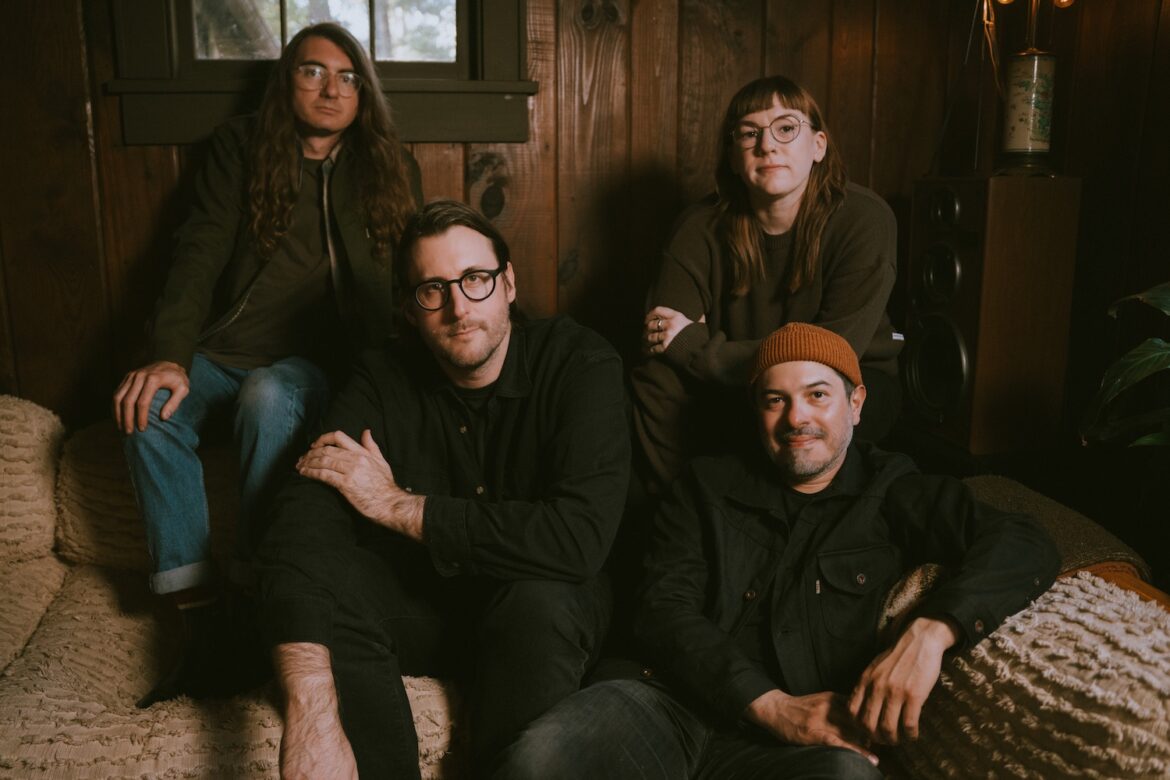
Spanish Love Songs turn dread and angst into shared language on their stunningly cinematic EP ‘A Brief Intermission in the Flattening of Time,’ a smoldering, beautifully collaborative effort that reckons unapologetically with self-denial, aging, and the messy truths of survival. It’s a quietly devastating set of gut-punch singalongs that trade resolution for recognition and false comfort for companionship – a collection that doesn’t offer easy answers, only the hard comfort of being seen.
* * *
In our conversation, frontman Dylan Slocum reflects on finding confidence in clearer, more direct storytelling, the fragile reality of sustaining a “middle class” band, and why making these songs as a true collection – rather than disposable singles – was essential to who Spanish Love Songs are right now.
* * *
Stream: ‘A Brief Intermission in the Flattening of Time’ – Spanish Love Songs
There’s a glow to “Cocaine & Lexapro” that warms the ears just as it does the mind, body, and soul.
For a song built on self-recrimination, chemical crutches, and the slow realization that your body won’t bounce back forever, it sounds strangely tender – earnest, buoyant, and quietly luminous, like streetlights on a foggy night. Spanish Love Songs and Kevin Devine turn what could have been pure self-loathing into something smoldering and humane: A confession that still believes in the possibility of getting better, even as it asks, who gives a f* about landing?
Well, I don’t miss my friends
I miss a time and a place
Mostly just the age
When I was living okay and living cheap
Beaumont truck stop casino
I’m near-prone and tapping on Keno
Warm cocktails, cocaine, and Lexapro
Early dementia, help me get back to sleep
“Cocaine & Lexapro” is the emotional center of the recently-released A Brief Intermission in the Flattening of Time, a four-song cul-de-sac of a record that finds Spanish Love Songs returning not just to the studio, but to themselves. Frontman Dylan Slocum calls the EP “a return to myself in a quite literal storytelling sense,” and you can feel that directness in every line; these songs are less opaque than 2023’s No Joy, more linear in their storytelling, more at peace with being, as he puts it, “imperfect snapshots of a moment.” Where the band once buried their dread in frenetic punk catharsis, they now lean into space, atmosphere, and cinematic scope – and “Cocaine & Lexapro” is the clearest distillation of that shift.

Los Angeles indie-punk lifers Spanish Love Songs – comprised of Dylan Slocum, Kyle McAulay, Trevor Dietrich, Ruben Duarte, and Meredith Van Woert – have spent the last decade turning late-night dread into something you can scream along to, building a catalog defined by richly personal lyricism, existential unease, and the uneasy collision of the hyper-specific with the culturally true. Since 2013, they’ve carved out a singular lane in the genre, one where the hooks hit hard, the storytelling cuts deeper, and the “big questions” never stay abstract for long.
That emotional honesty has only sharpened across albums like Schmaltz (2018), Brave Faces Everyone (2020), and No Joy (2023), the latter two of which landed on Atwood Magazine‘s year-end lists – records that hold space for self-loathing and tenderness in the same breath and treat survival not as a victory lap, but as a daily practice. Over time, the band’s work has come to feel less like catharsis for its own sake and more like a running inventory of what it means to stay present in a world that keeps asking you to disappear, confronting politics, grief, addiction, and aging with equal parts urgency and care. They have never offered easy hope, only hard-earned clarity, and that commitment to emotional authenticity has made their music a refuge for listeners searching for truth over optimism.
A Brief Intermission in the Flattening of Time lands as exactly what its title suggests.
A reflective pause that pulls from the past while staring straight into an uncertain future, a self-contained world in the band’s evolving career where looseness and honesty become the point. Rather than signaling a reinvention or detour, it frames these four songs as a pause – a moment to take stock, to breathe, to return to the reasons this band exists at all. For Slocum, the EP represents a literal and figurative return: To clearer storytelling, to confidence in his own voice, and to the act of making music not as a gamble, but as a calling.
“It’s a return to myself in a quite literal storytelling sense,” he tells Atwood Magazine, describing songs that feel less opaque than the band’s last album, and more grounded in lived experience. But the intermission is also practical and existential, reflecting the realities of being in a band at this stage of life – not a local pastime, not a financial guarantee, but something that defines who they are. “We’re getting to the point where [Spanish Love Songs] is going to be one of the defining things of our lives,” he reflects. “It’s also incredibly difficult to sustain as the sort of ‘middle class’ (for lack of a better term) band that we are. We’re not just goofing around as a local band anymore, but we’re also not ‘big money’ successful. We exist in a space where most of us have day jobs, but this is our would-be career. So every time we get together to make music or perform, it’s a return to what we truly love and the thing that defines a huge piece of us.”
And it’s precisely that in-between reality that gives the EP its sense of purpose: “We release every collection of songs with the hope that enough people will care for us to get to do it again, so the EP seems like it’s off to a great start in that regard. It’s probably too new to compare it to anything else we’ve done, but as with all new songs, I think they’re the best we’ve ever written. It’s a good indication of who we are as a band now, and what we’re interested in chasing down at this moment.” In that sense, the EP becomes a statement of intent: A belief in collections over singles, in honesty over expectation, and in carving out space to make the work that matters, even when the future remains uncertain.
We knew that we wanted it to be its own thing, its own cul-de-sac of whatever career we’re building, half-informed by what came before and half-informed by what we think is coming next.
That intention extends to the EP’s very existence. A Brief Intermission in the Flattening of Time wasn’t born out of surplus or convenience, but circumstance and care.
Spanish Love Songs were originally planning to release a full-length last year, but when that album was delayed, the band were faced with a decision about what to release in its place – and how to make that release matter. When the label floated the idea of an EP, Slocum agreed on one condition: It needed to be special, something more like “SLS & Friends” than a stopgap release. Once that off-the-cuff pitch became real, the focus shifted from ideation to intention and affinity – choosing collaborators they genuinely love and respect, and shaping the project as a cohesive collection rather than a scattering of singles. “We wanted to make sure it was bands that we all love,” Slocum says bluntly. “All four features are incredible, and the fact that they took the time to do them is still mind blowing to me.”
The resulting EP is its own singular, special standalone moment – a collection meant to be experienced together, shaped by partnership and grounded in community. Featuring contributions from anthemic pop-punk standard-bearers The Wonder Years, indie-rock elder statesman Kevin Devine, left-field indie-pop provocateurs Illuminati Hotties, and emo revival mainstays Tigers Jaw, the record plays like a conversation between kindred spirits – artists who understand the emotional terrain Spanish Love Songs occupy and know how to meet it with generosity rather than spectacle. Nashville-based producer Arun Bali helped the band build these songs from the ground up, lending them a shared looseness and instinct-driven feel that gives the record its own internal gravity – less about polish or reinvention than about following texture, atmosphere, and emotional momentum wherever they led. In that way, the EP becomes more than an intermission; it becomes a reaffirmation of what this band values most – connection, collectivity, and the belief that songs still matter more when they’re allowed to live together.

With that context in place, “Cocaine & Lexapro” comes into sharper focus as the EP’s emotional and philosophical anchor – the song where everything Spanish Love Songs are wrestling with right now converges in real time. It’s a reckoning with aging and consequence, with denial and self-control, with the uneasy balance between wanting to feel good now and fearing what comes after. The song doesn’t offer answers so much as it names the tension, pairing some of Slocum’s most incisive writing with a sound that feels expansive rather than explosive. In its warmth and restraint, it captures the core paradox of A Brief Intermission in the Flattening of Time: How to sit inside the moment without pretending it won’t eventually demand something from you.
The title started as a dark joke between Slocum and his brother, a sequel to Schmaltz‘s “Beer & Nyquil (Hold It Together)” that would pit two equally “damaging substance combinations” against each other. It stuck because it hit too close to home: “There’s a real tension between the idea of using one chemical responsibly to try to battle your depression/anxiety and then poisoning your body with another because you want to feel good or have fun for once,” he explains. Written ten years after “Beer & Nyquil” – which find Slocum singing, “I feel like I’m stuck on an island / I’ve been more than selfish / Wishing I could be landlocked again / I want to do something great / Instead I’ll question my age / And wonder why I’m such a mess” – this song looks back at those so-called good days with a wince and a wince disguised as a smile: More mature, more self-aware, still just as tempted.
“It’s a song about feeling older, missing some idealized version of the good days (even though I was likely miserable in the good days too), and reckoning with who I am and the choices I make,” he says. “How do you balance wanting to enjoy the moment because life is terribly short with the notion that it might not be as short as you think, and that one day you might reap the consequences of your poor decisions.”
You said a problem’s not a problem
’til you call it by name
Pilot’s still a pilot
’til he crashes the plane
I swear I have control
just like a universe expanding
Try not to think about landing
You hear all of that push-and-pull in the song’s dramatic and devastating chorus, where Slocum sings, “you said a problem’s not a problem ’til you call it by name, pilot’s still a pilot ’til he crashes the plane…” Landing, for him, is both the pilot touching down and the comedown off whatever you’ve taken to get through the night. He’s brutally clear about the denial at the heart of it: As long as you haven’t “crashed,” you can keep pretending you’re fine. “You can be in denial about a problem as long as you’re in control and not hurting anyone… And then it wraps up with a nice dig about my own lack of self-control.” But the band cushions that honesty in glowing guitars, a spacious rhythm section, and synth textures that make the whole thing feel widescreen and weightless. It’s intimate and epic all at once – the kind of song that makes you want to close your eyes and drive, even as it quietly warns you about the cost of never slowing down.
Kevin Devine’s presence deepens that ache. Spanish Love Songs “don’t exist without Kevin Devine,” Slocum says, and you can hear the reverence in how they leave space for him. Devine takes what Slocum had demoed as “an angry, contrarian second verse” and turns it, in Dylan’s own words, “into something delicate and full of pathos.” His verse doesn’t argue; it empathizes, tracing the same cycles of self-sabotage with a softer touch that somehow hurts more. The song becomes a dialogue between two narrators who recognize the same destructiveness in themselves, both clinging to the illusion of control, both aware it can’t last forever.
Two-star hotel lobby breakfast
Last seen just outside of Memphis
I write down the town and the room I’m staying in
You know I won’t remember if I don’t
‘Cause every night is an occasion
And I’m so goddamn easily persuaded
Say I just need some brand new entertainment
And help me write my own name on the cake
Across A Brief Intermission in the Flattening of Time, Spanish Love Songs lean into that kind of vulnerability and self-knowledge. Slocum describes this EP as the first time he’s ever felt truly confident as a songwriter – not because he assumed everyone would love the songs, but because he “walked away knowing that I did my job and understanding the things I’m good at.” You can hear that confidence in the way “Cocaine & Lexapro” lets its emotions breathe: There’s no need to shout when the lyrics already cut this deep. For all its references to decay and bad decisions, this song glows with something resembling hope – or at least recognition.
Crucially, that turn toward restraint, clarity, and emotional spaciousness isn’t confined to one song. “Lifers Too” opens the EP with a quiet but unnerving reckoning, turning Slocum’s inward narration into something generational and heavy with dread – a song about not expecting to live for as long as you have, and the strange terror of realizing you’re still here, that you’ve become the adult you once watched from a distance. Time doesn’t simply pass; it presses in, revealing itself through small, unavoidable details – the wrinkles on your hands, the feeling that the world is always “on the brink,” the uneasy question of whether you grow up or simply endure. Even the chorus lands like an exhausted surrender and a plea at once – “We don’t need this boulder / so we just let it roll” – as if naming the weight is the first step toward learning how to live with it.
We don’t need this boulder, so we just let it roll
I’ve got this weight on my shoulders
Can you help me let it go?
We don’t need this boulder, so we just let it roll
You thought I was a lifer
Never thought I’d get this old
Featuring The Wonder Years’ Dan “Soupy” Campbell, “Lifers Too” also quietly establishes the EP’s collaborative spirit from the outset. Slocum calls Campbell “the first choice to feature on this song and the first idea for the EP in general,” crediting him as both a longtime champion of Spanish Love Songs and a creative force who continues to push him forward. That mutual respect is audible in the song’s emotional balance – Campbell doesn’t overwhelm the track so much as stand alongside it, reinforcing its sense of shared reckoning. Campbell, in turn, describes the band’s writing as “singular and haunting,” praising the way Slocum captures “the decay at the heart of the American facade.”
As an opener, “Lifers Too” doesn’t explode or posture – it settles in, sets the emotional terms, and teaches the listener how to hear everything that follows. Read alongside No Joy’s “Lifers,” the song feels less like a repetition than a reply – written from the other side of the fear, after survival has already happened. Where that earlier track asked whether you could outrun the pain of simply being, “Lifers Too” sits with the quieter, heavier realization that you didn’t, and now have to figure out what living with it actually means.
If “Lifers Too” traces the anxiety of time passing, “Heavenhead” sinks into what comes after – a darker, more cinematic haunt shaped by fever-dream imagery, moral bruises, and looming mortality. This is the EP at its most atmospheric, where Spanish Love Songs’ expanded sense of space becomes emotional architecture: A hill, a care home, oxygen, a shoreline, a tidal wave. The band’s gift for making catastrophe feel intimate is in full force here, memory turning into something destabilizing and inescapable. At its core, the song reckons with the terror that happiness is fleeting – that even moments of peace arrive with an expiration date – a fear Slocum captures with devastating clarity as he sings, “I’ll be standing on the shore, begging for that tidal wave.”
Illuminati Hotties’ Sarah Tudzin doesn’t soften that unease – she heightens it, her harmonies lending brightness and lift that make the dread feel larger, not lighter. The chorus moves like a confession you can barely bring yourself to admit out loud – “My heavenhead / I’m afraid to admit…” – suspended between fear, guilt, and the quiet pull of inevitability. And yet, as Tudzin herself puts it, “this track delivers in the most epic way – it’s a windows down, volume all the way up chorus and I couldn’t help but sing along,” a release that makes the song’s ache feel not diminished, but shared.
Holding onto your hand
Said I ain’t died young, so I guess I’m no good
Yeah, my dad gave me a good life,
and I wasted everything I could
You said the pain will find me
‘Cause my head don’t fit its socket right
Why waste my time with changing?
Baby, that shit’s overrated
My heavenhead
I’m afraid to admit
When the boatman comes my way
I’ll be standing on the shore,
begging for that tidal wave
The brooding “Berlin” arrives as the EP’s shadowed counterpoint to its softer reckonings, a darkly romantic “spy movie of a love song,” as Slocum describes it, where devotion and fear move in lockstep. The imagery is immediate and visceral – “They cut off your hair / And made you look in the mirror” – grounding the song in threat and disorientation, as if safety itself has become conditional. But the emotional core is tenderness under pressure, love rendered not as comfort but as alertness.
The chorus reads like a vow spoken as a protective spell: “I trace the details of your face / And etch them in my mind… in case they take you in the night.” It’s a song about loving someone in a world that feels increasingly hostile, where intimacy becomes a form of vigilance and memory a last line of defense. As the EP’s final note, “Berlin” doesn’t resolve the tension so much as sit with it, closing A Brief Intermission in the Flattening of Time on a quiet, watchful breath – aware of what’s at stake, and unwilling to look away.
They’ll call you brave
But they don’t know one thing about bravery
You spend too long feeling safe
And that’s when they get you
Oh, that’s when they get you
I push it all away
I trace the details of your face
And etch them in my mind
To fill in the blanks
Of your outline
After they take you in the night
As Slocum says, Spanish Love Songs just want people to “find one thing in it that makes them feel a little less alone in the world.”
A Brief Intermission in the Flattening of Time does exactly that. The band look the worst parts of ourselves in the eye – the avoidance, the coping mechanisms, the refusal to name the problem – and wrap them in warmth instead of contempt. These four songs are smoldering, cinematic, and quietly humane, offering recognition instead of resolution, companionship instead of false comfort. Whether it’s the self-interrogation of “Cocaine & Lexapro,” the generational weight of “Lifers Too,” the mortality-soaked unease of “Heavenhead,” or the watchful devotion at the heart of “Berlin,” each track holds space for the same truth: That living means reckoning, and reckoning doesn’t have to be lonely.
In a catalog already stacked with gut-punch singalongs and existential slow-burners, this feels like some of Spanish Love Songs’ most quietly devastating work yet – four classics-in-the-making that trade urgency for intimacy without losing an ounce of impact.
To understand how A Brief Intermission in the Flattening of Time came together – and what this moment represents for a band reckoning with time, sustainability, and their own sense of purpose – we spoke with Dylan Slocum about confidence, collaboration, and learning to trust where these songs wanted to go. Read our conversation below, and get lost in the cinematic heat of this soul-stirring EP.
You said a problem’s not a problem
’til you call it by name
Pilot’s still a pilot
’til he crashes the plane
I have the self-control
of a universe expanding
Who gives a f* about landing?
– “Cocaine & Lexapro“
— —
:: stream/purchase A Brief Intermission in the Flattening of Time here ::
:: connect with Spanish Love Songs here ::
— —
Stream: ‘A Brief Intermission in the Flattening of Time’ – Spanish Love Songs

A CONVERSATION WITH SPANISH LOVE SONGS

Atwood Magazine: You've called A Brief Intermission in the Flattening of Time a return not just to the studio, but to yourselves. What does this EP represent for all of you, and where do you feel it sits in the Spanish Love Songs pantheon?
Dylan Slocum: Lyrically, the EP is a bit less opaque than No Joy. So it’s a return to myself in a quite literal storytelling sense. But in a more thoughtful sense, given how late we started this band and how deep into it we are, we’re getting to the point where it’s going to be one of the defining things of our lives. It’s also incredibly difficult to sustain as the sort of “middle class” (for lack of a better term) band that we are. We’re not just goofing around as a local band anymore, but we’re also not big money successful. We exist in a space where most of us have day jobs, but this is our would-be career. So every time we get together to make music or perform, it’s a return to what we truly love and the thing that defines a huge piece of us.
We release every collection of songs with the hope that enough people will care for us to get to do it again, so the EP seems like it’s off to a great start in that regard. It’s probably too new to compare it to anything else we’ve done, but as with all new songs, I think they’re the best we’ve ever written. It’s a good indication of who we are as a band now, and what we’re interested in chasing down at this moment. I also want to give our label due credit for not just releasing these as one-off singles throughout the year. I absolutely abhor digesting music that way, and still believe in the power of collections of songs, naive or not. In that sense, it gets to be a part of the greater SLS pantheon, which was important to us.
Atwood (and I) have been ardent fans and followers of Spanish Love Songs from the beginning. 10 years in, where do you feel you all are as a band today, and what do you think this EP says about you today – what does it capture about this moment, this era, this chapter in your story?
Dylan Slocum: I guess I got ahead of myself in the previous answer. I try not to let myself think too deeply about where we are as a band, because it’s easy to fall into the trap of being envious or angry at not having more. We’re incredibly lucky. My only goal is to keep on doing this, and hopefully find enough success for all of us to have a functional, nice life, where we can maybe afford healthcare and put some money away for when we’re old. Or at least afford all the stupid music gear I want? Or, dear lord, pay off my student loans?
I’ve been in bands since I was 17. So 20 years. We’ve technically been playing together as SLS for over 10, though we didn’t take it serious until 2018. So that’s 7 years of treating this band like it matters. And this EP is the first time I’ve ever felt confident as a songwriter. Not in the sense that I knew everyone would like them — I honestly didn’t know what the response would be — but I walked away knowing that I did my job and understanding the things I’m good at. The EP reflects that confidence. We’re continuing to refine what an SLS song can be, and what makes us, us.
You've said “Cocaine and Lexapro” is the heart-wrenching answer to “Beer & Nyquil (Hold It Together).” Can you speak more about that, and those turbulent emotions it addresses – and the growth you feel you've gone through over the past 7 years?
Dylan Slocum: What’s funny is that the title “Cocaine & Lexapro” came from my little brother and I pitching ideas for a “Beer & NyQuil” sequel with two equally damaging substance combinations. C&L got the biggest laugh and the most “oh shit” moment of reflection – there’s a real tension between the idea of using one chemical responsibly to try to battle your depression / anxiety, and then poisoning your body with another because you want to feel good or have fun for once.
Once I had the title, the lyrics came pretty easily as a sequel. I wrote “B&N” on Thanksgiving 2015, and “C&L” 10 years later. It’s a song about feeling older, missing some idealized version of the good days (even though I was likely miserable in the good days too), and reckoning with who I am and the choices I make. How do you balance wanting to enjoy the moment because life is terribly short, with the notion that it might not be as short as you think, and that one day you might reap the consequences of your poor decisions. This is a daily struggle for me, and neatly encompasses every issue I have with food, alcohol, drugs, sports, even the band itself. I’m not sure there’s been any growth beyond at least considering the consequences. I still choose poorly, but maybe less often.
To me, this song is Spanish Love Songs at your most cinematic – it feels intimate and epic, atmospheric and expansive all at once. What was your vision for this song – how did you hope it would sound, what did you want it to feel like – and how did you go about bringing that vision to life in the studio?
Dylan Slocum: I love that description. I wish I had a cool answer, but we entered the studio with our producer Arun without even acoustic demos done for these songs. I played the song on an acoustic guitar to show the song off, and then we just built from there, following our instincts on the stuff we like. I think Ruben came up with the drum groove first and I played with the Arp on the Moog synth. Usually that’s combo – drums and some sort of texture – is enough to send my brain in a million directions. Then it’s a matter of everyone generating ideas, laying them down, and then editing anything extraneous out until the song feels right.
I'd love to unpack the chorus' lyrics with you: “You said a problem's not a problem 'til you call it by name, pilot's still a pilot 'til he crashes the plane. I swear I have control just like a universe expanding, I try not to think about landing.” What does it mean to land, in this context, and how do these metaphors capture the message you're going for in this song?
Dylan Slocum: Landing here is doing double duty both as the literal sense of the pilot landing the plane and also coming down off drugs or alcohol, and how rough that can be. In my mind the rest is pretty straightforward – you can be in denial about a problem as long as you’re in control and not hurting anyone. And then it wraps up with a nice dig about my own lack of self-control.
This EP is obviously notable for its special collaborations – with The Wonder Years, Kevin Devine, Illuminati Hotties, and Tigers Jaw. What was it like especially working with Kevin Devine for this track, and what made you ultimately release these four collaborations as their own record, rather than a part of a greater SLS album or something else?
Dylan Slocum: We were supposed to do a full-length this year, but it was delayed for various reasons. When we knew it wasn’t going to happen, the label floated the idea of doing an EP, and I said it needed to be special, like SLS & friends or something. And to everyone’s credit they took the off-the-cuff pitch seriously and made it happen. Once the idea got serious, we had to choose who we’d ideally want to work with, and we wanted to make sure it was bands that we all love.
Working with Kevin and getting to meet up for the music video was an absolute dream. He’s a supersized influence in what we do, and has shaped my own ethos towards a career in music in such a powerful way. We’d never actually met, but had a ton of mutual friends who had been trying to will a collab into existence. I’m glad their manifestations worked. He gave us such a stunning verse.
All four features are incredible, and the fact that they took the time to do them is still mind blowing to me.
I totally get that this EP is an island unto itself, but do you feel these four songs themselves have any narrative, throughlines, or even musical DNA that sets them apart?
Dylan Slocum: Production wise they were a new direction for us. We worked with Arun at his spot in Nashville and really built the songs from scratch. I’m not sure if the listener can necessarily hear that, but the songs certainly have their own vibe. That’s the joy of working with new producers – someone who can bring a different POV to your band and make you think a little differently.
What do you hope listeners take away from “Cocaine & Lexapro” and this new EP, and what have you taken away from creating these songs and now putting them out?
Dylan Slocum: I just hope they find one thing in it that makes them feel a little less alone in the world, or a little more recognized. That’s all we’re ever trying to do.
I have the same hopes for us. We’re a part of a special community, and we really felt the love in making the EP with our friends, and now hearing people’s reactions to it.
— —
:: stream/purchase A Brief Intermission in the Flattening of Time here ::
:: connect with Spanish Love Songs here ::
— —
— — — —
Connect to Spanish Love Songs on
Facebook, 𝕏, TikTok, Instagram
Discover new music on Atwood Magazine
© Hannah Gray Hall
 © Hannah Gray Hall
:: Stream Spanish Love Songs ::