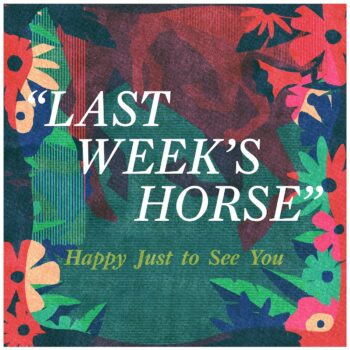
Happy Just To See You’s bruised, emotionally raw indie rock confessional “Last Week’s Horse” finds them merging alt-country grit and New England emo urgency into a breathtaking break-up song with the self – a hard-won declaration of self-acceptance that opens their upcoming third album with honesty, motion, and heart.
“Last Week’s Horse” – Happy Just To See You
Self-acceptance isn’t a breakthrough moment – it’s a grind.
It’s the quiet, daily friction of learning how to live inside your own head without tearing yourself apart, of choosing compassion over the easier seduction of self-loathing. That tension – between who you are, who you think you should be, and who you’re afraid you’ve already been – sits at the heart of this song, pulsing with urgency and bruised honesty. It doesn’t romanticize the struggle or smooth it into something tidy; it lets the mess stay loud, unresolved, and real.
That emotional volatility finds its sharpest expression on Happy Just To See You’s “Last Week’s Horse,” a bruised, churning indie rock confessional that plays like a break-up song turned inward. Marrying the twang and grit of alt-country with the raw nerve of New England emo, the track barrels forward on catharsis and self-reckoning – a portrait of choosing to love yourself even when every instinct tells you not to. It’s both confrontation and release, a stubborn declaration that growth isn’t graceful, but it’s necessary.
Every time I hit you up
Like fine wine in a Solo cup
No clue why you’re talking to me
Sense of self-worth in the trash
You laugh it off but get real mad
How can I not see what you see, darlin?
How can I not see what you see
Atwood Magazine is proud to be premiering “Last Week’s Horse,” the lead single and title track from Last Week’s Horse, the upcoming third studio album from Happy Just To See You. A charged and churning introduction to the record’s emotional core, the song arrives as both a thesis statement and a point of entry — a restless, full-bodied collision of aching grit and unfiltered urgency that captures the band at their most self-aware, self-questioning, and alive.
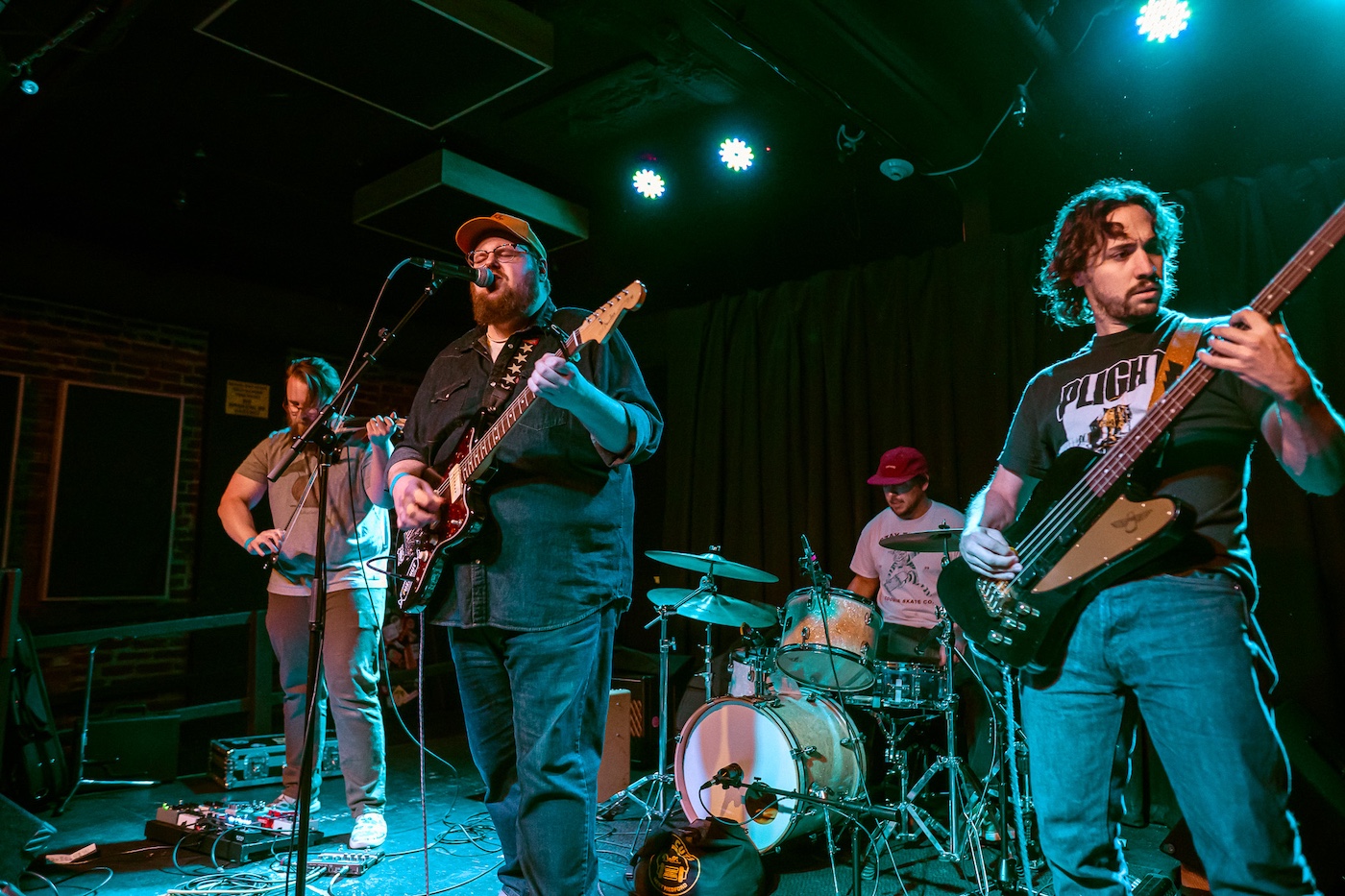
Based between Southern New Hampshire and Boston, Happy Just To See You is a band shaped as much by resilience as by community. The four-piece band of Evan Benoit (vocals, guitars), Evan Yarmo (bass), Matt Bacon (drums, percussion), and Zachary Glennon (violin, viola, cello) first formed in late 2017, cutting their teeth in the New England scene with a sound rooted in connection and emotional honesty. That bond was tested early on when Benoit survived a life-threatening accident, a moment that forever altered the band’s trajectory and deepened their commitment to making music that feels lived-in and unguarded. Since then, Happy Just To See You has steadily evolved, threading Americana warmth, emo intensity, and indie rock muscle into a voice that’s unmistakably their own.
Where 2024’s sophomore LP Ways to Cope carried the weight of survival and reflection, Last Week’s Horse finds the band moving with greater looseness and momentum – less concerned with narrative cohesion and more focused on emotional truth in the moment.
Across the record, that freedom translates into a vibrant, shape-shifting sound that pulls from punk, country, ‘90s alternative, folk, and blog-rock without ever losing its center. “Last Week’s Horse” sets that tone immediately, opening the album with a surge of feeling that frames the record not as a resolution, but as a reckoning – one that embraces self-acceptance as a process rather than a destination.
“‘Last Week’s Horse’ is the title track of the record for good reason,” Benoit tells Atwood Magazine. “The song encapsulates the energy and mission statement of the album as a whole – an evaluation of the human condition and the battles we have within ourselves to love who we are, warts and all. I wrote it with the intention of purposeful ambiguity; while on first blush the lyrics could be depicting a romantic relationship on the rocks, if viewed within the greater context of the whole album, it is more a break-up song about oneself, and a stubborn necessity for self-acceptance.”
That inward-facing tension – the slow realization that the relationship unraveling might be the one you have with yourself – gives “Last Week’s Horse” its emotional punch. The song resists easy answers, instead embracing ambiguity as a way to make space for listeners to find their own meaning inside it.
“I really like it when a song has a purpose but also allows for some level of self-interpretation,” Benoit continues. “Lyrically, I wrote the song shortly after I had started therapy. It was a battle to finally get myself there, but I’m very thankful I did. A big part of therapy for me has kind of been a battle royale against myself. And I guess that’s what this song and album are also about.”
Open source astral code
Looking for the motherlode
I can’t get you outta my head
Let the doctors deep in there
With scalpels ready for repair
I can’t get you outta my head, darlin
I don’t want you outta my head

Musically, “Last Week’s Horse” wastes no time easing you in.
Happy Just To See You kick the door down with a hearty punch – crunchy guitars snapping to attention, pounding drums landing with conviction, and the sweet heat of Zachary Glennon’s emotive strings cutting straight through the mix. The violin doesn’t hover politely in the background; it burns, adding urgency and ache in equal measure, setting the tone for a song that refuses restraint. From that opening surge, the track barrels forward with purpose, restless but controlled, alive with tension.
Evan Benoit steps into the spotlight at the center of it all, writing from a place of close, unsettled self-scrutiny, letting humor and self-reproach sit uncomfortably side by side. His lyrics moves with a restless, conversational intimacy, blurring the line between accusation and confession. Lines like “Every time I hit you up / Like fine wine in a Solo cup” pair self-deprecation with aching sincerity, while images of self-worth “in the trash” land with a disarming bluntness that mirrors the song’s emotional volatility. Even as the language remains deceptively casual, there’s a quiet desperation running underneath it, a sense of searching for validation and clarity from a source that can’t quite provide it. That push and pull between humor and hurt, confidence and collapse, gives the song its lived-in honesty and keeps it from ever tipping into melodrama.
Benoit’s performance is the song’s emotional glue; he sings hot on the mic, trembling with vulnerability as he asks, “How can I not see what you see, darlin? / How can I not see what you see?” It’s a line that lands like a confession – raw, exposed, and unresolved – and the band gives it space to breathe before lifting him up. When the chorus hits, the instruments wrap around Benoit like a blanket, harmonies swelling as the song rises together toward its emotional fulcrum: “So I choose to love you… yeah, I choose to love you.”
That word – choose – hangs in the air, held just long enough to feel the weight of it. The moment is tender and overwhelming all at once, harmonies and churn colliding in a dizzying display of musical unity. It’s not a triumphant declaration so much as a hard-won one, underscoring the song’s core truth: Self-acceptance isn’t passive, and it isn’t guaranteed. Here, Happy Just To See You turn that realization into something cathartic and beautiful: A release that doesn’t resolve the struggle, but honors it.
“Sometimes choosing yourself, loving the body you’re in, loving the brain and heart you have, it has to be a conscious decision,” Benoit says of the chorus. “You have to put in the effort. Probably not that way for everyone, but for me it is. And if you feel the same, I see you.”

In that sense, “Last Week’s Horse” functions less as a break-up song in the traditional sense and more as a reckoning with the self.
Benoit has spoken candidly about how depression can make self-loathing feel familiar, even comforting, and how this song emerged from the slow, difficult work of confronting that instinct. “When you suffer from depression, the self-loathing can almost become seductive,” he explains. “It feels comfortable and safe. You have to learn to love yourself, and find new ways to retain that love. The intrusive thoughts try to swim in, it’s all about finding new ways to keep them out or at least keep them paused.” The song captures that push and pull in real time, dramatizing the moment when you realize that the relationship you need to leave behind is the one defined by intrusive thoughts, shame, and quiet self-erasure.
That tension is sharpened by the song’s central metaphor. Benoit frames the feeling of worthlessness as being “last week’s horse,” an image he describes as intentionally blunt and a little crass. “I was trying to create an idiom for the feeling of uselessness you can feel, like a race horse whose best days are behind them,” he says. “If I’m going to joke about mental health I’m going to make sure it has some weight to it.” By casting self-rejection as something that must be cut loose, put out to pasture, the song becomes an act of separation. Not a clean one, and certainly not a final one, but a necessary step toward choosing something better for yourself.
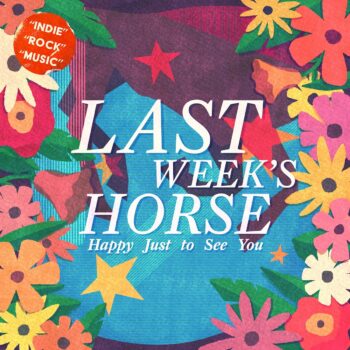
As the opening track and title cut, “Last Week’s Horse” sets the emotional terms for the album that follows.
Benoit has described Happy Just to See You’s new record as less concerned with a rigid narrative arc and more focused on capturing emotions as they arrive, and this song embodies that philosophy immediately. Compared to 2024’s Ways to Cope, this material feels more relaxed, more alive, and more willing to sit in contradiction. “This song in particular is an internal struggle that I think a lot of people can relate to,” Benoit says. “Self love and self understanding. Felt like a good place to start.” It is an opening statement that does not promise resolution, but honesty, movement, and emotional risk.
That honesty is what makes “Last Week’s Horse” resonate so deeply right now. In a moment where self-improvement is often framed as optimization or aesthetic, the song insists on something harder and more human. Loving yourself is not a glow-up, a peptide, or a finish line. It is work. It is effort. It is a conscious decision made again and again, even when it feels undeserved. By naming that struggle without softening it, Happy Just To See You offer listeners something rare and necessary: Permission to be unfinished.
“Last Week’s Horse” is available to stream now exclusively via Atwood Magazine. Stay tuned for the band’s upcoming third studio album, Last Week’s Horse, and scroll on to dive deeper into these themes in our full conversation with Happy Just To See You below, where the band opens up about self-acceptance as a conscious choice, writing through depression and self-loathing, the role therapy played in shaping this record, and how embracing emotional looseness and variety helped them rediscover joy and flow as a band.
“More than anything I just hope people enjoy it,” Benoit says – and if you find yourself drawn to twang-tinged indie rock, heart-on-sleeve vocals, raw emotional candor, or quietly devastating storytelling, you’ll be just as happy to see them as they are happy just to see you.
So I choose to love you
Yeah I choose to love you
One week later it’s all done
This horse has had its final run
Someone’s gonna turn it to glue
Darlin, you tell me it meant nothing to you
— —
:: stream/purchase Last Week’s Horse here ::
:: connect with Happy Just to See You here ::
— —
“Last Week’s Horse” – Happy Just To See You
A CONVERSATION WITH HAPPY JUST TO SEE YOU
Atwood Magazine: Happy Just To See You, you might say I’m… happy just to see you! For those who are just discovering you today through this writeup, what do you want them to know about you and your music?
Happy Just To See You: We’re four friends that have fun making music together! Connection is at the heart of what we do. I don’t think you could necessarily classify us as a full blown emo band, but emotion is what drives us, it’s what informs our songs, Music is a well we’ve gone to many times and we want to contribute some water back to said well. To put it simply, we’re a rock band trying to make you feel something.
You guys have been actively releasing music in one way or another for the better part of 7 years. Can you recommend a couple personal highlights from the HJ2CU catalog for Atwood’s crate-digging audience to sink their teeth into?
HJ2CU: Sure! “Marbles,” “Ways to Cope,” “Car Door,” and “Bubblegum.”
You’ve got one foot in alt-country and the other in New England emo… who are some of your musical north stars, and what are you most excited about the songs you're making today?
HJ2CU: Yeah, I really love dipping into different influences and not feeling beholden to any one genre.. but I do naturally write songs with a little twang to ‘em. We’ve played with emo bands ever since we started making music, we love emo, we definitely take some aspects of it and add it to our sound. Neil Young and Jeff Tweedy are two musical north stars for me, for sure.
I think the most exciting thing about our newer material is the variety. This new record has punk, country, 90’s pop, emo, alt rock, folk, and 00’s blog rock influences depending on what track you’re listening to. It all stays pretty cohesive to “our sound” but we wanted some variety; it makes an album listening experience more compelling, I think.
We're announcing your third studio album Last Week’s Horse today. How do you feel this record reintroduces you and captures your artistry today, especially compared to your first two albums?
HJ2CU: I think we’re looser, having more fun. The last record was very serious. It was a bit of a meditation on almost dying. This new album isn’t as narratively conceptual, it’s more about emotions in moments and less about any kind of concrete through-line. We had way more fun writing this record. Not to say it’s not always fun to hash out new songs but I think as you progress as a band you reach levels of comfort with each other that makes it all seem so much more effortless, and I think that comes through on our playing here.
“Last Week’s Horse” is, quite aptly, the lead single and opening track – and you say it encapsulates the energy and mission statement of the album as a whole. Can you talk more about why that's the case, and what this song means to you?
HJ2CU: This was the first song I wrote for the album. I’ve been in therapy for a couple years now and it’s kind of put a lot in perspective. I think that’s a pretty common theme throughout the record, and something that subconsciously entered my songwriting at the time. This song in particular is an internal struggle that I think a lot of people can relate to: self love and self understanding. Felt like a good place to start.
You pack a punch with the refrain, “so I choose to love you” – there's a lot of emotion packed into those six words. What do they mean to you?
HJ2CU: Sometimes choosing yourself, loving the body you’re in, loving the brain and heart you have, it has to be a conscious decision. You have to put in the effort. Probably not that way for everyone, but for me it is. And if you feel the same, I see you.
I've heard of break-up songs about non-romantic relationships, but I've never heard of break-up songs with oneself, and I'd love to hear you unpack how that came about – what do you feel you needed to let out, that ultimately brought this song to life?
HJ2CU: When you suffer from depression, the self-loathing can almost become seductive. It feels comfortable and safe. You have to learn to love yourself, and find new ways to retain that love. The intrusive thoughts try to swim in, it’s all about finding new ways to keep them out or at least keep them paused. And in a way, you’re kind of cutting off an old aspect of yourself in order to.. well, fall in love with yourself. And that’s never going to be a linear journey, sometimes you feel like last week’s horse. What does that mean? I don’t know, I made it up. I was trying to create an idiom for the feeling of uselessness you can feel, like a race horse whose best days are behind them. It’s kind of crass imagery but that’s intentional; If I’m going to joke about mental health I’m going to make sure it has some weight to it. Framing it as a relationship falling apart, like a horse being put out to pasture, felt fitting. Sometimes you feel like last week’s horse. Important to remember it isn’t permanent though.
Given this song feels so personal, do you have any favorite lyrics off it?
HJ2CU: I don’t know if it translates as intended, but a lot of it is pretty tongue-in-cheek.
“One week later it’s all done
This horse has had its final run
Someone’s gonna turn it to glue
Darlin’, you tell me it meant nothing to you”
It’s using the metaphor of a race horse being put down to whine about a break up. So melodramatic! But it’s within the context of letting your old self go, or the acceptance that you must grow and let go (and that takes work), so it’s actually quite uplifting if you think about it too much.
What do you hope listeners take away from “Last Week’s Horse,” and what have you taken away from creating it and now putting it out?
HJ2CU: More than anything I just hope people enjoy it. If you want to analyze lyrics and dig deeper for connection, even better. On its surface, it’s some of my favorite writing and composition from everyone in the band. It really exemplifies our strengths as a group, I think. Also a nice example of the additional vocal harmonies from Brad Krieger and Courtney Swain that appear throughout the record. They helped us make this album and they add harmonies (as well as some additional instrumental performances) on most of the tracks. Big shout out to Big Nice Studio. It feels great to get it out. We’re really proud of what we made when recording this album, it was the most fun we’ve had writing, and I think it serves, for us, as a good reminder of what we can accomplish when we reach flow state.
In the spirit of paying it forward, who are you listening to these days that you would recommend to our readers?
HJ2CU: I’m going to highlight some more recent New England releases but before I get to that, shout out to Westside Cowboy’s new EP So Much Country ‘Till We Get There. No clue where they’re from but it’s really great.
Before I get to a few specifics I want to say that you could check out any band we’ve played a show with and they’re going to be great. There are so many amazing bands and artists in New England, we’re really lucky. Now, some recent New England stuff:
- “Star of the Show” EP by Bus Crush
- “Deer Isle” EP by Deer Isle
- “Cruisin’ Into the Nite” LP by Black Hatch
- “YUCK!” LP by Fun City Fan Club
— —
:: stream/purchase Last Week’s Horse here ::
:: connect with Happy Just to See You here ::
— —
“Last Week’s Horse” – Happy Just To See You
— — — —
Connect to Happy Just to See You on
Facebook, 𝕏, TikTok, Instagram
Discover new music on Atwood Magazine
 © Alex Illyadis
art © Evan Benoit
 © Alex Illyadis
art © Evan Benoit
© Alex Illyadis
art © Evan Benoit:: Stream Happy Just to See You ::