Bedouine’s Azniv Korkejian speaks with Atwood Magazine about all things songwriting, Leonard Cohen, and the inevitable in-between of diaspora at the heart of her fourth album, ‘Neon Summer Skin.’
Stream: ‘Neon Summer Skin’ – Bedouine
I feel like most of me is made up of my childhood, and my adulthood is this thin layer on top. It still feels like most of what I know. There is a huge sense of loss around it.
– Azniv Korkejian, Bedouine
* * *
I remember sitting in my great-grandmother’s courtyard. I was playing a one-sided game with the pebbles in the concrete, seeing how long I could tolerate their heat burrowing into my skin.
An arm’s length away sat my grandmother and her sisters, each carving away at a different piece of fruit. Between mouthfuls of gossip, she would reach over and hand me a wedge of melon. I sat with my cousins in the summer sun and felt the honeydew juices drip down my elbows, meeting the ground with a hiss.
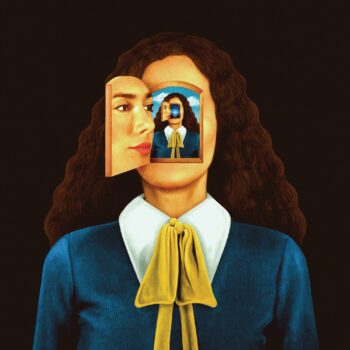
This memory found me somewhere in the title track of Neon Summer Skin, Bedouine’s fourth and latest record (out June 5, 2026 via Thirty Tigers). Between the moseying guitar and the strumming of the bass, Azniv Korkejian’s falsetto laments, “Everybody’s older now.” One by one, they get married. Then, they begin to leave. Now, they are somewhere else, speaking to their children in a language their parents do not understand.
This is what Azniv Korkejian calls “the diaspora experience.” At least, this is what I know it to be. Korkejian is living proof that it is indeed possible to miss the imprints of places twenty years and ten thousand miles away.
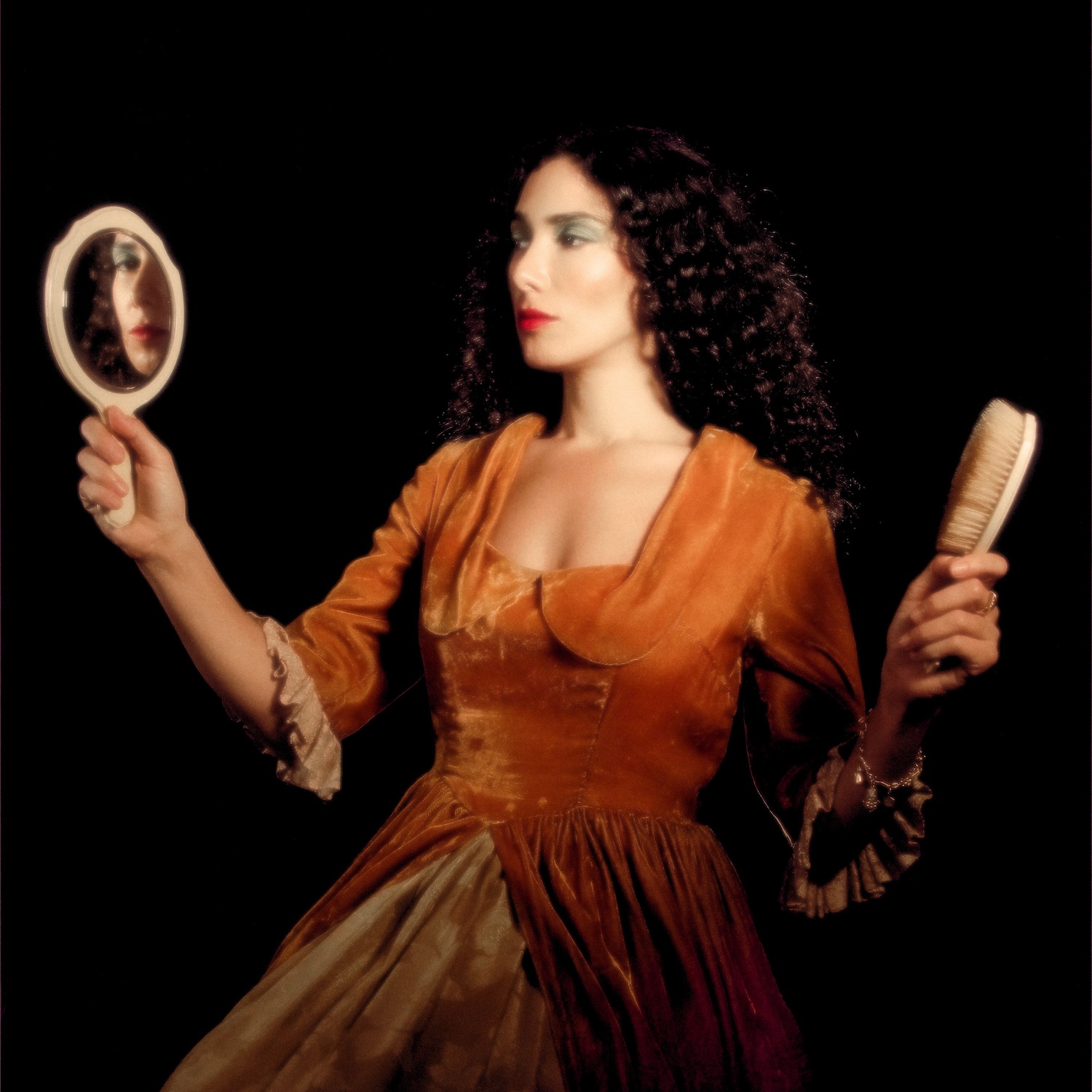
Bedouine’s fourth album, Neon Summer Skin, is the product of the in-between:
The seashores of Lebanon recounted over a folk waltz, a family member’s struggle with addiction set to a piano pop melody, the restlessness of alienation paired with a gentle bossa nova.
The record’s thesis, “Canopies,” places Korkejian in the shoes of her grandmother, who sent Korkejian’s mother in an orphanage for her safety. With the conviction of a mother who longs for a piece of her child, Korkejian dreams, “Waves, waves fold over / And send her scent to me / From the rugged cliffs of the Mediterranean / the bars of my balcony.”
Korkejian said it best: “And that is the diaspora experience: Wherever you go, there you are.” Across this record, she follows loss to its furthest reaches. Neon Summer Skin is an exercise in mourning the past and contending with the present. The songwriting is masterful, the stories vivid, and the undertaking massive. The “diaspora experience,” as Neon Summer Skin frames it, is not for the faint of heart – it is a lifelong commitment to carrying home, wherever or with whomever it may be.
Read our conversation below as Azniv Korkejian speaks with Atwood Magazine about the art of songwriting, Leonard Cohen, and the lifelong search for home.
— —
:: stream/purchase Neon Summer Skin here ::
:: connect with Bedouine here ::
— —
Stream: “One Thing Right” – Bedouine
A CONVERSATION WITH BEDOUINE

Atwood Magazine: This record is so beautiful! Every time I listen to it, time stops.
Azniv Korekejian (Bedouine): It’s been five years, which is crazy. It feels long overdue. It feels like the landscape has changed a bit. It feels like the stakes are higher and lower, in a sense, waiting five years.
You didn’t exactly take the time off. You had some collaborations, like on Hozier’s latest record.
Azniv Korekejian: Yeah. I did not plan on doing any of those things. Playing music with Norah Jones, writing with Andrew Hozier, and guest singing on Roger Waters’s record are some of my favorite things I have ever done. Maybe that’s why the time flew by.
Did you write for anyone during this time?
Azniv Korekejian: Hozier and I had been online friends for a while, and we got coffee when he came into town. It wasn’t the reason we started hanging out or anything. But we thought, “Hey, one of these days we should write something.” Then, we actually did it. Neither of us do that with other people regularly. We sat at my kitchen table and came up with something. He took the lead on the chorus and I took the lead on the verses. We finished it up on our own with lyrics and came back together in the studio. It all went really smoothly.
The first two tracks of the record address a profound sense of loneliness. Did recent events inspire these songs, or is loneliness something you have struggled with your entire life?
Azniv Korekejian: I was touring what felt like constantly before the pandemic. I would hop on other people’s tours and play my own shows in between. It was me, a backpack, and a carry-on. Sometimes being on my own was euphoric. I would wake up in a small village somewhere, take a walk, and look for coffee. Sometimes it felt really lonely. I really wanted this person that I am really close to, and I wanted us to help each other. They couldn’t find work, so I thought we could tour together. But, they were also dealing with addiction, which limited their capacity. It was a reminder to accept the circumstances.
This person is a family member. As you get older, there is also a societal change that happens when you can’t wrestle it out. That’s what the music video alludes to, these siblings fight and play-fight, then play – the full spectrum of youth. At this age, I can’t force things on people. You have to be polite, not primal.
When you write or sing about it, is that the primal release?
Azniv Korekejian: In a way. From a purely emotional perspective, yes. Writing a song allows me to neatly put things away. Actual songwriting is a bit more surgical. I want to use brevity and be economical when I write.
We have seen a shift towards a confessional, journal-entry writing style in the mainstream. When it’s done well, it’s great.
Azniv Korekejian: It’s very transparent. I said this and then you said this and then I did this.
Exactly. What is your take on that style of songwriting?
Azniv Korekejian: It might be a generational thing. It does not come naturally to me. When I read Leonard Cohen’s interviews, he talks about brevity, how to say the most with the least. Make every syllable as nutritious and packed as possible.
His songs literally split me in two.
Azniv Korekejian: Totally. You are so limited, but the parameters can be so inspiring. If I took that away, I don’t know what kind of songwriter I would be.
You should follow @leonardcohenarchive on Instagram. That’s where most of my screen time goes.
Azniv Korekejian: I will! I’ve been reading Cohen on Cohen. I got that when I released my first record. It was probably a mistake. Those were my first interviews. There are few people who can talk like him, and it made me panic about having to speak.
I think about him and his work all the time. I wish my life was that romantic.
Azniv Korekejian: Yeah, I’d love to be in Greece.
I have a love/hate relationship with immediately being profiled as Middle Eastern, especially as a woman. How do you feel about the fact that you are known as a Syrian-American artist?
Azniv Korekejian: I don’t know if this is on your radar, but I am trying to say West Asian, which feels so strange. (laughs)
It is on my radar, but no one knows what I am talking about when I say it. (laughs)
Azniv Korekejian: Yeah, I am so tired of everything accommodating Americans.
I will rephrase: There are not that many West Asian women in English-speaking, American contemporary music. How do you feel about the fact that you are known as a Syrian-American artist?
Azniv Korekejian: I don’t mind it at all. I am very curious about people’s stories and where they come from. There has been this societal shift towards not asking people where they come from. I feel like most of me is made up of my childhood, and my adulthood is this thin layer on top. It still feels like most of what I know. There is a huge sense of loss around it. I have not been able to visit the places I am from. That is what this record is about. I am making little vignettes to encapsulate it. I am trying to answer the longing. So as long as it comes from a place of authenticity, I am okay with it. My parents always say, “Why is everyone calling you Syrian-American? You’re not Syrian, you’re Armenian.” I tell them that I was born to a Syrian diaspora in Syria and all of my family was there until recently. I had never been to Armenia until recently. That part of my identity is new.
You have said you live as a nomad. I wonder if it is out of habit. Conflict has made rootlessness a primary identifier of the culture.
Azniv Korekejian: I am between cultures, for better or worse. That’s the experience of the diaspora. Ultimately, it’s my family’s story and it’s the thing I am closest to. The older I get, the more curious I am about my parents’ experiences. I don’t know if it’s the same for you, but it’s like pulling teeth to get my parents to talk about themselves. In a way I feel more connected to that than the second half of my life. It’s jarring to be a blend now.
For me, it’s jarring to decide the parts of the culture I want to carry with me and parts I want to leave behind. It’s pretty half and half. For instance, I love hospitality, but I hate materialism.
Azniv Korekejian: Yeah. Do you think that’s most cultures, or is it endemic to that part of the world?
Most Persians that have come to America in the last twenty years get their graduate degrees and go on to high-earning jobs. In my experience, the conversation around success and stability changes from surviving to thriving. When I think of the Arab diaspora, recent immigrants are here because they had to flee conflict. But obviously, that might change.
Azniv Korekejian: I think there is a mix with the Armenian diaspora.
Can you tell me about track eight, “Deghma Cheega?”
Azniv Korekejian: It’s an Armenian song that translates to, “I lived somewhere, there was nowhere to go. I lived somewhere, there was nowhere to go. Then I finally understood, there is no way to be comfortable.” And that is the diaspora experience: Wherever you go, there you are.
— —
:: stream/purchase Neon Summer Skin here ::
:: connect with Bedouine here ::
— —
— — — —
Connect to Bedouine on
Facebook, 𝕏, TikTok, Instagram
Discover new music on Atwood Magazine
© Janell Shirtcliff
 © Janell Shirtcliff
:: Stream Bedouine ::