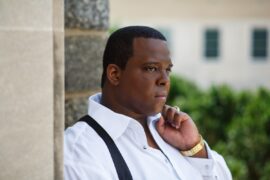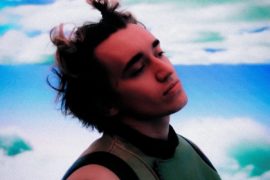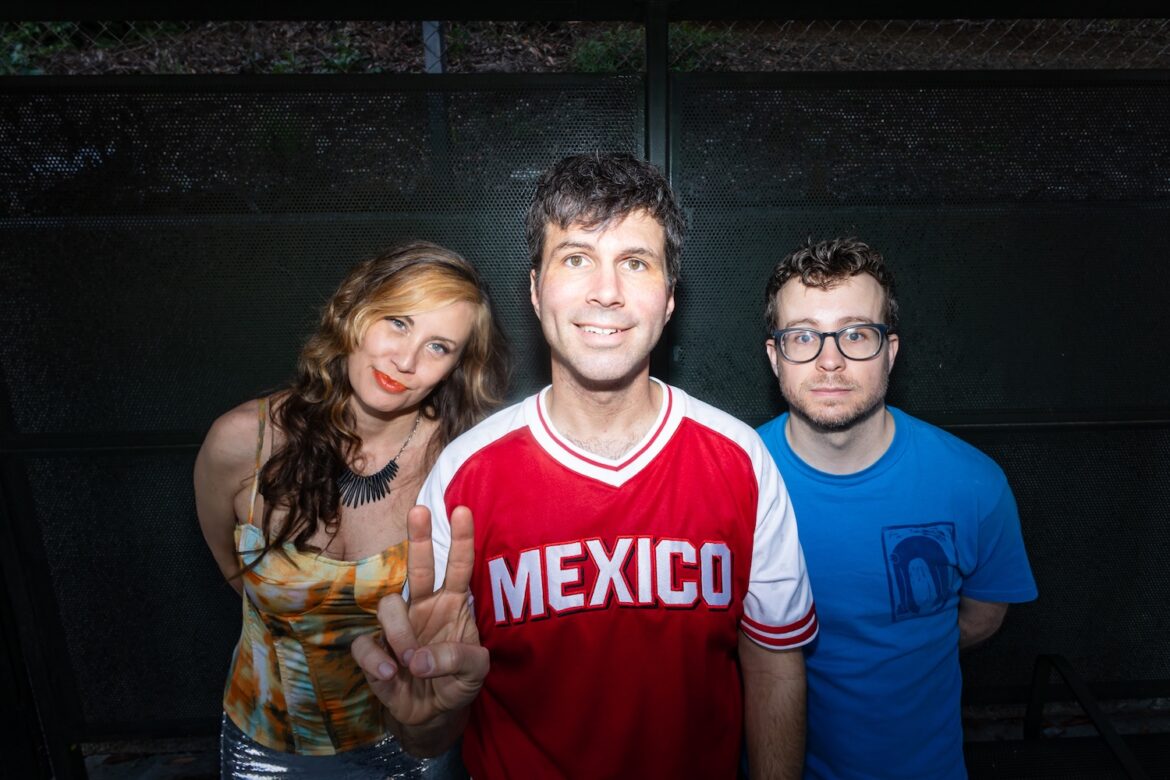
LA’s Cheekface channel the dread and absurdity of Trump’s second term into catchy, danceable indie rock on their incisive sixth album ‘Podium,’ confronting AI slop, black sites, ICE raids, and economic strain with wit sharpened by reality.
Stream: “Black Site” — Cheekface
It’s really interacting with the times, trying to figure out how the well-meaning weirdos and oddballs can navigate through this weird, callous, violent culture that we’re inhabiting right now together.
* * *
Almost every year since 2021, Cheekface has released a new record, filled with catchy, funny, and exciting new tunes.
Following up on 2025’s Middle Spoon, the Los Angeles indie rockers have just released their sixth album Podium, and while it maintains Cheekface’s beloved wit, it also confronts the often bleak reality that we’ve been faced with in 2026.
“Even people who are trying to be optimistic and trying to have fun and trying to be funny, you can’t avoid the shit that’s happening,” drummer Mark Echo Edwards tells us towards the end of our interview.
You hate to be reductive
Creative, not destructive
But you can destroy me, you can reduce me
To the size that you think that I should be
Reduce me, I wanna be reduced
Reduce me to nothing, until I disappear
And then when I’m gone, just
Keep reducing
– “Hostile Street,” Cheekface
While Cheekface don’t shy away from confronting ICE raids, AI slop clouding our better judgment, the rising cost of living, or black sites, they also infuse their songs with exciting styles like the funky opener “There is a God,” the singalong semi-power ballad “Rent is Down,” or the catchy post-punk “I Don’t Work Here.” While the band has always touched on many different styles of music, the rhythm section, consisting of bassist and vocalist Amanda Tannen and Edwards, makes the songs extra danceable.
Singer-guitarist Greg Katz keeps his punchy, sincere, yet silly delivery consistent throughout this record. Even though there are plenty of darker subjects that come up, the band doesn’t dwell on one thing for too long, and even when something is confronting a harsh reality, there are often jokes that can accompany them to lighten the mood, like the upbeat “Peanut Butter Prawns.”
As Tannen tells us, “It is a spoonful-of-sugar situation.”
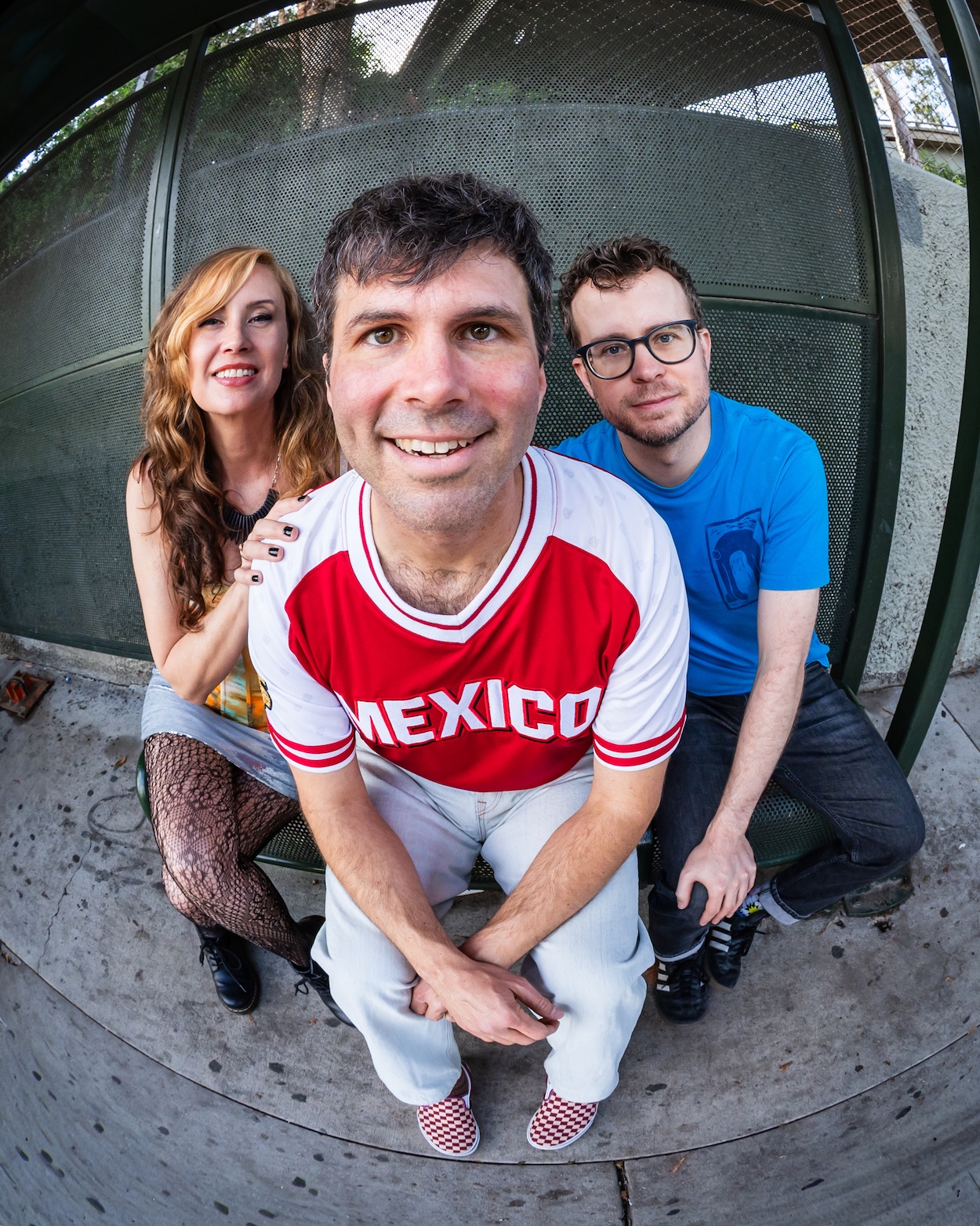
Just as Podium bounces between harsh reality and humor, so did our interview with Cheekface.
The conversation could just as easily maneuver between talking about black sites and war to quickly moving on to an aside about Scorpions’ “Winds of Change.” While the band are able to articulate many of the injustices we’re facing, they also keep that playful style when they bounce off each other throughout our interview.
Atwood Magazine spoke to Cheekface about pointing the finger at themselves, supporting DIY bands, and why they turned down an AT&T ad.
— —
:: stream/purchase Podium here ::
:: connect with Cheekface here ::
— —
Stream: ‘Podium’ – Cheekface
A CONVERSATION WITH CHEEKFACE
Atwood Magazine: Cheekface has been pretty prolific, releasing an album almost every year since 2021. How would you say that Podium is different than the ones that precede it?
Greg Katz: It’s the longest one.
Amanda Tannen: As far as time.
Mark Echo Edwards: By how much?
Greg: By a good bit, I think. By seven or eight minutes, I want to say.
Mark: Way more than I would’ve guessed.
Amanda: The songs are longer, right?
Greg: Yeah, some of the songs are longer, and it’s 13 tracks, and it really adds up.
Amanda: And we waited over a year to put it out.
What is typically the turnaround time then if you waited over a year for this one?
Amanda: We normally have been on the schedule where we release in January, but every January we’ve been releasing a new album and this one we’re like, let’s give it a little extra time and see what that does.
Greg: That’s the difference. I mean that, and look, we’ve done extensive market research and so we now know that people like things with added protein. So we have added 22 grams of additional protein to this record that the previous ones did not have.
Since you put out records so frequently, do you feel like it lets you evolve quicker in real time, or do you feel like it feels more like “this is what we’ve got, let’s do it”?
Amanda: Yeah, I think we’re evolving because we keep putting out records. We’re just doing what we’re doing. Nothing is like we need to change. We just keep doing what we do, and you can’t necessarily stay fully the same. As the inspirations change around us, our music’s going to change slightly and what we feel like how we use different instrumentation, the writing process has all stayed the same pretty much.
Greg: I think it’s both. Part of it is we just like to write and then when we have enough to put out a record, we put out a record. I think some songwriters find the process of songwriting very painful, very slow, very difficult to wake up in the morning and feel excited to make something. We’ve just never been like that. We just have fun when we get together to write a song. And so we write a lot of songs, and I don’t think it’s always like we have what we have. I think for this record, there’s a bunch of songs we didn’t end up recording. So it’s not like, “Oh shit, we have 10 songs. Time to go make the album now.” I think there is some thought that goes into what do we want to record. What do we want to prioritize recording?
Of course everything takes time. You write a song, and we might write it in a day or two or three, but then the recording and revising and mixing process all takes time. The learning and rehearsing process takes time, all that stuff. So there is, on some level, in some nuts-and-bolts way, we have to be like, “Here’s the songs where we feel more like this is what we’re saying on this record and that we want to get them onto this record because they live together well or they coalesce around a theme well or they have some relationship to each other.”
Amanda: I’ll just add, as far as being in a few bands, this band is very non-precious about our writing. We write something, it does take us a day or two, and then we kind of revisit it when we record it to refine the song, but it’s not like we’re sitting around for two months writing one song. It’s more of like, “Hey, that sounds good. Move on. Move on to the next.” It’s not a struggle like Greg was saying, a lot of people struggle because it’s like, “Ugh.” There’s this heaviness to writing songs because you want them to be perfect or you want them to be something. Whereas we go in not wanting anything and just being happy with what appears, what’s created.
Greg: Sometimes we’re not happy with what’s created, but we’re at least having fun creating it.
One of the things that I think a lot about when it comes to you guys is you're very musically diverse, but also very lyrical. When you're writing songs, is it sort of like, “Hey, we're playing around with this one's going to be a little bit more funky, this one might be more post-punk,” and then going back and writing lyrics that match that? Or do you go in with a lyrical idea and then try to write music that matches it?
Greg: Yeah, I think the writing process a lot of times comes with one of us being like, “Oh, you know what song is really cool? This song or that song, you know what kind of music I’ve been listening to a lot of lately is this or that. ” And we’ll go down the rabbit hole of listening to those songs, watching the YouTubes, being like, “Oh, did you ever hear about this band from that scene?” Or, “You know what that reminds me of is this other thing.” And we’ll just marinate in things that we’ve been listening to or excited about, and then we’ll just start from there. And a lot of times the song ends up sounding absolutely nothing like that original sapling of inspiration, but it just gives us a place to jump off from. But I don’t think we usually think about, oh, we need to write a slow song for the album, or we need to write a funky song for the album. It’s more just like we’ll start with some seed of inspiration and then we’ll just do our thing and it turns out like a Cheekface song.
In press releases you have said that this record is definitively a record about Trump’s second term, in what ways do you feel that you’re commenting on the “Trump 2” era?
Greg: Yeah, I hesitate to bring up Trump from my mouth simply because he gets so much attention from everything else. But also, when something is extremely obvious, one really needs to acknowledge its obviousness. And we are living in the Trump 2 era. This record was written in the Trump 2 era in the Trump 2 country, and it clearly interacts with the Trump 2 era in a couple of ways. Obviously there’s a direct way.
We talk about the police state and the politicians and the halls of power pretty directly about ICE abductions, about stuff like that, where we’re just hitting the politics of it head on. But then also this political situation creates a society that we all live in. We live in a society and the society has an effect on all of us regardless of whether we are thinking about the politics that are behind it.
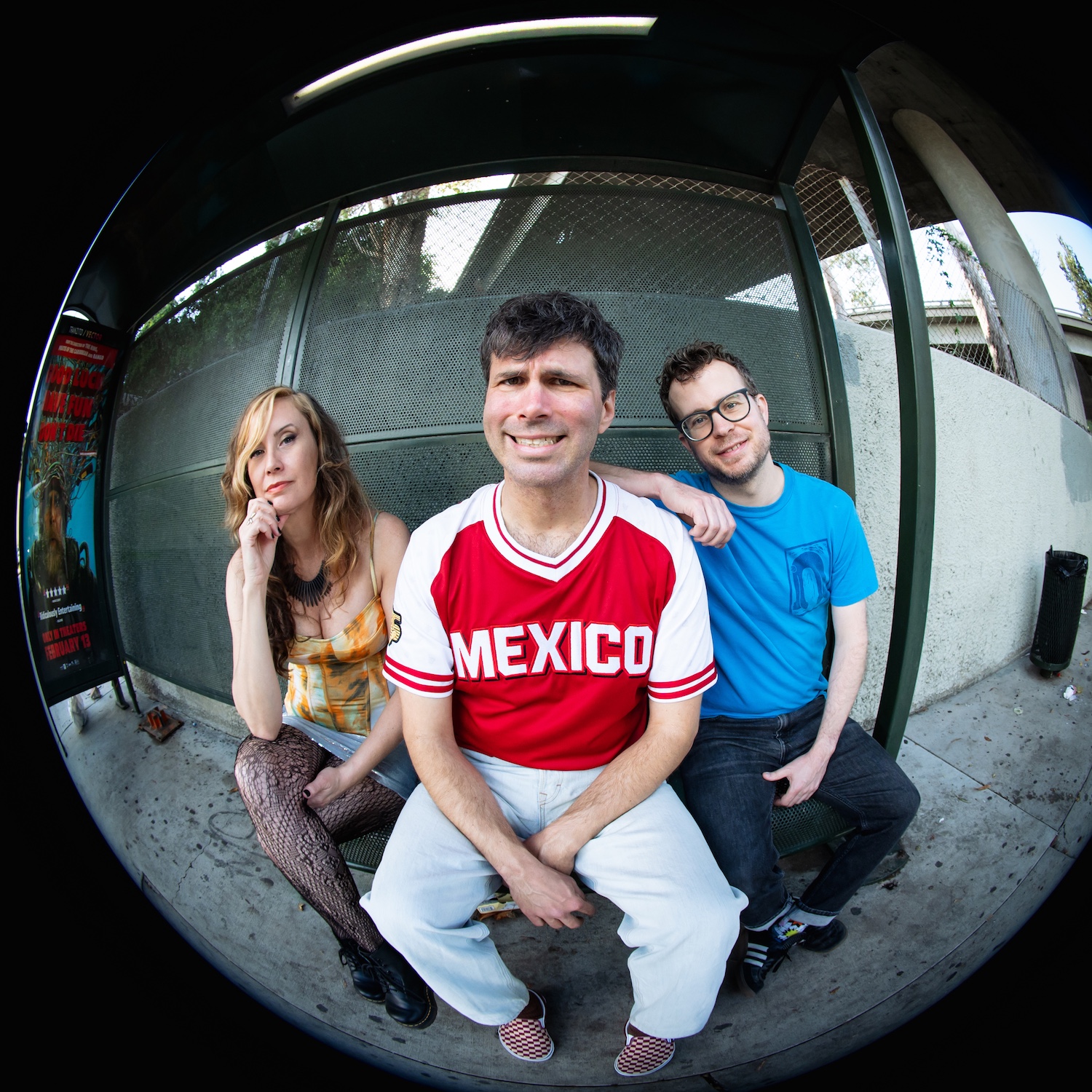
A lot of people are just trying to live their daily life in whatever their circumstances are. And yet the sick, crass, callous, violent politics of the Trump 2 era still creep in on you even when you’re not trying to interact with them, which I think is the purpose of the fascist state—to insert itself into your life when you’re just trying to be normal or be a weirdo and do your own thing. And I think “Hostile Street” is the first song on the record, and hostile street furniture is an instance of that that everyone has noticed. We’ve all noticed that bus benches and curbs are harder to sit on or lay down on because of a callous society that wants to punish the least fortunate and doesn’t care how much they suffer. And so that is the other window onto this era that we’re looking through.
Okay, or what if we kissed?
What if we held hands?
What if we kissed and held hands
On the hostile street furniture?
I'm glad that you mentioned “Hostile Street” because as you were describing it, that was where my mind went first just because being in New York, but really everywhere, it's very blatantly in your face how much infrastructure and just different public structures like a park bench can be used to show certain people that they don't want you here.
Greg: The hostile street architecture phenomenon is to punish people who are in a very difficult circumstance. It’s to make the circumstance more difficult, more painful, more uncomfortable, and that’s the only purpose that it serves. And that is something that we all interact with every day and that we pay for with money that we spend in taxes.
There are a lot of instances where you guys talk about just how those things intrude on our lives in the new hellscape we're in. Something we’re talking about more is AI. And I think that was something that I really liked about “The Weather” and talking about fake content and things like that. Can you talk about how that song works into that theme?
Greg: There’s a few references to AI on the record, which again, it’d be silly to not acknowledge it because it’s just so pervasive. Again, it’s just like when something is just really obvious, you have to make note of it. And yeah, I mean the fake content lyric in the weather, that was literally a thought that I was having as I was watching a bunch of people get fooled by some deepfake video. I was like, wow, all those people got fooled, but I would never. And then I was like, of course I would and have been and will be again.
I think “MFT” is another song where we got directly into that, and didn’t use the word AI in it, but it was a song that me and Mandy wrote after we read a news story about a kid who committed suicide and she’d confided in ChatGPT. And this was a year ago when this sort of thing was like, whoa, that is really crazy that that would happen. Now that news story is in the news every day, if not more often than once a day. But at the time it was like, oh, this is a new reality. Although I would say the song isn’t so much about, is AI bad or not? I mean, it is bad, but that’s not what the song’s about. It’s really about identifying with the loneliness of a person who feels they have nowhere to talk to and no safe space to share, and then being like, maybe this is the safe space to share.
I wonder if there’s any fake content
Out there fooling me
Nah, I would never fall for it
I would never fall for it.
Do you think there’s any fake content
Out there fooling you?
I don’t think you’re the kind of person
Who’d fall for it
And we would never fall for it
Not us two, not me and you
One of my favorite songs from the record, which I think is also a little uplifting, but also a little dark in a sense, is “Rent Is Down.” I think it does a good job tying many things together, but there's also something very soothing about it, even though there are times where you're talking about cost of living increases and other bleak subjects. Can you tell me more about that song?
Greg: [Mark] Echo, go ahead!
Mark: For me, it doesn’t feel like it’s the primary meaning, but there’s something about the phrase “the rent is down in my mind” that it’s like anything can dominate my head space. It’s like the current information economy or whatever world we live in where we’re so distracted by real and/or fake stuff on all of our devices. You spend 20 minutes going down a rabbit hole, and you have a brand new obsession that’s the only thing you’re talking to your friends about for three days. So for me, that’s the overarching, the rent is down in my mind. Yeah, just anything. We’re living in this hellscape of divided attention and crazy news stories that anything can just grab ahold and completely take over. Yeah, I think you said bleak earlier.
I think that there were certain things, like when it comes to cost of living – when I heard the song and the phrase rent is down in my mind, I kept thinking there's all this terrible stuff, but I found some sort of reprieve somewhere. And if that's entirely wrong, that's totally fine too.
Greg: It’s an interesting read. I think it’s a welcoming song. It’s like a singalong. It’s like a power ballad. And I think that’s true to our approach in general: we have fun making the music. The topics of the lyrics can be dismal, but the music itself is fun. It’s fun to make, it’s fun to record for the most part, and it’s fun to play it live, and it’s fun to share with people. And so there are certainly artists who are very head-on and agro about political messages that are very blunt. Although it’s probably fair to say we’re a political band, I think that the purpose of the music is not political sloganeering. It’s really interacting with the times, trying to figure out how the well-meaning weirdos and oddballs can navigate through this weird, callous, violent culture that we’re inhabiting right now together.
Amanda: I’ll add, but just a side note on that song, it did take a journey. It started out, as Greg mentioned, we were trying to write a power ballad and we’re listening to all these Scorpions – “Gorky Park.” I came in with Gorky Park and I was like, I don’t remember if that’s the name of the song or not, but.
Greg: I’d never heard of it before!
Amanda: Have you heard it, James? Do you know the song I’m talking about?
I don’t! I had a bit of a Scorpions phase, but I can’t say I remember a lot of it.
Greg: Wait, Mandy, can you screenshare it? Should we all watch the video together?
Amanda: I don’t even know if that’s the name of the song!
Greg: “Winds of Change!”
Amanda: It’s a full-on ’80s power ballad, rock hair. But talking about very serious things, but it’s put in this ’80s power ballad, and you’re just kind of like, “Ah.” And I felt that was very Cheekface. And it’s a song of my childhood. It hits, and the chorus hits real hard. It goes from very soft, very emotional to this huge chorus. And I was like, “Yes!”
Greg: It’s absolutely one of those lighters up type songs.
Amanda: “Rent Is Down” ended up not being that, but it was based with that start. So you kind of see it. It does start. That’s where the verses have this very quiet, soothing, and then the choruses are a little bit more upbeat. They’re not as much as a power ballad would’ve been.
So do you guys want people to have their lighters out when you bring it out on the road?
Amanda: That would be awesome!
Greg: Don’t burn your fingers. That’s what the phone flashlight is for.
Amanda: Anytime you want to put your phone light up at our shows, feel free!
A lot of the songs are pretty upbeat sounding and you guys also use a lot of humor. So do you guys have times where you're writing a song and you're like, “Okay, this might be getting a little too dark. I got to add a joke or a sort of silly little line or, oh, this one's really upbeat so we could make it something super serious?”
Greg: I don’t think that we usually reason it out that explicitly. I think we usually write what feels good as we’re writing it. And then sometimes we do come back to a song, and we’re like, “Oh, you know what? This line or this verse or this word shades it a little too dark or shades it a little too glib or shades it a little too happy or shades it a little too sad.” And then we’ll make those revisions as we keep working on the song.
Amanda: It’s a back and forth between Greg and I. So if one thing seems a little too much one way or the other, we’ll keep each other accountable for those things.
I think you do strike a nice balance. Just before I was listening to, I believe it was “Black Site” where it's the chorus that's like, “Oh, please put out the burning flags or the burning bill of rights on your way out.” Even though a pretty dark concept, but still framed as a joke in a way.
Greg: Yeah. I mean I think we wanted to look at the US government’s history of using music as a torture device, which it’s kind of funny to think about it. And certainly it’s one of those things like what’s your desert island disc? “What song would the US government play to torture you in a third-party country’s illegal prison facility?” But also it’s reality, and the US government abducting people into illegal prisons is something that happens in every generation.
It goes back as far as the country does. And I think that whatever age you are, there’s the first time you notice that happening and then there’s the second time you notice it happening. The first time you noticed it happening, you might’ve been like, “Oh my God, I can’t believe this unconstitutional torture is occurring.” And the second time you see it happening, you’re like, “This is a thing that America is. I remember this from before.” And I think that’s one of those things where we wanted to shine a light on it as part of the commentary of this record. Because I think as we all literally look out our windows and see the secret police taking our neighbors and community members away, I think that’s something that we’re all well served to remember is that this is a historical playbook of the US government and not of an oddity of the current era.
“Black site” itself was a term from the Iraq War era when the CIA was setting up what it referred to as “black sites” in other countries, because they didn’t want to torture people in America, because they felt that would be too unconstitutional. So they illegally flew them to other countries and tortured them there because that was also unconstitutional, but they felt less unconstitutional in that instance.
We’ve occasionally received criticism about that song, for instance, about, “Oh, this is just the way liberals imagine the world being.” And you could tell from how glib the song is that it’s not even real. And it’s like, no, you can just look out. I mean, I can look out in my street. I can drive around my neighborhood and see this occurring. It’s not like a liberal snowflake imagining. The song is fun and funny because it’s a song. That’s what songs are for. But the circumstances are real, and it’s happening all around us under our watch.
Amanda: In LA and particularly where we live, it really was just while we were writing this album just pushed in our faces and feeling like, “Okay, this is something we need to talk about because I don’t know if it’s happening anywhere else.” And then it started happening, obviously, a lot of other places. But initially it was just like I would call and be like, “Hey, my friends, the highway’s closed down, and it looks like the army’s on it. Why?” And everyone would be like, “No.” We felt like we needed to say something. And yes, we do it in a manner that makes it, hopefully, spread the word more because it is a spoonful-of-sugar situation where it’s just like you make it catchy, you make it a little light.
We also love to point the finger at ourselves. So it’s like, “Hey, if you’re going to torture someone with a song, torture them with Cheekface.” It’s like this will be the song you put on. So it was just a way to confront our own emotions with what was going on specifically in LA, in our community. And so a lot of the times Greg and I get together, right, and it’s like, “Well, what’s happening today?” And it’s just like that was happening. And we were like, “Okay, let’s write a song.”
Greg: I think it’s funny when people call it disingenuous—a song like that and other songs that we’ve done, because I’m like, “Is it disingenuous to comment on these things or is it disingenuous to write a sad love song about how you hate getting dumped?” When this is what’s happening in the world. I would choose our way, obviously, because those are the songs we write. Others may disagree, but yeah, it’s not disingenuous at all. It’s us looking at the world as we see it and reporting our comments on it.
Mark: As far as striking the balance, I feel like both as a band and as people, we are aspirationally fun and funny. But again, it’s just the world around us. Even people who are trying to be optimistic and trying to have fun and trying to be funny, you can’t avoid the shit that’s happening.
You also do a little bit of taking the piss out of performative activism too, with lines like “Boss makes a dollar, I make a dime, I do my leftist infighting on the company time.” Why do you feel it's important to point out those aspects too?
Greg: As Mandy was saying before, we like to point the finger at ourselves and make fun of our own tendencies to fall into the categories of people one might loathe or find annoying. And so I think the crack about leftist infighting, obviously it riffs on the old cliché about what you do while the boss makes a dollar. But yeah, I think that’s something we’ve come back to over and over throughout the Cheekface oeuvre is kind of the liberal urban Bohemian lifestyle and how that fits or doesn’t fit into real activism, real political movements, real social change, real community building, et cetera, et cetera.
Can you tell me a little bit about turning down the AT&T ad?
Greg: It was a really easy decision. Like I said, a casting director had reached out to us, didn’t tell us what the ad was for. They just said it was telecom-related. So we shot a little audition video of us just talking to camera and being ourselves. And then they responded back with the text that I had posted on our Instagram, which is just like, “Hey, that spot is for AT&T. The director wants to meet you. We’re going to shoot next week.” And then we had a quick huddle on text, and I think I just wrote, “Does this line up with our values AT&T?” And Echo was like, “Probably not. ” And Mandy was like, “I have no problem passing on this. ” And then we were like, “Okay, we passed.” And like I said, we have the privilege to do that because of the support of the Cheekfreaks, because of the support of the Stubbs Club, the subscription fan club.
We can just be like, we’re going to turn tens of thousands of dollars down in a situation where some other band would be like, “This is make or break for us being a band, and we’re just not going to look up how much money AT&T gets from ICE, but they’re the second biggest contractor behind Palantir.” So we could have not gone public with it, but we wanted people to know that you can say no. Let’s share it with the world, because it does create permission structure for other bands to be like, “Oh yeah, Cheekface was able to say no to this and keep going and being a band. They saw that it made them feel a little queasy and said no.”
I looked at other bands who have done that before. One that came right to mind was Los Campesinos! turning down an Airbnb ad, I think, last year. They were like, “Airbnb is not how we like property in our community to be used, and we don’t want to be part of that. Not for any amount of money.” I thought of that. It’s normal to say no to this type of thing if you don’t think it’s right. It’s good to put your values into play when you can.
Is there anything else that you wanted to add or anything that you think is important for your fans or our readers?
Mark: Greg was just talking about real community building. And so if we’re doing general important things that aren’t about the record, I would say go to a local show, go to a DIY show, see your friend’s band that isn’t particularly good, play and buy a T-shirt and stick around for the other bands and be in a room with real people and experience some art and talk to someone you don’t know. Because I feel like the world is trending towards less and less of that, and I think that’s probably the wrong direction just based on my gut instinct.
Greg: I was just thinking about something similar too. I think we’re about to go on tour, about to put out a record. The cost of all those things have gone up a lot since we’ve been a band, and they’ve gone up a lot over the course of this year, 2026, because the US government went on a foreign adventure into Iran, and it made all aspects of our life expensive. And of course one of those aspects is the cost of fuel, which we’ll be burning a lot of as we truck all around the United States and a little bit of Canada.
Obviously that’s the 6,423rd worst thing about the US going on another foreign adventure to the Middle East. But we do really depend on the Cheekfreaks, and we have their support, and they stick with us, and they’ve stuck with us for a long time, and so we get to keep doing this. And for that, we are really in the catbird seat as they say. But not every band has that, and not every opener on the show that you go to see, not necessarily our show, but any show that you go to see, doesn’t necessarily have that. Bands going out on their first tour don’t have that. Local bands playing in punk rooms and DIY venues don’t necessarily have that long-term sustaining community that keeps boosting the band year in and year out as the costs go up to do the things that we love to do.
So if you enjoy DIY bands, if you want bands to be independent, to say what’s on their mind, to be able to say no to the AT&T ad because AT&T is one of the biggest recipients of ICE contracts, below only Palantir, people who love the music have to support in the manner that they are able to. So yeah, let me underline Echo’s comment. Go to the local show, buy a fucking ticket, buy a T-shirt, buy a record.
Amanda: I will add to that that I’m really excited. I’m sure these guys are really excited to actually hang out with the Cheekfreaks again. So come hang out with us, come hang out with the other Cheekfreaks. We’re really excited. So we’re excited just every night to just have fun. So come join us.
Greg: Somebody DMed yesterday or two days ago, it’s crazy how close you guys are with the fans and how responsive you are and all that. And I was like, well, we have a lot of friends who are in bands, been in bands, and most bands’ fans are not cool. You would not want to hang around with them. And for whatever reason, our fans are cool, and that’s why we can hang out with them after the show while we answer all the DMs and whatnot. Yeah, so we are really lucky for that community. And part of why we love to go out on tour all the time is to reconvene the community and bring everybody back together and welcome in the new people and keep the community spirit going.
— —
:: stream/purchase Podium here ::
:: connect with Cheekface here ::
— —
— — — —
Connect to Cheekface on
Facebook, 𝕏, TikTok, Instagram
Discover new music on Atwood Magazine
© Mallory Turner
 © Mallory Turner
:: Stream Cheekface ::