Electric sparks fuse together in Really Good Time’s vulnerable debut album ‘Affirmations.’ Sitting with the temptation to disengage, the band navigate listeners through the internal chaos of trying to find peace amid a global crisis.
by guest writer Esther Akinborewa
Stream: ‘Affirmations’ – Really Good Time
Dark humour runs through Really Good Time’s debut album as they recount what it means to exist in an era where life seems set to make people fail.
As an Irish group, they draw inspiration from the current struggles with the housing and financial crises, creating a raw piece of work many could relate to – a project filled with passion that establishes who they are as a group.
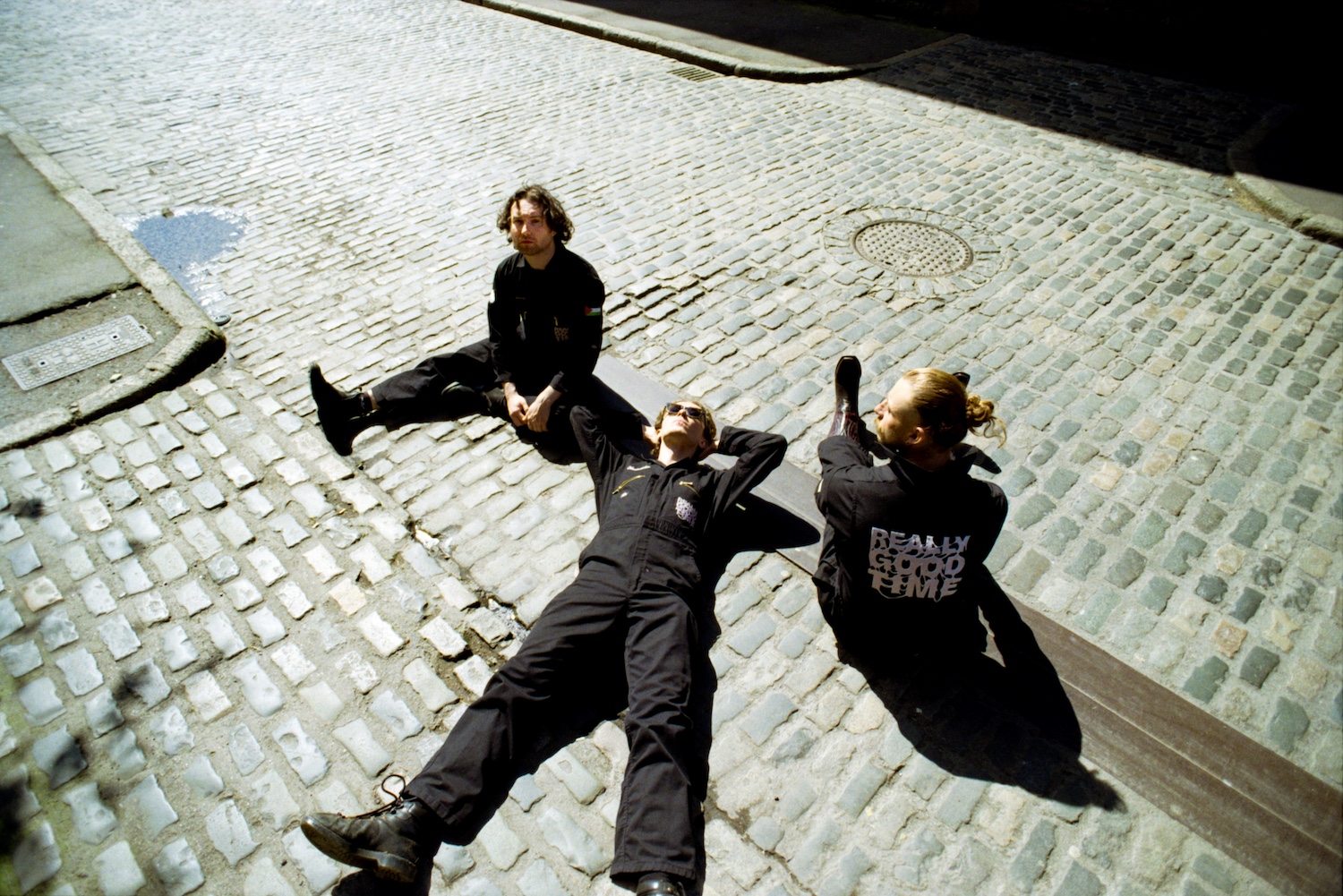
Comprised of Wastefellow (vocals and guitar), Ado Tornado (drums) and Jacque le Coque (bass), Really Good Time are a Dublin power trio who have built their identity through chaotic live performances and a raw, fuzzed-out sound. Since emerging from the Dublin scene in 2021, the group have gone from playing semi-legal shows on sheep farms and in squats to appearing at SXSW and The Great Escape, while sharing stages with Franz Ferdinand, The Murder Capital and Gurriers. After founding guitarist The Dúke left following SXSW, the band re-emerged as a trio, allowing them to lean further into the louder, more direct sound that now shapes Affirmations.
“On Dublin Bus” opens the album with an immediate rush as guitar riffs mix with Wastefellow’s cool vocals. There’s an element of observation in the track as the vocalist narrates how the passengers accept their reality without questioning it.
The raw lyricism carries a satirical edge as the lyrics are sung with conviction, becoming a plea for empathy and introspection as more people mindlessly accept their circumstances without question.
As an opener, this track leaves a strong narrative mark as it introduces the world of Affirmations, signaling that this won’t be a simplistic listening experience.

In a society where everything seems to be going wrong, bitter people turn into life teachers in order to feel somewhat accomplished. The grind is painful, yet when someone eventually makes it, they forget how difficult it was to even get to that point as they become a part of the problem, telling others,
“That isn’t how you do it.”
Driven by a dirty rock instrumental, “Do It” reflects the rollercoaster of being taught how to adult correctly, only to be told you didn’t do it the right way when things eventually fail. This song was more on the nose, poking fun at the contradictions people face in real life, as they consistently put in effort to gain independence yet are met with restraint. Instrumentally, the guitar mirrors that atmosphere of running in circles and seemingly never getting it right even when the right thing is being done.
Three songs into the album, Really Good Time consistently maintain their gritty edge, as their songs refuse to shy away from acknowledging societal issues through sonic cues and smart parallels. Hopelessness hangs over “Shit One” as every piece of news from the screen serves as a reminder of why there’s no point in doing anything if the world has already turned to shit. The guitar riffs and opening harmonies provide a dazed atmosphere mirroring that feeling of not knowing what can be done anymore, yet anger arises in Wastefellow’s voice,
“ASUNDNJFAPODSLKL better.”
The lead vocalist reflects the realisation that powerlessness won’t change anything when corrupt leaders rely on that powerlessness to succeed. “Shit One” embodies that state of wanting to give up, but pushes listeners to continue fighting for what’s right even when it looks like everything is turning to shit. As the song ends, it leaves behind a reminder that failure can only truly occur when one gives up.
A state of emergency arises in “The Love Song,” with sirens creating a base for the guitar as the drums (Tornado) and bass (Coque) follow through. The pacing is incredibly exciting as the instrumental begins to slow down at the 2:28 mark, only to pick back up again. The sonic choices pay homage to their underground roots as this song shows how confidently they understand and control their sound.
Once again, they lyrically stay on theme, looking to love as a grounding tool for the inner self, while also suggesting it can become a substitute for inner work – something necessary simply to feel something.
“She’s fun and I want some
‘cause I got no love but I need one.”

“Bob Dylan was on Pawn Stars in 2010” follows with a distorted guitar and eccentric lyricism, creating quite a woozy track as listeners are left pondering the Earth hurtling through space. The track captures a sense of insignificance:
“Turns out the world’s so big.”
It captures the inability to fully relax, knowing that nothing is as it seems and that the world seems to get worse by the day:
“You’re standing on a rock
hurtling through space
The weight of human history
Its pinning you in place”
“Best Medicine” seems like a coping mechanism, a song that almost gaslights its own narrator as the laughter creates an air of willful ignorance:
“HA HA HA HA”
“It’s the best medicine”
It came off as a song that reflected that state of being overwhelmed and just wanting to let go and lean on a temporary fix to feel better for a little while. The instrumentation enhances the overall tone of the song, as the group once again use the arrangement to reinforce the narrative of the album.
“Dig Up, Stupid” opens with an eerie synth before the drums suddenly kick in at 38 seconds, with the guitar following suit. As the song takes a darker turn, anxiety emerges in the lyric:
“le creuset panic attack”
The song continues to shift around that feeling, sustaining a sense of impending doom. The anxiety feels as though it will never end, revealing the sonic strength of the album as the production choices heighten the emotional experience of the track.
“Toadman” follows a steadier chord progression, with the character becoming a shell of a human in order to imitate the way others live and feel more normal. The group are able to incorporate a more upbeat instrumental with the bleak lyricism; it’s impressive how they shift away from such a dark sound without it becoming too abrupt, revealing their range as artists.
Nearing the end of the album, “Life, Life” uses addictive instrumental cues throughout the eight-minute runtime. The group fully embody the theme of the project, refusing to shy away from life’s confusion as dark moments hide in the shadows, never fully disappearing in the face of temporary joys:
“The black mould it grows
Until I can’t open the door
Anymore”

Leaning into the chaos, “Peter Hayes Is Not Who He Says He Is” allows the group to really let it all out in the final minute of the project, making a final statement about who they are as a group and why they create what they do.
As a debut, Affirmations shows that Really Good Time already have a strong understanding of their sound and who they are as artists. Affirmations is lyrically compelling, sonically unique, and conceptually engaging. It marks the beginning of Really Good Time’s career while leaving their identity stamped into every riff and melody.
— —
Based in the Irish Midlands, Esther Akinborewa got into journalism craving for a space to share her enthusiasm for the people behind the art. Her goal has always been to create a place for passion without restraints. As a writer of fiction, her writing style is an ode to her love of literature and desire to understand the human experience through melodies and words. Reflecting her love for music playing instruments was inevitable starting out with piano, and later venturing into guitar and violin (whilst running away from music theory). On most days you’ll find her putting on a good CD (probably Nothing But Thieves – Broken Machine), and writing a Substack draft she’ll forget about and then post a couple months later.
— —
:: stream/purchase Affirmations here ::
:: connect with Really Good Time here ::
— —
— — — —
Connect to Really Good Time on
Facebook, 𝕏, TikTok, Instagram
Discover new music on Atwood Magazine
© Saoirse Johnston
 © Saoirse Johnston
Affirmations
an album by Really Good Time