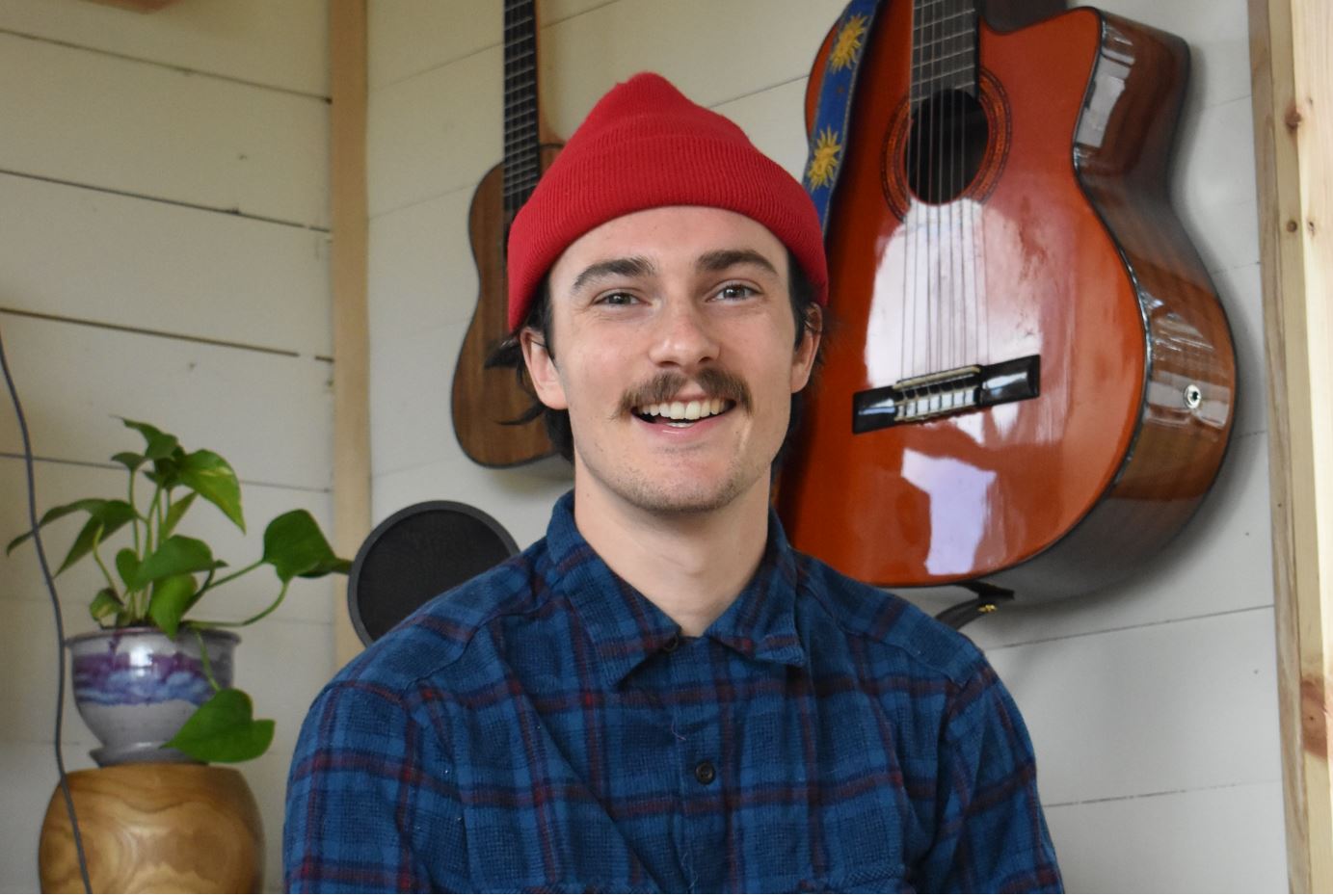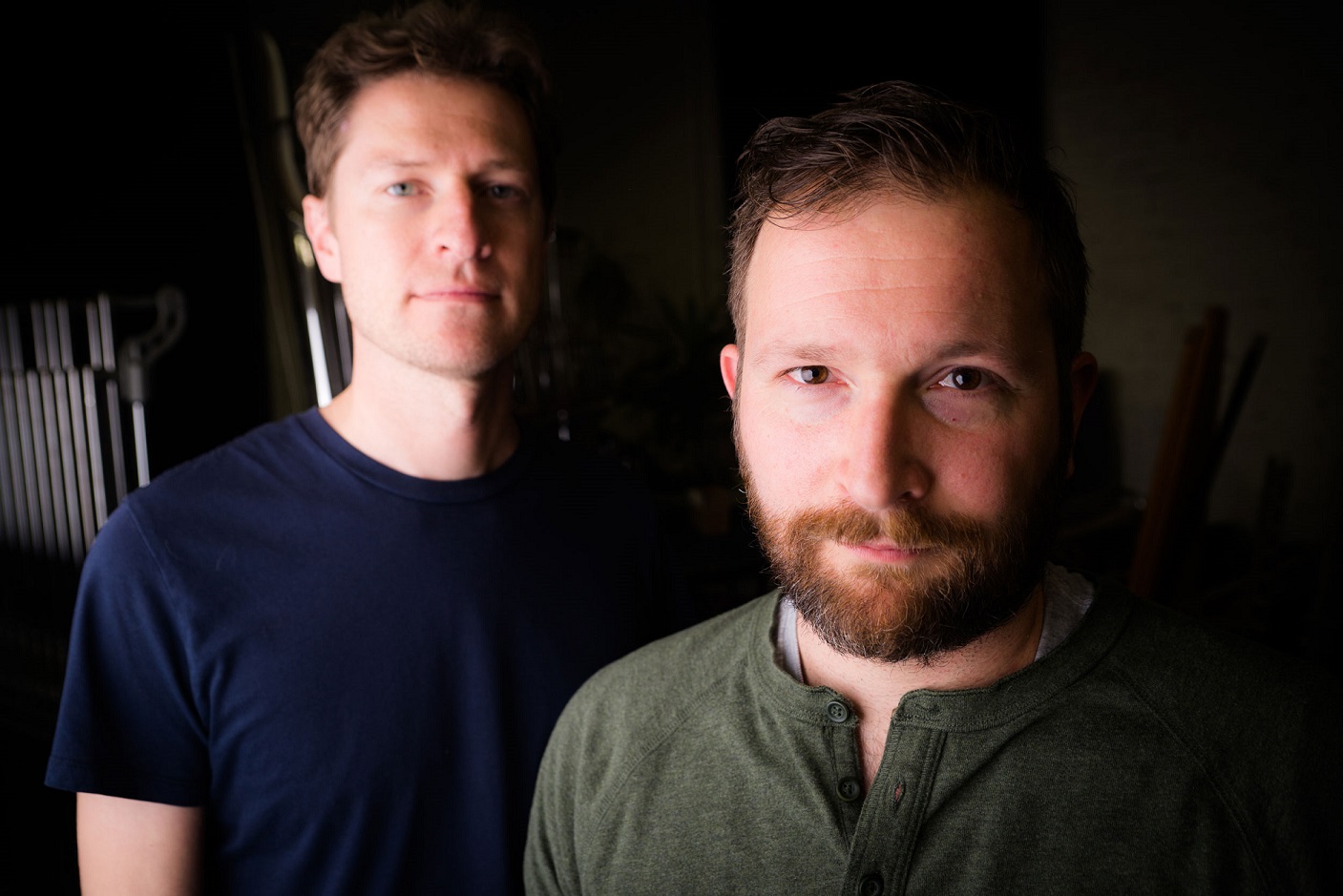
Atwood Magazine is excited to share our Editor’s Picks column, written and curated by Editor-in-Chief Mitch Mosk. Every week, Mitch will share a collection of songs, albums, and artists who have caught his ears, eyes, and heart. There is so much incredible music out there just waiting to be heard, and all it takes from us is an open mind and a willingness to listen. Through our Editor’s Picks, we hope to shine a light on our own music discoveries and showcase a diverse array of new and recent releases.
This week’s Editor’s Picks features Iron & Wine, ARCHIE, Young the Giant, Friko, People I’ve Met, and mildred!

 follow EDITOR’S PICKS on Spotify

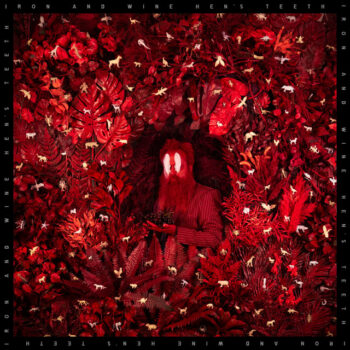
Hen's Teeth
by Iron & WineIron & Wine’s Hen’s Teeth feels like an impossible gift made real – a warm, wild, light-streaked folk record that seems to bloom brighter the longer it sits in the sun. Sam Beam’s eighth studio album has been living with me since its February release, but as the Northeast has slowly shaken off winter and opened itself to greener, softer days, these songs have only deepened their hold: “Roses” bursts open with earthy, spirited abandon; “Robin’s Egg” glows with sweet, featherlight charm; “In Your Ocean” swaggers and sways with uncanny ease; “Defiance, Ohio” wanders through brokenness and wonder; and “Dates and Dead People” moves with a strange, soul-stirring grace all its own. But it’s “Wait Up,” Beam’s tender, mournful duet with I’m With Her, that keeps pulling me back in – a dreamy, heat-hazed folk reverie whose radiant three-part harmonies feel almost weightless, even as its central question lands with quiet force: What are you waiting for?
Shaped in bursts of spontaneity and shared chemistry, Hen’s Teeth unfolds with an instinctive, lived-in ease – and, in many ways, a companion piece to Iron & Wine’s 2024 album Light Verse, drawn from the same fertile stretch of sessions in Laurel Canyon with a close-knit band of longtime collaborators. What began as a loose collection of songs slowly revealed itself to be more instinctual than intentional, shaped less by rigid structure than by feel, chemistry, and the freedom to follow wherever the music led. That sense of openness mirrors where Sam Beam finds himself now: Decades removed from the early days of second-guessing and self-validation, he’s settled into a creative space defined by curiosity, collaboration, and trust. As he reflects, “I don’t have anything to prove anymore… You just do what seems fun at the moment, and it’s a great place to be” – a perspective that breathes life into Hen’s Teeth, giving the record its relaxed, lived-in spirit and its confident sense of exploration.
Just like that
Everybody’s got a lot to lose
You know me
Never passing up a good excuse
What are you waiting for?
You don’t mind
What a funny way to make a friend
I give up
When I’m waiting for the world to end
What are you waiting for?
That freedom is especially palpable on “Wait Up,” a song that feels suspended between motion and stillness, urgency and surrender. Built on a soft, swaying foundation of acoustic textures and luminous harmonies, the track carries a light insistence that grows stronger with every repetition of its central refrain: What are you waiting for? It’s a question that lands differently each time – at once gentle and probing, curious and confrontational – cutting through hesitation with a kind of understated clarity.
From the opening lines – “Just like that, everybody’s got a lot to lose / You know me, never passing up a good excuse” – Beam frames the song around a more internal conflict: Not indecision, but avoidance, the small, self-aware ways we delay the very things we know we should do. That tension deepens as I’m With Her admit, “I give up when I’m waiting for the world to end,” a line that shrugs off responsibility even as it exposes it. The refrain doesn’t just ask a question; it presses on a bruise, returning again and again until it demands an answer. Beam and I’m With Her (the acclaimed trio of Sara Watkins, Sarah Jarosz, and Aoife O’Donovan) weave their voices together with remarkable intimacy, their harmonies glowing even as the song circles uncertainty, indecision, and the strange comfort of standing still. “Here it comes… you can feel it closer every day,” they sing, as if urging themselves forward just as much as the listener. In that space between knowing and acting, “Wait Up” finds its pulse – not as a call to rush, but as a reminder that time doesn’t wait for certainty, and that sometimes the hardest step is simply choosing to move.
Here it comes, here it comes
You can feel it closer every day
What a life, what a lifе
Getting out or getting in the way
What are you waiting for?
That same sense of gentle reckoning runs throughout Hen’s Teeth, a record that finds its power not in grand gestures, but in the way it lingers in small, human moments. These songs shine with an authentic, earnest warmth – messy, tender, radiant – where love blurs into memory, devotion into doubt, and nothing ever resolves as cleanly as we might hope. On the album’s uncannily catchy lead single “In Your Ocean,” Beam aches toward connection even as he admits, “Praying for dry ground / Though I only want to drown,” caught between self-preservation and surrender. “Roses” opens the record with bodies and lives colliding in surreal, almost mythic imagery – “Run into the one you love forever / Laugh into each other’s empty mouth” – turning intimacy into both a beautiful and disorienting experience. Even the smoldering, Tropicália-inspired “Defiance, Ohio,” in all its wandering groove and folksy spirit, carries that same undercurrent of reflection and fragility, tracing the long arc of a life lived forward and understood only in pieces. Across it all, Beam doesn’t rush to clarity or closure; he lets these moments breathe, trusting their contradictions, their imperfections, and their fleetingness. The result is an album that feels less like a set of answers and more like a series of open windows – each one catching the light just a little differently, each one offering its own fleeting glimpse of what it means to be here.
Beam speaks about Hen’s Teeth with a kind of wonder that mirrors the record itself – as if even he’s a little surprised by it at times. “That phrase, ‘rare as hen’s teeth,’ felt like this thing wasn’t supposed to exist, and so here it is,” he says with a laugh, calling it “a jig” – a playful, improbable creation that somehow came to life anyway. That spirit carries through not just in the album’s title, but in its language, its playfulness, its willingness to follow sound over certainty. “Wordplay, loosey-goosey, all this stuff… I’ve just been enjoying the sound of words, not just explicit meaning,” he adds. “I’ll take a good-sounding word over something explicit. Something suggestive.” There’s limitless freedom in that approach – a refusal to overdefine, to overexplain – that speaks to an artist fully at ease in his own voice, more interested in discovery than destination. So many years into his career, Beam sounds not only comfortable, but creatively energized, making music that feels curious, expansive, and adventurous in ways that only come from letting go.
What makes Hen’s Teeth resonate so deeply is the way it meets life where it actually unfolds – not in sweeping declarations, but in passing thoughts, half-formed realizations, and the small, flickering moments we carry with us long after they’ve gone. There’s a warmth to all these songs that feels earned rather than imposed, a sense of presence that invites you to sit inside them rather than rush through them. They don’t demand attention so much as reward it, revealing new textures, new meanings, new emotional undercurrents with each return. In a world that so often pushes us toward clarity, closure, and constant forward motion, Hen’s Teeth offers something quieter but far more lasting: Space to reflect, room to wander, time to feel without needing to resolve. It’s a record that doesn’t just soundtrack a moment – it stays with you, reshaping how you move through the ones that follow.
In the end, Hen’s Teeth doesn’t arrive with answers – it lingers with questions, with images, with feelings that resist easy definition but land all the same. It trusts its listener, believes in the power of suggestion over certainty, and in doing so, finds a rare beauty: One that unfolds slowly, in layers, and grows more vivid with time. Sam Beam has spent decades refining his voice, but here, he sounds freer than ever – unburdened, exploratory, and fully present in the act of creation. That spirit is what makes this album feel so alive. Like its title suggests, it’s a rare thing, an unexpected gift – one that perhaps shouldn’t quite exist, and yet does. And for those willing to sit with it, to return to it, to let it breathe on its own terms, Hen’s Teeth offers something lasting: A reminder that not everything needs to be explained to be deeply, profoundly felt.
“Nine”
by ARCHIE“Oh, I put my feelings on hold again…” Learning how to care for others without losing yourself in the process is a delicate, often painful balance – one we don’t always know how to hold. It can mean biting your tongue to keep the peace, or giving more of yourself than you have left just to keep someone else steady. It can look like shrinking your own needs in the moment, telling yourself it’s easier that way, even when it pulls you further from yourself.
This quiet tension sits at the heart of ARCHIE’s “Nine,” a glistening, emotionally charged indie pop track that turns inward with striking honesty and grace. Drawn from their March EP Together Apart, the song traces the push-and-pull between connection and self-preservation, capturing a core friction of intimate relationships where empathy can slip into self-erasure.

What kind of game is this
You take me for a ride
I wanna get through it
My bedroom looks like my mind
And I know
We all follow our own convictions
I’m blinded by myself
And haven’t seen for a while
Released in early March, Together Apart marks ARCHIE’s sophomore EP, and a defining step forward for the Canberra- and Wollongong-based quartet – Grant Simpson (vocals/guitar), Olivia Faletoese (bass/vocals), Xandy Wanjura (drums/vocals), and Geromy Houghton (guitar/synth) – whose indie pop sound pulses with melody, movement, and an unmistakable emotional core. There’s a sense of closeness woven through these songs, a feeling of shared experience and lived connection that seeps into every chord and chorus, balancing buoyant, danceable arrangements with an undercurrent of introspection and care. Where their 2024 debut EP Tell the people you love that you love them laid a heartfelt foundation after years of steady single releases, Together Apart feels more assured, more fully realized – a body of work shaped by growth, distance, and the ties that hold through both. At its center, “Nine” captures one of those unspoken emotional dynamics that so often linger beneath the surface of our relationships – a presence felt more than named, like a ghost moving quietly through moments of closeness and strain alike.
ARCHIE frame “Nine” as both a personal reckoning and a path forward. “[It’s] a self-reflective journey into learning how to love others and yourself,” Olivia Faletoese tells Atwood Magazine. “I wrote ‘Nine’ as a way to work through my understanding of myself and the people I love… I found myself in situations where I wasn’t able to take care of myself. Making space for other people is something I’ve always done, even to my own detriment. Some of these lyrics are reflective of my own frustrations with myself, and others while also learning to take care of myself better and leaning on my friends.” That duality – inward and outward, self and other – runs through every layer of the song, surfacing not just in its lyrics, but in the way it unfolds sonically.
I won’t ask you a thing
But you’re being unkind
You’re just stuck in your head
And now I’m stuck in mine
Oh, I put my feelings on hold again
Oh, I wore my heart on my sleeve again
It begins with a crystalline guitar line – bright, fluid, and instantly immersive – setting a tone that feels both weightless and emotionally charged. When the first verse arrives, there’s a sense of disorientation just beneath the surface: “What kind of game is this / You take me for a ride / My bedroom looks like my mind,” Faletoese sings, blurring the line between physical space and internal chaos. The instrumentation stays light on its feet, but there’s tension in the phrasing, in the way the melody stretches and pulls against itself. “I won’t ask you a thing, but you’re being unkind,” she confesses, laying bare the quiet compromises and internal fractures that come with loving deeply but unevenly. “You’re just stuck in your head, and now I’m stuck in mine.”
These feelings snap into focus in the chorus, where the emotional core lands with full force: “Oh, I put my feelings on hold again / Oh, I wore my heart on my sleeve again.” It’s a confession that feels both weary and cyclical, underscored by swelling harmonies and a rhythmic lift that gives the moment an undeniable urgency. As the song progresses, that opening guitar motif returns like a thread weaving everything together – a steady, shimmering presence that mirrors the push and pull at the heart of “Nine,” where vulnerability and restraint exist in constant conversation.
Who am I to say
I’m fighting gravity daily
And I bite my tongue
so you can get your word out
you never told me to do that for you
I won’t ask you a thing
But you’re being unkind
Your just stuck in your head
And now I’m stuck in mine
Oh, I put my feelings on hold again
Oh, I wore my heart on my sleeve again
That friction doesn’t resolve so much as evolve. As “Nine” moves forward, Faletoese’s voice carries a growing sense of awareness – “Who am I to say I’m fighting gravity daily” – a line that captures the visceral weight she describes so vividly, that feeling of heaviness, of being pulled down by your own instincts even as you try to rise above them. There’s a quiet resilience embedded in the song’s later moments, too: “Stand up, it takes time to learn what they might find is easy,” she urges, reframing vulnerability not as weakness, but as effort, as practice, as something earned over time. Even in its most introspective passages, “Nine” never loses sight of forward motion. It acknowledges the patterns, the missteps, the ways we fall short – and still reaches for growth, for clarity, for connection.
That’s what makes “Nine” resonate so deeply: It doesn’t pretend to have the answers. Instead, it sits with the tension, honors it, and gently pushes through it. ARCHIE tap into a deeply human experience – the instinct to give, to hold space, to love fully, even when it costs you – and reflect it back with care and precision. In doing so, they offer more than just a song; they offer recognition, a mirror for anyone who’s ever struggled to balance their own needs with the needs of someone they care about.
Stand up
It takes time to learn
what they might find is easy
Stand up
Take it all, try again
And find that feeling
I can’t tempt you
To see my world
You won’t understand
And darling
I won’t wonder (love in numbers)
Namesake questions (no more guessing)
I Feel alive again
“This EP marks a big change for ARCHIE – we’ve had a big season,” the band share. “This music reflects our growth as a band when the music brings us together but we’re physically further away… We’re growing into new sounds that feel both fresh and like home.”
In the end, “Nine” stands as one of Together Apart’s most affecting moments – a song that captures the complexity of connection with honesty, nuance, and heart. It’s tender, it’s raw, and it lingers long after it fades, not because it resolves its central conflict, but because it understands it so completely.
Oh, I put my feelings on hold again
Oh, I wore my heart on my sleeve again
Stand up
It takes time to learn
what they might find is easy
Stand up
Take it all, try again
And find that feeling
“Different Kind of Love”
by Young the GiantLove is easy to praise when it asks nothing of us; harder, and far more meaningful, is the kind that demands patience, compromise, endurance, and the daily decision to keep showing up. Young the Giant’s “Different Kind of Love” throws itself into that harder space with radiant force, channeling empathy into a spirited indie rock anthem that feels both deeply human and defiantly alive. It’s a song about refusing the numbness of a cynical world, about choosing care when detachment would be easier, and about holding fast to the people and ideals that still matter – even when the weight of it all feels impossible to carry.
Released February 6 as the lead single off their upcoming sixth studio album Victory Garden, “Different Kind of Love” arrives as a defining statement of intent – a record rooted in radical empathy, communal growth, and the belief that even in fractured times, connection can still be cultivated and carried forward. The Southern California band – Sameer Gadhia (vocals), Jacob Tilley (guitar), Eric Cannata (guitar/keys), Payam Doostzadeh (bass), and François Comtois (drums) – have spent the past fifteen years evolving across eras and ideas, and here, they return to the core of what makes Young the Giant resonate: Five musicians in a room, creating instinctively, leaning into one another, and channeling that shared energy into something expansive, immediate, and profoundly alive.

Livin’ in a house that’s not your home
Livin’ on a prayer you used to know
Give in to the weight, but don’t let go
Don’t let go
A golden cage, a record year
I’m hangin’ from a chandelier
I have a dream I disappeared
But I woke up
I can’t take the mind control
My heart, my body tells me “No”
You told me once, not long ago
But I forgot
“Victory Garden is an ode to radical empathy,” Gadhia tells Atwood Magazine. “I think it is a victory for us in [that] it’s such an internal practice. Nothing that you’re looking for is out there. You have to do the work within. It’s about trying to create community, trying to be good ancestors. In a time that seems consistently more meaningless and cruel, we want Young the Giant to be a beacon of hope. For us, that’s really just getting back to the joy of being in a room.”
That philosophy pulses through Victory Garden at every level, shaping not just what the band is saying, but how they choose to say it – turning inward reflection into outward connection, and reframing hope as an active, daily practice rather than a passive ideal. “For us, the mantra was: Don’t overthink. Do instinctual writing. Get back to the place of not being interested in how we want to sound, but just being ourselves,” Gadhia explains. “More than anything, more than any other influence, it was just trying to capture who we are in the most honest way. I think, in some ways, it’s one of our most honest records. It’s not just a beacon of hope – it’s the struggle to find that empathy in yourself to be able to share that with other people. That radical empathy in this time is its own form of resistance.”
Livin’ in a house that’s not your home
Livin’ on a prayer you used to know
Give in to the weight, but don’t let go
Don’t let go
We could be forever, not just once
We could havе a different kind of love
Givе in to the weight, but don’t give up
Don’t give up
“Different Kind of Love” carries that ethos in full, translating it into a song that feels as urgent as it is uplifting. From its opening pulse, the track surges forward on radiant, chiming guitars and a steady, driving rhythm, building toward a chorus that doesn’t just land – it lifts. “Living in a house that’s not your home / Living on a prayer you used to know…” Gadhia sings, tracing the dissonance between where we are and where we long to be, before pushing through it with resolve: “We could be forever, not just once / We could have a different kind of love.” There’s weight in those words, but also motion – a refusal to stay stuck, to give in without also holding on. His voice carries it all with a singular intensity, rising and cracking with feeling, grounded in vulnerability yet propelled by conviction. In that balance – between struggle and belief, friction and forward movement – “Different Kind of Love” becomes more than a song; it becomes a lived expression of the record’s core idea: That empathy, effort, and enduring connection are worth fighting for.
“In a world inundated by either unprecedented catastrophe or mind-numbing distraction, ‘Different Kind of Love’ reminds us that all hope is not lost,” Gadhia shares. “It’s an invitation to lead with empathy, to care deeply even when it’s easier to shut down or turn away. At a time when cynicism feels like the default, this song believes that hope and unconditional love aren’t naïve, but their own form of extreme resistance.”
Then I started buildin’ walls
I locked the doors, I screened your calls
I thought I was in control
But I was lost
Livin’ in a house that’s not your home
Livin’ on a prayer you used to know
Give in to the weight, but don’t let go
Don’t let go
We could be forever, not just once
We could have a different kind of love
Give in to the weight, but don’t give up
Don’t give up
Jacob Tilley sees “Different Kind of Love” as a reflection of something even more personal and enduring. “There’s the very traditional songwriting of writing a love song,” he explains, “but for me, that song really embodies my relationship with the band… things that are good and worth fighting for and true are sometimes difficult.” That added perspective reframes the track’s emotional core, grounding its sweeping message in lived experience – not just romantic love, but the connections that are built over time, tested through strain, and strengthened by the choice to stay. “All love… the enduring love takes time and patience and understanding,” he adds. “That’s the real stuff right there. The stuff you have to dig deep for and really fight for and stay true.”
This is the level where the song really lands: Not as an abstract call for empathy, but as a lived, hard-earned practice – one that asks for presence, resilience, and belief even when it would be easier to walk away.
I’mma be okay
I go all the way down
I’mma be okay
I go all the way down
I’mma be okay
I go all the way down
All the way down
All the way down
With Victory Garden on the horizon, “Different Kind of Love” feels like a powerful turning point – not a departure from what Young the Giant have built, but a re-centering of it. Where 2022’s critically acclaimed American Bollywood unfolded as an ambitious, deeply personal exploration of identity and heritage, this next chapter leans into connection in a more immediate, communal way, shifting the lens from introspection to interaction, from narrative to practice. If that record was about understanding where we come from, Victory Garden seems poised to ask how we show up for one another now. In that sense, “Different Kind of Love” isn’t just a lead single – it’s a thesis, a mission statement, and a promise: That even in a fractured world, there is still space to build, to believe, and to love in ways that last.
In the end, what makes “Different Kind of Love” resonate isn’t just its message, but the way it carries that message forward – boldly, generously, and without hesitation. “Give in to the weight, but don’t let go,” Gadhia urges, and in that line, the song reveals its truest form: Not blind optimism, but active belief – a willingness to stay, to care, to keep choosing connection even when it’s hard. It’s a rallying cry wrapped in melody, a reminder that the most meaningful kind of love is the one we build, protect, and fight for every single day. And in a moment that so often pulls us toward distance and doubt, Young the Giant offer something far more enduring: A reason to hold on.
Livin’ in a house that’s not your home
Livin’ on a prayer you used to know
Give in to the weight, but don’t let go
Don’t let go
We could be forever, not just once
We could have a different kind of love
Give in to the weight, but don’t give up
Don’t give up
I’mma be okay
I go all the way down
All the way down
All the way down
Something Worth Waiting For
by FrikoMomentum is a hard thing to hold onto – and an even harder thing to refine. Plenty of bands break through on instinct alone, catching lightning in a bottle once and spending the next record chasing it. Friko don’t chase anything on their Something Worth Waiting For; they build on it, hone it, stretch it, and let it hit with even greater force. What made their debut Where we’ve been, Where we go from here so immediate – that volatile, wide-eyed urgency – is still here, but now it’s more deliberate, more expansive, and somehow even more alive.
That evolution is felt in every corner of this sophomore record. The Chicago indie rock band sound tighter without losing their looseness, louder without sacrificing nuance, more explosive without ever feeling forced. Touring has clearly left its mark – not just in stamina, but in instinct, in knowing when to push and when to pull, when to let a moment breathe and when to let it rip. Working with John Congleton only amplifies that energy, giving their songs a fuller, more urgent shape, but the real shift comes from within: A band that’s played the rooms, lived the songs, and come back sharper for it. As they put it themselves, this record was about expanding everything they did before – writing with more intention, capturing a fuller picture of who they are now, and letting that lived experience bleed into every note.
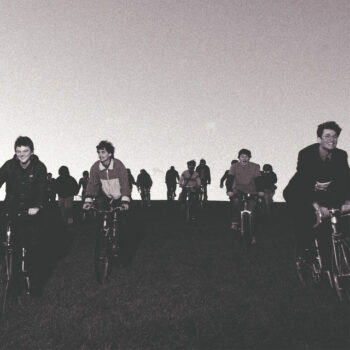
This sense of range and intention shows up across the tracklist, where Friko lean fully into their extremes. Title track “Something Worth Waiting For” feels like a mission statement, moving with restless energy – barreling forward without ever quite arriving, chasing a feeling that always seems just out of reach. The spirited “Choo Choo” barrels in with unrelenting joy and velocity, a live-wire rush that captures the band at their most euphoric and alive, while deeper cuts like “Certainty” push into more ambitious territory, its sweeping arrangements and emotional weight marking new ground for the group. “Dear Bicycle,” the album’s closing chapter, offers a reflective, full-circle moment that doesn’t so much resolve the record as send it drifting forward, asking what comes next rather than answering what came before.

Dad said we were young
Seven ties between us and anyone
We’d ever wish to meet
One’s your mom, two’s your friends
Three’s the one that broke your heart
And then threw you to your knees
Four’s an asshole in disguise
And we don’t ever speak of five
Six is just really mean
But there’s one I’ll tell ya
One who’s gonna help you anytime
You’re ever in need
Seven degrees
Just one morе for you and me
We’re souls in a linе
Waiting to meet
Waiting for that summer breeze
To throw us through each others’ arms
We’re severed souls with seven more degrees
Lead single “Seven Degrees” presents a softer, but no less electrifying side to Friko’s world – what the band themselves called their “most welcoming” song – and that charm is part of its magic: A soul-stirring, wide-open anthem of connection that feels unlike almost anything else in Friko’s catalog. Inspired by Kapetan’s longtime misunderstanding of “six degrees of separation” as “seven degrees,” the song turns that tiny linguistic slip into an achingly human reverie – a meditation on distance, closeness, and the invisible lines that draw us toward one another. “There’s a lightness to that song but really it’s about connection, and trying to stay close to the people you care about,” Kapetan explains. Built around Lennon/McCartney-esque bright melodies, Hunky Dory-era Bowie grandeur, and a classic psych-folk glow that nods toward Procol Harum’s “A Whiter Shade of Pale,” “Seven Degrees” carries a timelessness that feels raw, real, and deeply heartfelt. Its slow-building arrangement lets that feeling bloom rather than burst, turning “We’re souls in a line / Waiting to meet” into a communal ache – a sing-along for severed souls still hoping to be thrown back into each other’s arms.
I have searched, I have crawled
I have drank at every bar
Still I sit and weep
(Well, well, well, well)
One was something, two was more
God, I can’t count it any longer
I’m losing it, you see
Some might say the well is dry
But I just pray I’m living wise
And waiting on my beats
Seven degrees
Just one more for you and me
We’re souls in a line
Waiting to meet
Waiting for that summer breeze
To throw us through each others’ arms
We’re severed souls with seven more degrees
As the band themselves explain, the song came to life organically – it wasn’t overthought into existence so much as uncovered in real time. “I had written a hook… thinking that was the right term for the phrase, seven degrees, not six,” Kapetan recalls, a small misinterpretation that unlocked something much bigger. What began as a simple acoustic demo gradually evolved through instinct and collaboration, each member adding their own textures and touches until the song found its shape. “We didn’t really have a full arrangement… but working with Congleton, it became more of a slow build,” he explains – a choice that ultimately defines the track’s emotional pull. Nothing rushes, nothing forces its way forward; instead, “Seven Degrees” unfolds with patience and care, mirroring the very kind of connection it’s reaching for. It’s that restraint – that willingness to let a song breathe, to let feeling lead form – that makes it feel so timeless, like it’s always existed somewhere just beneath the surface, waiting to be found.
And maybe that’s what makes this record land as hard as it does. Friko aren’t trying to pin anything down – not success, not identity, not even resolution. They’re reaching, stretching, moving forward in real time, chasing whatever it is that keeps them up at night and pulls them back to the stage. That openness – that willingness to live inside the question instead of answering it – is what gives Something Worth Waiting For its pulse. It’s not about arriving; it’s about believing there’s something out there worth the wait, and having the fire to keep going until you find it.
I’m counting out the days, you see
Yes, I’m counting out the days ’til we meet
And I’m so excited (So excited)
But we’re souls divided (Souls divided)
And I’m counting four, five, six, and one, two, three
But those numbers don’t mean much to me, well
(Two, three, four)
Seven degrees
Just one more for you and me
We’re souls in a line
(So excited)
Waiting to meet
Waiting for that summer breeze
To throw us through each others’ arms
We’re severed souls with seven more
Severed souls with seven more
Severed souls with seven more degrees
“Loving One”
by People I've MetThe first thing that hits is the voice – high, trembling, and impossibly exposed, like it might crack under the weight of what it’s trying to carry. People I’ve Met’s “Loving One” doesn’t ease you in so much as place you directly inside its ache, its opening moments suspended between fragility and release. “Heaven don’t seem far from what I’m needing…” Moses Martin sings, his falsetto hovering over soft, shimmering guitar as if searching for something just out of reach. What unfolds is a song about the slow, painful realization that love isn’t always mutual – and the quiet devastation of being the one who feels it more, holds on longer, gives more than they ever get back.
Heaven don’t seem far from what I’m needing
Give me a call, I’m doing worse than what I said
Hearing I belong won’t stop the feeling
Give me a call, I’ll say I’m better than I am
It dawned on me that I’m the only loving one
It breaks my heart
It leaves me numb
It dawned on me that I’m the only loving one
It kills me now
What have I done?

Released March 20 via Interscope Records, “Loving One” is the New York-based trio’s third single, following “Promise” and “For Hire,” and a defining centerpiece of their upcoming debut EP Bunny (out May 1). Comprised of Moses Martin (vocals/guitar), Orlando Wiltshire (drums), and Andrew Suster (bass), People I’ve Met channel a lived-in intimacy that feels at once immediate and expansive – music that’s as rooted in raw emotion as it is in atmosphere. These early releases sketch out a band unafraid to sit inside feeling, to stretch moments out until they ache, and to let that emotional honesty guide the shape of the song itself.
“Loving One” sits at the heart of that approach. “Essentially it comes at the intersection of grieving the end of a relationship, yet is also strongly rooted in an unrequited love,” Martin explains – a duality that runs through every line, every note. The chorus lands like a realization you can’t unhear: “It dawned on me that I’m the only loving one / It breaks my heart / It leaves me numb.” There’s no dramatics, no overstatement – just clarity, and the kind of emotional truth that settles in slowly before it fully sinks.
So you and I were never meant to be then
Look at my heart, it’s not quite broken, but it’s bent
How can I go on bearing this feeling?
Tell me a lie, and say you don’t want this to end
It dawned on me that I’m the only loving one
It breaks my heart
It leaves me numb
It dawned on me that I’m the only loving one
It kills me now
What have I done?
Sonically, the track mirrors that unraveling. It begins in a near-whisper – acoustic guitar, soft textures, and Martin’s voice front and center – before gradually expanding into something fuller, richer, and more overwhelming. “Initially, the track was a lot simpler… but when we all took it into the studio it became more clear what the feeling of the track as a whole was going to be,” Suster shares. That sentiment ultimately blooms in the song’s final stretch, where everything opens up: drums crash, guitars swell, and the emotion that’s been held back finally spills over. “I woke up tired-eyed again / And cried about the state we’re in…” he sings, the delivery shifting from restraint to release in a way that feels both inevitable and earned.
That slow-build catharsis gives “Loving One” its quiet power. There’s a warmth to it – a softness in the melodies, a tenderness in the performance – but beneath it all lie heavier, unresolved emotions. “‘Loving One,’ to me, is essentially about the feeling of being in the depths of longing,” Martin explains. “It’s about the way that loving someone who you are no longer with, or will never be with is all consuming, and has such a profound impact on your condition.” It’s a song that doesn’t try to fix the feeling it captures; it just lets it exist, lets it linger, lets it breathe. Even in its most expansive moments, it never loses that sense of closeness, of being right there inside someone’s thoughts as they try to make sense of something that no longer makes sense.
I woke up tired-eyed again
And cried about the state we’re in
My limerence just fell on you
And now there’s nothing I can do
I was never gonna let you in,
or let you go, go back again
So baby, could you treat me kind?
And say you’ll love me all the time
Please hold me in your arms again
Don’t let this be “remember when”
I do not think we can break through
But what’s left of me, I’ll give to you
So until the day I fix myself
May my lungs be chambers of your wealth
Your existence is my currency
So, please could you run back to me?
And maybe that’s what makes People I’ve Met feel so compelling this early on: Their willingness to leave things open, to prioritize feeling over resolution, to trust that honesty will carry the song further than polish ever could. “I hope that people take away the raw emotion from the track and feel a sense of nostalgia,” Suster says – and “Loving One” does exactly that, wrapping its heartbreak in warm, human, and quietly devastating sound. It’s delicate, it’s aching, it’s deeply felt – and by the time it reaches its final breath, it’s clear this is a band already learning how to turn vulnerability into something lasting.
“Fish Sticks”
by mildredThe beauty of everyday life lingers in its smaller moments – the passing conversations, half-formed thoughts, and quiet rituals that stitch one moment to the next. Mildred’s “Fish Sticks” lives inside that in-between, turning workplace monotony, late-night drives, and shared meals into a sprawling, heartwarming indie rock meditation. Crunchy and loose yet deeply intentional, the Oakland quartet’s lead single off their debut album Fenceline hums with a smile-inducing warmth – equal parts brooding and buoyant, reflective and restless – as it traces the fragile line between obligation and escape, solitude and togetherness. It’s a song about pushing through the static of daily life and finding meaning in the exchanges that pass us by, the comforts we cling to, and the fleeting connections that end up defining us.
Windows down just in time
Pistol finger, wrinkled eye
Heaving notes, making rhymes
All is scattered I’m just pushing
Fish Sticks, the lemon rind
I could eat ‘em any time
The moon rose like a pickup line
Here’s what matters I keep pushing
The world Mildred build on Fenceline feels less like a collection of songs and more like a place you can walk through – a shared, human space shaped by four distinct voices moving as one. The Oakland, CA quartet – Henry Schrott (vocals, guitar), Jack Schrott (vocals, guitar), Matt Palmquist (vocals, bass, woodwinds), and Will Fortna (drums, production) – operate without a singular focal point, their songs passed between hands, reshaped, reimagined, and ultimately claimed by all. That creative democracy is the heartbeat of their sound: Loose but never careless, ramshackle yet remarkably precise, steeped in indie rock but dusted with folk, Americana, and a poetic, almost literary sensibility that lets their music linger long after it fades. It’s the same spirit that made last year’s dual EPs mild and red such a soul-shaking introduction – what we described as a “softly spellbinding alt-country reverie” that lived “in the fog between memory and change” – and it carries through here with even greater confidence and clarity.

Born out of shared spaces and shared lives – kitchens, rooftops, garages, long afternoons that blur into evenings – Mildred’s music reflects the rhythm of real connection, but more importantly, it’s what gives “Fish Sticks” its natural pulse. The song doesn’t feel constructed so much as gathered – a collage of passing thoughts, small frustrations, and fleeting joys stitched together in real time.
You’re too cool, buddy, that’s a fact
Pick up the change I’ll pick up the slack
Mr. Stern forgive what my brain does lack
Two cents was all I asked
Feeling in tune
A feeling so fine
You just pay the piper
back from time to time
“‘Fish Sticks’ is a song of scenes from two worlds. Conversations with your boss. Acute workplace mediocrity. Riding home and eating fish sticks with your friends,” the band explain, framing the track as a series of snapshots rather than a singular narrative. That duality runs deeper across Fenceline, too – an album about conversations with old friends, little cousins, ceaseless piles of dust in your crumbling duplex, loves and theologians and their books.
“Fencelines mark two places but belong to neither. Neither nor, either or,” they share – a sentiment that lingers in the song’s push and pull between detachment and warmth, routine and release. Within that space, “Fish Sticks” becomes more than a moment; it becomes a feeling – one shaped by proximity, by memory, and by the continuous act of living alongside one another.
Stern sits with stony eyes
I won’t get on any fight
Move so slow, and whittle lies
Two years can just blow right by
Pilling pulling at my sides
Tugging at my focussed mind
Drinking coffee, passing time
Cooped up wrapped in chicken wire
A churning, off-kilter indie rock jam, its crunchy, ever-present guitar line cuts through the mix like a restless thought you can’t quite shake. There’s a scrappy propulsion to it – a sense of forward motion that never feels rushed, just constantly in motion, mirroring the song’s fixation on pushing through the blur of everyday life. Lines like “Fish sticks, the lemon rind / I could eat ’em any time” land with a disarming simplicity, grounding the song in the tangible before it drifts back into abstraction – “The moon rose like a pickup line” – where humor, poetry, and mundanity collide. That balance is where Mildred thrive: The push and pull between the literal and the lyrical, the mundane and the quietly surreal. As the song moves, so do its textures – guitars chiming, voices weaving in and out, rhythms tightening and loosening just enough to keep everything feeling alive. It’s unpolished in all the right ways, a little frayed at the edges, but that’s exactly what gives it its spark – a breathing energy that captures the quirks, the charm, and the restless spirit that make Mildred burn so bright.
And maybe that’s the tender triumph of “Fish Sticks” – the way it transforms the overlooked into the unforgettable, not by elevating it beyond recognition, but by sitting with it long enough to understand its worth. Mildred don’t chase grand statements or easy resolutions; they find resonance in the in-between, in the half-lit spaces where life actually unfolds. In doing so, they offer a comfort that feels both grounding and expansive – a reminder that meaning isn’t always found in the big moments, but in the accumulation of small ones. With Fenceline, and with “Fish Sticks” at its heart, Mildred prove that even the most unassuming scenes can carry profound emotional weight – if you’re willing to stay present long enough to feel it.
Writing my findings in a science almanac
Feeds the fodder, then folds the facts
Too much caution, little tact
Please just send it back
Voice coming through the shower glass
Like wind on a bottle, then it cracks
Riding home the sky goes black
Two turns and then I’m back
That could be cool, that could be nice
Well the more I think about it I’m just doing fine
That could be cool, that could be nice
Well the more I think about it I’m just doing fine
— — — —

Connect to us on
Facebook, 𝕏, Instagram
Discover new music on Atwood Magazine
Editor’s Picks
follow EDITOR’S PICKS on Spotify