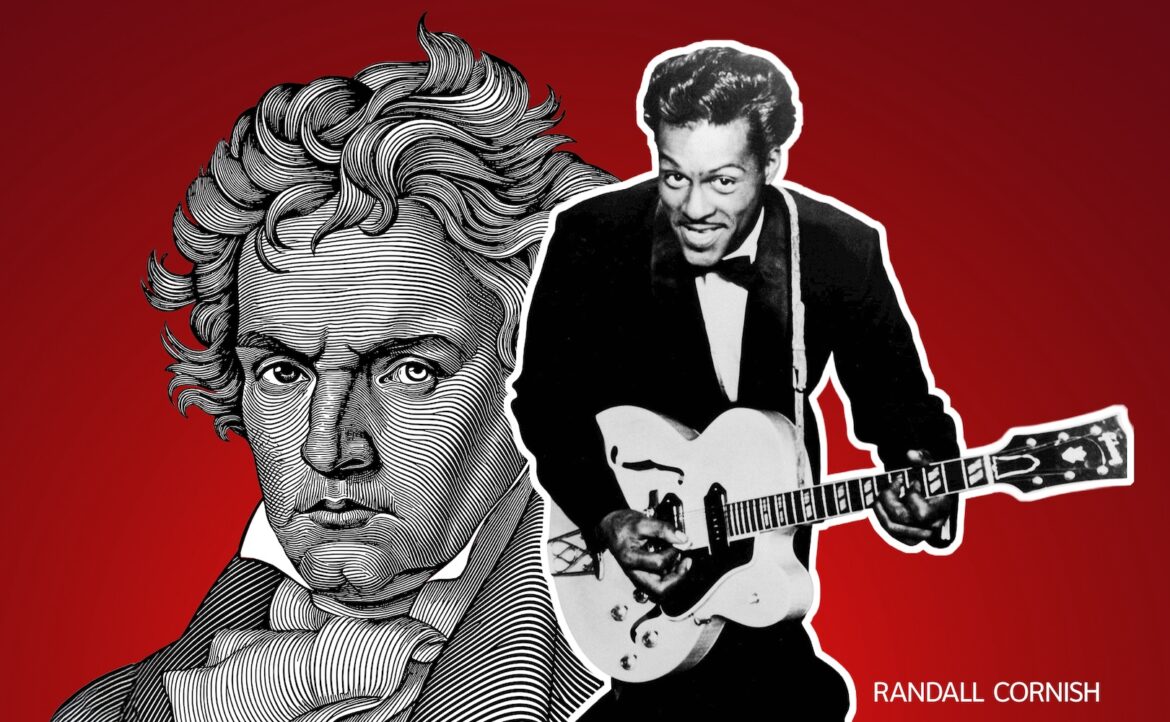
From name-dropping to myth-building in popular music: Why musicians keep talking about each other, and what it says about music culture.
by guest writer Randall Cornish
Stream: “Roll Over Beethoven” – Chuck Berry
If you’re a music fan like me, you probably get excited talking about music.
I’m guessing musicians get excited talking about music too because sometimes they mention other musicians in the lyrics to their songs.
When Chuck Berry name-drops Beethoven and Tchaikovsky in his song “Roll Over Beethoven” (1956), he not only makes a distinction between classical music and rock and roll, but he also makes a connection.
The song may describe a generational shift – teenagers enjoying music their parents don’t like – but the truth is both generations love music in their own way.
Classical music may have been widely popular in the 1800s, way before rock and roll, but the two genres share a similar cultural significance.
Back in the day, classical musicians had a fan base just as rock and rollers do today. Fans of any kind of music make up a unique close-knit community of people who identify with one another, which is of cultural importance.
By mentioning Beethoven and Tchaikovsky, Chuck Berry uses the rhetorical device of allusion to transfer the prestige of classical music to this new rock and roll phenomenon, a clever way to elevate the status of his favorite genre of music.
But musicians have various reasons for mentioning other musicians in their song lyrics. Most often they name-drop musicians who were influential.
Listeners learn something personal about the singer or songwriter (who it was that influenced them) and at the same time listeners hear (possibly for the first time) the names of other musicians (usually in the same genre) whom they should investigate.
One of the most talented country and western musicians around today, Kimmi Bitter, is a good example of an artist who name-drops musicians who were influential. In her song “Old School” (2024) she mentions a bunch of ground-breaking musicians who influenced her:
I’m just a dang fool for that old school. Take me back to that tried and true…. A time when Wanda Jackson sang and every guitar had a twang…. Gimme some of that moan and whine of Loretta Lynn or Patsy Cline.
In the Beach Boys song “Do You Remember?” (1964) they name-drop musicians who introduced them to rock and roll:
Little Richard sang it and Dick Clark brought it to life. Danny and the Juniors hit a groove…. Chuck Berry’s gotta be the greatest thing that came along…. Elvis Presley is the king, he’s the giant of the day, paved the way for the rock and roll stars.
And John Mellencamp lists even more in his song “R.O.C.K. in the USA” (1985):
There was Frankie Lyman, Bobby Fuller, Mitch Ryder…. Jackie Wilson, Shangra-Las, Young Rascals…. Spotlight on Martha Reeves. Let’s don’t forget James Brown. Rockin’ in the USA.
Sometimes a song title itself refers to a beloved musician. “Buddy Holly” (1994) by Weezer is about a guy who looks like Buddy Holly and a girl who looks like Mary Tyler Moore.
“Springsteen” (2011) is a song by country musician Eric Church who reminiscences about his teenage years and recalls songs he liked by Bruce Springsteen.
“Blind Willie McTell” (1991) by Bob Dylan is a tribute to the musician who was well-known in the 1940s and ‘50s for playing twelve-string guitar.
“Brian Wilson” (1992) by the band Barenaked Ladies is, you guessed it, an homage to the legendary Brian Wilson of the Beach Boys.
Sometimes a musician brings up another musician in a song in order to address the nature of the music business. In his song “Are You Sure Hank Done It This Way” (1975), Waylon Jennings refers to country and western musician Hank Williams:
Ten years on the road making one night stands, speeding my young life away.Tell me one more time…. Are you sure Hank done it this way?
In her song “Dolly” (2002), referring to Dolly Parton, Elizabeth Cook discusses the trials and tribulations she has faced as a woman in the music industry:
There’s a guitar man with a golden sound but I wish he wasn’t such a hound…. To see me hurt before my band but I felt the way he shook my hand…. I feel like I’ll blow the deal with one little mistake…. Oh, Dolly, did you go through this?
Other times, a musician brings up another musician in a song in order to respond to something the other musician said in one of their songs. Perhaps the most well-known song that directly responds to the lyrics of another song is “Sweet Home Alabama” (1974) by Lynyrd Skynyrd.
Actually, the record is responding to two other songs, “Southern Man” (1970) and “Alabama” (1972), both by Neil Young. And it’s not exactly a lovefest. In the two songs, Young criticizes lingering racism in the South in spite of the hugely successful civil rights movement in America. In the latter Neil Young sings:
Alabama, you’ve got the rest of the Union to help you along. What’s going wrong?
Skynyrd doesn’t pull any punches when they respond:
I heard old Neil put her down. Well, I hope Neil Young will remember a Southern man don’t need him around, anyhow.
The result is a noteworthy dialogue between musicians that takes advantage of our precious First Amendment right to freedom of expression.
Hip-hop and rap musicians often refer to other musicians in their songs, usually to praise them but sometimes because there’s a rivalry going on. In the 1980s and ‘90s, East Coast and West Coast hip-hop artists didn’t get along very well and musicians such as Tupac Shakur and The Notorious B.I.G. documented the feud in lyrics to their songs.
More recently, in a flurry of songs released by hip-hop artists Kendrick Lamar and Drake, such as the song “Not Like Us” (2024) by Lamar and the song “The Heart Part 6” (2024) by Drake, the two musicians engage in brutal takedowns of one another in their songs.
On a more gentle note, some musicians mention other musicians in their songs to tap into the warm feelings of nostalgia. Once upon a time, before streaming services, people listened to music on AM or FM radio which sounds kind of quaint or old-fashioned today.
In “Thunder Road” (1975) Bruce Springsteen sings about a woman named Mary and makes a reference to a smash hit by Roy Orbison, “Only the Lonely” (1961):
Like a vision she dances across the porch as the radio plays. Roy Orbison’s singing for the lonely. Hey that’s me and I want you only.
It was listening to the radio that inspired many kids in the 1950s and ‘60s to pick up a guitar and learn how to play. Bad Company sings about it in their song “Shooting Star” (1975):
Johnny was a schoolboy when he heard his first Beatles’ song, “Love Me Do” I think it was. And from there it didn’t take him long. Got himself a guitar, used to play it every night. Now he’s in a rock ‘n’ roll outfit and everything’s all right.
Another way people used to listen to music was on a jukebox, a coin-operated machine with a variety of records inside to choose from. Popular from the 1940s to the mid-1960s, you could find jukeboxes in diners, bars and ice cream parlors.
Musician Zoe Muth has a very clever song she sings about a couple on a first date that features a jukebox.
In the song “If I Can’t Trust You with a Quarter, How Can I Trust You with My Heart?” (2011) the protagonist wants to like the guy she’s on a date with but when she lends him a coin the kind of music he chooses to play on the jukebox is a deal-breaker for her:
Then you asked me for a quarter, that’s when it all went wrong…. When I heard that jukebox start I knew the cupid’s dart had missed its mark. If I can’t trust you with a quarter how can I trust you with my heart?… When you said you’d never heard of John Prine, well I knew right away you weren’t worth my time.
In this case, the songwriter name-drops country-folk musician John Prine not only as a tribute but as if he’s the gold standard when it comes to judging music.
Many people feel the same way about The Beatles, one of the most popular musical acts of all time.
Bad Company isn’t the only group to mention The Beatles in a song. So does Mott the Hoople in the song “All the Young Dudes” (1972), The Who in “The Seeker” (1971), The Temptations in “Ball of Confusion” (1970), Peter, Paul and Mary in “I Dig Rock and Roll Music” (1967), Electric Light Orchestra in “Shangri-La” (1976), David Alan Coe in “Willie, Waylon and Me” (1977), and many others.
The Beatles themselves do their fair share of name-dropping. For example, in “Dig It” (1970) they mention B.B. King, in “For You Blue” (1970), Elmore James, and in “Yer Blues” (1968), they refer to Bob Dylan.
But The Beatles do something else few other musicians could pull off. The lyrics in some Beatles songs refer to other Beatles songs which I call myth-building, meaning they are shaping their own story. Not that The Beatles are supernatural beings, but they are a social phenomenon that joyfully defies gravity.
In most of the songs mentioned in this essay, when a name is dropped in a song and it draws your interest, you go listen to music by that other person and maybe even forget where you heard about them in the first place.
The Beatles mention their own songs to keep it in-house. If you hear another Beatles song mentioned in a Beatles song you can leave the current song and listen to the other song without leaving the Beatles catalog. If nothing else, The Beatles are masters at publicity and self-promotion, certainly one reason for their oversized popularity.
Probably the most obvious Beatles song that mentions other Beatles songs is “Glass Onion” (1968), off the White Album. John Lennon wrote lyrics that refer to a bunch of Beatles songs, including “Strawberry Fields Forever” (1967), “I Am the Walrus” (1967), “Lady Madonna” (1968), “The Fool on the Hill” (1967), and “Fixing a Hole” (1967):
I told you about strawberry fields, you know the place where nothing is real…. I told you about the walrus and me, man, you know that we’re as close as can be, man…. Lady Madonna trying to make ends meet, yeah…. I told you about the fool on the hill, I tell you man, he’s living there still…. Fixing a hole in the ocean, trying to make a dovetail joint, yeah.
The lyrics “see how they run” in the song “Lady Madonna” (1968) is a reference to the song “I Am the Walrus” (1967). “See how they fly like Lucy in the sky” in the song “I Am the Walrus” (1967) refers to the song “Lucy in the Sky with Diamonds” (1967).
Perhaps the most meaningful time one Beatles song refers to another Beatles song is in the anthem “All You Need is Love” (1967). As the song fades out at the end they sing “she loves you, yeah, yeah, yeah” which harkens back to one of their earliest hits, “She Loves You” (1963). This is a wonderful way to bridge the time between when they first burst onto the scene and when they achieved near-mythic status.
So we’ve seen that musicians have a variety of reasons for mentioning other musicians or songs in their song lyrics. They name-drop other musicians to elevate their own status, simply as a tribute, or to give credit because the other musicians were influential.
Sometimes they mention other musicians or songs because they want to address the nature of the music business, to respond to something another musician said, to evoke nostalgia, or to declare another musician or band the best of the best.
Or, in the case of The Beatles, they mention other songs to promote their own music. The bottom line is, it’s so much fun to talk about music!
— —
Randall Cornish taught graphic design for 21 years at various colleges and universities. In his retirement he enjoys drawing with soft pastels and writing essays, short stories, and poetry. He lives by the ocean with his two cats in Encinitas, California.
— —
— — — —

Connect to us on
Facebook, 𝕏, Instagram
Discover new music on Atwood Magazine