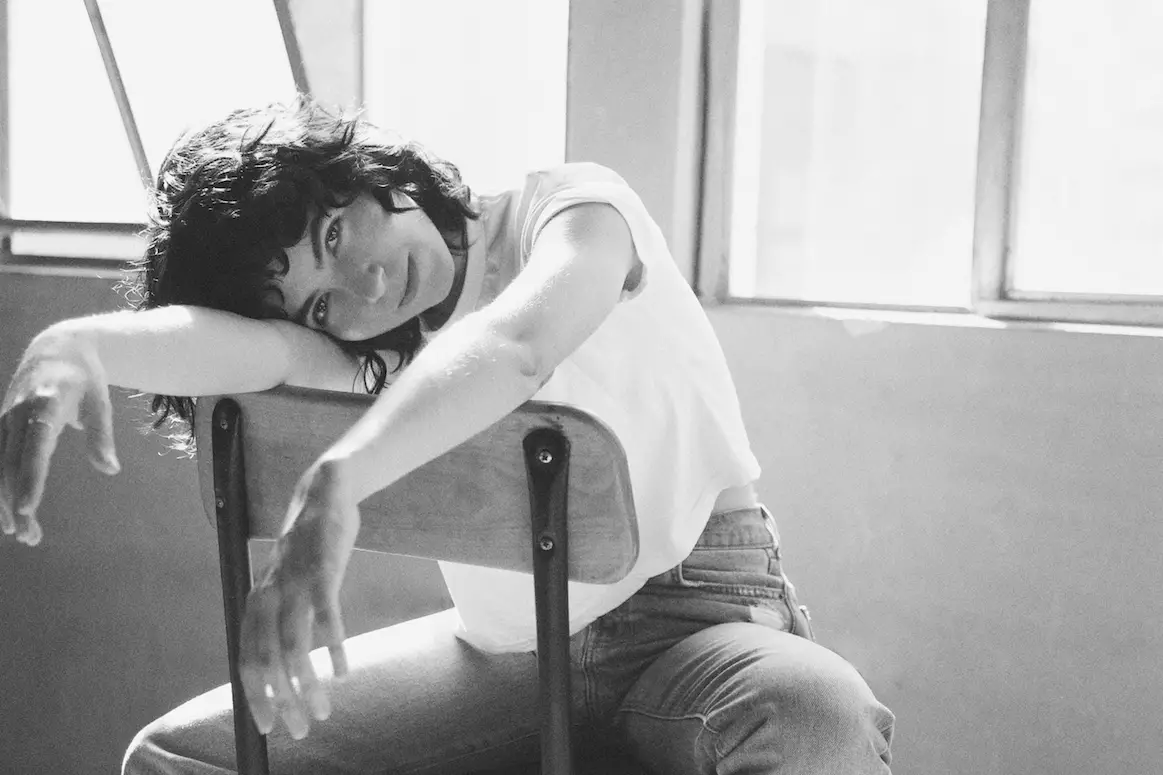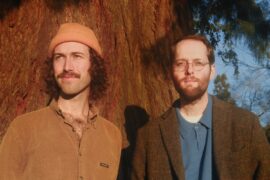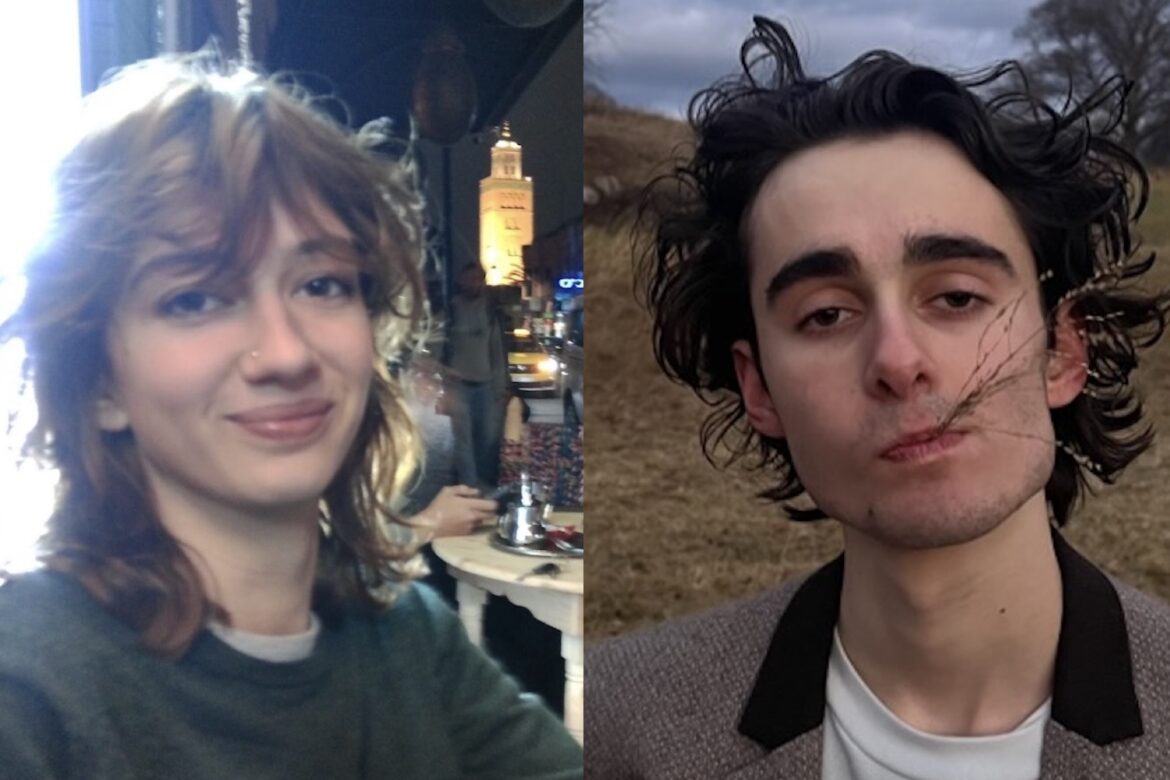
Oberlin folk duo Frontlawn introduce themselves with gentle honesty and acoustic warmth through “Jenny Says” and “Commack,” an enchantingly intimate pair of songs whose close harmonies and lilting melodies reveal the friendship, trust, and shared sense of discovery at the heart of their music.
Stream: ‘Jenny Says / Commack’ – Frontlawn
I often turn to songs when there’s something I’m dealing with that feels like it’s too much to hold. The songs help me hold and honor those things. Sometimes, I feel like the songs hold more than I can alone.
– Tyler Buckser-Schulz, Frontlawn
* * *
They’ve only just begun, and yet Frontlawn’s folk music already captures that intimate instant when someone looks at you and the whole room changes.
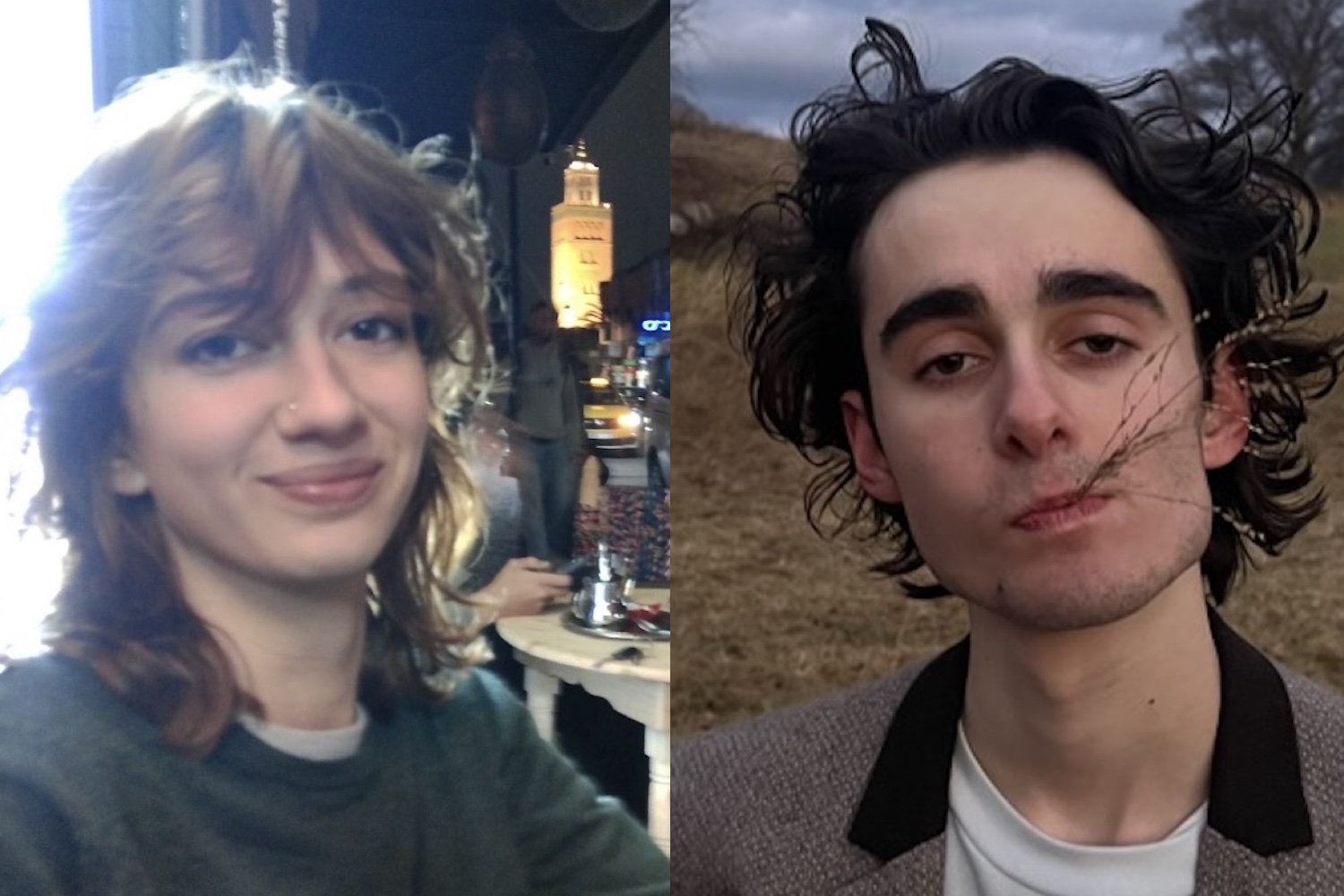
On their debut double single, “Jenny Says” and “Commack,” Tyler Buckser-Schulz and Viv Tullis let close harmonies, lilting acoustic melodies, and the natural hush of a live room carry love, grief, and memory into the light. The result is intimate and enchanting – a beautiful introduction whose stirring sweetness never dulls its emotional edge.
The independent songwriting project began with friendship at Oberlin College, where the New York-raised Buckser-Schulz and Colorado-raised Tullis quickly connected after hearing one another play. That same closeness shaped these recordings, captured during a December 2025 live session in the basement of Oberlin’s conservatory building with bassist Sebastian Dalisay-Hockett, lap steel player Meredith Grotevant, and drummer Mats Hoerenz. Rather than chasing polish, they trusted the room, each other, and whatever might happen once the tape began rolling.
“I think a lot of the heart of the release is in the spirit of that live session: Four to five of us in the room, trying to capture something fleeting and real,” Buckser-Schulz shares. “Frontlawn is a project rooted in friendship first, and I think both songs come out of that kind of intimacy – the fear and joy of being seen by another person, and the way songs can hold a light to things we might not otherwise appreciate.”
sacred in the morningtime
all the words inside your mind
burst into an old refrain
I just wanna hear you say my name
– “Commack,” Frontlawn
That trust breathes through both performances. Acoustic guitars ripple and sway beneath voices that sound close enough to touch, while bass, drums, and lap steel gather around them without disturbing the songs’ fragile center. Every breath and instrumental scrape remains part of the picture. Frontlawn’s music is raw because it is alive – earnest, unguarded, and filled with the natural warmth of friends listening closely to one another.
“Jenny Says” moves with a gentle restlessness, its rolling guitar carrying a narrator caught between forward motion and familiar emotional cycles. Written through voice memos exchanged over summer break, the song began during Buckser-Schulz’s cross-country road trip and retains the road’s hypnotic pull: Pavement, double lines, distance, and the promise that escape might be waiting one town farther west. Yet love keeps charging the smallest domestic details with consequence. A porch light flares “like a wound,” a sock crosses the room “like a harpoon,” and the speaker races seventy miles back toward the person whose gaze leaves nowhere to hide.
jenny says “it’s stages,
better to lose it all than have nothing to lose”
but I knew when you called
I’d fall right back in
70 miles and I cut it quick
chasing the night far
West from the young dawn
and into your arms,
I’m like a god-fearing kid
think I could hide from your judgment
but there’s no evading your
eyes when the veil’s drawn
to look in your eyes
is the ground that I stand on
“‘Jenny Says’ is, to me, a song about patterns of thinking and emotional fallout, but also about the strangeness of intimacy – how the most simple moments and images start to feel charged when you’re inside a certain kind of devotion. A porch light becomes a wound, a sock tossed playfully across the room becomes a harpoon, the road becomes a never ending spiral, a symbol of cyclicality. It’s definitely a love song, but more specifically I think it’s about the feeling of being pulled back into someone despite yourself,” Buckser-Schulz explains.
skipping rocks alone this time
cause you won’t meet me in my mind
I don’t pray, no I don’t pretend
I’ve left to watch what never ends
“Commack,” meanwhile, settles into a deeper stillness. Named after the Long Island town where Buckser-Schulz’s mother spent part of her childhood and his grandmother spent the final months of her life, the song confronts the disorientation of losing someone slowly. Its spare arrangement leaves every image exposed: Cold light, fraying gowns, photographs, a fork raised carefully to an open mouth. When Buckser-Schulz sings, “I just wanna hear you say my name,” recognition itself becomes the precious thing grief is trying to preserve.
cold light trickle open mouth
screaming in a dream
horizon between your eyelids
like an old inseam
fraying gowns can’t warm you now
what is it you need?
couldn’t that love be enough
to set you free?
“‘Commack’ is quieter and heavier for me. I wrote a lot of it during the final months of my grandmother’s life, so it carries a lot of that disorienting grief from watching someone who was such a source of love and vitality leave the world in a slow and painful way. But I also wanted it to capture the flipside of that grief. I wanted to honor the love we shared and the joy of taking care of her the way she had taken care of me,” Buckser-Schulz says.
sacred in the morningtime
all the words inside your mind
burst into an old refrain
I just wanna hear you say my name
One song is pulled helplessly back toward a lover; the other reaches for a beloved voice that is disappearing. Together, “Jenny Says” and “Commack” reveal Frontlawn’s instinct for illuminating the ordinary objects that gather meaning around our closest relationships – porch lights, socks, old photographs, and all the rooms that remember us after we leave. Their acoustic beauty comes from restraint, but their music never feels slight. These songs hold an abundance of life.
shiver through the kettles teeth
lips taste like a memory
love you but I don’t know how
I just wanna hear you say it now
I don’t think either of these songs is trying to deliver any one thing. They’re more like little rooms we made, and I hope people feel welcome to wander around in them and notice whatever corner lights up for them.
* * *
Frontlawn are only beginning to discover the full shape their music can take.
Buckser-Schulz and Tullis are already dreaming about fuller, louder, and more experimental possibilities, but their debut captures the rare magic of arriving before certainty sets in – when songs can still pass between them as unfinished voice memos and emerge glowing with shared trust.
Atwood Magazine recently caught up with Frontlawn to explore the friendship behind their musical language, the people and places held inside these introductory songs, and the freedom they found by letting the moment be enough. Their first release offers the thrill of hearing a new band discover that friendship itself can be an instrument – drawing us close and leaving us looking at our own lives with a little more tenderness.
— —
:: stream/purchase Jenny Says / Commack here ::
:: connect with Frontlawn here ::
— —
A CONVERSATION WITH FRONTLAWN
Atwood Magazine: Tyler and Viv, hello and thank you for your time! For those who are just discovering Frontlawn today through this writeup, what do you want them to know about you and your music?
Tyler Buckser-Schulz: Thanks for having us! This is probably a boring answer, but we’re really just a couple of friends in college right now who love to make music together. I’m from New York and Viv is from Colorado, but we met at Oberlin and were quick friends after hearing each other play.
What’s the story behind the name Frontlawn?
Viv Tullis: I wanted to call the band Frontcountry, but apparently there’s already a band called that. Theirs is two words, but still. I told Tyler about that idea when he came to visit me in Dublin and he suggested Front Lawn as an alternative, which I thought was cool, and I was like, if we can push the words together, then yes.
Tyler: Yeah, pretty much! One of my favorites when we started throwing around names was “Point Dawn”, because I like the idea of a single place or point that is also everywhere at different times; I also just liked how it sounded.
Viv: Yeah, but then I vetoed Point Dawn because I thought it sounded like a summer camp.
Tyler: Haha yes. So when I visited Viv in Dublin last semester and had time to kill while she was in class, I was writing down a free-associated list of similar-sounding/feeling names, and that one immediately stuck out to me. I think it’s fitting but not too over-signified. The image of a front lawn, especially in America where we have this ideal about them and kind of fetishize them, feels symbolically ripe to me.
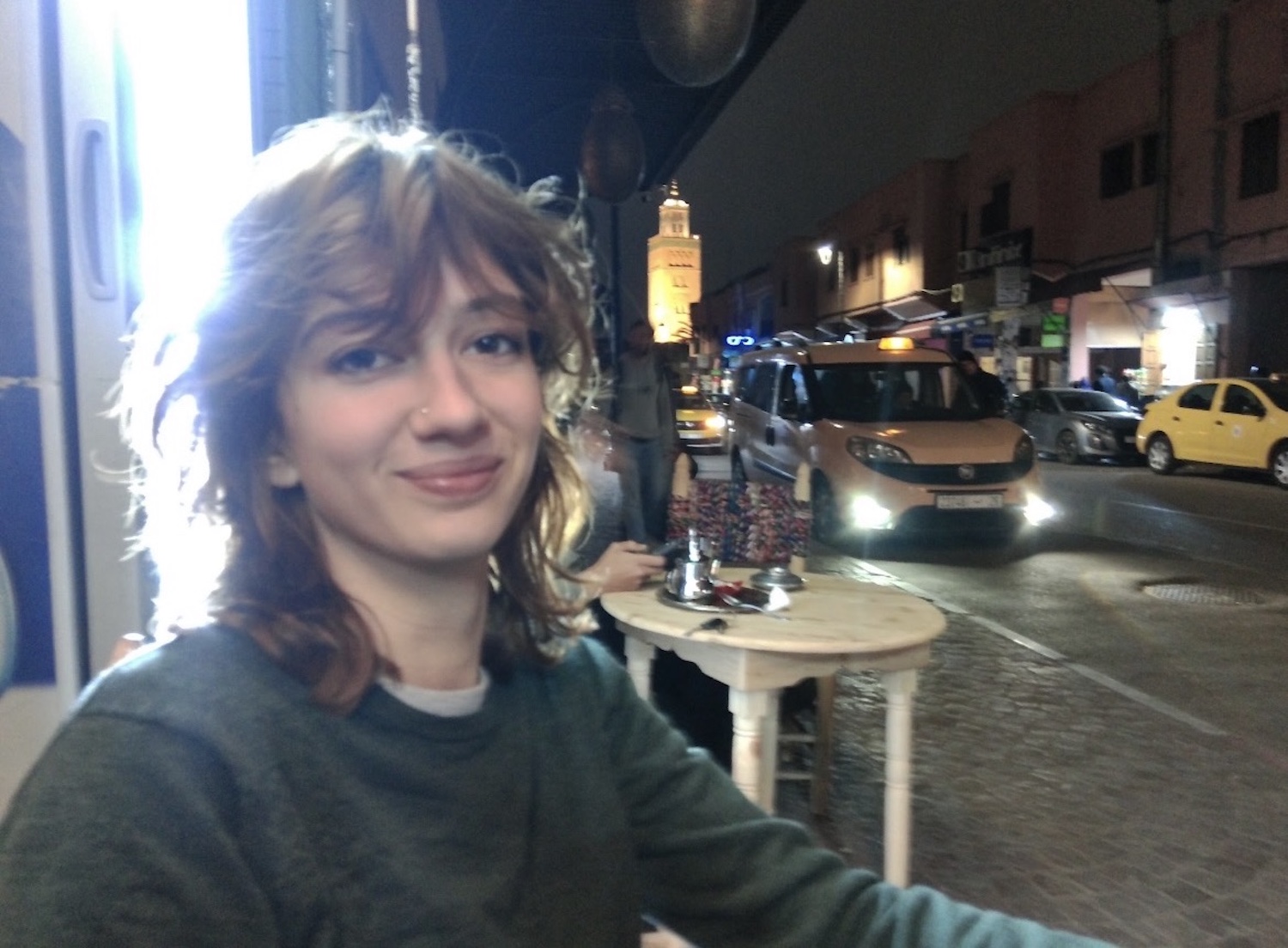
You’ve described Frontlawn as a project rooted in friendship first. How did that friendship become a musical language between you?
Tyler: I think the musical language came out of trust before anything else. I think the most important aspect of this project and the reason we’ve taken to sharing it with the world is the way we encourage and support one another as friends. There’s a feeling of safety in that, where an idea doesn’t have to arrive fully formed or impressive, and the other person will still meet it with care.
Viv: Yeah, I didn’t even want to release any music at first because it kind of freaked me out. I just wanted to record stuff to have it for myself. But Tyler encouraged me I suppose.
What first drew you both toward folk and this kind of close, vulnerable, song-forward music?
Viv: I started playing guitar when I was like eight or nine but didn’t have a ton of musician friends before college, so I think folky music was just easy for me to make because it didn’t require a producer or a band to feel finished. I listen to a lot of different music and could see myself making more experimental stuff in the future but for right now I think Tyler and I have a similar vision of how we want our stuff to sound.
Tyler: I definitely didn’t grow up on folk, but I’ve always loved singing and writing. I started messing around on my older brother’s acoustic guitar when I was around 13. I also have to credit an old childhood friend of mine named Sam Hurwitz. He was two years above me growing up but we were super close, and he was an eerily prolific singer-songwriter at like age 14-15 (he still is!). He was truly inspiring to me, and I think I took after him a little bit. You can listen to his stuff on streaming platforms too!
Who are some of your musical north stars, and how have they shaped the kind of band you hope Frontlawn can become?
Viv: I know we’re both gonna say Big Thief. I saw them live last semester and the show made me think about how we could mess around with making louder stuff in the future. I also love Lucinda Williams. When I was getting serious about guitar in high school, who I really wanted to sound like was John Fahey. And I love all of Mark Kozelek’s various projects. I also really like the band Luna.
Tyler: 100% agreed on Big Thief and Lucinda. Adrianne Lenker’s guitar work is just so magical to me. I’m self-taught on guitar, so playing her songs was a lot of how I learned. I could talk forever about the songs themselves, but if I had to say just one thing right now about her writing that inspires me, it would be her balance of cosmic and personal imagery.
I think much of what makes Lucinda’s writing so beautiful lies in her plainspokenness: I definitely try to learn from that. I also find it so inspiring how she didn’t really see any commercial success at all until her mid-40s, but she just kept going anyway because it was what she wanted/needed to do.
There are so many musical heroes of mine, some more obvious than others. Frank Ocean, Leonard Cohen, SOPHIE, Arthur Russell, Aphex Twin, Talking Heads, Sufjan Stevens, Eiko Ishibashi, Ella Fitzgerald, Phoebe Bridgers, Elliott Smith, to name a few.
“Jenny Says / Commack” is your debut double single. Why did these two songs feel like the right way to introduce Frontlawn to the world?
Viv: We recorded four songs when we did the live session that these two came out of and I just felt like these turned out the best. I think they work well together as a pair, since you’ve got a faster one and a slower one.
Tyler: Agreed. I love the other songs we recorded, too, and hope to release versions of them at some point, but these two felt like the strongest from that session. I also think they complement each other nicely.
Both songs came from the same live session in Oberlin, with 4-5 of you in the room trying to capture something fleeting and real. How did that setting shape the sound and spirit of these recordings?
Viv: Yeah, we were just in the basement of the conservatory building at Oberlin playing for hours and hours. Our friends Sebastian and Meredith who play bass and lapsteel on these songs are both so fucking good. We didn’t really give instructions to each other, we just messed around a little and then recorded. I think both of the songs lent themselves pretty well to live sessions and obviously we liked how they turned out. We didn’t really mess with the songs too much after we recorded them.
Tyler: Yeah. I think the trust we had in each other was palpable while we were recording, and I hope it’s there in the songs, too. I also really felt that live sense of “whatever this is is it,” which I think helped me forget my perfectionism for a while and obliged me to the moment.
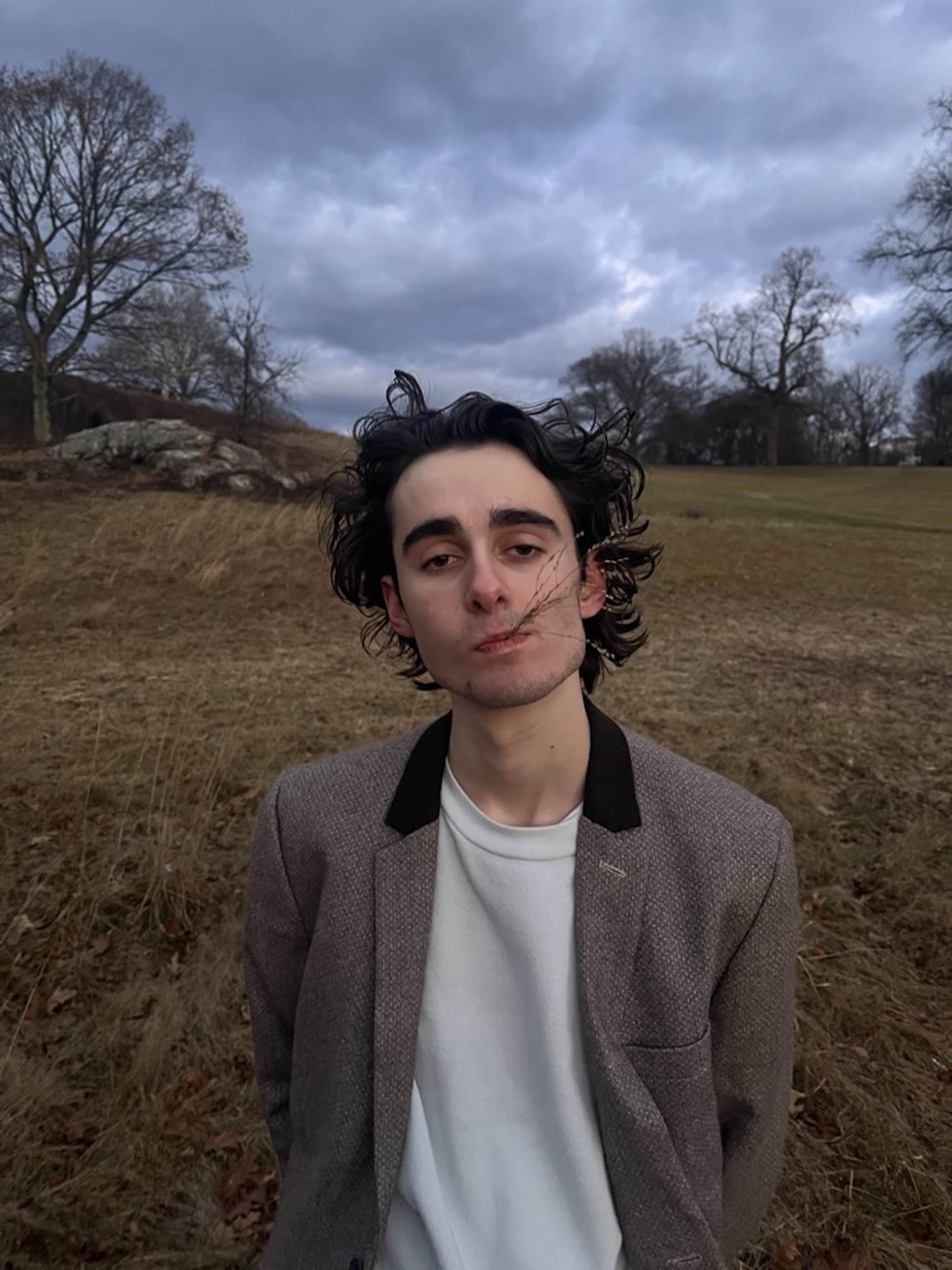
What’s the story behind “Jenny Says”?
Viv: Tyler sent me that verse idea as a voice memo last summer while we were on break. I thought it was sick and tampered with it a little and sent him back a chorus, and then he changed it some more. We just sent voice memos back and forth until it was done, so we basically made that song over text.
Tyler: Yeah that sums it up! I started the song while I was on a cross-country roadtrip, doing a lot of overthinking and driving. It was just the guitar part and those first two lines when I sent it to Viv. ‘Jenny’ is a nod to my Aunt Jenny, who would occasionally drop these small kernels of advice while I was growing up.
The line “when you left the porch light flared like a wound” is such a vivid image. Why did it feel important to write about intimacy through these small, charged domestic moments?
Tyler: I think that’s just a lot of what love feels like for me, is being so moved by another person that the world around you starts to change. You start to map your love and pain onto everything you see.
“Jenny Says” seems to circle around devotion, emotional fallout, and getting pulled back into someone despite yourself. How did you find your way into that feeling?
Tyler: Yeah, well I’ve definitely been there haha. I think those feelings and experiences were there inside of me, and writing the song brought them out in a new way.
Likewise, what’s the story behind “Commack”?
Tyler: Commack is a small town in Suffolk County, Long Island. My grandparents both grew up in Queens, but they bought a little house in Commack around the time they got married, so my mom spent the first 10 years of her life there. It’s also where my grandma spent the last few months of her life last year in a rehab center. I visited her there frequently.
You’ve shared that “Commack” was written during the final months of your grandmother’s life. How did writing this song help you honor both the grief of losing her and the love of caring for her?
Tyler: This question is hard. Those feelings are still so ripe. I often turn to songs when there’s something I’m dealing with that feels like it’s too much to hold. The songs help me hold and honor those things. Sometimes, I feel like the songs hold more than I can alone. I hope that feeling comes across.
What do you hope listeners take away from “Jenny Says / Commack,” and what have you taken away from creating these songs and now putting them out?
Tyler: Whatever someone wants or happens to get out of it is good with me – ecstasy, unquellable rage, salvation, mild confusion, an interest in walking outside, etc. I don’t think either of these songs is trying to deliver any one thing. They’re more like little rooms we made, and I hope people feel welcome to wander around in them and notice whatever corner lights up for them.
The process of recording and producing these songs has taught me a lot about how to be kinder to myself in a creative setting. I feel like I’m often chasing something ineffable in my music, which sometimes makes me seek perfection in a way that starts to kill the thing I loved about it in the first place. Putting them out now feels like letting go of all that.
Viv: I hope people hear them and think, “I should play some music with my friends.”
What can you share about what’s coming next for Frontlawn?
Viv: Hopefully when we get back to campus in August and we’re with the rest of the people we play with we can record some more stuff. We’ve all been sending ideas back and forth a lot since school ended. I feel psyched about maybe recording some of Sebastian and Meredith’s songs too.
Tyler: Yes! We’re always bouncing ideas off each other and we’ll be playing out and recording again come August. Viv has a couple gems we have to record ASAP.
In the spirit of paying it forward, who are you listening to these days that you’d recommend to our readers?
Viv: Galaxie 500 put out this cool collection in 2024 called Uncollected Noise New York which I’ve been listening to a lot since like November or so. Our bassist, Sebastian Dalisay-Hockett, also just released a great EP of his own. I also think mark william lewis is putting out some cool stuff right now.
Tyler: There are two acts that came to Oberlin this past semester I can’t recommend enough: The Wild Shoats (such magical fiddling and singing), and Preacher & Daisy, which happens to be the project of my dear friend’s cousin, Sam Bailey! He’s currently pursuing a PhD in religious poetry at Harvard, which I only mention because it’s funny how many of his songs have recently become religious poetry to me (maybe they always were).
— —
:: stream/purchase Jenny Says / Commack here ::
:: connect with Frontlawn here ::
— —
Stream: ‘Jenny Says / Commack’ – Frontlawn
— — — —
Connect to Frontlawn on Instagram
Discover new music on Atwood Magazine
© courtesy of the band
 © courtesy of the band
:: Stream Frontlawn ::