The Urban Renewal Project has just completed their post-pandemic resurgence with the release of ‘Love Glory Duty Death,’ and they have plenty of intriguing stories to share from the album’s elaborate six-year production process.
Stream: ‘Love Glory Duty Death’ – The Urban Renewal Project
Back in the early 2010s, East Coast native R.W. Enoch, Jr. was fresh out of college and new in Los Angeles with two goals in mind: To make new friends and keep his musical passions as a pianist and saxophonist afloat.
Those dual ambitions brought him in contact with a number of talented individuals across the area – among them, rapper Elmer Demond, singer Alex Nester and a slew of trumpet, trombone, bass and saxophone players, and more.
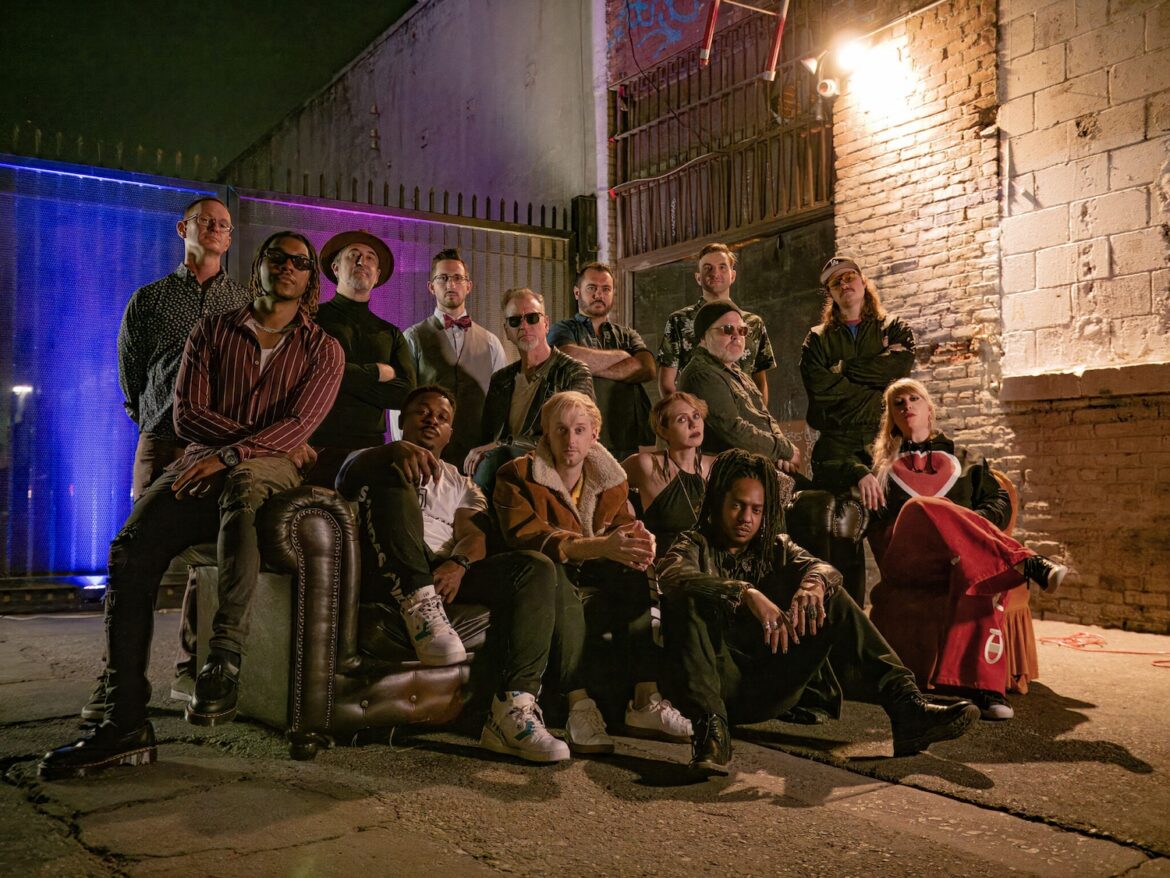
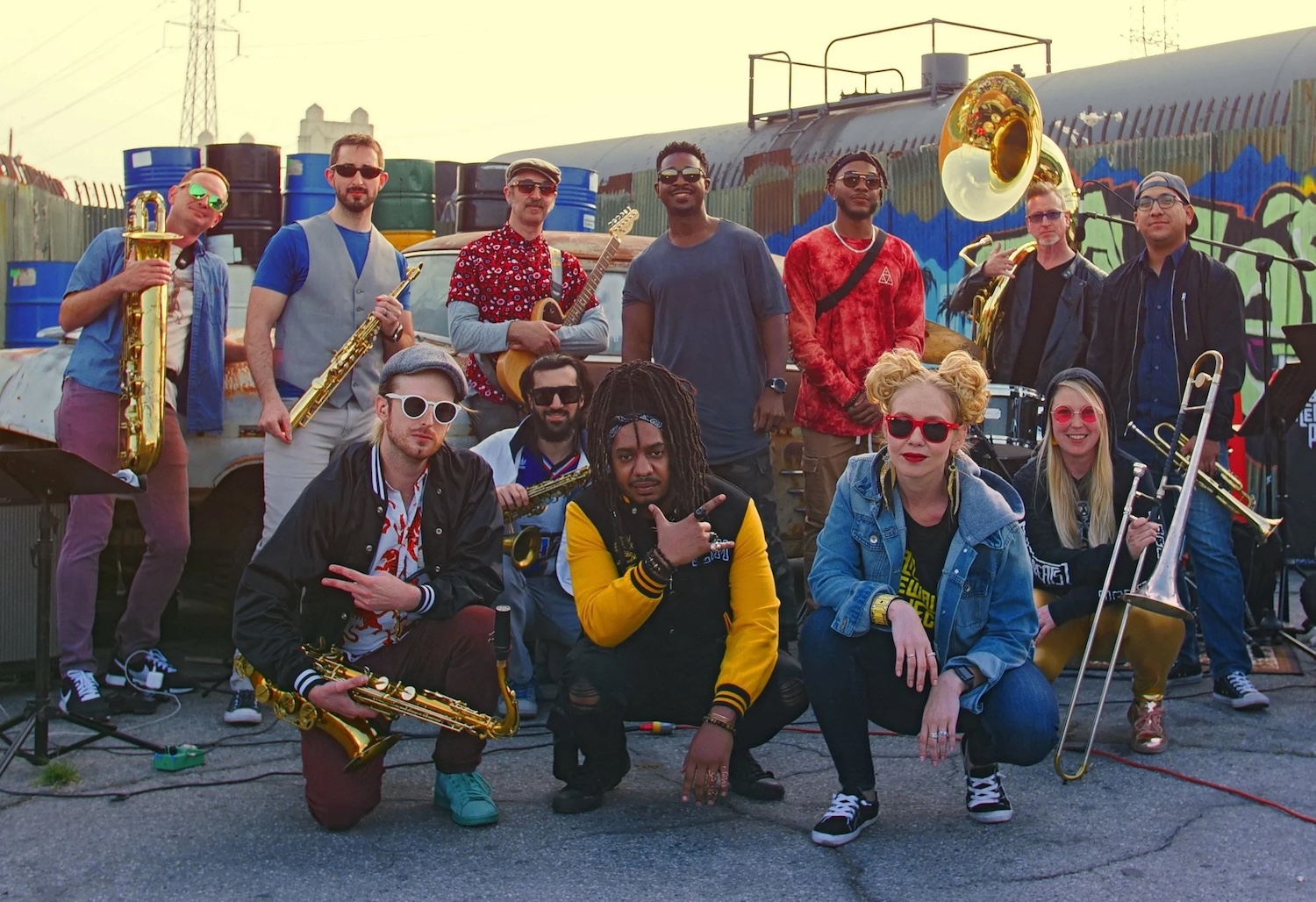
Together, these musicians would form a rambunctious big band called The Urban Renewal Project. They recorded three albums throughout the 2010s – Go Big or Go Home (2012), Local Legend (2014), and 21st Century Ghost (2017) – then took some time to reassert themselves post-pandemic and properly integrate a couple more key members, including dexterous rapper Slim Da Reazon.
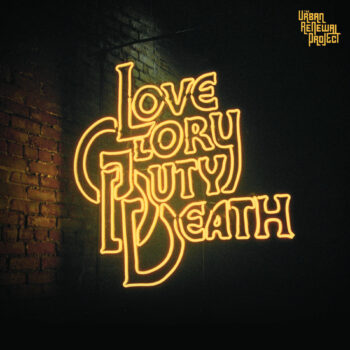
Their fourth album, Love Glory Duty Death, was finally released on October 24th and represents the group in their most ambitious mode yet, both in terms of the record’s politically charged lyricism and its efforts at blending multiple genres – jazz, soul, and hip-hop most of all – into one cohesive artistic statement.
R.W. Enoch, Jr., The Urban Renewal Project’s tenor saxophonist and band leader, and Matthew “Slim Da Reazon” Parm, the group’s chief lyricist and emcee, described their impressions of the group’s current state in the following interview, conducted on Love Glory Duty Death’s release date.
— —
:: stream/purchase Love Glory Duty Death here ::
:: connect with The Urban Renewal Project here ::
— —
A CONVERSATION WITH THE URBAN RENEWAL PROJECT

This interview has been lightly edited for purposes of length and clarity.
Atwood Magazine: Let’s start with the history of the band. If you could highlight some of the moments that helped the Urban Renewal Project become what it is today, what would you point out?
R.W. Enoch, Jr.: We’ve been making music together for 15 years. This is our fourth album, and it’s taken us seven years to make it. Our third album came out in 2017 and we’ve been grinding away at this one since before the pandemic.
Slim Da Reazon: The band’s been together for 15 years, and I joined seven years ago as an additional MC. This is our fourth album and my first one with the band. I think we had a version of what might have been the album before the pandemic, and then that kind of caused us to reevaluate what was important to say – not only to ourselves, but to the industry. And I think the first one or two songs we started to do mid-pandemic, post-pandemic, kind of caused us to reconceptualize the album. What we have now is indicative of an appreciation of the music that was coming out of the pandemic and the state of the world during that process.
Enoch: You meet people and they’re like, “Oh, you play in a band? What songs should I check out to see what the band sounds like?” I never felt like I really had a good answer for that, and so I wanted to make an album where I’d be proud to show off all of the tracks as an introduction to the band. That’s a much higher standard than what we had held ourselves to previously.
There’s a song called “Rush” which we completely rewrote four times, and there’s a song called “Baroque” that we recorded twice in two different keys because we realized that the first key we were trying just wasn’t working. And so, things like that – which are kind of expensive or at least time-consuming, things that artists don’t often do – we really just took our time with them, and I think that is the statement that we’ve just released today.
Today’s the big release day – congrats on that! The album is being promoted as a crossroads for different genres, especially hip-hop, jazz and soul. Those genres have had lots of overlap for decades, going back all the way to groups like De La Soul and A Tribe Called Quest. What do you think has attracted these genres to one another so much, and how do you think your album makes a statement about how the interconnection between these genres is still alive and well and going strong in 2025?
Enoch: Yeah, we love those artists you mentioned. We’ve covered A Tribe Called Quest in our show. The thing that sets us apart is that while ATCQ was sampling records, we’re bringing a whole composition of musicians into the studio to make something new that might be reminiscent of what sampled hip-hop has sounded like, but with a live band. We do that as a gesture of reverence and respect for the history of hip-hop, but also for the history of the forms of music that hip-hop has been sampling from, which are mainly soul and jazz. A bunch of these golden age rappers grew up in the ’70s and ’80s listening to their parents’ soul records and such, and then they were like, “Oh, what if I chopped this up with my producer and played a verse over it?” That’s how so many classic hip-hop records have been made, and we go into the studio with the approach of: “We want to capture that same vibe but with a live band.”
Slim: I would agree whole-heartedly. Like R.W. said, [our music is] a reverence of what came before, and it’s a lineage. It all started with jazz, and then jazz sparked soul, and then I feel like hip-hop is kind of an amalgamation and a reinvention of those forms, chopped up and reimagined and mixed with poetry. It’s just paying homage to what came before and the through-line between jazz, soul, and hip-hop. But like R.W. said, as opposed to having it chopped up and spliced and sampled, we’re doing it all live ourselves. It’s all intrinsic and comes from within. That’s what separates us differently – as opposed to having to search outside for the samples, we just generate the music from within us organically, and the poetry reflects that as well.
What struck me when I first listened to the album this morning is how political it is. You’ve got references to Huey Newton and the Black Panthers, the January 6th Capitol takeover, all kinds of stuff. What are some ways in which you’ve made the most of the platform you have as musicians to make the political statements that you do in your new album?
Slim: I think it’s the responsibility of the artist to reflect the times. Hip-hop in its purest has always been a reflection of reality – a reflection of the have-nots’ lived experience. I think it’s categorized as political, but what I think it is is just reality. It’s not like I made a conscious decision to write from a certain perspective. I think when I look at the world and I look at my community, this is what I see. I see people hurting, I see politicians not connecting with people. I see my African-American community being treated a certain way. I see people without money being treated a certain way. And so, as an artist who absorbs this, I think this is what comes out. The input is what it is, and the output just reflects that.
And so, when you have music that allows you a canvas to paint a picture without warping it, it only elevates the prose and the perspective of hip-hop, I think you have a certain synergy that’s unique. R.W. and I often talk about ideas and concepts. I just hear certain music and certain tracks provide a bedrock for what needs to be said, and it just comes out the way it is. It’s the state of reality right now in America, so I think that’s what the album reflects.
As you mention, this album is seven years in the making, and you’ve had an amazing amount of collaboration with all of these singers, rappers and instrumentalists. How do you think, with all of these people participating, you were able to determine what everyone’s collective vision for the project was and get that out in musical form the way you wanted to?
Enoch: It’s been tough. That is the story of the seven years, right? Like I mentioned, we rewrote “Rush” four times. By rewriting it, the instrumental didn’t change that much, but [Alex] Nester and Elmer [Demond] wrote four discrete verses and we collaborated on four different hooks for that song. It was fine, it was good, it was releasable, but it just never really felt like the project was what we really wanted to make at this time.
The short of your question is sort of like: I’m like the editor-in-chief of this project and we have a bunch of contributing writers. Even the instrumentalists contribute in their own way by coming up with a melody that has been written a certain way. It’s sort of like having a bunch of contributing writers to a newspaper, but ultimately I have to make decisions like, “This is good enough! This is not good enough! This is going on the record! Or, “We’ve spent enough time on this one, it’s just done. Print it!”
Slim: R.W.’s a great band leader. The Urban Renewal was created by him, fresh out of college, 15 years ago, and I think he chose to have certain elements in his color palette – hip-hop, jazz and soul. I think the beauty of it is that we’re all just instruments in his repertoire. We’re all just weapons in his arsenal, and our job is that each color, each weapon – so to speak – shows up to do the best that we can. It’s wild; you have to kind of relinquish control.
We’re all our own individual artists, but in this group ensemble, what we’re all agreeing to is to show up and give ourselves to this process. The Urban Renewal Project is greater than the sum of its parts because we all throw our two cents in – we write our verses, write our instrumentation – and then let R.W. kind of mastermind it because he writes every note for every instrument. We give him all of this organic material and then he crafts it how he sees fit.
How has being based in Los Angeles and Southern California colored the band’s identity and music? How have you been able to pull from the Los Angeles creative scene and come out with the band that you have?
Slim: I think – at least for me, coming from the hip-hop perspective of the band – I write what I see. I come from South Central Los Angeles, the Crenshaw district, so I see the part of Los Angeles that people have historically written hip-hop songs about in a negative light. I think that’s what I bring to it: my lived experience of being in my neighborhood. The thing about Los Angeles is there’s just so many different pockets and areas. And so, yes, I live in Crenshaw, but we might meet in Hollywood for a recording session or in Melrose to do albums and party.
You see this rich dichotomy of existence in Los Angeles. We have diversity. We have different people from different walks of life. We have different people in the band – different collaborators. It opens your mind up to more than just your immediate environment. And so, I think the music reflects that. It reflects an openness. It reflects diversity. It reflects a multifaceted patchwork of experiences that we’re kind of weaving together into one cohesive sound.
Enoch: Yeah, I think certainly, Los Angeles is one of the world’s great cities and there’s so much going on here culturally. It is a literal melting pot in the same way that I think the band tries to be with the different styles of music we try incorporating. We haven’t really even touched on some of the more technical things, like the way Afro-Cuban, Afro-Latin rhythm and instrumental music have influenced jazz and soul music and, in the same way, hip-hop. And of course, we look at the huge Spanish-speaking community here in Los Angeles that Reazon and I interact with every day just by virtue of living here. And so I think that’s just the beauty of the band and being based in a big city. Also, very few of us come from Southern California. Neither Reazon nor I grew up here [R.W. is originally from Virginia, while Reazon comes from Cincinnati], and so, we’re a human melting pot as well, with different experiences – which, I think, is just emblematic of the city.
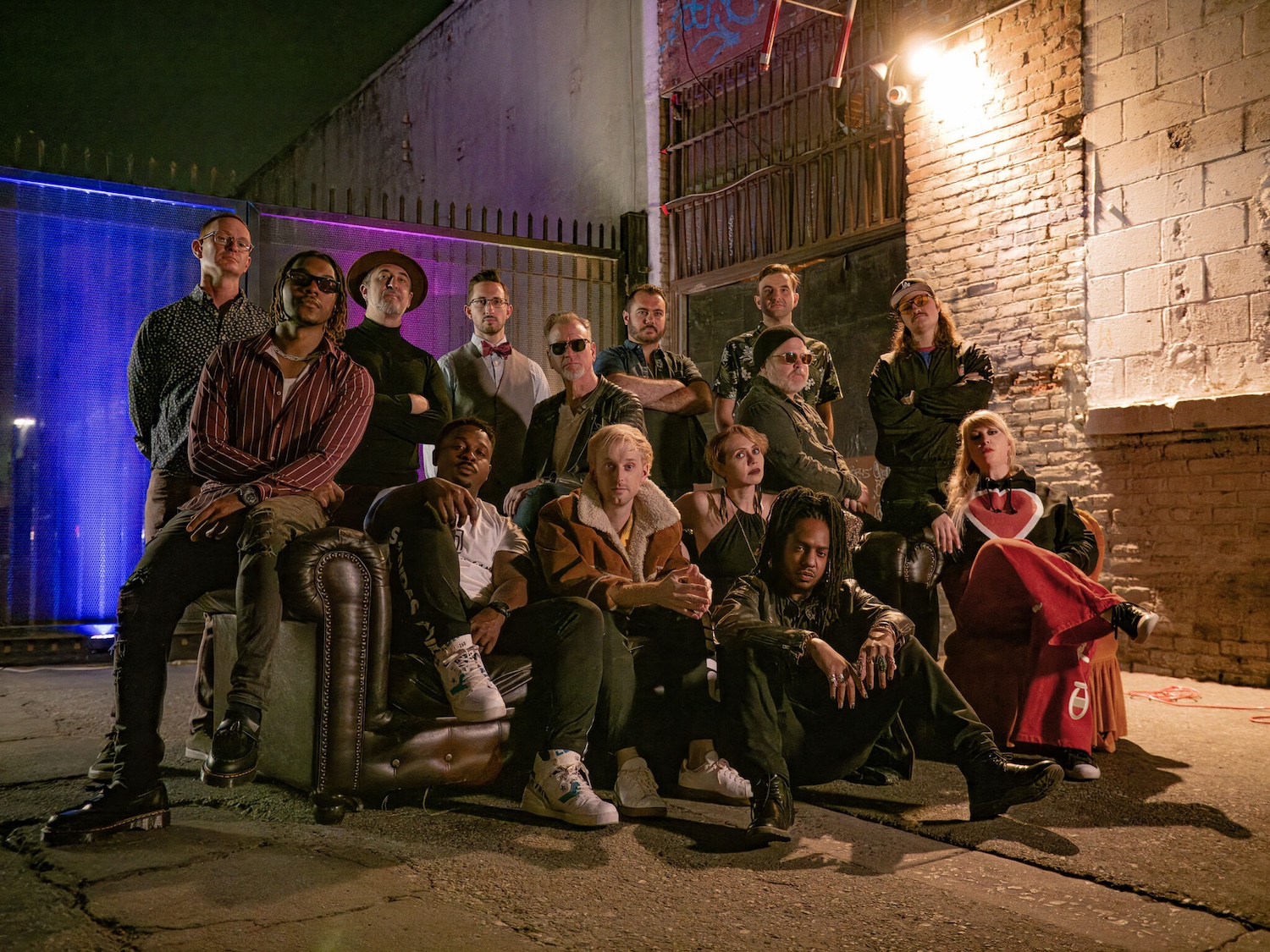
To a certain extent, a lot of this album – as well as the title indirectly and our camaraderie as an ensemble of 16 people – kind of boils down to having a sense of community. Los Angeles is not the same as it was in 2019 when we started making this album – it’s changed, and not necessarily for the better, unfortunately. And I think that’s sort of true across the country and probably across the world. I think we’re at a unique point in human history for stuff like this, and I think we could all use a little more community in our lives.
We had this album release show last night, and there were a lot of people there. It was arguably our best show ever, I think, just having 18 musicians onstage playing to a crowd of maybe 100 people. Live music creates community, but I think that’s missing more and more in people’s lives. We had booked this release show back in August at a venue which, in the intervening period, went out of business. So, we had to scramble to keep the date and time the same, find a new venue that did not already have something else on their schedule, and so we ended up where we ended up. It’s just so poetic that the venue we were supposed to play at went out of business and now there’s one less music venue in Los Angeles.
What are your hopes for the immediate future now that the music has seen the light of day? How do you hope people will connect with the album? What do you hope they’ll learn about the band that’s resurfaced after some years?
Enoch: I’m just interested to see how people will react to it. We released a few singles, but the vast majority of the album has been unheard by anyone outside of the band. I’m just so proud of this one and I’m really interested to hear what people’s favorite tracks are. People often notice things in your music that you didn’t notice – “I noticed this in track 2!” or “You did this in track 10!” So, that’s kind of where my head’s at now. We’re going to continue to try and promote it, book some shows, and hopefully go on tour with it next year.
Slim: I would say that the album reaches people that need it. I think there’s a message, and not just poetically with the lyrics and hip-hop. I think there’s a message in the music, too. In a time where people think that you can just create everything with AI and be a musician – or that you can just sequence things on the computer and that makes you a musician – I think it’s a resurgence and a renaissance of true music, true hip-hop, true creation and collaboration. I hope that this changes the complexion of music and the outcome of our musical experience in the zeitgeist, because lyrics matter. I think musicality matters, instrumentation matters, organic collaboration and creativity matters.
I think the quality of music has kind of dwindled in recent years, and I hope that this shows people that there’s a higher elevated platform. When you’re used to eating fast food and burgers, you think there’s all there is, but there’s Michelin star music and restaurants out there, too. I want us to be the Michelin star music out here for people who are used to getting fast food, drive-thru music. And I hope the appreciation that’s cultivated from that allows us to do this at a higher platform, bigger stages, more dates, more money, more ability to interact with more people.
I want us to be the Michelin star music out here for people who are used to getting fast food, drive-thru music.
* * *
What’s the general vision for your upcoming live shows? And what are some ways in which your music gets to take new life when you do it onstage?
Enoch: Well, I think when we’re on the road, most cities are smaller than Los Angeles, so we often find ourselves in communities that don’t have anything like this within driving distance, and they’re the most appreciative audiences ever. I think we also bring hip-hop to a lot of venues that don’t normally have any rap happening whatsoever. And so, you get people in the audience who’ve never heard anything like this before. But generally, at least the ones we’ve talked to really like and appreciate it. They say, “I’ve never listened to rap before, I don’t usually listen to hip-hop, but you guys were just amazing.” It’s just so great to sort of change people’s lives in a way.
Slim: I would whole-heartedly agree with that statement. Because it’s a 16-piece ensemble, with a lot of horns and brass, the hip-hop is kind of Trojan Hose’d in, where all of a sudden you have me onstage rapping about politics. The flip side of it is that sometimes we find ourselves in hip-hop dominated areas, but we’re coming from a band, and so we’re standing apart from the other rappers who might be there.
We’re coming in and doing real music, and I think our frontwoman – our lead singer, Alex Nester – is truly a singular talent. Her vocal ability and prowess are truly world-class. When you see her onstage belting out these soulful melodies and harmonies – sounding like Aretha Franklin but packaged into this skinny white girl – and then you have me next to her rapping and playing off of her, I think just the image of that and the impact of the sound is very healing and endearing, especially in smaller markets where you don’t normally get that. It’s just all of us meeting together in Los Angeles to create something that’s magic. So, when you take that music and pop it in different pockets around the country, it’s very well-received and it’s always kind of cool to see people’s minds literally get blown from it.
Anything you’d like to add about the band, the album, and what have you?
Enoch: I just want people to check it out and enjoy it.
Slim: I just want people to know that this is a labor of love, but it was also a labor and a lot went into it, you know what I’m saying? I think the album’s called Love Glory Duty Death because we love this so much that we set out to do it and we got some glory from it, and it became our duty to actively do this – to show up no matter what and fulfill our duty. I want to do this til death, til we can’t do it anymore. So that’s what it is: it’s love, glory, and duty until death, you feel me?
— —
:: stream/purchase Love Glory Duty Death here ::
:: connect with The Urban Renewal Project here ::
— —
— — — —
Connect to The Urban Renewal Project on
Facebook, 𝕏, TikTok, Instagram
Discover new music on Atwood Magazine
© courtesy of the artist
 © courtesy of the artist
Love Glory Duty Death
an album by The Urban Renewal Project