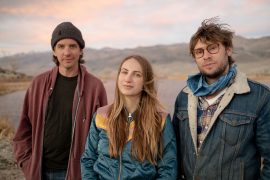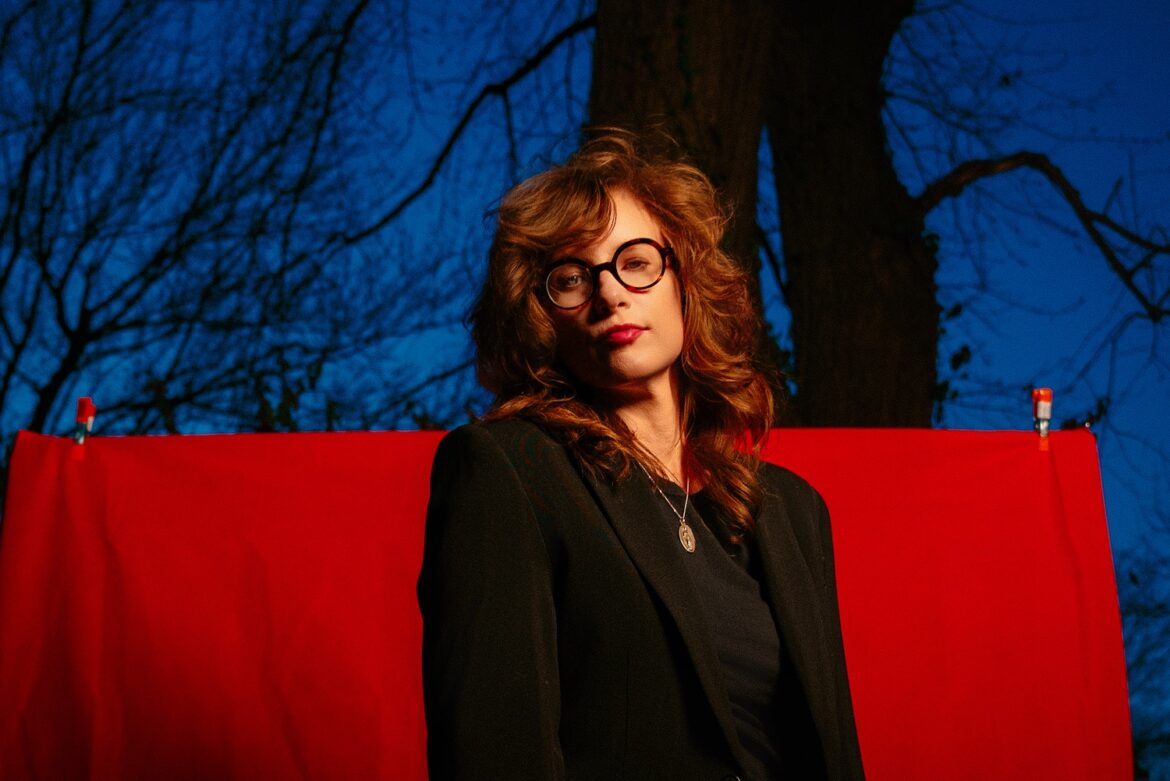
Kentucky singer/songwriter S.G. Goodman opens up about grief, legacy, and the ancient practice that inspired her breathtaking third album ‘Planting by the Signs’ – a record of inheritance, survival, and the search for meaning. Speaking with Atwood Magazine, she reflects on loss and responsibility while taking us track-by-track through her most vulnerable and visionary work to date.
Stream: “Fire Sign” – S.G. Goodman
With each year and each funeral, I am understanding the weight of my responsibility in passing down stories and beliefs.
* * *
Kentucky’s own S.G. Goodman doesn’t write albums so much as she builds them from the marrow of lived experience – fragile and unflinching, jagged and sublime.
Planting by the Signs is her most cinematic, intimate, and devastatingly beautiful record yet: A breathtaking journey through grief and survival, inheritance and responsibility, and the eternal tug-of-war between control and surrender. Her third record aches inside and out; Goodman’s lyrics are bold and unforgettable, her voice a vessel of raw humanity, wrapped in a warm, expansive soundscape that glows like firelight in an all-encompassing darkness.
Driven by an unshakable passion and forged in the fires of loss and grief, Planting by the Signs is Goodman’s most vulnerable and visionary album yet – a resonant record of inheritance and survival, told with piercing honesty and soul-stirring cinematic grace. It’s an album that burns slow and steady until it consumes everything in its path – including our ears and our hearts along the way.
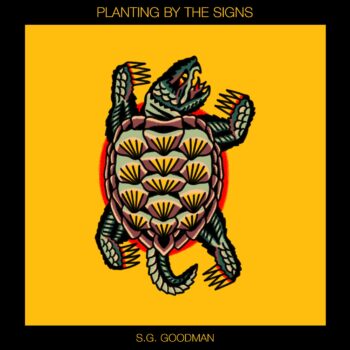
Released June 20, 2025 via Slough Water Records / Thirty Tigers, Planting by the Signs arrives as the highly anticipated follow-up to 2022’s Teeth Marks and 2020’s Old Time Feeling. Those albums made Goodman one of America’s most essential singer/songwriters, earning her critical acclaim, an NPR Tiny Desk performance, and the Americana Awards’ “Best Emerging Artist” prize. She’s toured relentlessly with the likes of Jason Isbell, My Morning Jacket, and Margo Price, while her instant-classic ballad “Space and Time” has been covered by both Tyler Childers and Dev Hynes.
But the road took its toll. Between the loss of her beloved dog Howard and the tragic death of her friend and mentor Mike Harmon, Goodman was forced to reckon with mortality and memory, absence and belonging.
“After writing and releasing my previous albums, I felt an urgency to focus my attention on a subject that when I’m gone, my nieces and nephew would be able to hear our history,” she tells Atwood Magazine. “With each year and each funeral, I am understanding the weight of my responsibility in passing down stories and beliefs.”

That urgency became Planting by the Signs, a record steeped in the ancient practice of ‘planting by the signs’ – the Appalachian folk belief that the cycles of the moon should guide life’s rhythms, from gardening and haircuts to weaning children.
“Planting by the signs is an ancient practice, where it’s believed that because the moon affects water, that during certain phases of the moon, there are more suited conditions to do things than others,” Goodman explains. “Because all living things consist of water, it’s believed that all living things are affected by the moon. I was weaned from my Mother by the signs. I grew up hearing things about cutting your hair in accordance with the moon and planting gardens under certain phases of the moon.”
For Goodman, this was both personal and universal. “‘Planting By The Signs’ isn’t something that is unique to my family alone, or to any group of people,” she adds.
“I can trace some of the practices back to my pagan Celtic ancestors, as well as talk about how it was adopted to fit the beliefs of my conservative Christian ancestors. That is my particular story, but all ancient civilizations first looked to nature to guide them. It is our collective heritage and belongs to each of us.”

As with every Goodman record, the making of Planting by the Signs was as transformative as the songs themselves. “People who record often talk about ‘studio magic,’” she says. “One of the tracks I really felt this experience was while tracking ‘Planting by the Signs,’ my title track. My initial sonic approach to that song was not a stripped-down folk song, but after tracking it with the full band, I knew instinctively that we needed to go another direction. I had blown my voice out the night before, so I wanted to experiment with the arrangement without being the one singing the lyrics. I asked Matt Rowan to lead the song, and shortly after singing lightly alongside him to teach the vocal melody, the studio magic was known. We were supposed to sing ‘Planting by the Signs’ together. Matt has been one of my longest music collaborators to-date, and he had agreed to join me again as co-producer for this album.”
That balance of collaboration and intuition threads through the record. Where her debut and sophomore records leaned heavily on rootsy folk-rock grit, Goodman saw this one as a chance to broaden the palette. “Sonically, I came into the recording process with the goal of expanding my approach with more modern elements than I used in previous recordings. I love an organic approach to recording, and chose a team of players and producers who I knew would be able to actualize our vision.”

The opening track, “Satellite,” feels like a transmission from the in-between: A smoldering fever dream where Goodman’s trembling voice hovers over sparse guitars and a steady beat, whispering warnings into the static. “Look what it’s done to you,” she repeats, the line landing like both a lullaby and a lament. The song aches with disconnection and distortion, circling anxieties about the signals we trust, the false lights we follow, and the widening gap between humanity and the natural world.
If “Satellite” looks to the heavens, “Fire Sign” turns inward, naming the flame at Goodman’s core. Here, she wrestles with exhaustion and endurance, questioning how much of the fire one can bear to carry while still insisting on the importance of keeping stories alive. Together, these early songs frame the album as both cosmic and deeply personal – tethered to the stars while rooted in Goodman’s Kentucky soil.
Well, I’m just trying to build a good life
Nailing down shingles in the right sign
No curling in the daylight
Ah, like the old folks said they could
Some tried to make me out a liar
But I’m a dreamer with no answers
Oh, who’s been living like the sun don’t shine
On the same dog’s ass every day
Oh, and who’ll put the fire out
Who’ll put the fire out

That duality is laid bare in “Snapping Turtle” and “Michael Told Me,” two of the album’s most piercing meditations. In the former, Goodman transforms a childhood memory into something mythic: A harrowing scene of kids tormenting a turtle in a small Kentucky town, and her own visceral act of stepping in. The brutality of the moment becomes allegory, a meditation on cruelty, justice, and the impossibility of controlling how life unfolds. Over sparse, pulsing instrumentation, she sings with a voice that feels both fragile and unflinching, carrying grief and defiance in equal measure. “The opening scene of ‘Snapping Turtle’ still gets me,” Goodman admits. “Not all my songs are deeply personal, but ‘Snapping Turtle’ is definitely one of them that really came from my life, so those lyrics mean a lot.”
When you’re a farm kid in a small town
You drive before the legal age
And I won’t forget that day
When I drove up on some low-down kids
They were all huddled around a poor snapping turtle
Taking turns with a stick
They were beating the hell out of it
So I asked if I could take a lick
When I raised my hand,
I brought down the wrath of God himself
Beat those kids till they were crying out for help
I couldn’t help myself
Then threw the turtle in the truck
Ooh, small town is where my mind gets stuck
– “Snapping Turtle,” S.G. Goodman
In “Michael Told Me,” agricultural wisdom becomes metaphor, with pruning reframed as the delicate, dangerous work of tending to human relationships – cutting back in hopes of regrowth, or risking total severance. Both songs ache with grief and the hope of reconciliation, proof of Goodman’s ability to hold devastation and tenderness in the same hand. The title track then gathers all of these strands – the celestial and the earthly, the inherited and the intimate – and distills them into a hushed hymn. “Planting by the Signs” bends ancient lunar wisdom into a love song, a reminder that timing and tenderness matter as much in the heart as they do in the garden.
The record’s journey culminates in “Heaven Song,” a nine-minute odyssey that feels like both parable and pilgrimage. In its winding verses, Goodman sets off on a road trip toward the afterlife, filling the car with characters like Love, Faith, Hope, Sin, and even Jesus himself – each passenger a symbol, each stop a reckoning. It’s sprawling, surreal, and darkly humorous, yet beneath the allegory lies a raw meditation on grief and desire, on what it means to leave behind the known in search of something beyond.
As the final notes fade, we’re left with a haunting refrain – “maybe if I see it, then I’ll want it” – a line that lingers like both question and confession. “Heaven Song” doesn’t offer resolution, but it does something rarer: it leaves us suspended in wonder, reminded that the act of searching is itself sacred.
I bought an old Malibu from the guy next door
Then I did, what many have done before
I filled the tank up full, and took out for heaven
When I first cut out, all I had was my dog
But I was told he wouldn’t be here for long
Gave him a french fry and I asked him,
does he know where we’re going?
He just looked out the window,
and so far, no heaven was showing
Then a stranger hopped in at the first red light
She said, my name is Love and does that dog bite?
I told her no but would she mind riding shotgun?
Said I never cared much for Love behind me or on the run
the first hundred miles, the talking was light
She said, you can’t get to heaven driving through the night
And by the way I never asked your reason for going
If I’m heading there with you, i guess I better be knowing
And I said
that maybe if I see it, then I’ll want it
Maybe if I see it then I’ll want it

Taken together, Planting by the Signs is not just a collection of cathartic songs, but a breathtaking body of work – intimate and immense, delicate and unflinching – that stands as the fullest realization of S.G. Goodman’s artistry to date.
It succeeds as both personal testimony and lasting legacy, transforming her private history into something communal and resonant. Every track feels bound by purpose, each lyric sharpened by the weight of responsibility, yet the music itself breathes with warmth, humanity, and grace. In threading her own story through ancient wisdom and timeless truths, Goodman has created a deeply personal album that also feels universal: A soul-stirring reckoning with grief, inheritance, and survival, and a record destined to leave its mark on all who listen.
For her part, Goodman hopes Planting by the Signs inspires reflection in its audience. “I’d like to believe the hints I’ve included lead to people reflecting on their relationship with nature, with the stars and plants and water and planets around us,” she shares. “We are nature’s children, and we should act accordingly.”
This album has also been about reclaiming presence. “Unlike some of my previous albums, I’m actually trying to be less online and more present in my life during the roll-out. But it’s really gratifying to see people respond to it especially live. I played two nights in my home state of Kentucky right after the album came out, and that was a deeply special experience.”
And so Planting by the Signs closes not just as Goodman’s most ambitious and moving record to date, but as her most human – a reminder that life, like the moon, moves in cycles, and that our stories are worth passing down.
Experience the full record via our below stream, and peek inside S.G. Goodman’s Planting by the Signs with Atwood Magazine as she goes track-by-track through the music and lyrics of her third studio album! In Goodman’s hands, the past isn’t just remembered – it’s replanted, so that it may grow again.
— —
:: stream/purchase Planting by the Signs here ::
:: connect with S.G. Goodman here ::
— —
Stream: ‘Planting by the Signs’ – S.G. Goodman
:: Inside Planting by the Signs ::
— —
Satellite
The whole premise behind the practice of Planting By The Signs, is that we can look to nature to understand when would be the best time to do something to get the best results. I am interested in how men are obstructing nature and its ancient knowledge, while the human condition remains the same: that to survive we must be in harmony with nature and each other.
Fire Sign
My essence, “Who’ll put the fire out?” The only person who can put my fire out is myself. I believe that I am naming what I feel is my fire/essence throughout the actions described in the song. After touring relentlessly from 2021-2023, I came off the road questioning my purpose and choices. People are quick to tell you that you are not working hard enough, but slow in telling you that you are working hard enough. That seems to be up to you, as well as your “why.” Furthermore, I’ve centered myself around the idea that passing down stories connects us through generations. This notion was a driving force in the creation of this album as a whole.
I Can See The Devil
To me this is a song about how throughout our lives we are able to feel the effects of sunshine and what it brings in a physical and spiritual way. I believe that “walking in the sunshine” is an optimistic declaration of mindset and worldview that is hard to hang onto, but I believe that it is symbolic of an innate desire we all share. I believe it’s a distinct human experience to search for the good throughout circumstantial hardship. The old saying of when you see sunshine through the rain, means that the devil is beating his wife. The way this old saying has been described to me is seeing the good through the bad.
Snapping Turtle
“Snapping Turtle” represents the experience of wanting to control outcomes, and the hard realization that in many cases that is impossible. Instead of having control, we are left merely a witness to the conditions the life’s seasons offer in our own lives and in those around us.
Michael Told Me
When you prune a plant, the timing and technique can amount to a healthier future for the plant or its destruction. According to the signs, there are better times to prune than others. When it comes to human relationships, cutting people out of your life can result in a relationship dying altogether, or space and time for it to develop a healthier form. I describe a story where I have experienced this in a relationship with a friend. The story doesn’t contain whether the friendship came back, but the experience of knowing that it could.
Solitaire
The song “Solitaire” evokes the game of life portrayed in two different card games, with two different sets of rules, but played with the same type of cards. The river is found in Texas Hold’em, and is the deciding factor in a showdown during the game.
I’m In Love
In this song I use imagery and scenarios that are simple and vivid in regards to the human experience of being in love. Unlike many of the concepts found in “Planting By The Signs” this song hinges on a universal experience, which is easy for everyone to believe and acknowledge in themself and others.
Planting By The Signs
This song takes the physical concepts of “Planting By The Signs” and bends them into a love song about applying those to the emotional. A short summary would be that in love, we have the physical and emotional, and that even within that reality we are striving for the best outcome.
Heaven Song
Every human has within them the desire for what is next, how to get there, and often in response to the reality of leaving what is known. During that natural quest, humans have created concepts (Love, Faith, Sin, etc.) that inform our journey, all to try to better understand what it is we should expect, even if in the moment we cannot perceive what lies ahead. The song ends with the refrain of “Maybe if I see it then I’ll want it.” But this comes after the narrative ends with the protagonist being asked, “What they learned from Sin.” This is significant because Sin wouldn’t be thought of as a typical medium of moral imperative, but isn’t lust as desire a reason we all move forward one way or another?
On a personal note, I believe one of the concepts not mentioned in this song was that of grief. It wasn’t intentional not to mention it, but I believe that everything that was mentioned in “Heaven Song” were the ingredients necessary to feel and accept grief. Living is losing and gaining along the way, and if you are doing it right, grief will be your closest passenger and gift.
— —
:: stream/purchase Planting by the Signs here ::
:: connect with S.G. Goodman here ::
— —
— — — —
Connect to S.G. Goodman on
Facebook, TikTok, Instagram
Discover new music on Atwood Magazine
© Ryan Hartley
 © Ryan Hartley
:: Stream S.G. Goodman ::