Rising pop star Avery Cochrane’s debut EP, ‘Male Validation and Other Drugs,’ glitters with desire and disassociation, proving the duality of pop to be both an escape and a confrontation.
‘Male Validation and Other Drugs’ – Avery Cochrane
On a Sunday night in San Diego, I found myself thinking of the Voyager Golden Records, floating in outer space as I walked to the Avery Cochrane concert.
Sent up in 1977 for extraterrestrials to someday discover, Bach and Chuck Berry represent humanity. With all due respect to those legends, I couldn’t help but wish there was an update to include humanity’s 21st century self-destruction. The artist I saw this evening back in February, Avery Cochrane, is the perfect candidate for an addendum. Her discography sounds like a series of elegant dispatches from a dying empire. Her most recent batch was released on March 27th, on a highly anticipated 7-track debut EP, Male Validation and Other Drugs.

When her set started at The Music Box, I stood in the middle of the crowd holding a diet coke with all its ice melted. Cochrane danced onstage in a black chemise, singing out, “pray for my soul, start the funeral.” The room sang along eagerly with this refrain from “Afraid to Die.” Beginning with the end had never felt more apt. Cochrane’s songs unravel all sorts of kinds of loss – getting fired, getting ghosted, getting stuck. This modern ennui aligned with the mostly Gen Z audience on this night at The Music Box, but Cochrane’s music is also nostalgic, a reminder that my chest holds one broken heart in a chain of many.
When we met after the show for an interview, we sat ourselves next to a glowing red light and began to talk. “I have this ginormous short story collection by F. Scott Fitzgerald that I’ve had for a long time,” she said when I asked her about influences. “I love the glamor in his stories. I think ‘Existential Crisis at the Tennis Club’ was kind of inspired by that, because he writes about the bourgeois a lot, and their internal struggles and strife.”
“Existential Crisis at the Tennis Club” was my favorite song on her setlist that evening, a burgeoning lamentation of a housewife pining for an old female flame. It’s one of several of Cochrane’s songs that showcases queer longing, which parallels the tension between Nick and Gatsby in Fitzgerald’s most famous book, The Great Gatsby. “Yeah, these rich people have all this money,” she described of the Fitzgerald canon, “but they still aren’t very happy at the end of the day, and that theme comes out a lot in his writing.” About a century later, Cochrane’s lyrics remind us that this gap between materialism and fulfillment remains true: I think I got it right, so why am I so bad at the good life?
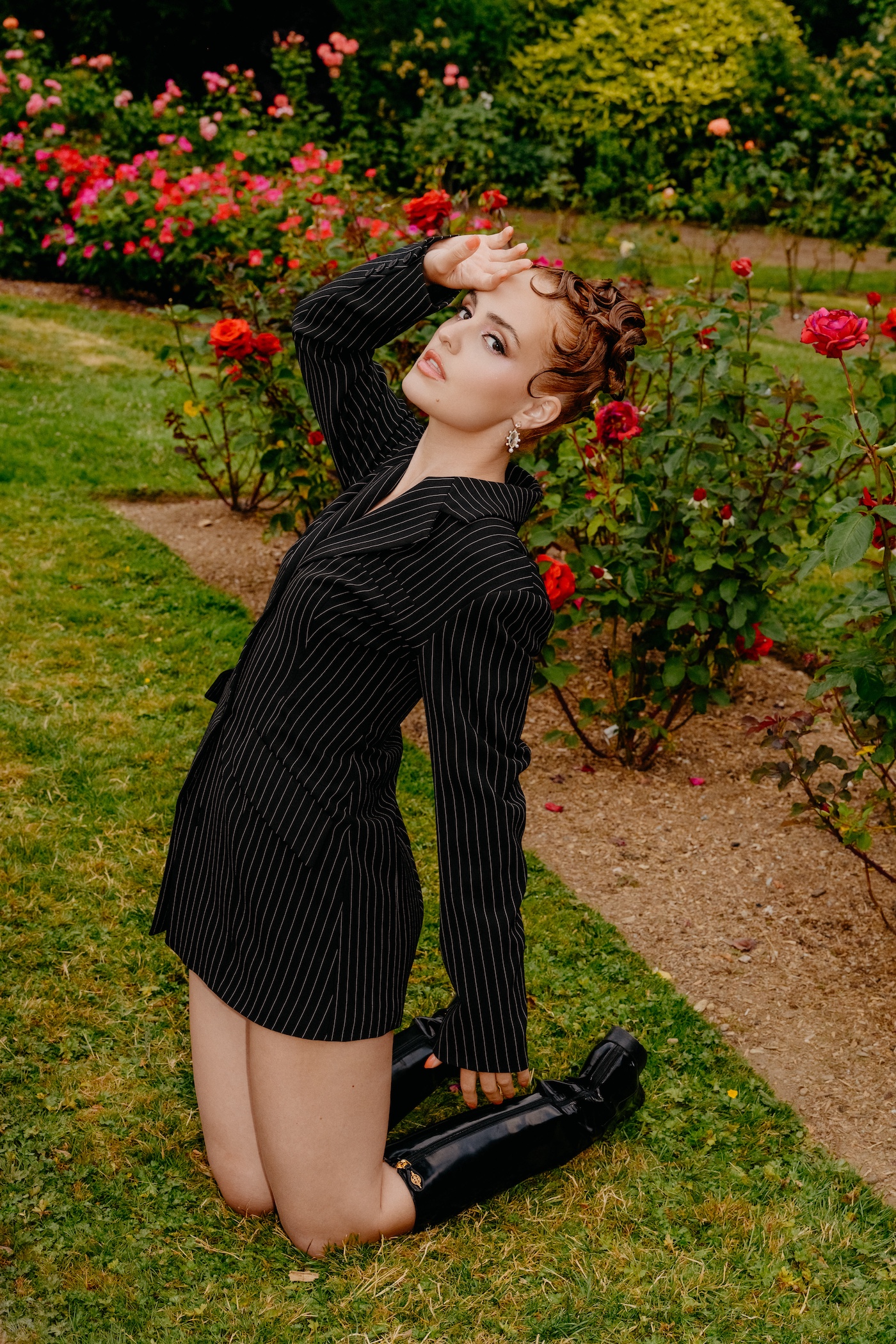
I asked her what kind of existential crises she’d been having lately, and where they’ve been taking place.
“I went to my first Grammys party and I had an existential crisis there,” she said. “It ended up just being a lot of what people told me it was going to be, a lot of rubber necking, a lot of who’s who, and what’s what. And like, that’s fine – I totally expected it, it’s LA – and I’m not even trying to sound above it, cause I wanted to get in so bad.”
“But how do you not have an existential crisis when you’re going from a Grammys party to an anti-ICE protest?” An hour and a half north of where we sat that Sunday evening, Bad Bunny won album of the year for DeBÍ TiRAR MáS FOToS. While the news notification on my phone felt briefly like a win against recent political cruelty, it crystallized more so into evidence of how large of a gap there remains between what typical Americans value and what our rulers impose. Is it progress or is it proof that we’re stuck with symbolic wins in a world that gives little to no chance for more than that? As Cochrane stated, “I keep seeing a lot of discourse that art is political, and I agree, art should be political. But I feel like there’s so many actors and forces, especially in the pop world that are not political at all. And that sent me spiraling this week.”
Cochrane’s explorations of the diminishing returns of glamor are carefully threaded, using her production style to provide the romanticized escape that pop music is known for, but never capitulating her commentary in her lyrics. “I was never making pop music from the jump at all,” she explained, “a lot of my songs kinda started out as very singer-songwriter. The intention was always to make pop music, because I listen to a lot of pop music. But also to keep the integrity of the lyrics, and the authenticity of the lyrics there.”
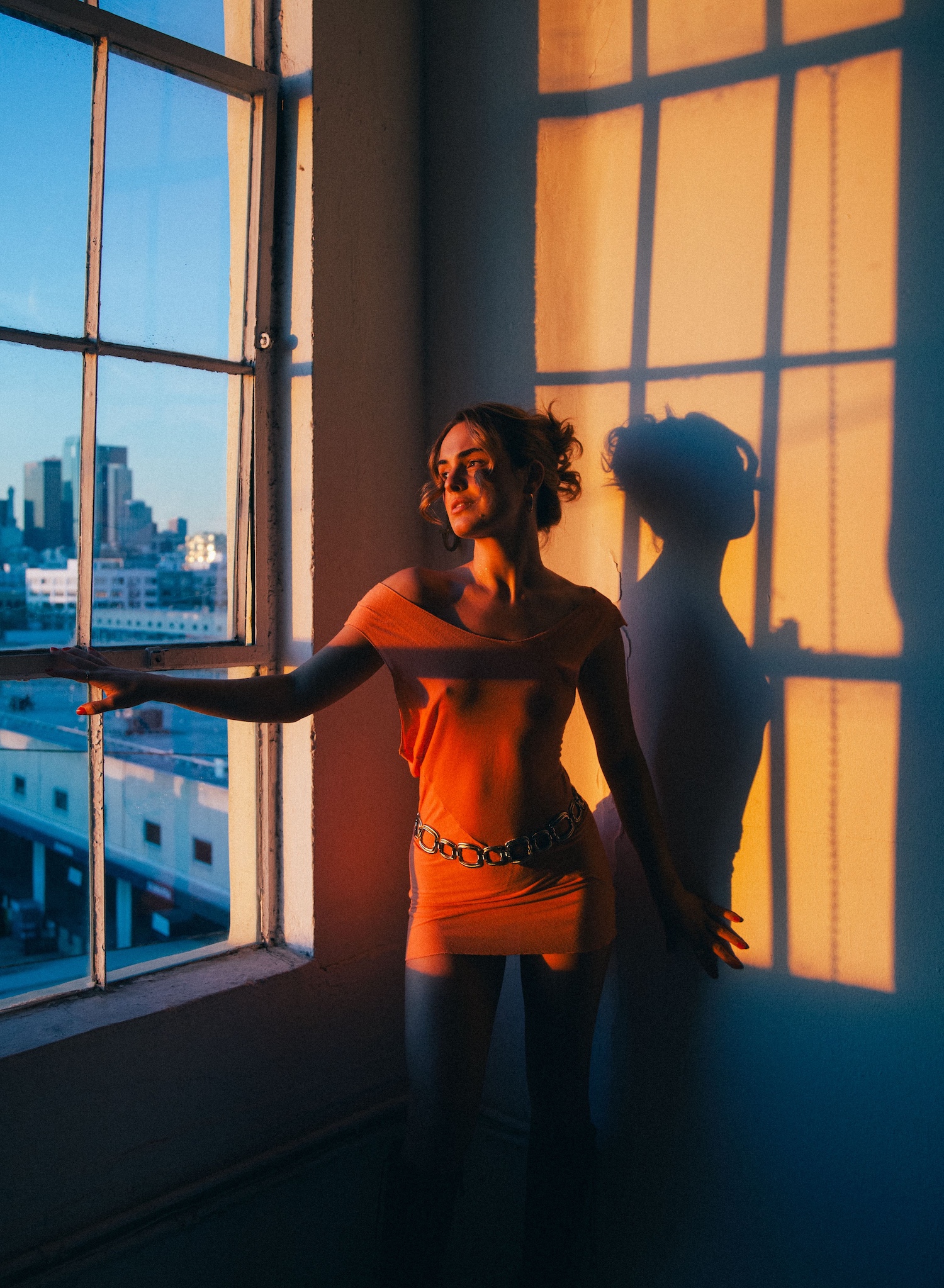
While on stage, she described several songs as being written on campus at San Diego State University when she was a student. As she described her songwriting origins to me after the show, it was easy to imagine her writing these songs with a guitar in a dorm room, the analytical lens of a recent political science lecture finding its way into the narrative.
Indeed, Cochrane first started creatively interpolating social science through her coursework. “I got permission from several of my professors to write satirical essays and stories as essays about the political theory that we were learning,” she told me. “I wrote a satirical essay about Jean-Jacques Rousseau and his social contract theory. Like, I read his book and his essays and stuff and then I wrote about what it would be like if Rousseau got his body frozen – I think it’s called Cryotherapy preservation or something – and I wrote this whole story about him navigating modern Los Angeles with this theory in mind.”
As soon as she said this, I couldn’t help but hope for her to revive this exact premise into a song one day. But regardless of whether she takes the Rousseau narrative out of the cryogenic chamber of her mind, it’s a clear ancestor to the work she’s put out on Male Validation and Other Drugs.
The exploration of stark contrasts and their inevitable chasms of turmoil are well shouldered on the EP, wherein the song “Loneliness in Numbers” is perhaps the best example of Cochrane’s satire skills.
A commentary on the vapidness of social media’s preoccupations amidst the darkness of current events, it’s the track I was most excited to be able to stream once the EP dropped. So I got pumped with the plastic front to back, cause I gotta look good for the nuclear blast, she sings facetiously in the lyrics. “You’re scrolling and you’re seeing all these beautiful, unobtainable women, and then you see like, you know, breaking news, drone strike here! And you’re like, oh my gosh, how am I being fed this much information about two completely unrelated things? Like, OK, product placement here, borderline pornography here, and political violence here,” explained Cochrane of what she unravelled in the lyrics.
The track reminds me in many ways of Lily Allen’s hit song, “The Fear,” released way back in 2008, as well as Marina’s lyrics on “Oh No!” from her 2010 breakout album, The Family Jewels, which have held onto a timelessness that I believe Cochrane’s work is also destined for.

In the weeks leading up to the EP release, Cochrane released one final single, “Losing Streak,” which immediately landed on 5 Spotify editorial playlists, including All New Pop, which used Cochrane’s photo as the playlist cover for the week. The track is centered on a growing divide between two lovers, and the release included a music video which opens with Cochrane arriving at a house with a boombox. Despite still being unreleased at the show where I interviewed Cochrane, the crowd knew the chorus well and sang along with fervor.
“We left the session with just the chorus,” Cochrane explained of working on the track. “Then I posted it on TikTok and it did really well. So I was like, God, I need to go back and write these verses, but it was really hard to lock in and write these verses about this relationship that I was still in, that was kind of on the rocks. It was painful to write about, to be so honest about it in real time. I like to write a lot of my songs in hindsight, so this one is very fresh.”
Pushing herself in this regard has paid off – while Cochrane met fans at her merch table, I meandered down the line and spoke to those waiting, surveying them on which song they’re most looking forward to being able to stream once the EP is out. “Losing Streak,” said Bellise Sachetto, as she held onto Cochrane’s set list, standing in line with fellow concert goer, Grace Brummel. “Same,” said Brummel, nodding adamantly. “We’re in agreement,” they said in unison. The two of them drove 45 minutes from Orange County to come to the show; another fan flew into San Diego from Colorado. I asked Sachetto where she would put the set list once she got home. “With my Taylor Swift one, from the Eras tour,” she said immediately.
When I asked Cochrane what the “other drugs” are on the EP – aside from male validation – it seemed like every answer was both a description of a release and a trap, proving the precision of her writing to send listeners into frenetic loops of joy and deep thinking.
“Antidepressants, like sertraline. Sex, but that kinda falls into the male validation of it all,” she said as she counted on her fingers how many things she’d listed. “And then, approval, wanting approval, and shapeshifting – that feels like a drug to me, going out and partying and trying to fit in. Anything that’s trying to fill some void that you haven’t filled in yourself.”

As I wrapped up the interview with Cochrane, I asked her for thoughts during the final stretch of the EP release, and what she was most looking forward to. “I’m really excited to release the rest of the songs and give context to what these existential crises are,” she said, referring back to our discussion of her soft spot for tarnished narratives of the gilded age. “I’m excited to give context to the politics behind the music. Because I feel like my music isn’t overtly political,” she described. “I like to give subtle nods. I hope people can feel that and hear that in the music and the lyrics.”
Though she pointed out this penchant for subtext the night of our interview, the EP’s release showed the full form of her vision – the seven tracks all together in order are an intricate, interdependent solidification of these values and messages, crystalized into an indefatigable piece of art. The final track, “Oh, Mercy!” was kept close to the chest in the weeks leading up to the release, neither played at the San Diego show nor heavily teased on TikTok. But as the mic-drop ending to Male Validation and Other Drugs, it’s the perfect emphasis on the themes Cochrane truly cares about exploring as an artist: Save me, I’ve been feelin’ nothin’/Prayin’ for beauty in the numbness/Is it the state of the world or my state of mind?
— —
:: stream/purchase Male Validation and Other Drugs here ::
:: connect with Avery Cochrane here ::
— —
— — — —

Connect to Avery Cochrane on
Facebook, 𝕏, TikTok, Instagram
Discover new music on Atwood Magazine
© Aaron Sinclair
 © Aaron Sinclair
:: Stream Avery Cochrane ::