
Dhani Harrison and Nigel Godrich are Dragonflies, a production duo and live project borne of a decade-long friendship that blends their collective interests and know-how. Speaking with Atwood Magazine, the pair discuss the origins of their project, the ins and outs of its imagery, and how their music evolves from the studio to the stage.
Stream: ‘Dragonflies’ – Dragonflies
Dhani Harrison and Nigel Godrich have a collective superpower – their infectious, disarming enthusiasm.
Both men have a litany of production credits, all-star collabs, and a fleet of Grammys, but it’s immediately apparent that neither wants this to eclipse our conversation. When I last spoke to Harrison nearly three years ago, we spent ten minutes discussing Superman and painting Warhammer miniatures. From the jump, the artifice melted. This time around, Harrison sidesteps the first question to chat about illustration. With an ear towards the cosmic and an eye towards visual immersion, Harrison notes, “I love people who make things, and I love makers and artists and things, so I’m always more inclined to talk to them, you know?”
Godrich pops into our Zoom a few minutes later, and an easy rapport is instantly apparent. This friendship has metamorphosed into Dragonflies, a jointly produced record and a series of live appearances beginning with a spot on Jimmy Kimmel. Their collaborative experiment began when Godrich advised the production of Innerstanding, and their trust in each other seeps into the songcraft.
The somberness of the album opener “Slower” belies the very danceable, bass-heavy tracks that follow: the punchy, fuzz-guitar-tinged “Setting Sun,” the pulsating heartbeat of “Straight Line,” the metronomic click-clack of “Heart or Head,” and the marching snare of “In Between.” Two tracks borrowing their titles from the Band, “Ophelia” and “The Weight,” are lovelorn, twinkling, and enmeshed in the natural imagery that pervades the record.
In 2017, I felt Harrison rattle the walls of The Knitting Factory with his distortion pedals as he found his solo voice on “All About Waiting.” Innerstanding, a record entrenched in lockdown, echoed the warnings of Brainwashed and TheNewNo2 as bile was broadcast to the masses. Yet with Godrich at Harrison’s side, this latest project is a culmination of those narratives in a more welcoming alcove, amongst friends, in the garden. They are at play, experimenting with sprightly strings, tinkling piano flourishes, unspooling and looping analog tape. The result is a sprawling, danceable, and cosmically infused confection that blends trip-hop loops with stabbing strings and the soaring high end of Harrison’s tessitura. Dragonflies cannot stop literally singing each other’s praises, nor those of their musical co-conspirators Joey Waronker, Nick Valensi, and Maurice Talbot. Though they thematically grapple with the end of the world, it’s a weight they’re carrying together. We discuss the ins and outs of musical experimentation amongst friends, years of near-misses leading to their team-up, sailing in the Antarctic tundra and through the Vedic cosmos, and the secret weapons that elevate the live versions of these tunes.
Harrison and Godrich are no strangers to collaboration. Both have worked extensively on film and television scores – Harrison on the Wu-Tang docuseries and Godrich on the much-lauded Scott Pilgrim soundtrack. They needed each other as friends, first, to clear some of the fog hanging over the AI-laden hellscape, before they unlocked the key to a musical partnership. Harrison rationalizes, “My record [Innerstanding] was full of dread, and [Dragonflies is] really light and has got lots of positivity. It wasn’t so much the time between them, because they were made actually quite close together. But the same thing happened [with] In//Parallel as with Innerstanding, it was the feeling of we were about to go into this ‘post-truth’ world – ‘Too late to wise up, I hope you’ve done the work.’ So it’s really up to us whether or not we’re ready to be healed in this new world. And I think that Nigel and I getting together as a friendship was really part of that healing for me… everyone knows, the cat’s out of the bag now, that the creepy crawlies are out from underneath the bed. I felt obliged to [focus on] that with my last two records, whereas with Dragonflies we wanted to shine a light on this feeling of positive influence, you know? We can all really help each other and send each other into an upward spiral by being good. And if you want to have good friends, you gotta be a good friend – Dragonflies is just good friendship, you know?”
One of the keys to cracking the partnership was sharing Japanese cuisine – and a decidedly Japanese attitude. Notes Harrison, “Someone was talking about it the other day; in Japan, you can have a community where people do little acts of kindness and go the extra way, and they blow your mind! That’s millions of little sacrifices from everyone, every day. But if you go there as a tourist, you just think, ‘Wow, these people are so nice!’ It’s like, ‘Well, yeah,’ because they’re sacrificing their own time and comfortability to make sure that you have that experience, we can all do that for each other every day! I wish everyone would, but that’s kind of how we’re rolling right now.” The duo liken themselves to the Town Mouse and Country Mouse; sequestered in rural England, Harrison hiked to Godrich’s turf in Brixton to soak in “graffiti, Japanese food, and all of this diversity, because I come from a very posh little quaint town that’s not really that multicultural. I used to skate in Brixton when I was a kid, so now I get to go back and make music.”
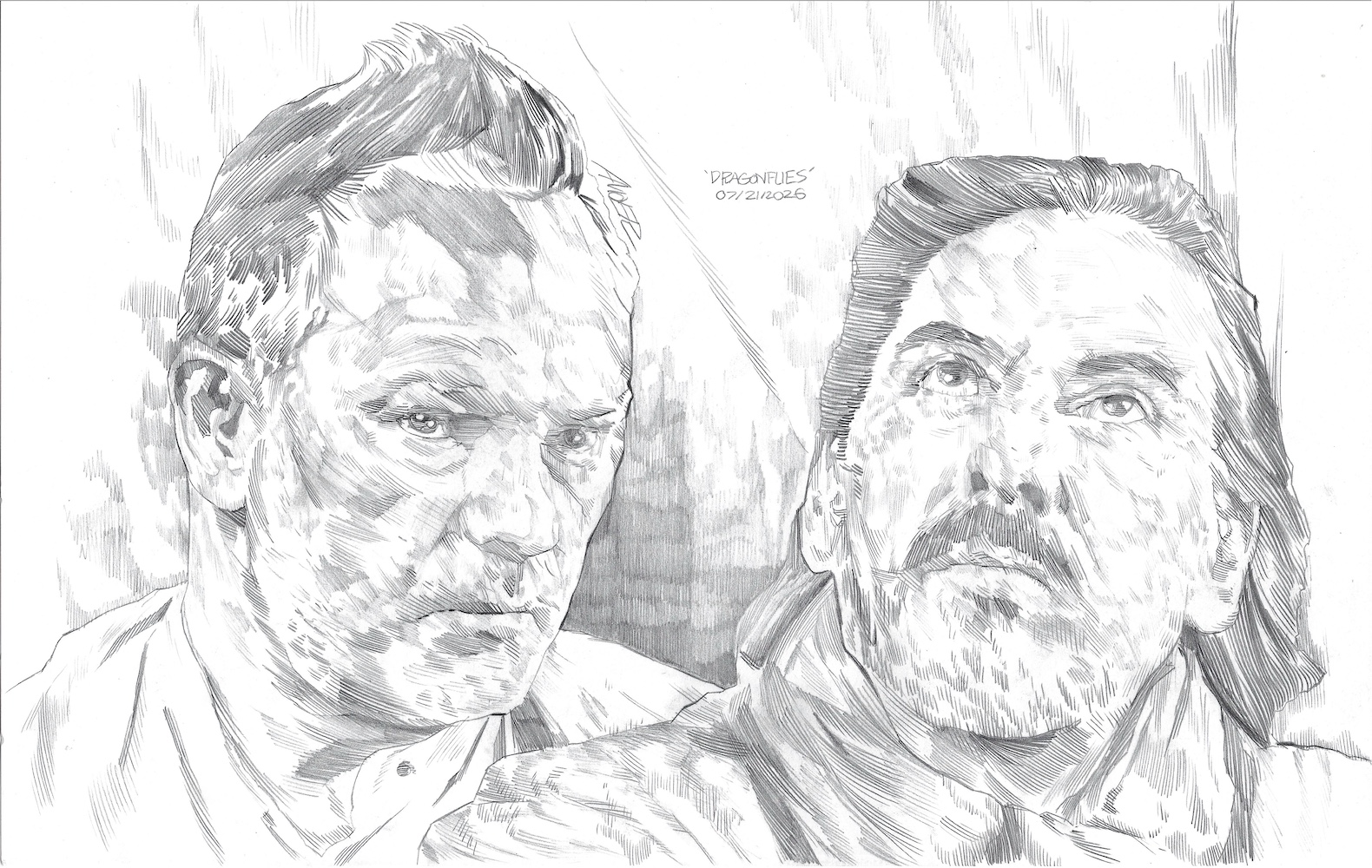
Godrich initially admired Harrison from afar as an impresario, “Sort of famous for bringing people together. The Wammys and the little ‘Fests,’ like Petty Fest and [George Fest]. It was like a fantasy, bringing of lots of musical friends together. You were a linchpin in that thing, you know?” Though seated at different charity tables, they vowed, “We’ve got to make a point of getting together and doing something.” The near-misses spanned the literal ends of the Earth as Harrison recalls, “One of our mutual friends [DJ] Chris Holmes and I had just been to Antarctica together on a boat for 2 weeks in the tundra, looking at the ice wall, and you tend to get really close with people when you’re out there on an expedition. [Chris and Nigel] are so close, I ended up at [Nigel’s] house party, and [Nigel wasn’t] there! He’d gone!”
Nevertheless, affirms Godrich, “It all worked out.” He briefly adjourns their mutual admiration society – “So, Aidan, how are you? You can’t even get a word in edgeways, can you?”
I assure him they’re making my job easier. But can a friendship this tight complicate the production process?
Harrison: “I think when I first started recording with Nigel, before I understood his method, there was a couple times where I didn’t feel like we were giving certain things enough time to evolve. He was like, ‘No, let’s go on.’ But now that we became musically very close, I realized it’s a really good challenge to [have] a fair trial. If there’s anything that we disagree on, you have to present your case, and if I can make it sound compelling to Nigel, then it’s a ‘yes,’ you know? And we’ve developed this patience of ‘Okay, let’s try it out.’ I think [that’s] the good thing about making music with anyone. I’ll stand in ‘court’ and be like, [mock lawyer affect] ‘I do believe that this guitar riff here is going in [laughs]’…I don’t think I’ve had any… major… disappointments, musically, with things that we haven’t both vibed on.”
Godrich jests, “That’s a very important statement. I think as well there’s a thing about building trust and confidence together that comes from things going right. What happened with us was very fluid and moved very quickly, but we got somewhere really good in a morning [over] a couple of hours. The confidence in ‘us’ was there, straight away. We’ve been dancing around each other for years, so we do try instinctively [to] know who we are and what we do. There’s never been a moment when I felt like something was a particular problem. It’s not about scoring points and being right or wrong. We’re so lucky to be at leisure [to] have this and the facilities to do it, and so I just feel like it was just quite easy, really.”
In kind, Harrison teases, “A second record’s in the mix, there’s still time! We can always ruin it.”
Godrich: “New directions, see, that’s always a bit tricky.”
Harrison: “Yeah. Glam.”
Like Slade?
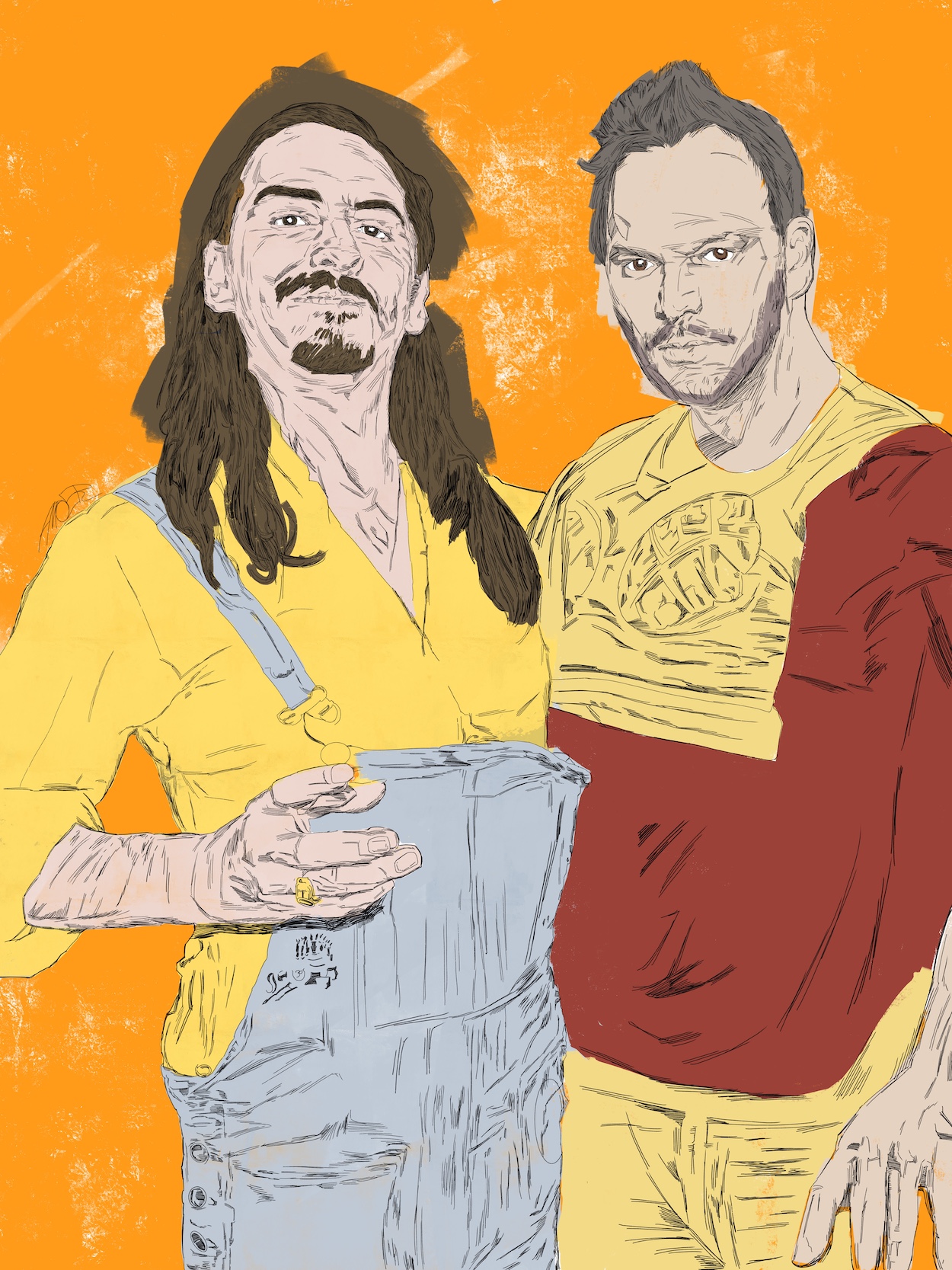
“Slower” took shape as a foray into Harrison’s falsetto range and set the stage for more experimentation. All the tracks on Dragonflies began as “Varispeed tape loops,” which allowed the keys of each song to be malleable. Harrison began “sketching out something creepy, like a girl’s vocal.” Godrich marked the approach as “pure, yearning, and soulful,” evoking Harrison’s favorite trip-hop tracks and his earlier work with TheNewNo2. Harrison initially demo’d falsetto vocal tracks for his first two records that were later fleshed out by vocalists Mereki (Harrison’s partner) and Cami Grey, but he takes point this time around.
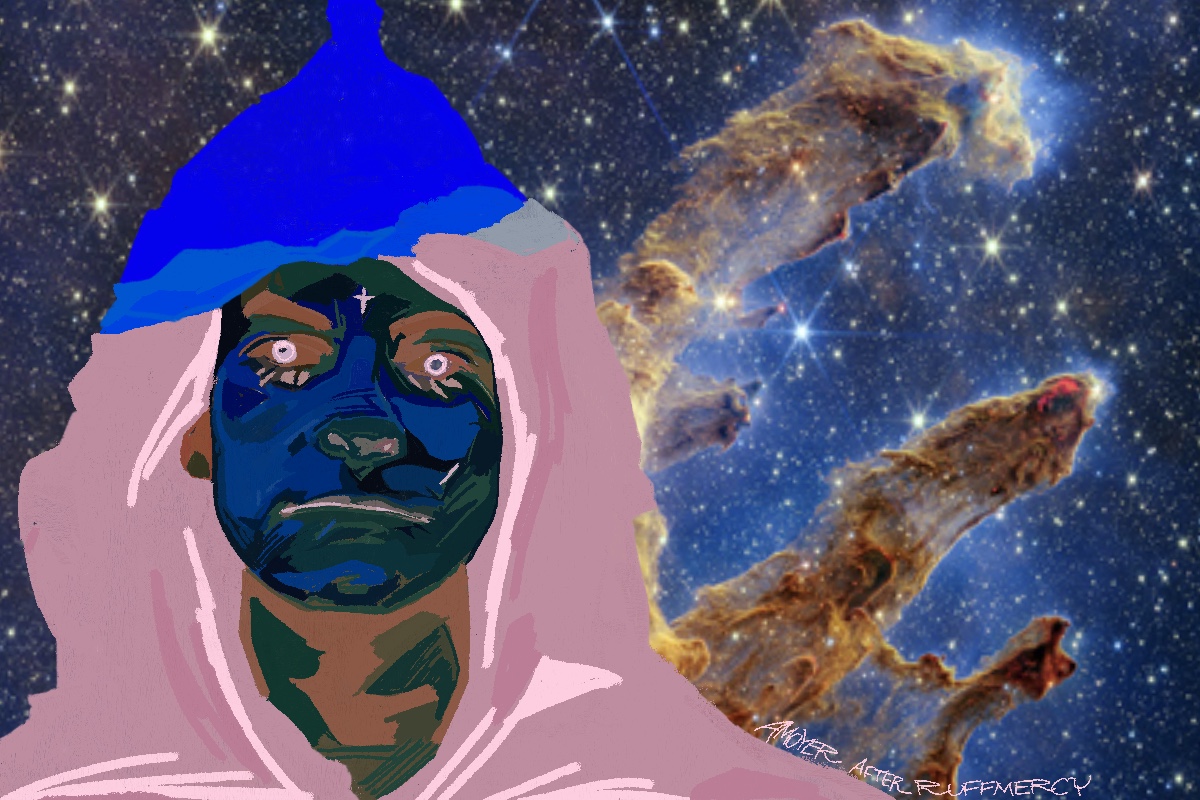
“In my last record, I was trying to sing out a bit more, it was a bit more aggro, because that was what I was trying to say. But this was more floaty. I didn’t think that that would be something that Nigel would go for, but then he started playing me some stuff… Japan, David Sylvian, and I was like, ‘Oh, yeah, I remember this.’ It’s a different ‘me’ that you can see in this record. Less angry.” Accompanied by a rotoscoped RuffMercy video, “Slower” heralded the project as its lead single and sets a cryptic tenor for the record.
As a bookend, serenity pervades the final track, “End of World,” as Dragonflies resign themselves to the apocalypse. The idea came from the masthead of Dark Horse Records, Uchchaihshravas, selected for the label by Dhani’s father, George Harrison, in 1974. The younger Harrison explains, “The bad guys were winning, and then the Vedic gods went to the Milky Sea and stirred it up, and out of that came the seven-headed horse.” In turn, Godrich evoked the Hubble telescope photos of gas nebulas and how their scale dwarfs our squabbles; eventually, “the wind will blow us out. You know, we are so small and minute and insignificant… there’s a beauty in looking at that image.”
Harrison, a self-proclaimed hermit, revels in the notion – “It didn’t feel like a depressing subject. I think it’s time for the ‘nice world,’ you know what I mean? They’re throwing so much stuff at us to overload us, to try and control us, you know? And there’s just so much of it that optically just awful. But really, when you let it all go inside yourself, and you just focus on your family, your friends, the meal that you’re eating, if you’re fortunate enough to have those things. Then that’s a whole new world that’s coming. And it’s not quite here yet, but it will be, and… you know, there is a real comfort to that. It just might be out there in those nebular fingers, a bit further away. Whatever you’re putting out there, you’re attracting. The other stuff has to die off first.”
“And the same with ourselves,” he continues. “It’s like the other stuff inside here has to go away, too. The sadness, and the pain, and all of those things, they go away, and then you’re getting paid in full, you know? [We’ve] got this new frequency that’s just for us to enjoy, and to be so lucky as to be doing the things that we’re doing in this day and age, and actually talking about it, and listening to music, that’s wonderful.”
Harrison is meticulous in the visual design of his records, but in this case he deferred to Godrich. “You want to [speak to] that, Nige? That would really have a lot to do with your aesthetic.” Ensconced in the organic feel of the sessions – “all tape loops, organic, kind of ‘furry’” – Godrich tapped bandmate Maurice Talbot’s mother, artist Claire Burbridge. Seeing her “crazy pencil drawings of galaxies, bumblebees, fish and everything in between” led to the omission of Godrich and Harrison’s faces on the outer packaging. Burbridge told me, “I work in any medium that you can use on paper. The Dragonflies work is color pencils on black Arches paper. A combination of watercolor, high flow acrylics and alcohol-based inks is my favorite media at the moment.” Friar Park, Harrison’s home studio and a resplendent garden, seeped into the album aesthetic. Harrison recalls, “We spent a lot of time at Friar Park with our families and had a deep appreciation for the nature and healing… [I was] living in LA in the big Matrix city grid and back here we spend a bit more time together in Finsbury Park at a rave or something, you know what I mean.”
Godrich muses, “Friar Park is the most beautiful garden I’ve ever seen and that image is what I associate with Dhani.”
“You know I don’t get out much, as I said on the last record, Aidan. We’ve heard this before, I don’t leave the house, you know? If you stay still enough in the universe, everything will eventually come to you, and eventually it was Nigel. As soon as I saw Claire’s image, I was like ‘Oh yeah, that’s it.’”
For the album insert, Harrison and Godrich posed for a tintype portrait.
A bemused Harrison reminisces, “It’s like a Victorian plate camera… Magda Kucha, she’s a trip. She’s out there, man, she really made it a very enjoyable procedure. Someone said on my Instagram ‘is Dhani cosplaying as Dr. Ford from Westworld?’ Yes, actually, I am! Funny that, I always loved that sense of ‘is it really [the real deal] or is it just a theme park’, you know? This was another [cosplay]… I got right into it. As soon as the old National guitars came out, and all the silver weird resonators, and neck scarves and things, just because when you’ve got that kind of a camera. And those pictures will be like that forever.” Harrison got very into the ambiguity of those Gold Rush portraits – “Why are they leaning up against each other? Are they exhausted? Have they just been down a coal mine? Did they kill someone?”
Godrich is just as granular, citing a “book of those daguerreotypes” captured with “portable laboratories to take photos of people who were trying to go down mines and make their fortune. They would have, sometimes, rods up their backs to be still. Dhani and I have the problem where it’s like, ‘well, we need a defining photo for the project.’” Despite an initial reluctance to pose, they were bemused at the session as Kucha is “into Victorian plague masks, Steam Punk, shit like that. Goggles. Quite scary, I believe. It’s a little bit witchy but not my kind of witchy [crystals and sage]. It’s very evocative, as a way of doing pictures. 100% the vibe is turned up to 11, you know, something special happens there.”
In lieu of the dense orchestrations on the record, Dragonflies are stripping these tunes to the frame on the road.
Godrich set a framework: “Never to try and copy the record literally, just play that part on the instrument that works. No computers or samples or anything like that. We have two secret weapons in the form of an amazing keyboard player and guitarist, Maurice (Talbot) and Nick (Valensi, of the Strokes), and they have come up with this language where they’re translating these things into reality.” Harrison laments, “I’m not allowed my 6 Kaoss Pads,” and Godrich counters, “It’s alright, I forfeit other things.”
Harrison ultimately praises his bandmates, Joey Waronker and Valensi, gushing, “Joey’s just incredible – he’s literally on every great record. And I used to play Guitar Hero 2, and try and do Nick’s solos, you know what I mean? And when you watch him playing technically weird, ambient stuff, which is totally not his style of playing, he’s so f***ing good. I get to play lead, and then I turn around, and I’ve got Ultraísta and Atoms [For Peace] on one side of me, and then Maurice and Nick on the other side. And it’s a pretty cool view from where I’m standing.” Godrich notes a symbiosis between the musicians as they “kind of become one thing, a real Maestro Wizard,” or, in Harrison’s parlance, “a weapon, they’re well weaponed.”
That aforementioned superpower has worked its magic; Dragonflies have graciously gone ten minutes over their allotted time. Harrison bids adieu with “I’ll see you again…in another universe. I hope it all goes well, and I hope we catch up with you again sometime.”
— —
:: stream/purchase Dragonflies here ::
:: connect with Dragonflies here ::
— —
— — — —

Connect to Dragonflies on
Facebook, 𝕏, TikTok, Instagram
Discover new music on Atwood Magazine
© Aidan Moyer
 © Aidan Moyer
:: Stream Dragonflies ::