Atwood Magazine is excited to share our Editor’s Picks column, written and curated by Editor-in-Chief Mitch Mosk. Every week, Mitch will share a collection of songs, albums, and artists who have caught his ears, eyes, and heart. There is so much incredible music out there just waiting to be heard, and all it takes from us is an open mind and a willingness to listen. Through our Editor’s Picks, we hope to shine a light on our own music discoveries and showcase a diverse array of new and recent releases.
This week’s Editor’s Picks features Cherry Bomb, Chet Faker, Claire Rosinkranz, The 4411, Donovan Woods, and Bad Tiger!

 follow EDITOR’S PICKS on Spotify

“Never Be Me (M★therf★cker)”
by Cherry BombLeaving a relationship that taught you how to shrink is not a quiet act. It’s a loud, body-first rupture – a reclaiming – a hard-earned moment where pleasure, power, and selfhood finally outrank endurance. Cherry Bomb’s glittering, unapologetically bold debut single, appropriately titled “Never Be Me (M★therf★cker),” is about that threshold: The instant you stop offering yourself as the solution to someone else’s damage and decide, with fire in your chest and clarity in your bones, that their healing is no longer your responsibility. It’s a dramatic, dynamic fever dream about burning the script and breaking patterns, about choosing yourself when self-erasure has become habit – and about the intoxicating, chest-lifting freedom that arrives when you finally say no and dance forward anyway.
I hope you get the help that you need
But darling, know that it can never be me
When you’re looking for somebody to leave
Oh, darling, know that it will never be me
‘Cause you love to make ’em suffer
Oh, you motherfucker
If you ever find another
She better be a runner
I hope you get the help that you need
But it will never be me
Released January 16th as the debut single from Cherry Bomb – the solo project of MisterWives’ effusive frontwoman Mandy Lee – “Never Be Me (M★therf★cker)” is a gutsy, glitter-soaked declaration of independence, drenched in disco-pop euphoria and maximalist release. The track pulses with radiant synths, buoyant basslines, and layered harmonies that shimmer like a dance floor under strobe lights, and its joy is earnest and authentic. This isn’t escapism for escapism’s sake – it’s liberation earned through clarity and action. After more than a decade spent holding space for others, this moment feels pointed and urgent – a first act of self-definition that could only arrive once the old rules stopped applying. Lee’s vocals move with confidence and command, luxuriating in the pleasure of self-possession as she sings a breakup not as grief, but as victory.

For more than a decade, Lee has been the unmistakable frontwoman of MisterWives, an indie pop band (and longtime Atwood favorite) defined by connection, catharsis, and communal release. Cherry Bomb doesn’t abandon that history – it detonates it into something newly personal and fiercely autonomous. Where MisterWives has often channeled collective resilience, Cherry Bomb zooms inward, spotlighting the body, the ego, the inner child, and the long-neglected joy of excess. This project is not a pivot away from Lee’s past, but an expansion of it – louder, freer, and unrestrained by expectation.
We hear that evolution instantly as the song begins, a lush collision of shimmering synths and sweeping strings laying out a glistening red carpet for Lee to step into her power. The track blooms with theatrical flair – glossy, cinematic, and intensely alive – as if the music itself is taking a deep breath before the declaration lands. Each beat feels deliberate and buoyant, designed not just to move bodies, but to lift spirits, turning self-realization into something communal and kinetic. There’s a physicality to the performance – the pulse of the bass, the sparkle of the harmonies, the way the melody swells and struts forward – that mirrors the song’s emotional arc. This isn’t a quiet reckoning whispered into the dark; it’s a full-throated arrival, radiant and unapologetic, announcing that something has shifted and there’s no going back. There’s risk baked in, too – the knowledge that choosing yourself means leaving familiar chaos behind, even when it once felt like home.
3 a.m. texting that you’re drunk
Clawing out of thе hole you dug
Telling me I’m thе only one
If you’re counting one of a million
Little man always crying wolf
Careful now, it’s not how it looks
Little lamb with an upper hook
Got a standing O from Hollywood
I’m not a quitter,
but you know I have no choice
Lottery winner, you’re such a lucky boy
Cherry Bomb isn’t just a new musical chapter for Lee; it’s a permission slip – a reclamation of scale, volume, and identity after years of contorting herself to fit spaces that demanded less. “Growing up I was always called a ‘Firecracker’ and a ‘Glitter Bomb,’ so Cherry Bomb felt like the perfect moniker to honor and embody all the parts of myself I’ve been trying to get back to,” she explains. “The name carries duality which really sets the tone for all sides to exist – the glitter, the grit, and everything in between.” That duality pulses through “Never Be Me (M★therf★cker),” a song born from recognizing destructive patterns and finally refusing to reenact them. “She is a farewell to the Frankenstein made from many relationships,” Lee says, “where I realized I was an absolute creature of habit – trying to receive love in loveless places. [It’s] for all my recovering, white knuckling people pleasers who have had a hard time letting go of what you absolutely need to.” The result is a song that doesn’t ask for closure – it creates it.
Lee describes “Never Be Me (M★therf★cker)” as “a defiant Declaration of Independence dressed up in maximalist synth pop made for dancing out a loveless love.” Reflecting on the song’s origin, she shares, “Starting this project I knew I desperately needed to reconnect with parts of myself I lost along the way, and ‘Never Be Me’ was the catalyst to reclaiming my power, saying farewell to spaces that made me shrink while welcoming back the energy of the little girl who once wore boas routinely, blasting ‘You Don’t Own Me’ through a bedazzled boombox. This song has become a mantra in learning to let go of old painful patterns and letting in the pleasure of self I once abandoned for the love and acceptance of others.”
I hope you get the help that you need
But darling, know that it can never be me
When you’re looking for somebody to leave
Oh, darling, know that it will never be me
‘Cause you love to make ’em suffer
Oh, you motherfucker
If you ever find another
She better be a runner
I hope you get the help that you need
But it will never be me
That mantra lands hardest in the chorus – a line that snaps like a door finally slammed shut: “I hope you get the help that you need / But darling, know that it can never be me.” It’s uncompromising, cathartic, and deeply empowering, delivering the song’s central refusal – and skewering the cycle of manipulation – with clarity, rather than cruelty. Even the track’s most biting lyric carries that release with a wink – “You love to make ‘em suffer, oh you motherf*er / If you ever find another, she better be a runner” – a moment Lee admits “really scratches an itch,” and one that has “offended quite a few angry men on the internet – which makes it that much more satisfying.” The power here isn’t just in the words themselves, but in how confidently they’re delivered, wrapped in sound that insists on movement, joy, and unfiltered release.
That sense of liberation has become the emotional anchor for everything that’s followed. “She was such a North Star for this project because it was the first time in a long time I wasn’t ruminating over how to make things right,” Lee reflects, “but rather letting the broken pieces remain, resigning from trying to fix them.” That choice – to stop repairing what was harming her – helped lay the foundation for Cherry Bomb as a whole. “That liberation set the tone for the rest of this project,” she adds, grounding the song’s defiance in something human and hard-won, a reminder that our power comes from within, not without.
“Never Be Me (M★therf★cker)” doesn’t just introduce Cherry Bomb – it sets the terms: That self-betrayal is no longer the price of connection. For Mandy Lee, it marks a rare and thrilling beginning – a moment of arrival after years of giving, now finally centered on who she is and who she’s becoming. This is a project rooted in pleasure as power, excess as healing, and honesty as survival. It’s an anthem for anyone who has mistaken endurance for love, who has tried to fix what was never theirs to repair, and who is finally ready to walk on with their head high and their body dancing. Cherry Bomb has arrived in full color, and the world is a brighter place because of it.
It really does feel good to choose yourself – loudly, joyfully, and unapologetically.
“Over You”
by Chet FakerMoving on is rarely a clean break. More often, it’s a loop – a cycle of almost-closure, where time passes but feeling doesn’t, and the body lags behind the decision the mind keeps trying to make. It’s the strange purgatory of believing you’re finished while still carrying someone everywhere you go: in memory, in habit, in the quiet reflex to reach for what’s already gone. That emotional limbo – tender, unresolved, and quietly exhausting – sits at the heart of Chet Faker’s achingly beautiful new single “Over You,” a hypnotic, slow-burning meditation on heartbreak as repetition rather than release. Built on a translucent piano figure, hushed electronics, and a gently pulsing breakbeat, the song drifts and circles just like the feelings it captures, never rushing toward resolution. Faker’s voice floats through the track with weary intimacy, tracing the ache of being almost free – suspended between what was, what still hurts, and the fragile hope that time might eventually do what willpower cannot.
Keep wondering where the time went so fast
Some part of me that never lasts
If you could see what I could see
I’d put your hands all over me
Been running north to south, hard to breathe
What I feel, what I believe
So tell me what you think of me
‘Cause I just lost a memory
Gone in places, lost inside my history
And I don’t wanna know love if I can’t hold it
Someone set me free
I was getting over
You
Released January 22nd as the latest single from Chet Faker’s forthcoming album A Love For Strangers, “Over You” arrives as a quiet but devastating emotional entry point– a song that feels less like a statement than an admission. It’s also the opening track on the record, a deliberate choice that signals its role as both emotional thesis and tonal compass. Where past singles have explored expectation, distance, or devotion from different angles, this one lingers in the unresolved middle, letting silence, space, and repetition do the heavy lifting.

For Chet Faker, that sense of circling isn’t accidental. Reflecting on where he finds himself now, he describes his artistry as having completed “one big circle,” returning to what first drew him to music after years of success, distraction, and constant motion. “I feel like I’ve finally sort of done this full lap,” he explains, “where I’ve come back to a lot of what I originally started making music for – but with all the added growth and lessons and inspirations along the way.” Rather than chasing reinvention, A Love For Strangers feels like a homecoming – not to the past, but to instinct.
That instinct shapes the album’s core idea as much as its sound. As Faker puts it, the title is both conceptual and literal: “This record is loves that I experienced sort of bottled up into song form, and I’m giving it to people – essentially strangers.” It’s an album fascinated by the many shapes love can take – the intimacy of strangers, the distance that can grow inside familiarity, the quiet warmth of connection that doesn’t always require permanence. “Over You” embodies that tension beautifully, sitting with a relationship that refuses to resolve cleanly, even as time insists on moving forward.
Sonically, the track mirrors that emotional state with remarkable restraint. Faker traces its origins back nearly a decade, built around a piano idea that lingered until it found its moment. The song unfolds patiently, layering dry guitar strums, soft keys, and a bittersweet breakbeat that never quite swells into catharsis. There’s a reason, he notes, that it opens the album: “It probably says everything that I wanted to say for the whole record. In a way, it’s like the cipher.” The long intro and extended outro aren’t indulgences – they’re invitations to sit inside the feeling, to let it breathe.
What makes the song so affecting is how unapologetically, how calmly Faker breaks himself open in those first moments, admitting not strength but disorientation. He doesn’t posture as someone who has figured it out; he lets the listener sit with the embarrassment, the fragility, the quiet self-reckoning of realizing how much of yourself you’ve already lost. “Keep wondering where the time went so fast / Some part of me that never lasts,” he sings, sounding less heartbroken than disarmed – aware that love hasn’t just ended, but has eroded him in small, cumulative ways. Time isn’t healing him here; it’s exposing the damage, revealing how distance can move forward while feeling stays put. “If you could see what I could see, I’d put your hands all over me. Been running north to south, hard to breathe, what I feel, what I believe. So tell me what you think of me, ‘cause I just lost a memory.” There’s an ache in that confession, a recognition that time has moved forward while something essential stayed behind, leaving him suspended between memory and absence. It’s not just about missing someone; it’s about confronting the parts of yourself that didn’t survive the relationship intact.
That openness isn’t accidental; it’s central to how Faker understands songwriting itself. “Music, every record I’ve ever made, and every song has always been a kind of way of processing,” he explains, “making sense, and unpacking whatever’s going on in my life at the time.” Rather than smoothing over discomfort or rushing toward resolution, “Over You” lingers inside it, allowing confusion, sadness, and half-healed feeling to coexist. For Faker, the act of writing becomes a way of sitting with what hurts long enough to understand it – and, eventually, to feel better because of it.
Lyrically, the song captures heartbreak not as devastation, but as erosion. “Gone in places, lost inside my history, and I don’t wanna know love if I can’t hold it, someone set me free,” Faker sings, his voice suspended between resignation and disbelief. The chorus doesn’t explode – it repeats, gently but insistently: “I was getting over you.” Each refrain lands a little heavier, not because the words change, but because their truth doesn’t. It’s the sound of someone realizing that healing isn’t linear – that you can be “over” someone and still very much inside the aftermath.
That approach extends across A Love For Strangers, an album built less on grand statements than on presence and performance. Faker describes writing these songs with a renewed focus on the body – on being able to sit at a piano or pick up a guitar and play each track through, live and whole. “Almost every song on the record has the skeleton of it through performance,” he says. “It’s the first record where I made it thinking, I want to be able to play every one of these songs live… that was a big shift for me, was moving more towards performance and away from curating and piecing things together.” That commitment to immediacy gives the album its warmth, grounding even its most electronic moments in something human and felt.
You said it’s over now, don’t feel sad
‘Cause I don’t think this feeling lasts
And soon we’ll just be memories
Someone that you used to see
And if you file my name inside your dreams
Remember how we used to sing
You still got the melody
But some things just aren’t meant to be
I was getting over
You
Importantly, Faker resists the idea of reintroduction altogether. Though the album came together alongside the 10-year anniversary of Built on Glass, he sees continuity rather than comeback. “I didn’t go anywhere,” he says plainly. “I’ve been following the same line of authenticity and instinct the whole way.” The difference now is clarity – a willingness to trust inconsistency, to let exploration itself become the throughline. “The less I try to intellectually create a through line,” he reflects, “the easier everything gets.”
Ultimately, “Over You” doesn’t ask to be decoded or defended. It simply exists, offered freely, without persuasion. Faker describes his hope for the album with similar generosity: “I didn’t really try to make something that was trying to convince people of how good it is. It’s more like, here – have it if you want.” In that spirit, the song becomes what heartbreak so often is – not a lesson, but a companion. A place to sit with the ache, let it pass through you, and trust that meaning can emerge simply from paying attention.
In its tenderness and restraint, “Over You” stands as one of the most quietly affecting moments in Chet Faker’s catalog – a reminder that growth doesn’t always announce itself, and healing doesn’t always hurry. Sometimes, the most honest thing a song can do is stay with you while you figure it out.
“Chronic”
by Claire RosinkranzLiving with chronic illness rewires your relationship to time. Days blur together. Recovery never quite arrives. Pain becomes familiar before it becomes manageable, and the body starts to feel less like a home than a boundary you’re trapped inside. It’s an experience defined not by drama, but by repetition – cycles of fatigue, frustration, and quiet endurance that are nearly impossible to translate to anyone who hasn’t lived them. That tension – between wanting to heal and learning how to exist while unwell – sits at the core of “Chronic,” a devastatingly intimate new song from singer/songwriter Claire Rosinkranz that confronts illness not as a plot point, but as a lived, ongoing reality.
Look in the windows
They don’t see nothing at all
Sometimes, they’re open
But they’re usually closed
Everyone’s knocking
I look through the hole
I wish I could open the door
But I’m tired and cold
Feels like mm, mm, mm, mm
Mm, mm, mm, mm…
From its opening moments, “Chronic” feels physically vulnerable. Melancholy piano chords arrive like a slow exhale, setting the stage for one of Rosinkranz’s most fragile vocal performances to date. Her voice barely lifts above a whisper, rising and falling with the song’s emotional pulse, as if each note requires effort. There’s nothing ornamental here – no excess, no distance. The track moves with restraint and gravity, allowing silence, breath, and space to carry as much weight as melody. It’s brooding, breathtaking, and quietly overwhelming, the kind of song that doesn’t rush to be heard so much as ask to be felt.

For Rosinkranz, that vulnerability marks a striking and intentional shift. After breaking out with sharp, self-assured pop instincts and building a reputation for wit, confidence, and emotional candor on tracks like “Dancer” and “Jayden,” “Chronic” strips everything back to its barest elements. It’s not a reinvention so much as a deepening – a moment where her songwriting turns inward, prioritizing truth over momentum and emotional accuracy over polish. Arriving just ahead of her sophomore album My Lover, the song reveals an artist willing to pause, soften, and sit inside discomfort, trusting that honesty alone is enough to carry the weight.
Rosinkranz wrote “Chronic” during her first experience with chronic illness, and the song exists as an attempt to communicate what words alone could not. “I wrote ‘Chronic’ after experiencing chronic illness for the first time,” she explains. “I think it’s incredibly difficult to explain what that feels like to people who have never gone through chronic illness, and so, in order to help the people around me best understand what I was experiencing – the cycles of fatigue and sickness and tiredness, and feeling very stuck inside of my body – I decided to write this song. It’s just this little piece of this journey I went through.” That impulse – to be understood, rather than fixed – gives the song its emotional clarity and its quiet power.
Maybe I’m dying
So comfortable crying
I don’t know the difference between
Lying and smiling
My bones are like water
My head’s getting hotter, hotter
And I can’t remember
My blood’s running thinner like
Mm, mm, mm, mm
Much of that power comes from how Rosinkranz builds feeling through energy rather than volume. “I’ve had a weird relationship with chronic illness and learning how to function with it,” she says. “It’s an experience that words alone can’t really express, so to try to communicate what I was feeling, I sat down at the piano one night and began releasing what it feels like to be in this strange tension and relationship with sickness; its relentless pursuit, and the feelings of being stuck, trapped, and frustrated. Words can’t fully express it, so a lot of it is communicated through the melodies, the production, and every other part of the song.” You can hear that intention in every choice – the way the song swells and recedes, the way her voice trembles without ever breaking, the way the music seems to carry what language cannot.
Lyrically, “Chronic” reads like a series of confessions whispered behind a closed door. “I wish I could open the door / But I’m tired and cold,” Rosinkranz sings, capturing the exhaustion of wanting connection while lacking the strength to reach for it. Later, she delivers the song’s most piercing line: “I wanna feel better, but something about being sick is easy, twisted, comfortable.” It’s a lyric that lands with startling honesty – not romanticizing illness, but acknowledging the complicated familiarity it can create. “That line rings very true,” she reflects. “When you are relentlessly pursued by sickness, it becomes very familiar – a comfortable, comforting crutch in your life. It’s very twisted, and it can bring you into this strange victim mindset that becomes an excuse. I wrote this song to feel understood, because it’s really hard and exhausting to explain this experience to people who haven’t gone through it.”
That desire for understanding – not sympathy, not solutions – is what makes “Chronic” resonate so deeply. Rosinkranz isn’t offering answers; she’s offering companionship. “I just wanted something that I could resonate with,” she says. “It’s a very complex journey to be on, so I wanted to emulate that journey and feel seen and understood through it.” In doing so, the song opens itself up beyond illness alone, becoming a mirror for anyone stuck in a complicated, toxic, or confusing relationship – with their body, with another person, or with themselves.
That openness extends to what Rosinkranz hopes listeners take away. “I hope people feel understood by it, in the same way that I wanted to be understood,” she shares. “It doesn’t necessarily have to be about sickness – I think people will have their own interpretations, but it could be about any complicated, toxic, or confusing relationship. It’s hard to explain those experiences to people who haven’t been in the same situation. When other people can’t meet those needs, I hope this song can.” It’s a generous sentiment, one that positions “Chronic” not as a statement, but as a refuge.
I don’t remember, how could I ever forget?
I wanna feel better,
but something about being sick is
Easy, twisted, comfortable
No, I don’t remember, I don’t remember, no
I don’t remember, how could I ever forget?
I wanna feel better,
but something about being sick is
Easy, twisted, comfortable
But I don’t remember, I don’t remember, no
The song arrives as the final single ahead of Rosinkranz’s sophomore album My Lover, due February 13, and it offers one of the record’s most unguarded emotional moments. Where past tracks have leaned into confidence, chaos, or propulsion, “Chronic” slows everything down, asking the listener to sit with discomfort rather than outrun it. In that way, it feels essential – a necessary pause that deepens the album’s emotional range and human stakes.
“Chronic” is not an easy listen, but it is a vital one. It doesn’t glamorize pain or tidy it into a lesson. Instead, it honors the messy reality of living inside a body that won’t cooperate, and the courage it takes to name that truth out loud. In its tenderness and restraint, the song becomes what so much healing music aspires to be – not a cure, but a companion.
“Sweet July”
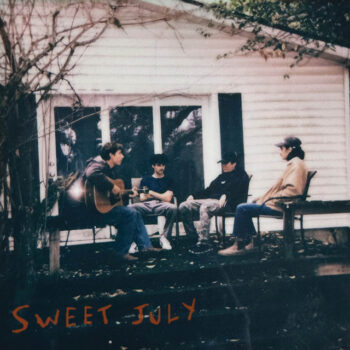
by The 4411Time doesn’t always announce itself when it changes things. Sometimes it slips by quietly, measured not in milestones but in missed birthdays, postponed plans, and the growing realization that the people who once shaped your every day now live at a distance you can’t quite close. Growing older often means learning how to live with that ache – the strange loneliness of loving people deeply while seeing them less and less. That tender, bittersweet truth sits at the heart of “Sweet July,” a radiant new folk-pop gem from The 4411, one that captures the warmth of connection and the quiet grief of time passing in the same gentle breath.
Sweet july
You always leave with time
The morning’s quite
And it bleeds into the night
Take me down to the place
Where you know that I’m dying
And I’ll wait for you
Released January 21st, “Sweet July” arrives as the latest single from Austin, Texas-based indie folk band The 4411, a four-piece rooted in friendship, shared history, and quietly resonant songwriting. Formed by lifelong friends Cogan McBride and Tomas Gerlach before expanding into a full band, The 4411 have spent the past several years honing a warm, lived-in sound that blends folk intimacy with melodic indie-pop sensibility. Following their 2024 debut EP We Killed the Sun and a steady run of sold-out shows and national touring, the band enters 2026 with growing momentum – and “Sweet July” feels like a natural next step, both emotionally and artistically.
There’s an immediate sense of peace to “Sweet July,” as if the song itself were sunlight spilling across a hardwood floor. Dreamy acoustic fingerpicking lays the foundation, soon joined by lush mellotron textures and radiant harmonies that bloom slowly and naturally around Cogan McBride’s golden, honeyed vocal. The arrangement is soft but intentional, immersive without ever feeling heavy, drawing the listener into a soundscape that feels outdoorsy and alive. Even the birdsong that flutters in at the song’s close feels purposeful, grounding the track in a reconnection to the natural world – a reminder of stillness, presence, and the comfort of simply being.
Where we dance with the flames
and burn with the embers
Sing with the waves
til the sun, it surrenders
Making bets with the days
that I hope I’ll remember by December
Sweet july could you stay here forever?
Sweet goodbyes
Hurts a little more each time
We laughed and cried
That redwood tree has died
Take me down to the place
Where you know that I’m dying
And I’ll wait For you
At its core, “Sweet July” is about time separating people who once felt inseparable. The band traces the song’s origin back to a summer spent reconnecting with friends from their hometown, when scheduling time together felt unexpectedly difficult and goodbyes carried extra weight. “We started feeling like we only see our friends that we grew up with once a year in the summer and as you grow up and life gets busier you see your friends less and less,” they share. It’s a sentiment many listeners will recognize instantly – the quiet reckoning that closeness doesn’t disappear, it just becomes rarer.
That feeling is woven delicately through the lyrics, which read like snapshots from a fleeting season you’re already afraid of losing. “Sweet July / You always leave with time,” McBride sings, capturing the way summer memories are often marked by their impermanence. Later, the refrain aches with longing: “Making bets with the days that I hope I’ll remember by December / Sweet July could you stay here forever?” It’s not just nostalgia, but awareness – the painful clarity that these moments matter precisely because they don’t last.
Vocally, McBride leans into restraint, letting softness do the emotional work. “When we were recording it, I wanted to try singing extremely soft and delicately,” he explains. Drawing inspiration from Jeff Buckley’s more intimate performances, the result is controlled yet deeply vulnerable, as if the song were being sung just for one person sitting across the room. That intimacy allows the emotion to land without spectacle, trusting the listener to meet it where it is.
The warmth of “Sweet July” also reflects who The 4411 are at their core – a group of best friends from Austin, Texas, making music rooted in shared history and genuine connection. The band’s name itself comes from the street address of their drummer’s parents’ house, where they first rehearsed and wrote together, and that sense of origin still lingers in their sound. Influenced by artists like Hozier, Fleetwood Mac, Bob Dylan, and The Backseat Lovers, they’ve learned to lean into sincerity over grand gestures, allowing songs to unfold naturally rather than forcefully.
Where we dance with the flames
and burn with the embers
Sing with the waves till the sun, it surrenders
Making bets with the days
that I hope I’ll remember by December
Sweet july could you stay here forever?
Ultimately, “Sweet July” is a song about gratitude – for the people who shaped us, for the seasons that held us, and for the fleeting moments that stay with us long after they’re gone. “I hope listeners take away a sense of gratitude for the time they get to spend with the people they care about,” the band shares. “Maybe you’re having your ‘Sweet July’ right now and don’t even realize it yet.” In that way, the song becomes both a comfort and a quiet call to attention: To hold close what you can, while you can, and to honor the beauty of moments that are already becoming memories. In its warmth and simplicity – in the glow of its harmonies, the hush of its melodies, the way it seems to breathe rather than rush – “Sweet July” feels like a small pocket of sunlight you can return to, again and again, whenever the distance starts to ache.
“I Talk About You”
by Donovan WoodsGrief doesn’t arrive with a lesson plan. It shows up as repetition – saying the same name over and over, replaying the same moments, circling the same memories because letting them go feels like a second loss. Loving someone after they’re gone often means carrying them forward in language, in habit, in the quiet insistence that their life still matters. “I Talk About You,” Donovan Woods’ devastating new single, lives in that space – not as a tribute polished by time, but as grief caught mid-sentence, raw and unfiltered, spoken aloud because silence would hurt more.
The song opens with a line so plain it feels almost dangerous in its honesty: “I talk about you / To anybody who’s gonna listen.” There’s no metaphor to hide behind, no poetic sleight of hand. Woods names exactly what grief does to us – how it spills into conversations uninvited, how it refuses decorum, how it demands witness. The song doesn’t ask permission to exist. It simply tells the truth: When you lose someone you love, you talk about them because you have to.
I talk about you
To anybody who’s gonna listen
Your life may be through
But I’m gonna go on living
All your pill bottles
Had two kinds of pills in them
I talk about you
To anybody who’s gonna listen
Released January 21, “I Talk About You” is the first song shared from Woods’ upcoming EP Squander Your Gifts, out February 27. The five-song collection is largely written for and about his late friend and longtime writing partner Abe Stoklasa, who passed away unexpectedly in 2023. It marks Woods’ first new original music since 2024’s Things Were Never Good If They’re Not Good Now – and emotionally, it feels like a rupture from the very first note.

Musically, the song is restrained to the point of reverence. Acoustic guitar, soft percussion, and subtle Celtic instrumentation – including whistle flute, mandolin, and accordion played by Aaron Collis – create a soundscape that feels almost ceremonial. The influence of Irish funeral music is intentional. Woods cites the funeral of Shane MacGowan as a formative moment in the song’s creation – a performance where grief wasn’t muted or sanitized, but sung fully, fiercely, and without apology. “It was exactly what I needed to feel,” he says. “I hope to god my funeral is like that.” That spirit lives here – grief not as whisper, but as offering.
What makes “I Talk About You” so shattering is its refusal to soften regret. Woods doesn’t present himself as a narrator who has made peace. He confesses what many people are too afraid to admit aloud – that relationships fracture, that pride interferes, that timing fails us. “I did nothing / I’ve never really done a thing for anyone,” he sings, naming guilt without defense. The song doesn’t seek absolution. It simply bears the weight of truth and lets it stand.
Woods explains that the opening lyric came from lived behavior, not intention. After Abe’s death, he found himself bringing him up constantly – to strangers, to acquaintances, to anyone who would listen. “Probably for too long,” he admits. It wasn’t performative. It was survival. Saying Abe’s name became a way of keeping him present, of refusing the finality of silence. In that way, the song becomes both memory and protest – against forgetting, against moving on too quickly, against pretending love ends when life does.
This directness has long been Woods’ greatest strength as a songwriter. Across a career that bridges folk, country, and pop, he’s built a reputation for emotional clarity – for writing songs that don’t flinch from discomfort. Beyond his own catalog, he’s written for artists like Tim McGraw, Kenny Chesney, Charles Kelley, Ben Platt, and more. But “I Talk About You” feels different. It isn’t crafted for radio or resonance. It’s written because it had to be.
I thought so much of you
Though we had our share of friction
AC set to 62
Only one kind of food in the kitchen
And all your sweetness
Had a little bit of anger in it
I talk about you
To anybody who’s gonna listen
That urgency shapes Squander Your Gifts as a whole. Woods describes going through a long period where he could only write about Abe – not out of strategy, but necessity. “I didn’t set out to do it,” he says. “I just couldn’t write about anything else.” While the EP isn’t exclusively about his late friend, it’s undeniably shaped by loss. Dedicating the collection felt less like a choice than an obligation – a way to honor someone who loved music deeply, who believed in Woods’ voice, and who helped shape the songwriter he became.
There’s tenderness, too, in how Woods speaks about Abe – a man who was both difficult and deeply loving, stubborn and childlike, brilliant and frustrating. He doesn’t mythologize him into perfection. He lets him be human. That honesty is part of what makes the song resonate so widely. “I’m amazed by how specificity resonates with universality,” Woods reflects, noting how listeners have found their own grief inside this very personal story. The song may be about Abe, but its emotional truth belongs to anyone who has ever loved and lost. “People telling me they relate to the song, or in fact feel like it could be about their experience of grief is, as always, surprising and heartening to me. I felt as though I was writing the song only for me. I had no intention of writing something that anyone else could possibly care about. I wrote so many songs with Abe that I sing and hear every day. They all make me think of him. I can hear his melodic choices and recall which lines he came up with. When I miss him, I’ll probably sing those songs. I needed to write this one to grieve.”
“I Talk About You” doesn’t offer closure. It doesn’t suggest that time heals all wounds. Instead, it honors the ongoing relationship we have with the dead – the way they continue to live inside our speech, our memory, our daily rituals. Woods hopes listeners find the song useful – something that helps them cry, or drive, or sit with what hurts. That humility matters. The song isn’t here to teach. It’s here to accompany.
In the end, “I Talk About You” feels less like a performance than an act of devotion – a refusal to let silence have the last word. It carries memory with grace, guilt with honesty, and love with humility. In giving voice to his grief, Donovan Woods reminds us of something essential: That talking about the people we’ve lost is not weakness, but proof that they mattered – and that they still do.
I think about you
Both your eyes wide open
All alone in your bedroom
A week before anybody noticed
And I did nothing
I’ve never really done a thing for anyone
I talk about you
To anybody who’s gonna listen
“Do It Right”
by Bad TigerThere’s a moment grief doesn’t warn you about: when life starts moving again, and you’re still stunned it has the audacity to. Bills still come. Morning still happens. Your body still asks for sleep. And somewhere inside all that forward motion, you’re trying to learn how to be a person again – how to carry what happened without letting it swallow you whole. That’s the quiet emotional terrain Bad Tiger inhabits on “Do It Right,” a gentle, grounding folk meditation that feels less like a statement and more like a companion, something to walk beside you while life keeps unfolding at its own imperfect pace.
Unbelievable –
What it felt like when it worked,
Indecipherable
Can’t make sense of it
or do it again with some guy.
Can’t even make myself try.
Taken from Bean Hollow, the 2025 album by Portland-based singer/songwriter Bad Tiger, “Do It Right” exists in the liminal space between grief and grace – a place where you’re still sorting through loss, still learning how to live with it, but beginning to feel moments of light again. It’s not about fixing anything. It’s about continuing. About showing up gently. About learning how to keep going without hardening yourself in the process. The song sits near the heart of an album shaped by nonlinearity – emotionally, structurally, spiritually.

Led by Yasi Lowy, Bad Tiger has forever resisted straight lines and tidy arcs. “[It] has evolved as a project over the past six years, but none of that growth is linear,” Lowy explains. Bean Hollow, she says, is simply “the latest point in that spiral.” That refusal of linearity is key. Bean Hollow was born from a period of tremendous grief, yet emerged as a deeply joyful record to make – written quickly, recorded largely in solitude, and shaped by instinct rather than expectation. Lowy spent a week alone at Panoramic House in Stinson Beach, waking at dawn, tracking most of the instrumentation herself, moving at her own pace, unmonitored. “That made a huge difference for me,” she reflects. “It was incredibly empowering and meaningful.”
Getting older, though.
Getting old enough to know
Things just go, sometimes
Meaning sewn on the other side,
I shouldn’t have lost you, I lost you.
You can hear that freedom in “Do It Right.” Built around a nylon-string guitar played in an alternate tuning, the song moves with a soft, hypnotic pulse – plucky, circular, quietly radiant. There’s a calm confidence in its repetition, an ease that settles into your chest rather than asking for attention. Lowy cites Fleetwood Mac’s “Never Going Back Again” and Big Thief’s “Cattails” as touchstones – songs where steady motion carries complex emotional undercurrents without collapsing under their weight.
Lyrically, “Do It Right” balances tenderness with perspective, allowing big feelings to surface without overwhelming the listener. “I’m always trying to blend the big feelings with some perspective and with some humor,” Lowy shares, “and trying not to overdo any of it or be too dramatic. Always trying to pull back, find a bit more grace and understatement for some of the intense emotions underneath.” The result is a song that feels both vulnerable and grounded – emotionally open, but never indulgent.
Lines like “Should at least enjoy the ride / Do it right, but don’t worry ’bout doin’ it right” land with warm wisdom, not as instruction but as reassurance. The song doesn’t pretend life will resolve neatly. Instead, it acknowledges the impossibility of doing everything “correctly” while still urging care – for yourself, for others, for the moments that pass whether you’re ready or not.
It’s time to quit this job,
It’s time to get my head on straight
It’s time to pay my bills.
Always do, I’m never late,
I’m never late I’m never late
I’m never late I’m never late
I’m never late.
Within the larger arc of Bean Hollow, “Do It Right” functions as what Lowy calls “a brief break in the clouds.” She describes it as the Abel to “Lamb”’s Cain – a golden twin written in close proximity, representing the push-pull of grief’s nonlinear rhythm. The album moves like weather: storm, sunlight, storm again. Meaning found, meaning lost, meaning reassembled. “Do It Right” offers a moment of steadiness inside that churn – not resolution, but rest.
That sense of rest is part of what makes the song so magnetic. It doesn’t rush you toward insight. It lets you sit. It hums beside you. Over time, it becomes a mantra – not because it insists on being one, but because it earns that role through repetition and care.
Bad Tiger’s work has always leaned toward intimacy, but Bean Hollow feels especially unguarded. Less polished than 2024’s Bliss, the album foregrounds lyrics, texture, and atmosphere – birds in the trees, ocean churn in the distance, the sound of someone trying to “feel their way through impossible things.” It’s folk music at its most human: rooted in tradition, but unconcerned with propriety or genre boundaries.
Should make it out alive,
Just to die on the other side.
Should at least enjoy the ride,
Do it right, but don’t worry bout doin it right,
Keep your chin up, and your tread light.
You gotta sleep at night, rest up and live
to miss your baby with all your might.
Ultimately, “Do It Right” doesn’t ask listeners to take away a specific message. Lowy is clear about that. “I love the part where music goes out and makes its own meaning for people without my input,” she says. What she hopes, instead, is simply that the song finds someone when they need it – that they sit with it, return to it, let it walk alongside them for a while.
And that’s exactly what “Do It Right” does. It doesn’t promise clarity. It doesn’t solve grief. It doesn’t rush healing. It offers something quieter and, somehow, more lasting: Companionship. A steady rhythm. A reminder that you don’t have to do life perfectly to keep moving forward – you just have to keep going, gently, honestly, and with your chin up.
Sometimes, that’s more than enough.
— — — —

Connect to us on
Facebook, 𝕏, Instagram
Discover new music on Atwood Magazine
Editor’s Picks
follow EDITOR’S PICKS on Spotify