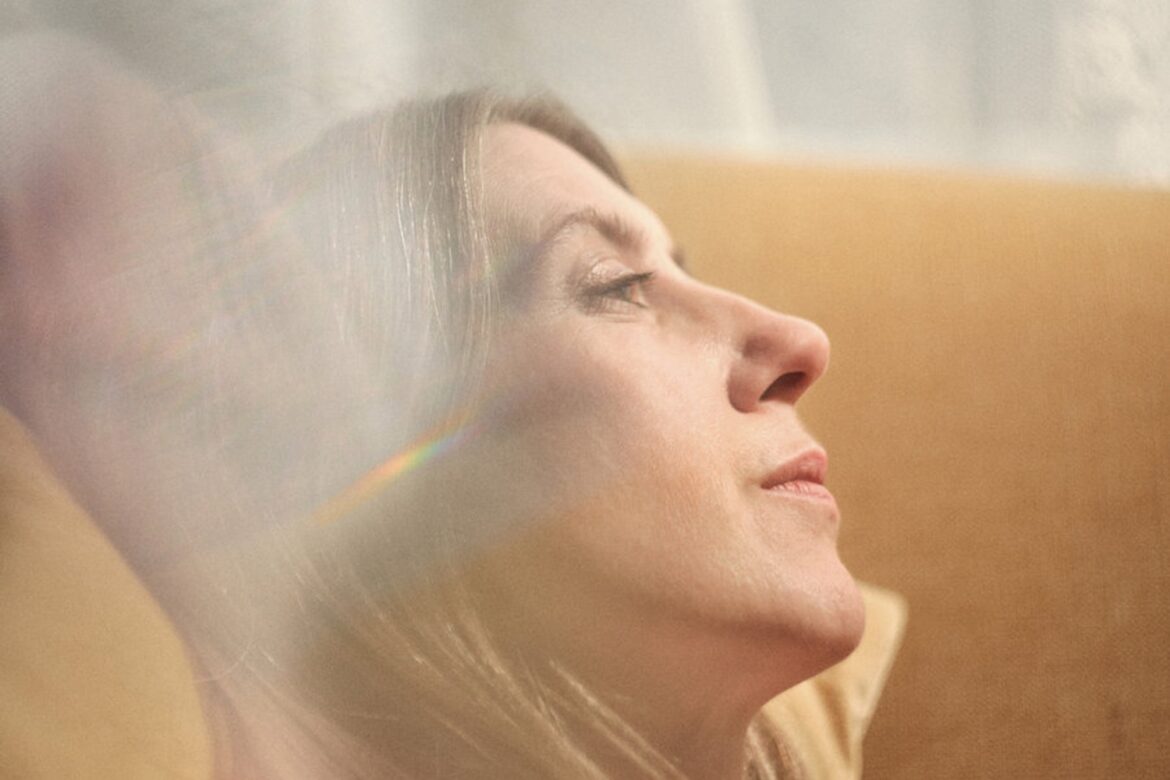
In honor of International Women’s Day, Atwood Magazine has invited artists to participate in a series of essays reflecting on identity, music, culture, inclusion, and more.
•• •• •• ••
Today, Bristol-based singer/songwriter Jenny Lindfors – who records as Sailing Stones – reflects on motherhood, identity, and the long-overlooked relationship between music and maternal life in a special essay for Atwood Magazine in honor of International Women’s Day.
Sailing Stones is the musical project of Irish-born, Bristol-based songwriter Jenny Lindfors, whose psychedelic folk compositions explore memory, identity, and the shifting emotional landscapes of motherhood. Lindfors first introduced the project with her 2020 debut album Polymnia, and now returns with the highly anticipated sophomore album Slow Magic, due July 3, 2026. Written in the years following the birth of her first child, Slow Magic explores the complex emotional terrain of matrescence – the physical, psychological, and emotional transformation that accompanies becoming a mother.
Across twelve panoramic songs, Lindfors channels experiences of joy, dissociation, loneliness, rapture, desire, and desperation, assigning each track its own color as a way of mapping the mercurial emotional spectrum of motherhood. Produced by Lindfors and arranged with composer Dan Moore, the album blends hazy woodwinds, warm guitars, and spacey electronics fed through malfunctioning tape machines, creating a richly textured sound world inspired by artists such as Bobbie Gentry, Scott Walker, David Axelrod, The Electric Prunes, and Jefferson Airplane.
Often writing at home in small windows of time while raising her young daughter, Lindfors drew inspiration from feminist writing, art therapy, and songwriting workshops to help shape the album’s themes and language. What emerged is a deeply personal and kaleidoscopic body of work that reflects the emotional intensity and transformation of early motherhood.
Slow Magic arrives July 3, 2026. Read Jenny Lindfors’ essay below as she reflects on motherhood, music, and the missing cultural soundtrack of matrescence.
•• ••
THE MERCURIAL, MISSING MUSIC OF MOTHERHOOD
by Jenny Lindfors, Sailing Stones
There’s a well-known book on ambient music called “Ocean Of Sound,” written by David Toop.
Early in the book, he discusses the origins of music and says it most likely “developed from the prosodic exchanges between mother and infant.” Then he moves on.
In my dreams, Toop has a ‘needle scratch’ moment at this point. He abandons the idea of writing about ambient music. Instead, he writes a patriarchy-smashing opus that rewrites music history, beginning with the (amazing) revelation that mothers were likely the inventors of music itself.
If he had, maybe my motherhood songs wouldn’t have felt so hard to write, especially when feeling more inspired than ever.
Motherhood was a trip. Days were both mind-numbing and mind-blowing, cycling like an endless whirlpool. This tiny world, magnified through my daughters eyes, was like a portal opening. As she stared into daffodils, I’d slowly repeat the word “yellow,” my vision blurring with exhaustion as she grasped the concept of colour.
It was a blissful and frenzied love, the fragments of which surely must permeate all creation. But it was giving me nightmares. I’d become haunted by the thought of anything happening to her. This made me cling to her, porous with anxiety. The world had never looked more beautiful, or more terrifying.
I suddenly looked very old. I pulled out fistfuls of hair, staring into shrinking eyes in the mirror. I wondered what had happened, and where I’d gone.
Some call motherhood an ego death, but I didn’t want my ego to die. I wanted to be stronger in my identity than ever. I wanted to lead my daughter, by example, through the toxic terrain of a man’s world. But, despite all the feminist principles I’d been raised on, I was living in a world that seemed to accept (embrace, even) my erasure as a consequence of having procreated. Anger and resentment took silent root in the form of guilt and shame.
These clashing feelings were on heavy rotation. On long buggy walks, I yearned to listen to an album that reflected it all. But I couldn’t find one. And I certainly couldn’t write a song.
I then read an article in The Quietus called “An Outlet To Scream – On Motherhood And Music Making” by journalist Jude Rogers. Those words crystallised my experience, and gave me permission to begin writing about it. But why did I need permission? And why was I scared?
I was alerted to the omnipresent symbol of the Madonna and Child, and the stronghold this archetype still has on society’s expectation of mothers. As she hovers above us in the firmament, she is voiceless, passive, and eradicated from the real world. A virgin who never gets pissed off? Please.
From where I stand, mothers know all too well the crucial role that chaos, fire and breakage play in creation. And yet, female anger is often ridiculed or diminished in the mainstream. The fact that the word “hysterical” originates from the Greek word for “womb” tells you everything you need to know.
Back in the 1970s, the feminist art movement produced some radical work concerning motherhood. In the last twenty years, several compelling, unflinching memoirs have been published. But music has remained largely silent. When I read countless articles lamenting the desexualisation of mothers, I wondered if this absence was a remark on the music industry and the nefarious ways it markets female artists. How do they sell the older ones? Are mothers still seen as a little bit icky?
I’d internalised so much of what my culture was saying, and it felt good to name it. It’s good to keep naming it. As I write this article, there’s a still an internal voice telling me I sound like an irrelevant, ranting old lady.
Of course, there’s also the practical issue of time and how rare it is for mothers. When the odds are stacked against you, it becomes dangerously easy to dodge creative pursuits in pursuit of clearing ‘to do’ lists (spoiler – they will never be cleared). I was told that if I created the emotional space for the work, then the time would be more accessible. I found it to be true. It was ten minutes a day sometimes, but that became an hour a week. Cumulatively, time was made.
In the six years that my album slowly emerged, there’s been a burst of brilliant motherhood-themed albums from artists including The Big Moon, Sharon Van Etten and Laura Marling. This was heartening, but sometimes felt devalued by reviews from some respected publications. One journalist lazily lumped several of the albums together as “common folky household stories.” Another referred to writing about motherhood as “a little bit cringe.” Which, incidentally, made me cringe. This was a moment, and there was a risk of the moment being missed.
As Jude Rogers said in 2020, “mothers are not to be silenced from cultural conversations, they are an integral, unshakeable part of them.” These words need to be said over and over again until all traces of the ick factor are gone. Music is the soundtrack to all of our lives. We must keep writing the songs that amplify and immortalise the stories of motherhood. Let’s make some noise and raise each others voices – with an eclectic, disparate and universal symphony of motherhood that will keep reverberating long after we’re gone. – Jenny Lindfors, Sailing Stones
•• ••
:: connect with Sailing Stones here ::
•• ••
•• •• •• ••
Connect to Sailing Stones on
Instagram, Facebook
Discover new music on Atwood Magazine
📸 © courtesy of the artist
Stream Sailing Stones