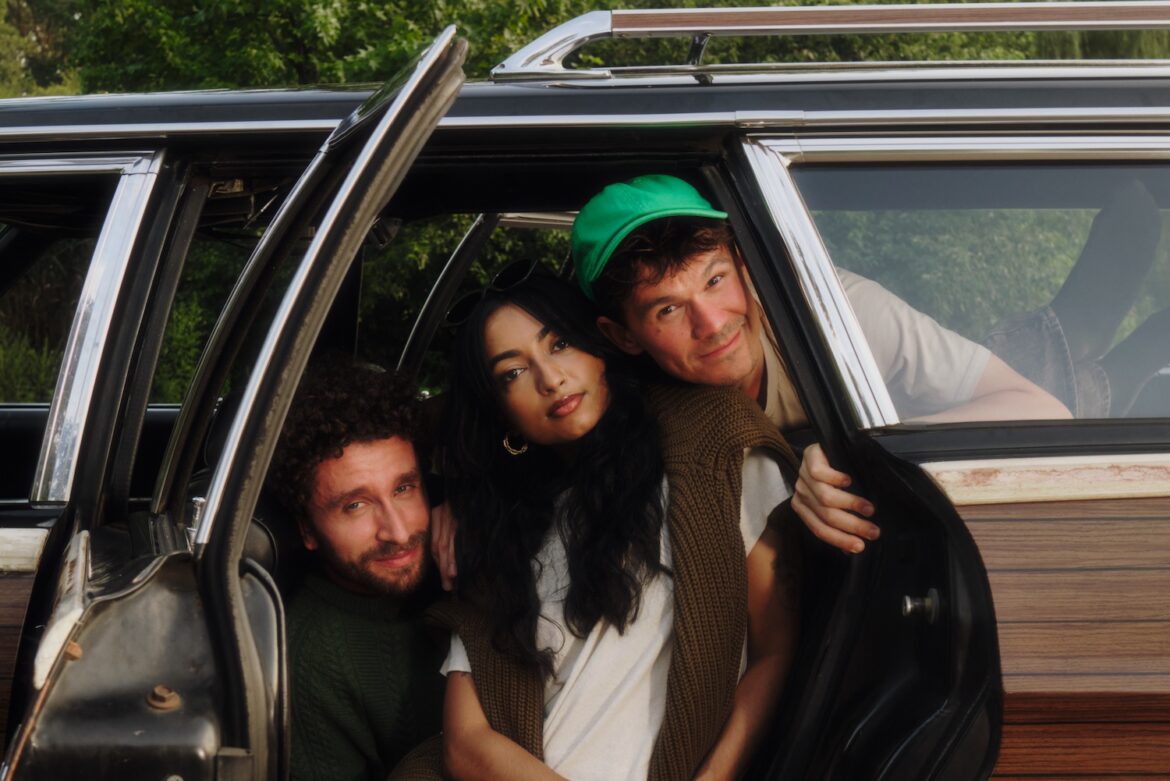
Brooklyn trio FORAGER pull the floor out from under us on their kaleidoscopic single “Pomeranian,” a provocative, shape-shifting, pop-minded fever dream that laughs at curated cool and calls out taste without artistry as empty posturing – refuting the idea that consumption alone counts as creativity.
 follow our Today’s Song(s) playlist


Stream: “Pomeranian” – FORAGER
It’s meaningless to call yourself “a creative” but have no art practice to speak of. It’s actively harmful to define yourself chiefly by what products you consume.
* * *
There’s a moment early in “Pomeranian” where the song seems to tilt under your feet – not collapsing, not quite resolving, just reorienting itself mid-thought.
It’s the kind of shift that makes you lean in rather than brace for impact, and from there on out, FORAGER never let you settle back into expectation. The Brooklyn trio’s stunning single is sharp, funny, unruly, and deeply considered all at once – a song that laughs at curated cool while quietly interrogating what it actually means to make something. Vocalist Shyamala Ramakrishna’s voice is the anchor through it all: Elastic and intimate, every breath and syllable alive with intent, pulling you through a structure that feels loose enough to snap, yet somehow holds together by feel alone. What matters most isn’t where the song lands – it’s that you’re willing to follow it.
There’s rubbish on the sidewalk
Nothing any good
Molly says she found
an old clock in her neighborhood
There’s a mural on the blacktop
She said it wasn’t any good
It’s cruel optimism,
and I don’t know but I should
Released in October 2025, “Pomeranian” arrives as the lead single off FORAGER’s forthcoming sophomore album Even a Child Can Cover the Sun with a Finger, due out this February, and it feels like a bold reintroduction to a band already operating on their own wavelength. One of Atwood Magazine’s 2026 artists to watch, FORAGER – the Brooklyn-based trio of vocalist Shyamala Ramakrishna, guitarist/bassist Jack Broza, and drummer Colum Enrique – have long been a live-first band, building songs with the stage in mind before the studio ever enters the picture.
“We love playing live! We are performers at heart, and our music is meant to be enjoyed at a concert,” Enrique tells Atwood Magazine, explaining that more than half of the new album was rehearsed and played live before any final recordings took shape. That physicality is embedded in “Pomeranian” – you can hear the room in it, the movement, the way parts feel tested and re-tested until the song’s personality reveals itself.
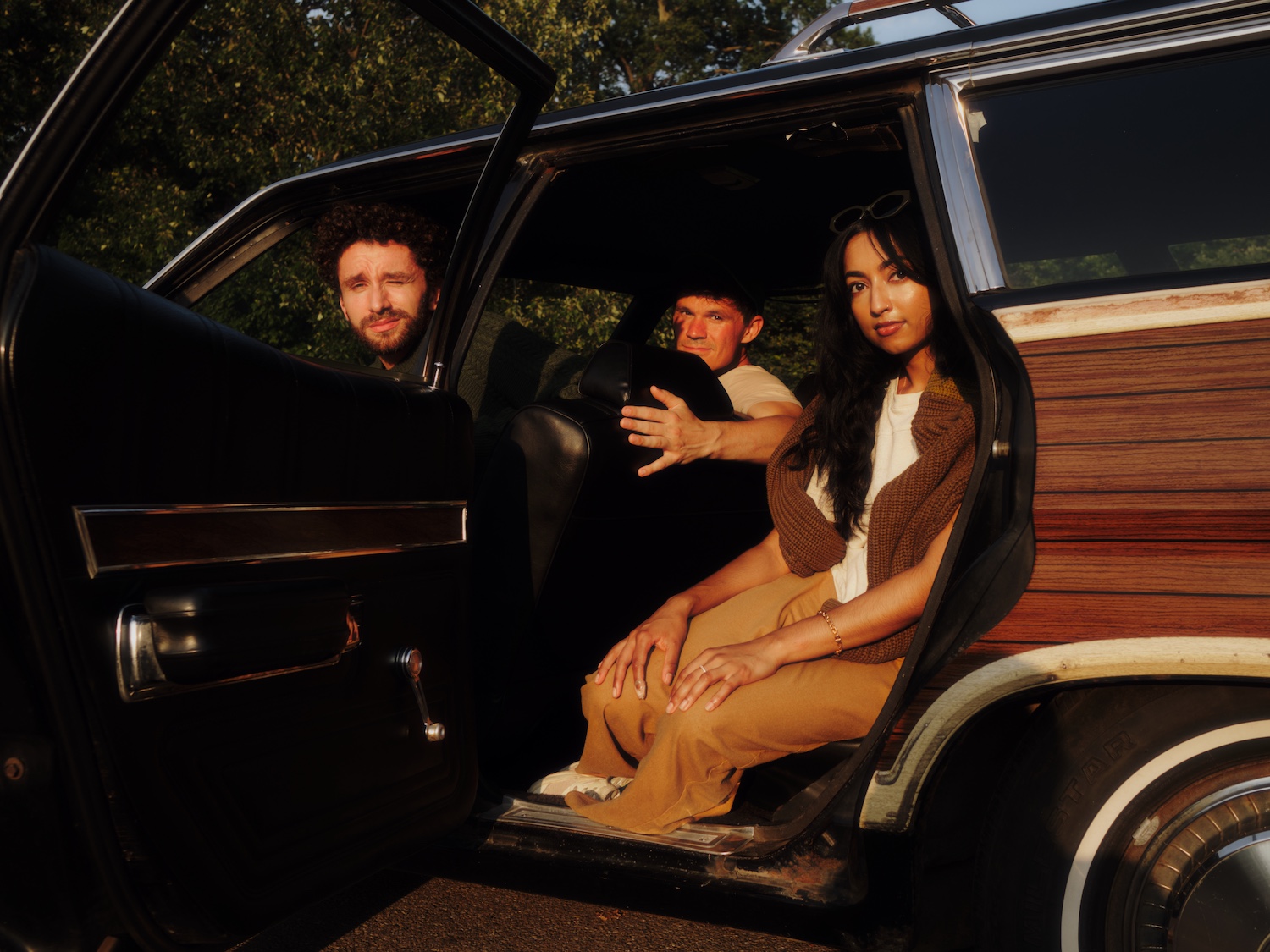
More than just another standout in their catalog, “Pomeranian” feels like the moment FORAGER’s ambition fully comes into focus –
– capturing their wit, restlessness, and technical curiosity all at once, and making a compelling case for why this next chapter feels bigger, stranger, and more self-assured than anything they’ve released before.
That personality is mischievous, pointed, and knowingly self-aware. Written linearly, the song began with Ramakrishna clocking discarded furniture on a Crown Heights sidewalk, which spiraled into a sardonic portrait of Brooklyn’s retro-obsessed, taste-signaling ecosystem. “The lyrics are poking fun without trying to prove a real point,” Broza explains. “My favorite lyric is the one about the grocery store wine… because within sassiness there’s a slight vulnerability and nostalgia – my friends are growing up faster than me, and I remember when we’d drink boxed wine on peoples’ stoops.” Lines like “everybody else’s palate is getting more refined / turning up their nose at the grocery store wine” cut with humor, but there’s ache underneath the punchline – the feeling of being slightly out of step, watching adulthood harden around you.
Everybody else’s
Palate is getting more refined
Turning up their nose
at the grocery store wine
Did you paint it
Making taste with
all that free time?
You’re a rocker
Window shopper
And I’m behind
Musically, FORAGER lean into that tension. The drums land just off where you expect them, the groove flexing and rebalancing beneath the song as it moves. Textures swell and recede, and Ramakrishna’s vocal stretches and curls around the beat, testing how much pressure the structure can hold before it gives way and snaps. A metric flip at the chorus – a trick they’ve explored previously – becomes the song’s gravitational center, landing in a way that feels both satisfying and destabilizing. “The idea of having a metric or feel shift at the chorus is something we’ve played around with before,” Broza says, noting how the band gradually shaped the song through rehearsal and live performance before layering in its stranger production moments. “It’s a cool way to have a chorus land in a satisfying and surprising way.” Those choices are never technical for their own sake. As Enrique puts it, the band is interested in “tempo changes, more interesting harmonic choices, chaotic noise, under the umbrella of a pop song that actually feels like one and isn’t just indiscriminately assigned that label.” It’s accessibility without obedience – hooks that invite you in, then quietly rearrange the furniture while you’re inside.
You’ve got the right touch of vintage
A layer of grit
But I kinda think that you’re full of shit
A touch of vintage
And nothing to say
A pomeranian chasing its tail
You’ve got the right touch of vintage
A layer of grit
But I kinda think that you’re full of shit
A touch of vintage
And nothing to say
A Pomeranian getting its way
Ramakrishna frames “Pomeranian” as an “evil cousin” to the band’s earlier lampooning track “Hello to the Kiddies,” but the critique here cuts deeper. “It’s not enough to have all the right signifiers of taste,” she reflects. “It’s meaningless to call yourself ‘a creative’ but have no art practice to speak of. It’s actively harmful to define yourself chiefly by what products you consume.” The irony, of course, is intentional: Singing about the right touch of vintage within a soundscape that knowingly nods to vintage aesthetics. FORAGER aren’t exempting themselves from the joke – they’re implicating themselves in it, too, wrestling with the uneasy overlap between genuine expression and performative identity in an era of endless curation.

That thematic push and pull threads through Even a Child Can Cover the Sun with a Finger as a whole.
Where their 2023 debut Pipedream Firewood found its shape almost accidentally, the new album is more deliberate, tinged with what the band calls “adult disillusionment,” but also clarity earned through time. Songs across the record grapple with pleasure, parenthood, creative burnout, and love that deepens rather than dazzles.
“In that way it’s all inescapably autobiographical,” Ramakrishna notes, “since the three of us are growing up together.” “Pomeranian” doesn’t try to sum up the entire record – instead, it sets the tone for its range, signaling a band unafraid of contradiction, humor, and risk.
Ask me where I got it
From eBay in Japan
I hate consumerism,
leave the boxes with the doorman
You said you had a vision
Of living off the land
I see you on the grid
in a tractor with a suntan
Everybody else’s
Palate is getting more refined
Turning up their nose at the grocery store wine
Did you paint it
Making taste with all that free time?
You’re a rocker
Window shopper
And I’m behind
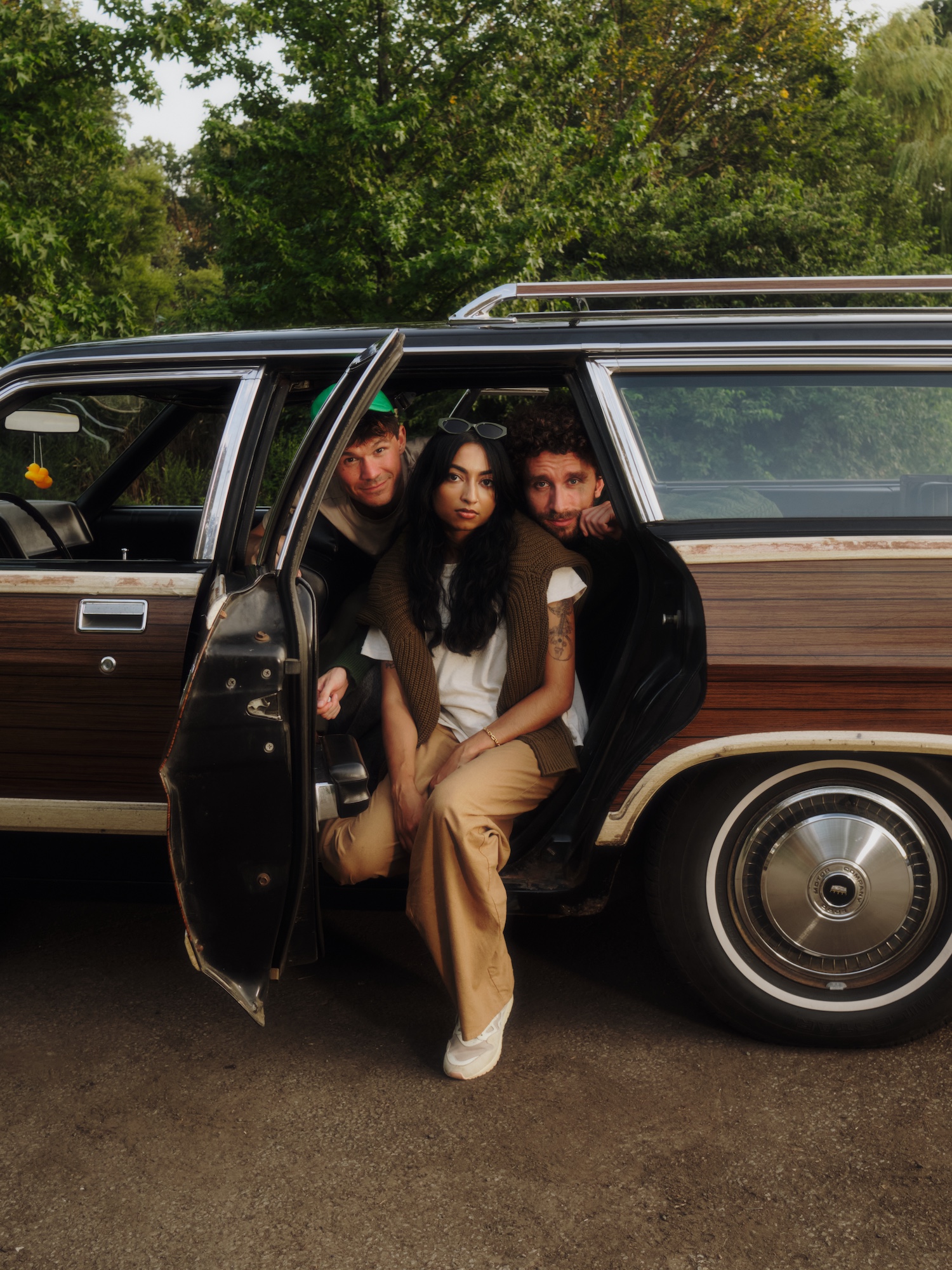
What’s perhaps most striking about “Pomeranian” is that it doesn’t ask to be agreed with. It asks to be engaged with.
It’s messy in the best way – funny without being flippant, complex without losing its pulse, critical without hardening into cynicism – and forever unapologetic in its uniqueness. FORAGER aren’t chasing perfection or polish here; they’re chasing truth through motion, through tension, through songs that can bend without breaking.
As Enrique says, some listeners have found it “accessible and interesting,” while others bristle at the choices. “I love that,” he admits. So do we. “Pomeranian” is alive, argumentative, startling, and deeply human – a song that asks you to pay attention, let your footing shift, surrender to the sound, and trust the feeling of following something that refuses to stand still. And that’s exactly what makes it irresistible.
FORAGER recently sat down with Atwood Magazine to talk through the ideas, instincts, and creative risks behind “Pomeranian,” their upcoming album Even a Child Can Cover the Sun with a Finger, and what it’s meant to grow up – and make art – together. Dive into our conversation below, and hit play on “Pomeranian” – a song that’s bound to knock your footing loose in the best way.
You’ve got the right touch of vintage
A layer of grit
But I kinda think that you’re full of shit
A touch of vintage
And nothing to say
A Pomeranian chasing its tail
You’ve got the right touch of vintage
A layer of grit
But I kinda think that you’re full of shit
A touch of vintage
And nothing to say
A Pomeranian getting its way
— —
:: stream/purchase Pomeranian here ::
:: connect with FORAGER here ::
:: pre-save Even a Child Can Cover the Sun with a Finger here ::
— —
Stream: “Pomeranian” – FORAGER
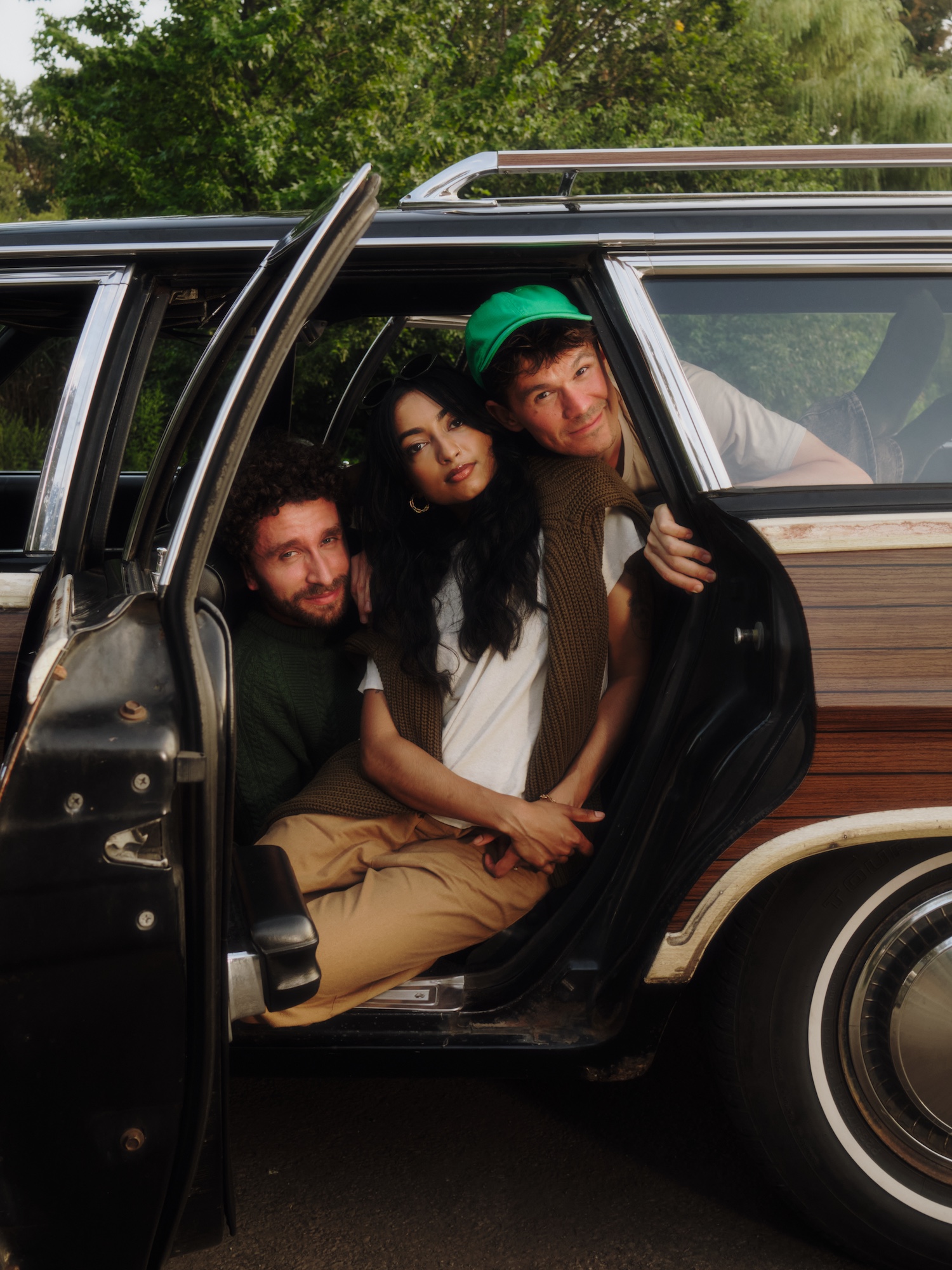
A CONVERSATION WITH FORAGER

Atwood Magazine: FORAGER, for those who are just discovering you today through this writeup, what do you want them to know about you and your music?
Colum Enrique: We love playing live! We are performers at heart, and our music is meant to be enjoyed at a concert. The process of creating our music invariably involves the question, “what does this sound like on a stage?” We used to write music for the sake of having enough repertoire for our shows. Once we were at the point where we didn’t need to rush or scrounge for original material – we noticed that we’d often continue to write and flesh out songs in rehearsals so that we could workshop them in a live context. More than half of the new record was rehearsed and played live before a single note was tracked for the final version. It feels more natural for us to tinker with parts and sounds after we have an honest idea of what the song’s personality is like on stage.
Your musical palette is one of the broadest I've heard in recent years. How do you describe your sound – how do you self-identify? – and who are some of your musical “north stars”?
Colum Enrique: It’s difficult to identify primary influences that we all agree on. We used to get compared to Hiatus Kaiyote a lot – and we have definitely been fans of them for a long time. But we each have our own musical north stars that inform our tastes, and even then those seem to always change. For example while writing and recording the album, Shyamala was listening to a lot of Madison Cunningham. I was listening to a lot of Pedro Martins. Jack has always been influenced by Blake Mills and his projects. But the result of mixing and matching our influences and preferences seems to broaden our palette as you mentioned – not simply because of having many different musical influences, but because the sum of those parts seems to cover more creative ground.
Your sophomore album Even a Child Can Cover the Sun with a Finger is set to release in February. What's the story behind this record, and how do you feel it reintroduces you and captures your artistry, compared to 2023's Pipedream Firewood?
Shyamala Ramakrishna: I’ll admit Pipedream Firewood took its narrative shape by accident, as it was primarily a collection of the songs we’d recorded by early 2023. We had more time to percolate on Even a Child; the center holding it all together is a bit more intentional, and it’s got moments that are darker. There’s a throughline of adult disillusionment – “Your Good Time” contemplates the cost of pleasure. “Split Lip” asks whether it’s worth it to become a parent, all things considered. “Age of Mythology” is the story of a creative kid finding out that the artist’s journey is actually kind of an uphill slog. But it’s not all dark – the album is also about the clarity that time can bring. “Double Dutch,” our upcoming single, explores how the wisdom of experience allows you to finally recognize true love when it’s in front of you. In that way it’s all inescapably autobiographical, since the three of us are growing up together.
I think our sounds have evolved a lot too. We aim to make pop songs through and through, but the new album brings a few more weird thuds and pings, a little more chaos, a lot more unexpected turns – and some truly head-banging moments that we think are new to our sound. We felt a little more free to play around in our third and fourth year together as a band. Our “Pomeranian” metric modulation videos are picking up steam on social media with music nerds. But ultimately we’re hoping for those technical decisions to reflect meaning and mood in a way that anyone can grab onto.
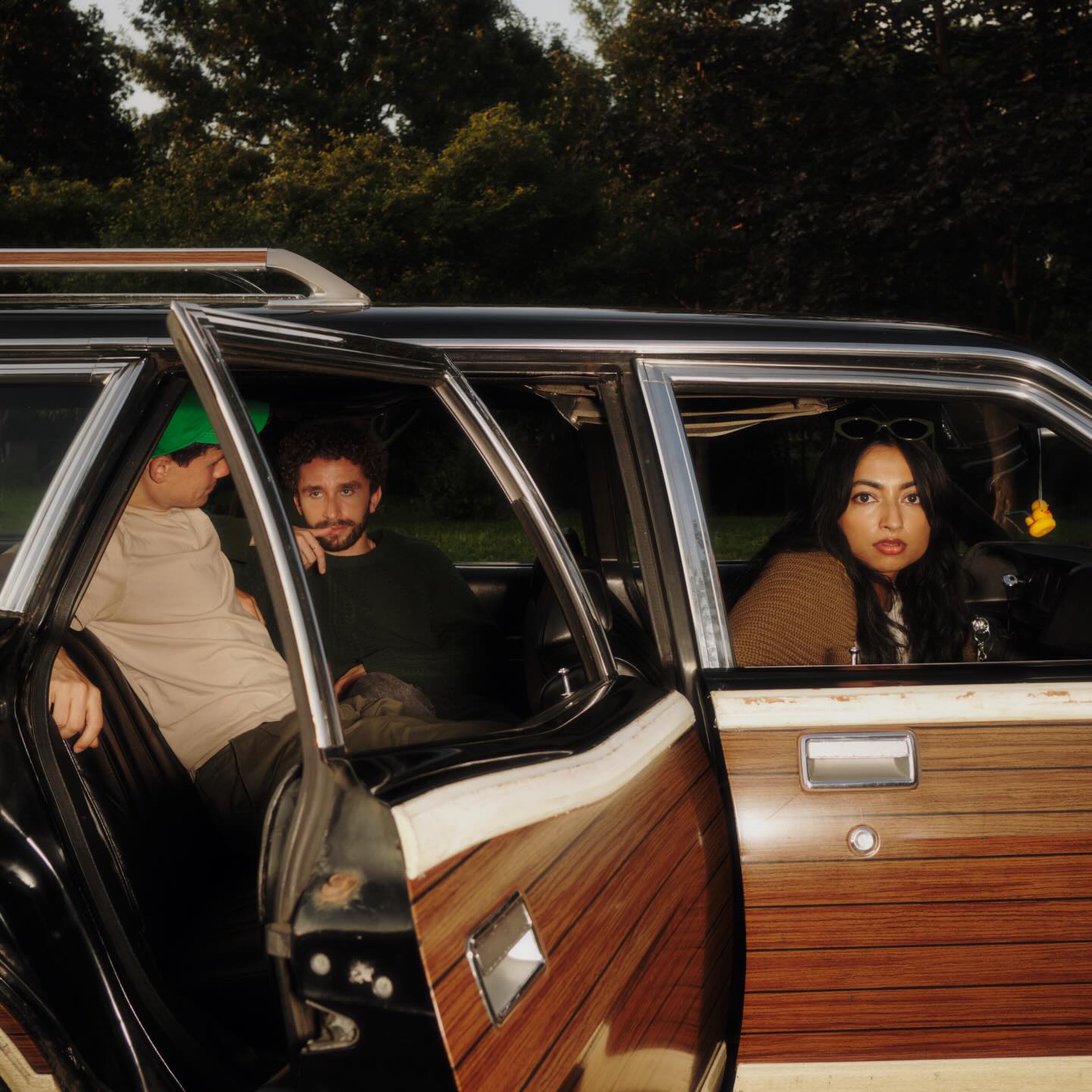
“Pomeranian” is striking for so many reasons – from playing with production, beats, and structure, to the lyrics themselves, I'm utterly transfixed! How did this song come about?
Jack Broza: The song was written pretty linearly– the first thing to come was the verse 1 lyrics, about seeing furniture being put out on the street in Brooklyn when on a walk around Crown Heights, and from that this sarcastic take on these retro-obsessed hipsters started to get developed. I brought the first verse and chorus into a rehearsal with the pre-chorus lyrics missing, but the time switch structure there to build off. The idea of having a metric or feel shift at the chorus is something we’ve played around with before on songs like Fuji or a Trek, and Edgewise, and we think is a cool way to have a chorus to land in a satisfying and surprising way. We gradually brought the rest of the song into its shape in rehearsals and playing it live and bunch, and integrated some of the weirder productions moments like the intro and mid-transitional section once we started recording.
Unpredictable, tongue-in-cheek, sweeping… there are so many words I can use to describe this song – and yet, I know it's so much more than meets the eye. What’s this song about, for you?
Jack Broza: I think tongue-in-cheek is a good way of putting it – the lyrics are poking fun without trying to prove a real point. My favorite lyric is the one about the grocery store wine (“everybody else’s palate is getting more refined, turning up their nose at the grocery store wine”) because within sassiness there’s a slight vulnerable-ness and nostalgia – ie. my friends are growing up faster than me, and I remember when we’d drink boxed wine on peoples’ stoops. Another take on the song that an online commenter pointed out that I really enjoy, is that the aesthetic kinda mirrors the exact thing we’re teasing about. There’s an irony in singing about “the right touch of vintage” in a musical aesthetic that in itself has a vintage-y vibe (as almost all contemporary indie, rock, pop, etc. does – with tape saturation and psychedelic effects all over the place).
Shyamala, you talked about playing with the idea of creativity as projection and “curated cool”; can you talk more these ideas, and how they drove the creation of this track?
Shyamala Ramakrishna: We have a history of gently lampooning unnamed groups of people (see “Hello to the Kiddies” off the old album). “Pomeranian” is, as a listener once described it, an evil cousin of “Kiddies.” In the song we are obviously kinda making fun of our thoughtfully thrifted, cosplaying-anticapitalist neighbors here in Brooklyn. There’s a bit of self-deprecation in there too, if we’re being honest – if we’re close-up enough to see this milieu, we’re closer to it than we think.
It’s unserious, but underneath the silliness is a sentiment about art. It’s not enough to have all the right signifiers of taste. It’s meaningless to call yourself “a creative” but have no art practice to speak of. It’s actively harmful to define yourself chiefly by what products you consume. These sound like harsh words, but in these times, we’ve got to distinguish the ugly and inefficient practice of art from the curation of an impeccable social media profile. Sometimes the two don’t mix (as we’re learning while we try to do this social media thing to draw in listeners). We need to hear that message as much as anyone else.
You recently followed that up with the 5.5-minute “Leave a Little to the Imagination,” another song that evolves throughout its tenure, albeit in different ways. Can you share a bit about this one too, and what it means to you?
Shyamala Ramakrishna: “Leave a Little” is also about growing up. About half of songs about romance (that I’ve heard) capture novelty, that frenetic energy of early stages of connecting with someone. And the other half seem to cover breakups. Which makes sense – there’s a ton of emotional urgency to mine there. I really wanted to write something that covers the vast chasm between – where you’re searching for mystery and novelty, as we’re always doing, but not making any sudden movements because you have a long-term relationship to nurture. In my experience, you can locate mystery glinting in the eyes of someone you know intimately, because you’ll never truly know anyone. That duality is both maddening and thrilling. I wanted “Leave a Little” to capture that, and so it’s a pretty patient and sprawling song.
How does “Pomeranian” fit into the narrative of your upcoming album?
Jack Broza: No single song on the record captures the whole album sound, but we chose the singles carefully to try and reflect the range of tone. There are more tongue-in-cheek moments, such as Haiku Nursery Rhyme, a song that became a fan favorite after we submitted it to the Tiny Desk Contest in 2023. But there are also lyrics with more gravity, like those you find on Split Lip, another track from the LP that we released this past March. It was fun finding the narrative throughlines between otherwise contrasting songs as we put this collection of music together and we hope listeners draw their own connections.
Why the album title “Even a Child Can Cover the Sun with a Finger” – and what can fans of your recent singles expect on the full record? Can you offer a tease in terms of what to expect?
Jack Broza: The album name is adapted from a quote from When We Cease to Understand the World by Benjamín Labatut. It appears on the record in the song “Double Dutch,” the final single from the LP, arriving January 23rd. We settled on that title on a long drive to Pittsburgh for a show – we went through all our favorite lyrics song by song with each of us vetoing and defending options (got so caught up in it we almost ran out of gas). We landed on this full sentence option; we all liked the ring of it, and that it captures something innocent about youth while also having an abstract, prophetic feeling in it.
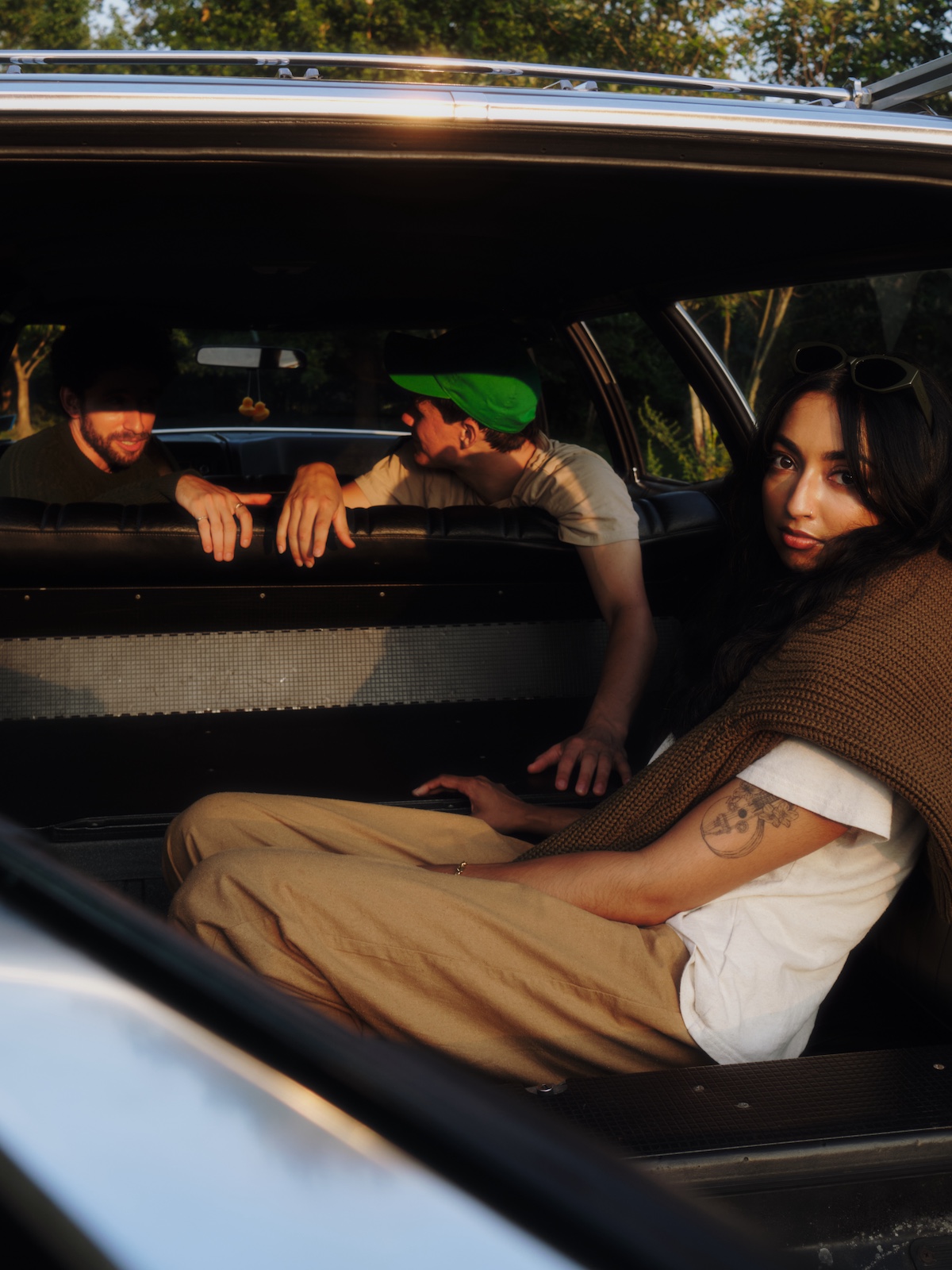
What do you hope listeners take away from “Pomeranian” and your upcoming LP, and what have you taken away from creating this music and now putting it out?
Colum Enrique: We try to reflect while writing and recording anything: is the song too on the nose? Is it too simple – without personality? Is it all over the place and should we rein it in a little? People who have found the song have reached out to us to tell us that it both feels accessible and interesting. But also many in angry comment sections seem to have an issue with the musical choices we’ve made. I love that. I think we did a solid job at expressing ourselves musically while taking creative risks – tempo changes, more interesting harmonic choices, chaotic noise, under the umbrella of a pop song that actually feels like one, and isn’t just indiscriminately assigned that label.
— —
:: stream/purchase Pomeranian here ::
:: connect with FORAGER here ::
:: pre-save Even a Child Can Cover the Sun with a Finger here ::
— —
Stream: “Pomeranian” – FORAGER
— — — —

Connect to FORAGER on
Facebook, TikTok, Instagram
Discover new music on Atwood Magazine
© Isabelle Zhao
 © Isabelle Zhao
:: Today’s Song(s) ::
follow our daily playlist on Spotify
:: Stream FORAGER ::