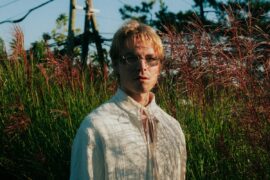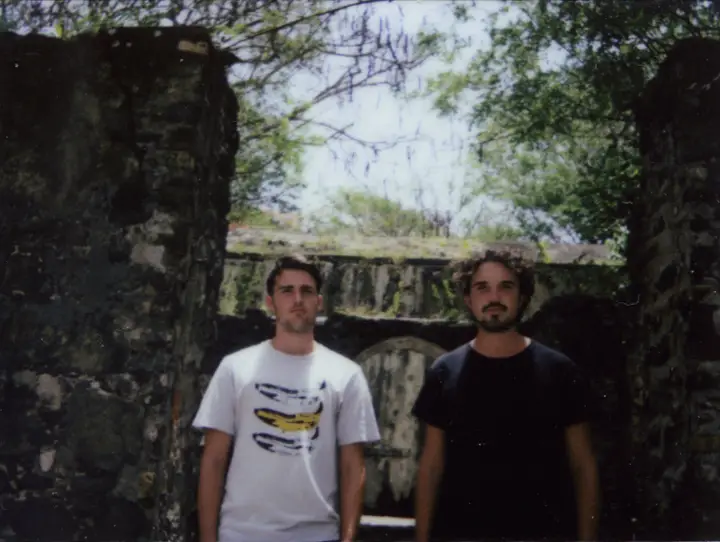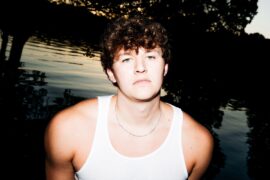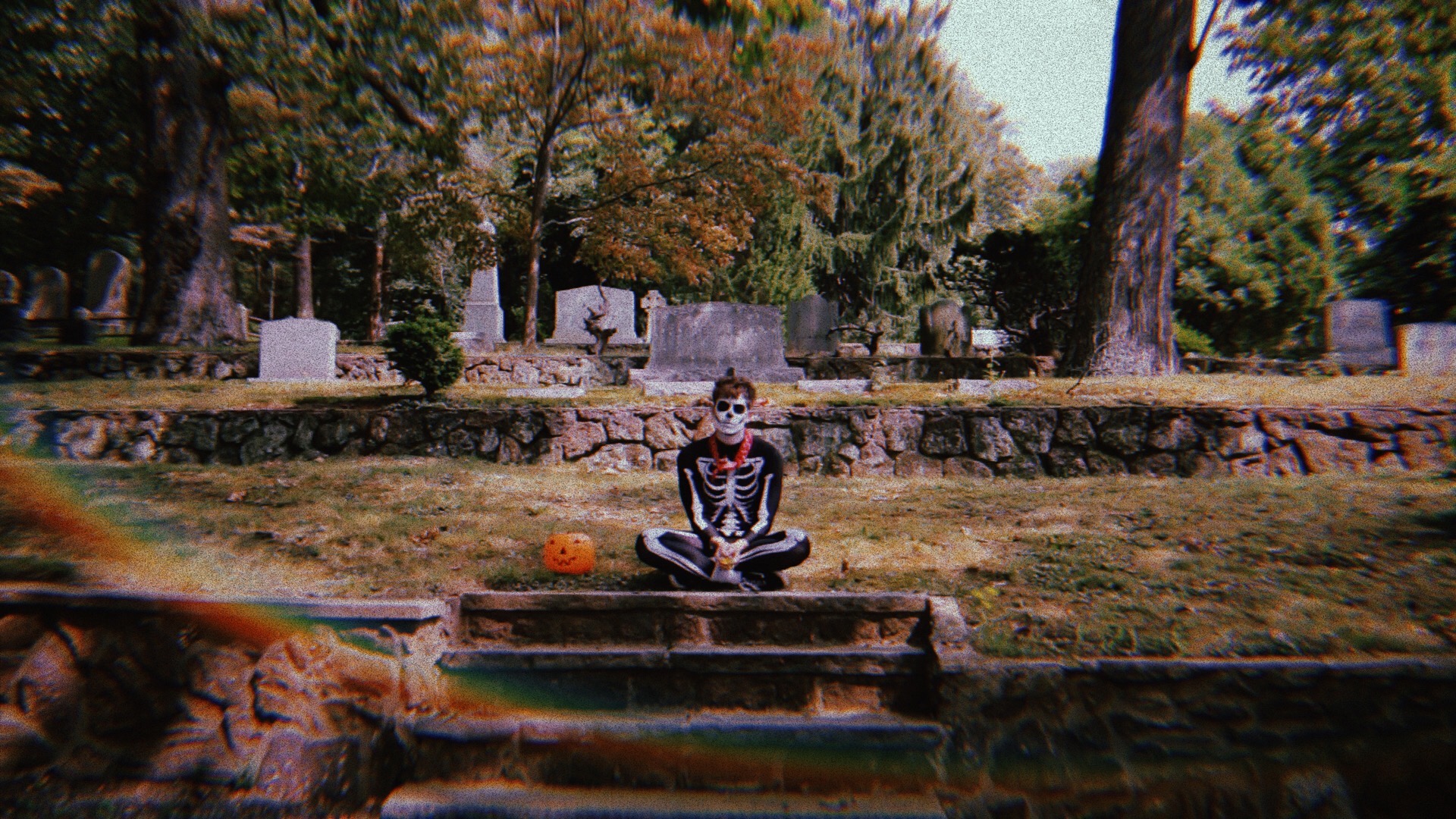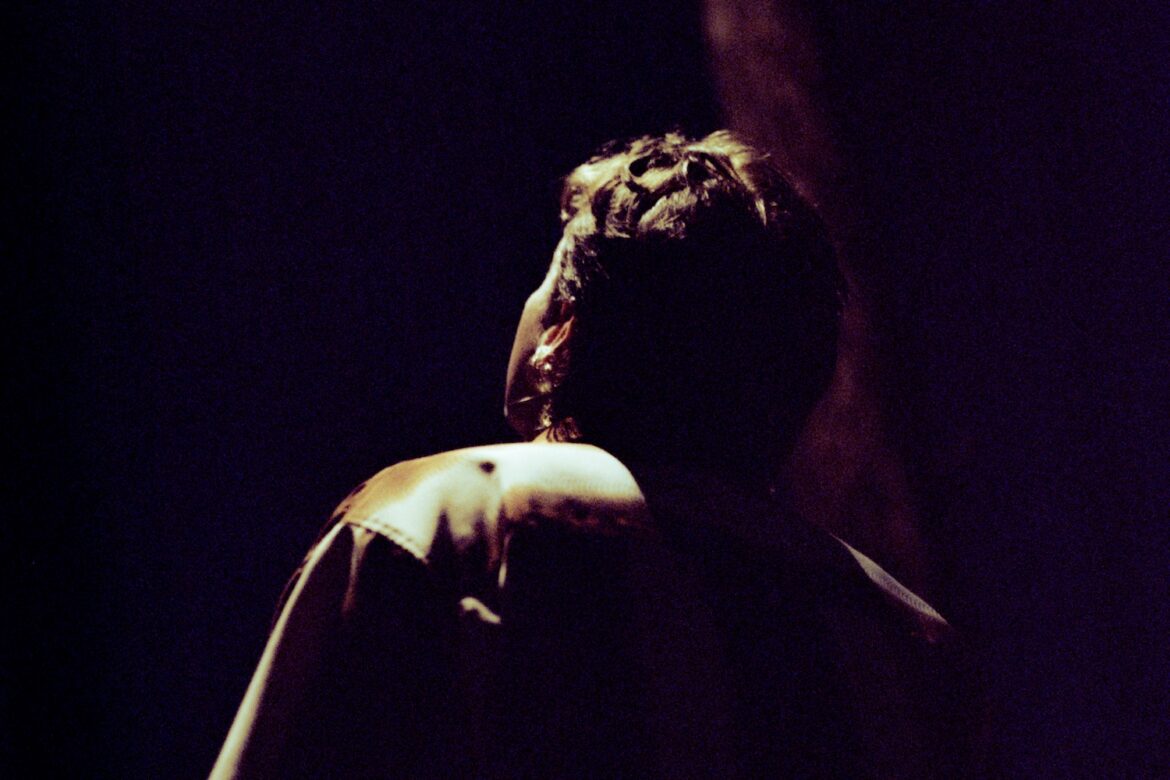
Gerrard makes time feel elastic and alive on his all-consuming debut LP ‘ii. How Many Seconds in a Moment?’, pulling memory, grief, and devotion into a feverish collision of French house pulse, underground shoegaze haze, and experimental pop feeling. Achingly intimate and disarmingly human, the LA artist and filmmaker’s genre-melting music lingers like a half-remembered dream – volatile, hypnotic, and impossible to shake.
‘ii. How Many Seconds in a Moment?’ – Gerrard
I just wanted to make music that I wanted to listen to that didn’t exist yet. Stuff that felt like shoegaze that you could dance to.
* * *
Time becomes unstable when memory gets its hands on it.
A second can stretch until it feels endless; a synth pulse can crack open an old ache; one voice, half-submerged in distortion, can pull grief, desire, panic, and devotion back into the body all at once. Atmospheric and disorienting, provocative and powerfully human, Gerrard’s genre-melting ii. How Many Seconds in a Moment? lives inside that strange suspension, where feeling arrives in flashes and the present keeps bending under the weight of everything it carries.
Atwood Magazine is proud to be premiering ii. How Many Seconds in a Moment?, the self-produced debut album from LA-based artist and filmmaker Gerrard. Out June 12, the eight-track project introduces a singular creative world built from live instrumentation, immersive production, and a rhythm-first approach.
Textural and emotionally direct, Gerrard channels early-2000s French house, underground shoegaze, and experimental pop into music that feels intimate, volatile, and completely alive – as haunting as it is utterly all-consuming.
tell me why you’re out here
standing under street lights
pouring pain on violence
honey shy for another
take another photo
Kubrick for my mantle
partial cinema love
honey shy for another
Tell me would you like it
The colors in your nightmares
Things that never fight fair
That sense of total immersion runs through Gerrard’s work from the ground up.
Long before ii. How Many Seconds in a Moment? became an album, music was the place he went to lose himself, rebuild himself, and make sense of whatever language feeling demanded next. Diagnosed with Perthes disease at seven, he spent much of his youth indoors and in a wheelchair, and music became his main outlet. By fourteen, he was making beats in FL Studio; within a year, producer Michael Uzowuru and members of Odd Future were sharing his instrumentals on a private forum. In his late teens, swimming offered another path forward – one he pursued all the way to a top-50 national ranking and a D1 scholarship offer – but music ultimately held the deeper pull.
This pull has since taken many forms. Gerrard taught himself guitar, bass, drums, cello, and piano; moved to Los Angeles in 2020; played in Bennett Coast’s and Chris Emond’s bands; made visuals for Magdalena Bay, Bickle, Asha Imuno, and Dylan Brady’s Cake Pop collective; produced for Johan Lenox and Rachel Prancer; and learned the film world alongside crew from A24’s Everything Everywhere All at Once. Even that list only begins to explain the density of his creative practice. What matters most in Gerrard’s work is how personal it all feels: Made by hand, chased with care, and shaped by an artist who treats sound and image as part of the same living architecture.
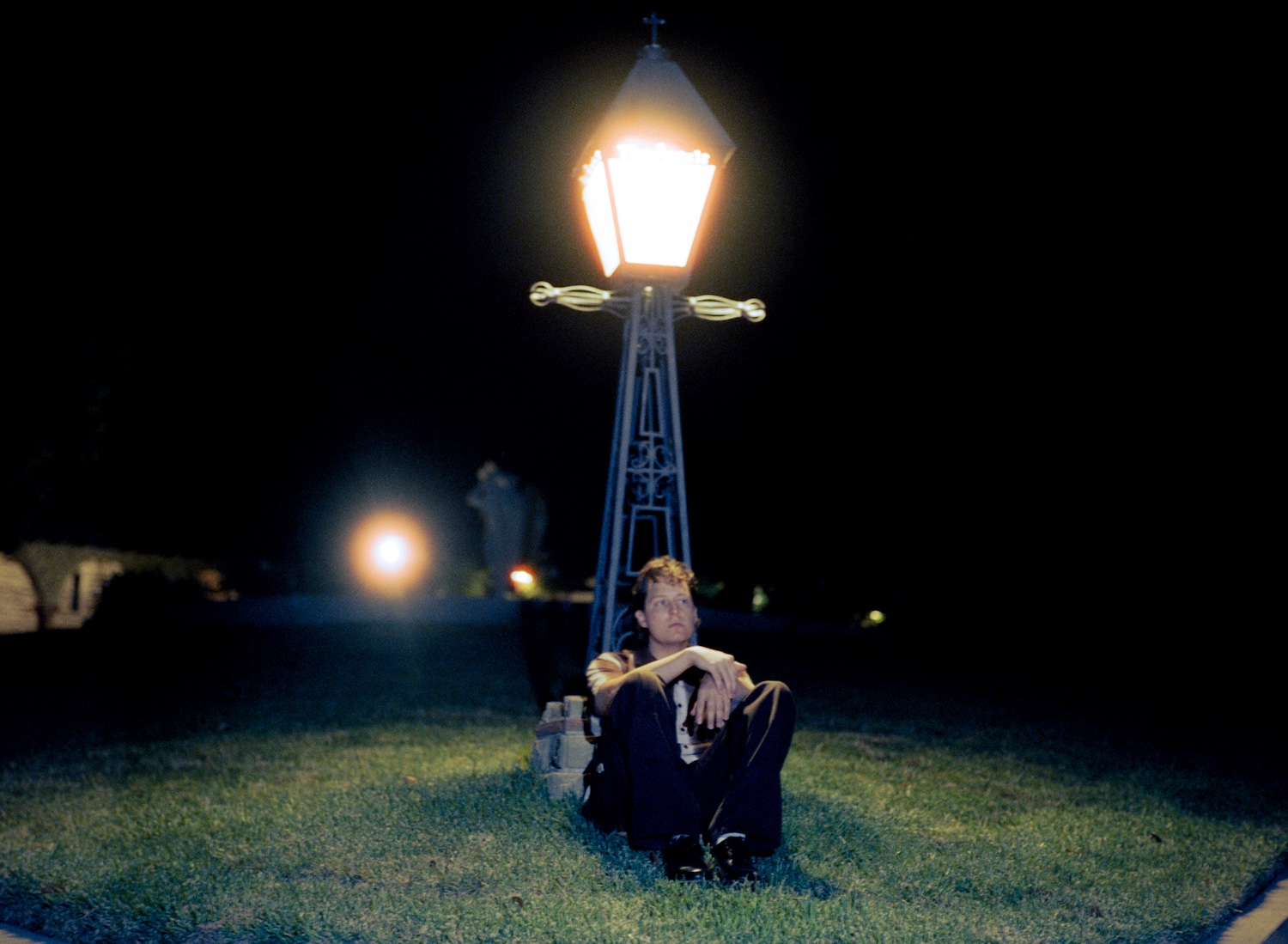
“Everything you hear on this record is played live on real instruments by myself,” Gerrard tells Atwood Magazine.
“No AI, no Splice loops, whatever. I do this because I enjoy the expressive nature of creating things, and get deeply lost in that process, and have for my whole life. I have also directed and shot all of the recent videos that accompany the songs, creating a fully formed visual world from scratch, going over every detail by hand. No shortcuts, just out of love for making art.”
His devotion is audible from the first seconds of “All That’s Holy*,” an opener that glows, throbs, and fractures before fully taking shape. Gerrard has said the song’s opening synth came from a Mutable Instruments Plaits modular synth, whose granulated texture reminded him of time breaking apart – and the effect is immediate. The song begins in suspension, all ache and signal, before locking into something more rhythmically driven and bodily. Its lyricism moves through under-love, overgrown fields, towers, flight, and surrender, eventually circling the stark refrain, “All that’s holy / All that lies.” It’s a fitting entrance into an album obsessed with presence and perception: sacred and unstable, devotional and distorted, like a prayer trying to keep its shape under pressure.
Sentimental cues of under-love
I hope you never find it out
Overgrown fields carry far too much
I hope they never cut you down
In the tower standing on his bluff
I hope he never sees the ground
Anywhere around that we could go
I would go, I would go
All that’s holy
All that lies
All that’s holy
All that lies
I was on the run from myself too long
And now I’m finally failing up
I was in the sun for far too long
And now I’m finally burning off
I was in the stars of million mile
And now I’m finding all the rest
Anywhere around that we could go
I would go, I would go
“Honeyshy” sharpens that emotional static into a grittier, glitchier charge.
The song feels lit from below, caught somewhere between streetlight confession and fever dream, with its imagery of pain, violence, photographs, cinema, nightmares, and colors that refuse to behave. There’s a bruised glamour to it – a sense of intimacy distorted through a cracked lens – yet the song never loses its pulse. Gerrard has called “All That’s Holy” and “Honeyshy” two personal highlights, and “Honeyshy” carries that excitement in its bones: It’s cathartic and strange, vulnerable and physical, the kind of track that feels like it’s falling apart and finding its body at the same time.
“Neverlet” moves differently, even as it remains tied to the same emotional atmosphere. Enchanting, glitch-warped, and trip-hop-adjacent in its sway, the song turns attachment into a loop that feels both romantic and haunted. Gerrard has described its second verse as a personal story threaded with a reference to Lost, and that sense of narrative dislocation feels essential: cars, karma, ocean, regret, and desire all blur together until devotion starts to resemble a place someone can’t leave.
In another life
No never mind
You were looking for it
You never noticed
That you adore it
Pulling on a broken line
Dialing in the light of lime
Summer time holding
Free for the morning
Three in the morning light
but you would never let me go
and i would never let you go
The lyrics drift through late-night drives, unanswered questions, and the uneasy comfort of familiarity, balancing tenderness against self-destruction as Gerrard sings of wanting someone close even while recognizing the damage that closeness can bring. Images of drowning, drifting, and being pulled under reinforce the song’s emotional undertow, while references to fate and consequence suggest a relationship caught between choice and inevitability. The repeated refusal at the center of the song gives “Neverlet” its ache; love here is not a clean release, but a gravitational field, pulling two people back through the same memory again and again.
“WYWH*” pushes that ache into more volatile terrain.
Gerrard describes the song as more experimental in nature, and it earns that distinction through its churn: jarring, propulsive, and emotionally exposed, with its longing for presence collapsing into images of traffic, headlights, blood, distance, and helplessness. The lyrics sharpen that desperation into something visceral, as Gerrard repeats, “I wish you were here,” caught between yearning and resignation. Elsewhere, flashes of imagery – “driving my hatchback in traffic, I swerve and see headlights, I look down and I’m bleeding out” – turn absence into something tangible, a physical force pressing against every thought. The title’s implied absence gives the track its wound, but the production refuses to sit still inside that grief. Instead, “WYWH*” moves like a mind in crisis – circling the same impossible wish, trying to outrun the reality it already knows it cannot change.
By the time “Modern Entropy” arrives as the album’s penultimate track, ii. How Many Seconds in a Moment? has traveled through desire, devotion, panic, remembrance, and release without ever settling into one stable form. Gerrard has called the song the album’s antithesis, and it feels that way immediately: Gentler in its drift, dreamier in its motion, and quietly devastating in the way it lets goodbye hover without fully landing. Its lyrics move through distance and dissolution with a striking tenderness, reaching for connection even as it slips away: “We go on and on and away,” Gerrard sings, later confessing, “I’ve fumbled every life / Time to say goodbye.” Where earlier songs burn with immediacy, “Modern Entropy” lingers like an afterimage, holding onto fading light for as long as possible.
Holding down the line
I see you every time
Can never say goodbye
We go on and on and away
We go on and on and away
We go on and on and away
We go on and on and away
I’ve fumbled every life
Time to say goodbye
The album ultimately ends on the nearly six-minute instrumental title track, “ii. How Many Seconds in a Moment?,” an electro-forward finale that leaves words behind altogether. After so much emotional excavation, its absence of lyrics feels meaningful: A suspension, a final immersion into texture, motion, and feeling.
Rather than answering the question posed by the album’s title, Gerrard lets it echo outward, dissolving into sound and leaving the listener inside the mystery a little longer.
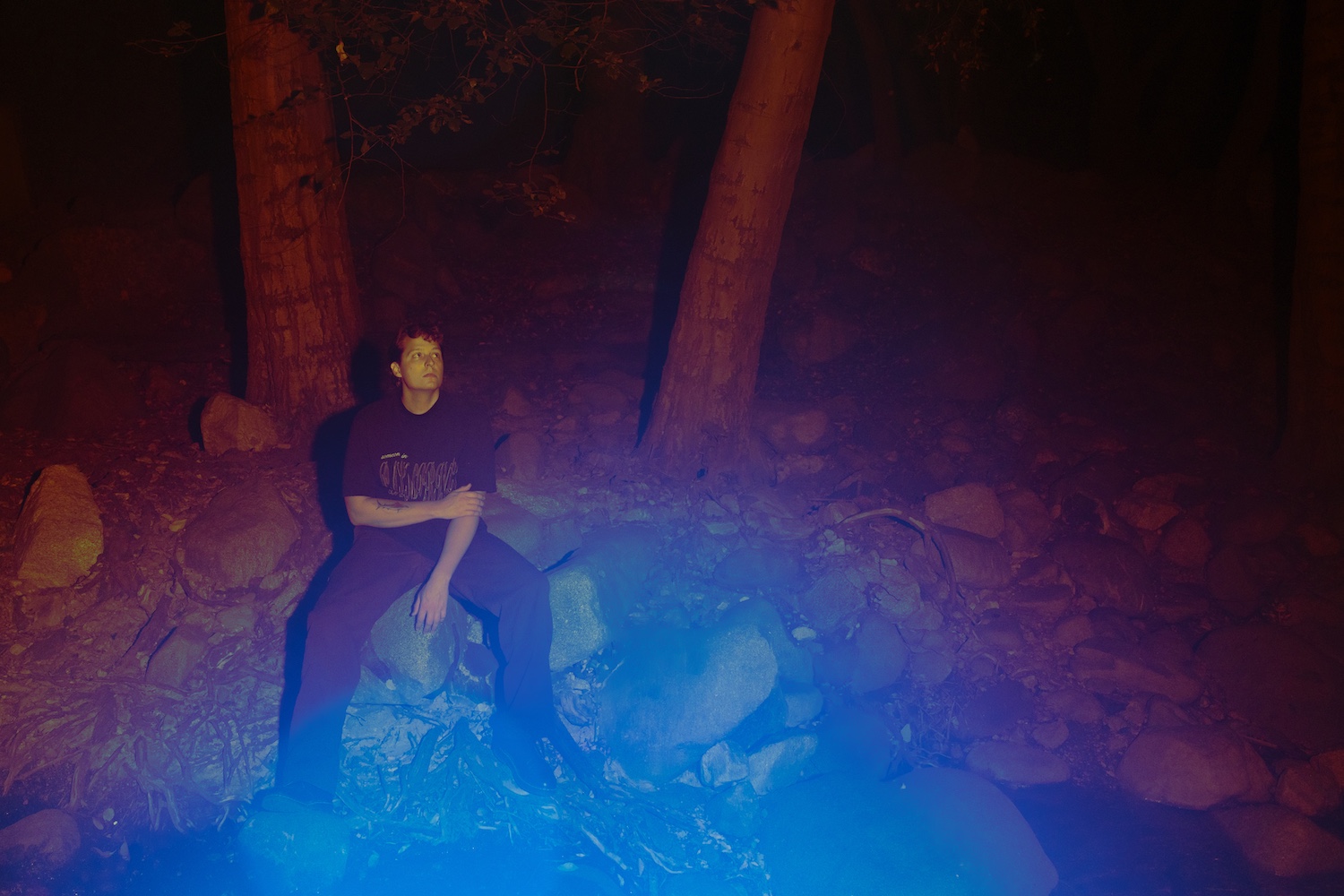
Taken together, these songs make ii. How Many Seconds in a Moment? feel less like a debut than an arrival into a fully realized inner language.
Gerrard’s music can soothe and unsettle in the same breath, pull the listener close and then split the frame wide open. It’s intentionally experimental without feeling alienating; accessible and thoughtfully crafted, without sanding down the strange edges; and deeply human in the way it lets time, memory, and emotion bleed into one another. Every track opens its own door; every sound seems to carry a hidden room behind it.
As Gerrard prepares to let ii. How Many Seconds in a Moment? move beyond the room where it was made, he is not measuring the album by whatever happens next. For him, the real triumph already lives inside the act of creation itself.
“I don’t have a real hope of what they might take away,” he says. “I think for everyone it may be different. This is my honest expression, and any given person may relate to it in a different way. And if they don’t, no worries. With this project I have found the ‘success’ of the music feels intrinsic to the creation. Meaning, whatever outcomes occur from release and sharing are out of my control. The real achievement for me personally was to be able to create a body of work that I wanted to listen to.”
That personal satisfaction is the ultimate, true beating heart of ii. How Many Seconds in a Moment?: An album made earnestly in devotion to the feeling of being fully inside the work. It asks how long a moment can last, then lets sound stretch the question until memory, presence, and emotion begin to blur.
Stream ii. How Many Seconds in a Moment? exclusively on Atwood Magazine, and read on for our expansive conversation with Gerrard as he opens up about time and presence, building a visual world by hand, making “shoegaze that you could dance to,” and the beautiful, sustaining act of creating art for its own sake.
Let this record pull you in and pull you apart; let a single second become a whole world unto itself. By the end, time stops marking the music and starts moving through you.
— —
:: stream/purchase ii. How Many Seconds in a Moment here ::
:: connect with Gerrard here ::
— —
‘ii. How Many Seconds in a Moment?’ – Gerrard
A CONVERSATION WITH GERRARD
Atwood Magazine: Gerrard, for those who are just discovering you today through this writeup, what do you want them to know about you and your music?
Gerrard: Everything you hear on this record is played live on real instruments by myself. No AI, no Splice loops, whatever. I do this because I enjoy the expressive nature of creating things, and get deeply lost in that process, and have for my whole life. I have also directed and shot all of the recent videos that accompany the songs, creating a fully formed visual world from scratch, going over every detail by hand. No shortcuts, just out of love for making art.
Who are some of your musical north stars, and what are you most excited about the music you're making today?
Gerrard: For the development of this album, it was pulling from a lot of 2000s French House like Daft Punk, Justice, Sebastian, and others in that scene, as well as early underground shoegaze like Loveliescrushing, Seefeel, and Lush. I actually shared some early versions of the album with Scott Cortez of Loveliescrushing and he put me on to a lot of obscure stuff they were doing back in the day fusing electronic ambient experimental stuff with big walls of distorted sound. I’m really excited about how I set out to capture that feeling, siphoned it through my lens, and what came from that. The cover of babysbreath was sort of the sonic thesis that laid the foundation for the project, and then from that the songwriting was built within that world.
You've cited Alex G as a major influence, and I'd love to know, where do you feel his imprint most in your own songwriting?
Gerrard: I’m just fascinated with his songwriting and lyricism. It’s so simple yet effective. I think it’s the authenticity and earnestness that resonates with me that I try to pull from in my own music. Not necessarily his specific sound. That said I have definitely pulled a lot of inspiration from his guitar playing over the years.
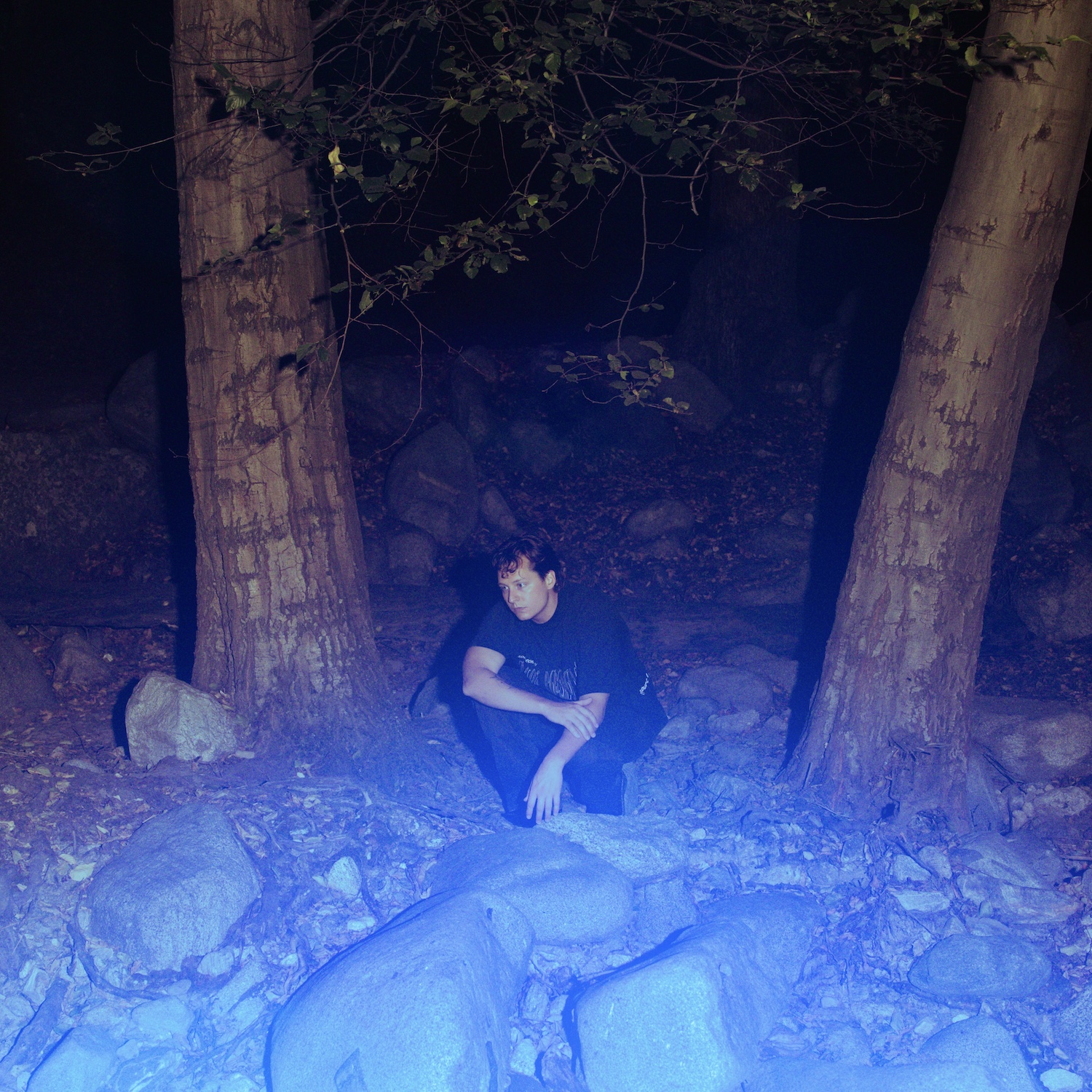
Can you share a little about the story behind your “debut album,” ii. How Many Seconds in a Moment?
Gerrard: It may be my debut album, but it’s one of many projects I’ve released as an independent artist over the years. This is the first time I’ve felt I’ve been able to really focus my vision across a larger body of work and construct a cohesive world around that successfully. It was a challenge to make, in the sense that I was pushing myself every day musically for over a year to get what I was looking for, but I feel that strain helped produce something I really resonate with.
What was your vision going into this record? Did that change over the course of recording this?
Gerrard: At the very beginning, I just wanted to make music that I wanted to listen to that didn’t exist yet. Stuff that felt like shoegaze that you could dance to. I did so much digging and never really found anything that sounded quite like I envisioned, just as a listener and fan, so I decided to start making that for myself. Songs like “cb:)” and “All That’s Holy*” were some of the first experiments in that world and over time each song built upon that and branched out further.
As I developed the album more, I wanted to be open to experimentation and trying more things that you may not hear on a single. The titular track is over 5 minutes of ambient live improvisation on guitar and synth – that’s not something I’d release as a single, and I think I wanted to explore those moments here. Modern Entropy became the antithesis to the project, but I feel fit in a way that it lived in the same sonic world while also breaking all the rules I developed along the way.
Why the title “ii. How Many Seconds in a Moment”?
Gerrard: The album was initially called ‘Every Precious Moment’ and just became a focus after a personal focus on presence in life, and how so much of my own internal dialogue and world could pull me away from the present moment. The question asked is a thought I had one day in high school while walking in the snow. How much can you divide time? We have seconds, milliseconds, etc. – but where does a “moment” as we perceive exist? I don’t know if there’s an answer, but the idea that a moment could be divided an infinite amount of times and could also look different for everyone alive interested me.
How do you feel ii. How Many Seconds in a Moment? introduces you and captures your artistry?
Gerrard: This project was produced almost entirely on my own, in my room, with very little outside input. The only exception was “WYWH,” which features some additional production parts from Bickle, and additional vocals from Rachel Prancer. But those were more tertiarily added later anyways. The album is a very undiluted view into my production and writing preferences. It’s the most honest version of what it sounds like in my mind and how I’d etch that into a tablet so to speak.
You open the album with this hypnotic pulse in “All That's Holy*” that can't help but recall the xx for me. Why kick off the record this way – what does it evoke for you, and how did you know “All That's Holy*” was the song to start things off as both opener and lead single?
Gerrard: I love the xx, and just long weird evasive moments in songs. Especially a song like “All That’s Holy*,” which after the intro is pretty rhythmically driven through the end. The opening synth was this new modular synth I got, the Mutable Instruments Plaits, and I was obsessed with that particular sound on it at the time, the way it granulated the initial oscillator and becomes this fragmented thing. It reminds me much of the concept of time and how it is broken up, in connection to the albums overarching theme. I approach title tracks of the view like, if I have one song to show people before they get bored and take off the record, what would it be? I’d love for them to listen to them all, but I appreciate everyone’s time is valuable and constantly fought for, so I want to begin in a way that can say everything needed.
You've since released the singles “Modern Entropy,” “Woolen,” “Neverlet,” and “Honeyshy” over the past few months. How do you feel these tracks expand the album’s world?
Gerrard: Every song tells a different story within the overall broader context of the album, written as letters to different people. I want to make sure each song exists in the same sonic space while still feeling like its own moment.
Do you have any favorite deep cuts / non singles that you’re particularly excited about?
Gerrard: There is a song on the album, “WYWH*,” that is a little bit more experimental in nature that I am really excited about. It came together over a long period of time and took a few different forms, but I think embracing the album format let me experiment more with songs like this.
Much of your lyricism feels incredibly intimate, cinematic, and emotionally suspended – like half-remembered scenes of grief and love, reflection and reckoning. Do you have any favorite lyrics in these songs?
Gerrard: I think my lyrics on “All That’s Holy,” “Honeyshy,” or “Neverlet” are some of my favorites. (Sentimental cues of under-love, I hope you never find it out, Overgrown fields carry far too much, I hope they never cut you down, In the tower standing on his bluff, I hope he never sees the ground, Anywhere around that we could go, I would go, I would go) Verse 1 from “All That’s Holy.”
Verse 2 from “Neverlet” (cue Elizabeth, I need you every time, riding in your Honda, coloring the karma, feeling alive but you’re feeling lost, I need you shepherded, we cannot afford this, falling in the ocean, standing in regret) was also both a personal story imbued with a hidden, or not so hidden, reference to the TV show Lost… which I was deeply into when I wrote the song. Myself, my girlfriend, and our friend Lauren (who shot the cover art for the album) were all watching it, and I just love the story and world from there and it found its way into the music.
Do you have any definitive favorites or personal highlights off this record?
Gerrard: I think every song captures a piece of what I have to say in a way that I am proud to share. In that way, they’re all my favorites, but if I had to be more specific, I would say that “All That’s Holy” and “Honeyshy” have always been ones I was particularly excited about. “Honeyshy” actually came together in the funniest way too. I originally made the instrumental while playing World of Warcraft, and sort of just saved it for later. Then one day, I had another song I had written and recorded to, that I was trying to pull up and it seemed like the file had corrupted. I started to panic, because I’d lost months of work, so I ended up re-recording those vocals with a new melody, but the same lyrics, over “Honeyshy.” I thought it worked out so well that when I was able to recover the other song, I ended up just letting it go and keeping “Honeyshy.”
Can you describe this record in three words?
Gerrard: Temporal, eclectic, pop
What do you hope listeners take away from ii. How Many Seconds in a Moment?, and what have you taken away from creating it and now putting it out?
Gerrard: I don’t have a real hope of what they might take away. I think for everyone it may be different. This is my honest expression, and any given person may relate to it in a different way. And if they don’t, no worries. With this project I have found the “success” of the music feels intrinsic to the creation. Meaning, whatever outcomes occur from release and sharing are out of my control. The real achievement for me personally was to be able to create a body of work that I wanted to listen to.
In the spirit of paying it forward, who are you listening to these days that you would recommend to our readers?
Gerrard: Rachel Prancer is one of my current favorite artists, and I have been working on a lot of music with her. Also Bickle, a good friend of mine and one of my favorite artists. Lots of Elliott Smith and 2Hollis as well. Kind of all over the place, but I come from the underground electronic music scene world and am constantly listening to new weird electronic stuff from friends. Some others like Loukeman, Tommy Fleece, The Hellp, have been in heavy rotation.
— —
:: stream/purchase ii. How Many Seconds in a Moment here ::
:: connect with Gerrard here ::
— —
‘ii. How Many Seconds in a Moment?’ – Gerrard
— — — —
Connect to Gerrard on Instagram
Discover new music on Atwood Magazine
© Lauren Kim
 © Lauren Kim
:: Stream Gerrard ::