Music isn’t just a job for Dogpark – it’s a way of life. All they want to do is create, but what does that mean in an industry obsessed with clicks and money? The NYC-based indie rock band utilize satire to make a statement about it all in their latest EP, ‘Corporate Pudding.’
Stream: “Dandelion” – Dogpark
Dogpark started off as a college cover band, but after a little word-of-mouth and determination, they quickly became much more.
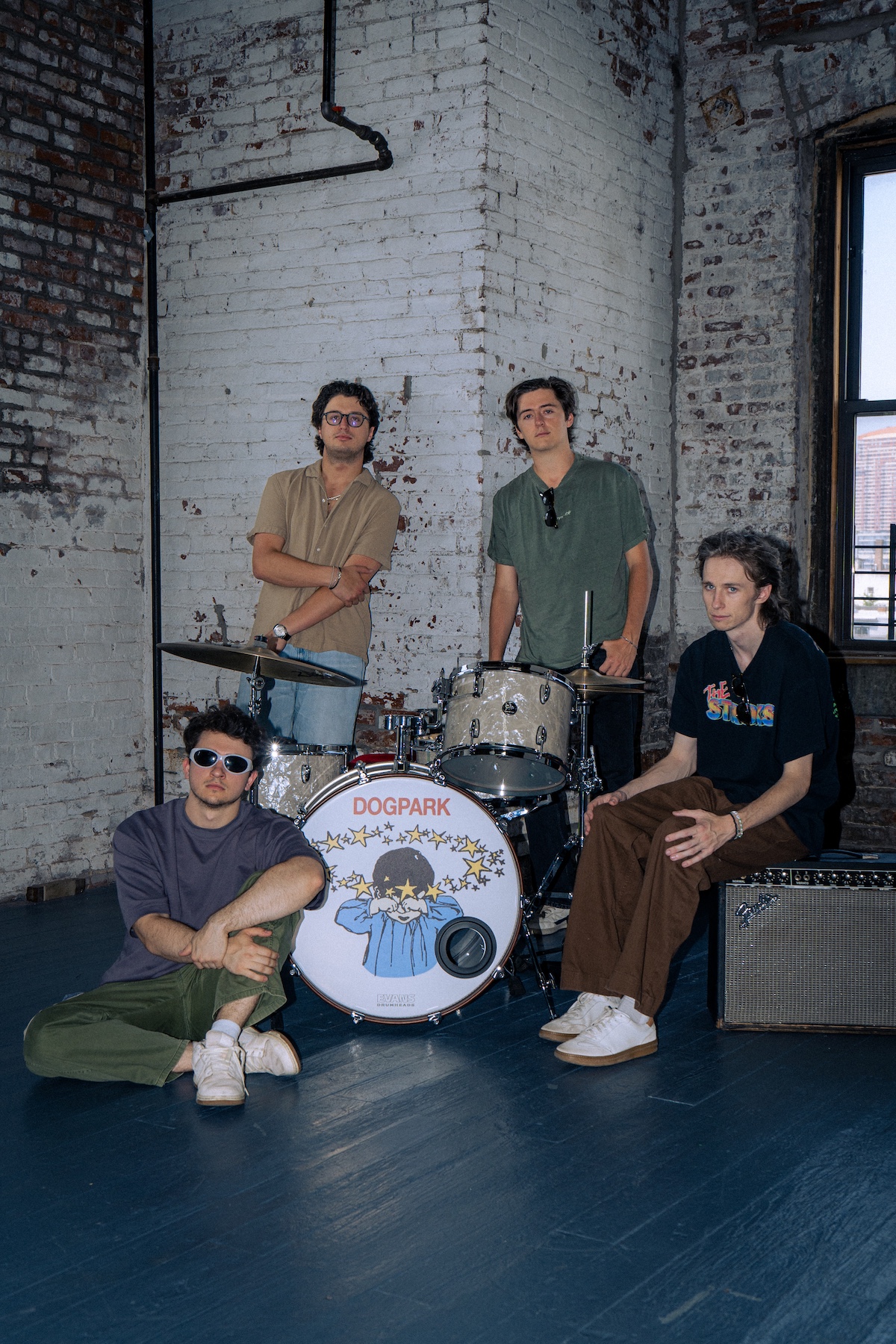
The NYC-based indie rock group consists of lead singer Eamon Moore, drummer Christian Conte, and guitarists Declan Harris and Billy Apostolou. The four released their first single in 2023, and already have played major festivals and a sold-out tour.
The success of the four-piece has come with tough decisions and learning curves, but it hasn’t stopped them from being unapologetically themselves. Dogpark’s music is so well perceived, not just because it’s catchy, but because it feels real. They’re far from a manufactured group tip-toeing around tough topics. Instead, they lean into them, pushing back on societal issues on their latest EP, Corporate Pudding.
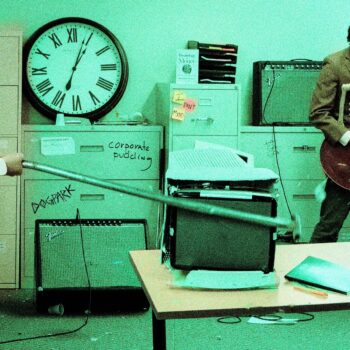
“Corporate Pudding is an EP that offers commentary on modern society through allegory and satire (along with a driving and electric rock sound). In particular, how the access to everything you could conceive at the click of a button has become sort of an opiate for the modern young adult,” Dogpark shared upon the record’s release in January (via Severance Records / Big Loud Rock). “The problems that stem from the internet are vast, but on this project, we mostly focus on how it has assisted in proliferating wealth inequality, an unnatural human experience, isolation, and how all of these consequences funnel into each other. More specifically, how a person can segue this feeling of loneliness to soullessly generating money and power.”
It’s easy to romanticize the lives of artists you look up to: Seeing them tour, release music, and live out their dreams. Even though fans may look at the music industry through rose-colored glasses, the reality is far less transparent than they realize. Behind-the-scenes, bands aren’t just making new music. They’re juggling business decisions, social media expectations, and frustrating discussions.

While the group has specifically experienced the corporate world through the music industry, this EP also speaks to something much bigger.
It’s about how Corporate America has shaped society, wealth, social media, and so much more. Dogpark’s single “75$72” is just one example of the range of topics on this project.
“‘75$72’ is inspired heavily by the 2008 housing crisis and more broadly the banking system in the United States, and a continuation of our thematic exploration of corporate greed,” Moore shares about the song. “It’s really a satire from the perspective of a banker who is content with crippling the nation’s middle- and lower-class economy for their own benefit. It dives into the dog-eat-dog mindset that is driven into the heads of a lot of young financiers. Watching films like The Big Short and Margin Call; these characters really stuck with me, and the disappointing reality that despite massive intentional negligence, most of the banks involved got off scot free because they’re too big to fail.”
Moore continues, “Sonically, it’s more inspired by classic blues rock than our typical palette; maybe we were somewhat subconsciously inspired by the time we spent on tour with Marcus King Band earlier this year. Whatever the case, I think it works for what the song is going for and is a fun deviation from our typical style while still maintaining classic Dogpark elements.”
There’s so much to unpack from this EP, each song bringing its own unique perspective to the table. Atwood Magazine recently sat down with Dogpark to talk about it all, specifically their experiences with the corporate world in relation to the music industry.
— —
:: stream/purchase Corporate Pudding here ::
:: connect with Dogpark here ::
— —
Stream: ‘Corporate Pudding’ – Dogpark
A CONVERSATION WITH DOGPARK

Atwood Magazine: Your latest EP, Corporate Pudding exposes the corporate world and the digital shift society has taken. Why did you feel it was important to make a more political album that spoke on these issues? How did you come up with the title Corporate Pudding?
Christian Conte: Well, I’ll answer the second part first, because that was my main contribution. When we were on tour, I liked to listen to podcasts while I’m driving. And I was listening to one where they were talking about New York City sanitation. And they were talking about how before there were trash cans, people would just put their trash on the street. The trash and horse poop, and any other disgustingness would just pile up outside these skyscrapers and corporate buildings, and so they referred to that trash as corporate pudding. It also can mean just tasteless slop that corporations put out as entertainment or advertising, so I don’t know what came first. But yeah, that felt like it encapsulated how we were feeling about corporate America and just the nine to five culture and greed.
Billy Apostolou: I think the concept came before the name Corporate Pudding, but at least the way that I started thinking about it was a little bit more in the lens of us as musicians. Dealing with putting out our first release with a record label that had all these lines to not cross, and things to not do, and things to do, and you got to keep posting, and you got to keep just putting out content. And I think that in the beginning that’s what I resonated with most. But then as we explored the project more, it more turned into just the idea that literally everyone in every facet of my life, not every person, but every entity that I come across, every business, every account on social media, it seems like they’re all hitting you with the same crap. Just the same formula to get on everyone’s algorithm and then everyone’s algorithm looks the same because the formula is all the same. And that’s when it really started resonating with me more. When I sort of took it out of the lens of music and just culture and media in general these days.
Eamon Moore: I would say the current political landscape is probably as divided as it’s ever been. And also, not to get specific, I guess, the billionaire class is getting richer and richer and richer. Especially in the 2000s, it’s an obvious thing, but those same people control everything. That’s what rock music’s there for, in my opinion. It’s pointing out these imbalances and injustices in the world a little bit. But also, off of what Billy said, social media and the internet itself has really proliferated not only the divide, but the ability of the people who own these media conglomerates to rile up the divide. And keep everyone’s attention off of them, and keep people focused on fighting with each other instead of unifying to fix some solvable problems. I think that’s just an overarching thing in my head often. So while we didn’t necessarily get that specific in our political commentary on this project, that definitely shaped the general conceptualization of it. I feel there’s a lot of satire and maybe anger at the corporatization of everything, and that comes out in the project.
Now that you’re looking at the industry from a different viewpoint as musicians, how has your perspective on the corporate side of things shifted? What have you seen behind the scenes that’s shaped you as a band, and in what ways do those experiences play out on the EP?
Christian Conte: Well, I would say it was a blessing and a curse that we were having I wouldn’t say issues, but annoying conversations behind the scenes with the people we work with in the industry, mostly our label. So we were having those conversations at the same time as we were writing this project, and it fueled the fire a bit. It was intended to be an album, and they stumped that process. And it lit a fire under us and gave the project some personal excitement. So, it definitely had an effect on the Corporate Pudding project.
Eamon Moore: Yeah, I’d say in addition to that, it’s a lot of repetitive conversations, and it’s not specific to the label. Everyone in this industry is working a job, their job is to make money for themselves and whoever their company is. And that’s not how we approach things, so that leads to chasms at times. Obviously, we want to make money too, so there’s a give and take. But at the end of the day, we are musicians, and our focus is music. And we feel that’s our job, and whether the music we make makes money, more money or not, it’s our music. And we made it, and that’s what’s important about it is that it came from us, and it’s organic and true.
Billy Apostolou: Yeah to Eamon’s point, for it being called the music industry, it seems as though from the inside looking out, it seems as though we’re the only people that really care about the music. And everyone else has their own motives.
Eamon Moore: I’d say probably a lot of artists feel that way.
Billy Apostolou: Yeah, this isn’t unique to us, I’m sure you could ask anyone that question.
Eamon Moore: If you want to see music without the strings attached, go to the Philharmonic or something, you know. Because in the money-making industry, which is really what this is, it doesn’t matter to these people what the music sounds like as long as it sells. That’s understandable, but there’s a chasm there, because that’s not our priority.

In the past have you let the pressure of the industry influence your music and how you approach it?
Eamon Moore Well, I think it’s a leverage thing. Where you only have so much power at the early stage of your career if you’re like, really trying to just get your foot in the door. “Breaking in Brooklyn” reference, I guess. When you’re trying to get your foot in the door, you have to say yes to things that maybe you don’t want to say yes to. And take out whatever opportunities are given to you. Because you just don’t have a lot of capital, and you don’t have the backing that you have once you’ve gotten some goodwill and are able to sell tickets in places.
When we were starting out, there wasn’t a thought process behind anything. It was just, do everything and let’s see what we come out with. And we ended up coming out with an EP. And that gave us enough leverage where we were able to have more say over what ended up happening in the future. But obviously, we signed with a label since then and it doesn’t really limit our control because honestly they’re pretty lenient with how they work with us. But it’s inevitably, there’s another cook in the kitchen.
Have you felt empty in an industry focused on money and success? How do you keep going while remaining true to yourselves?
Billy Apostolou: I don’t think I really feel empty, especially not on the road, when we’re touring, meeting fans, hanging out with other bands that are, you know, sharing the same experience as us in real time. You have support with you on the tour, we’re all just two bands in the grand scheme of things going through it at the same time. I think that times like right now, where we’re all home, and just writing, and taking meetings all day long. It feels a little isolating to be not around people. But yeah, I think that generally, given any misgivings we have, touring and being with people our age and in the same situation as us puts me out of the music industry headspace and more into the musician headspace, which is always great.
Eamon Moore: Yeah, I would agree with that, the camaraderie with the bands we go with on tour and stuff like that. The community of bands in our space is pretty small and connected, and as Billy said, we’re all going through the same thing. It’s nice to talk to people who are going through similar experiences in a similar stage as you. And also discuss with them what’s going on with the corporate end. Do you guys have the same problem? Are we crazy? They make you feel crazy after a while. And talking to all these people over and over again, who disagree with what you’re saying. It’s like, wow am I the problem? I don’t know.
Billy Apostolou: We also don’t know what we’re doing. We’ve never been signed to a label before. We’ve never had an agent before. So talking to other people about, oh, what’s this like for you? And I guess realizing that it’s all the same.
Eamon Moore: And it’s really all speculative, everyone will say they know what to do, but everyone’s just trying to do the right stuff. They don’t know, no one knows for sure what’s going to work, what’s not gonna work.
Eamon Moore: The thing about it is, with the fans, that’s not a thing.
Billy Apostolou: They don’t even know.
Eamon Moore: When a fan is listening to music, I’m thinking about all the shit that went in behind this. They don’t care about what we’re going through behind the scenes, but that’s why we find it so important to put out music we’re proud of, I guess. Because really, we trust the fans, ultimately they control everything at the end of the day. So, if we put out music we’re proud of, we trust that our fans will receive it well and trust our judgment as musicians and that will ultimately yield the best benefit for us in the end. Both from an artistic perspective and financial perspective, really. Because if we try to be something we’re not, that is a much larger risk because if that fails financially, then you have nothing to fall back on. But if this doesn’t ever boom out of the water financially, then we’ll still be okay because we have real fans that are really there for the music we make and the show we put on.
Christian Conte: I would also say being in the industry, sometimes, it starts to feel a little slimy and dishonest, just on the business side. And going out on tour really grounds me at least, as someone who’s just trying to make a living because it feels very honest. We’re going on the road, we’re telling fans we’re going to play shows, and they buy tickets, and we provide a show. We’re not doing anything more than that, there’s no motive beyond that. It’s what we love to do, and they’re going for an experience that hopefully makes them happy. That’s what it is at its core, it feels honest and I’m proud that’s the way that we get to make our money.
Eamon Moore: And our show, no one has influence over that. We control every aspect of our show, besides the sound guys, obviously, and the lighting guys. We just don’t know how to do that. Besides that, our discussion of how the show goes musically is fully the band and no one else, and the fans experiencing it. They’re just experiencing us straightforward.
Your EP criticizes today’s culture of constant scrolling, yet your band has found success on the platforms you’re skeptical of. What are the push-and-pulls of being a band in such a digital age?
Eamon Moore: Well, I’m a victim of it as well. I’m not saying I’m better than people. It’s more of just an acknowledgment of the ills of what comes with it. And that’s from personal experience, my own life of doom scrolling and how bad that can be, and how damaging that can be to your mental state.
Billy Apostolou: I think if any of us in the band had the choice, I don’t know, I guess maybe I’m speaking for myself, I would never post on TikTok ever again, ever. Delete the app off my phone, delete it off the internet. You know, I think that there’s a bit of you have to do it, in this day and age. If you want to get your name out there, there’s only one way to do it and that’s post a billion times on TikTok. We can, as a band, try and make it as artistic and uninvasive and unique to us as we can. But at the end of the day, every band with a team behind them has 50 people saying post today, post tomorrow, post the next day, post the next day.
Eamon Moore: No one wants to see a post that no one really wanted to post, but did because an obligation posts more.
Speaking of social media, you’ve been posting clips of the “Dandelion” music video and captioning them with the saying “Employee of the Month.” How does this subtle nod add to the satirical statement you’re trying to make in the EP? What made satire feel like the perfect method to explore these topics through the lyrics?
Eamon Moore: I mean not our idea, I’ll say that.
Billy Apostolou: Shout out, Ilona Donovan.
Eamon Moore: Yeah, our digital marketing leader and our label, but yeah, I don’t know. I don’t really know what else to say.
Billy Apostolou: Why don’t you talk about satire in the lyrics?”
Eamon Moore: Satire in the lyrics? “Dandelion” is a good example. “Dandelion” is probably the most satirical one, and “75$72,” probably the two of them. It’s not satirical in the sense of, it’s really just character. I’m playing a character and I’m being a little bit exaggerated, so I guess that is satire. It’s a caricature of a person who is… I don’t know, there’s a lot of directions. Like, what Conte said when we were talking about making an album. There were a lot of ways that this album could go and be a little bit more fleshed out. And one of them would be like, “Dandelion,” which is about a guy who thinks he can buy love, I guess. He uses his money to get affection from people, but that’s the only method they know. And then, losing that affection and then isolating themselves and becoming more of a greedy, type of soulless entity who only cares about money. And that’s not what we ended up exploring on the project, but was a potential area of exploration and one interpretation of the lyrics if you wanted to go there.
But the Employee of the Month videos, just to get back to that. They’re good, it stays on the theme and it is just a little cutesy way of getting people to see each band member have their own individual moment. It was the point.
Billy Apostolou: It’s a cutesy way of posting the same video again, but making it a little bit different so that we can get another day out of it on the calendar.
Eamon Moore: And we haven’t done a lot of isolated posts on a band member or something where it really gives one of us a moment.
Going off of that idea of “Employee of the Month,” who out of the band would most likely be nominated for employee of the month if you weren’t musicians? What jobs did you have before this career path, and what have those experiences taught you about the EP’s topics?
Eamon Moore: I would say Chris Conte or Billy. Billy was a Biochem major, so he probably would lock in if he had to.
Billy Apostolou: I think in terms of being a responsible young man that’s always on top of his shit and that we all in the band look up to, Chris Conte’s our guy. Employee of the Month every month.
Eamon Moore: I worked at a real estate law office as an intern. Honestly, it’s almost less corporate than the music industry, actually. I worked at nine to five o’clock every day, but I had a job that was necessary for people to go about their day. I had to do it for fulfilling a service, there was no politics or anything. It was just, do your job. You know what I mean? it’s not fake, be fake. Not that they’re saying “be fake,” you know. But when we’re saying we want to do something, and then they’re saying, well, have you thought about doing this? Well, that’s not what we wanted to do, so that seems not the most authentic portrayal. But, you know, I don’t know, I’ll leave it there. I’m rambling a little bit, that’s just a realization I just had. When I think back on it, at least it wasn’t that in that job. At least it was just a job, and my personality would never be affected. And I wouldn’t have to, I don’t know, maybe post something I didn’t want to… like, the whole world or something. That’s what comes with this too, it’s definitely better than my nine to five job, I prefer this.
Billy Apostolou: That’s a good point. I was a Biochem major, I worked in a bunch of research labs. And it’s not soul crushing like Corporate America, you know. There’s a goal, there’s a disease or a problem in the human body that you want to research. You write grants, and you get money from the people that are funding this research and then that’s it. You just do your research and you try your best and you come out with something you hope that you make the world a better place. It’s more similar to being in a band than you might think. You know, just trying to get some work out there that you’re really proud of and that you’ve spent a lot of time pouring your heart into.
“I Don’t Mind” is about the two different sides of New York City: The corporate world and the artistic world. Where do you see yourselves falling in the mix and is it hard to separate yourself from one or the other?
Eamon Moore: We’re definitely in the artistic world, comparatively to, I don’t know, a stockbroker on Wall Street. We do art, that’s our job. I go to the studio and we write a song. That’s what we do. So I’d say, we definitely live in the art world personally. It’s just, there is also a lot of corporate elements to the job. But definitely more on the art side.
Christian Conte: I would just say, I feel so out of place in a space where everyone’s wearing suits and doing small talk about business. There are business aspects of what we do, but it’s in no way corporate. We’re our own bosses, and we can skip the formalities with everything we do. I would say we’re very much artists and the fact that there’s money involved in no way makes it corporate for me.
Billy Apostolou: Agreed.
You’re releasing your first ever vinyl as a band. What made you decide to combine your two EPs into one record? Were you waiting to release Corporate Pudding before you put out a vinyl?
Eamon Moore: It was just a pretty brief discussion about what would go on the vinyl. I think the vinyl wasn’t going to be ready until after Corporate Pudding was coming out. So it made sense for us to put our most recent body of work on the vinyl we’re selling since it just came out, and it helps promote that EP, which we are currently most invested in. It’s really the most currently important to us, because it’s the most recent thing we’ve done. I think just from a cohesion standpoint, those two work together better than Breaking In Brooklyn and Corporate Pudding. And I also think the TV element of both makes it work in a lot of ways and concept in general.
Billy Apostolou: Yeah, it wasn’t much of a discussion. We had X amount of time that we had to fit on the vinyl to do it. Obviously we came out with Corporate Pudding, so that’s going to be on there, and then it was just between putting Until The Tunnel Vision Melts or Breaking In Brooklyn on there. And I don’t think there was much of an argument there. Between Brooklyn and Until The Tunnel Vision Melts, there’s definitely a pretty big gap in terms of sound. They’re both Dogpark, but they both have their own pocket within Dogpark, I guess. And I think that Until The Tunnel Vision Melts and Corporate Pudding mesh more.
Eamon Moore: If you put them on one big album, you might not know that they were two different albums with Until The Tunnel Vision Melts and Corporate Pudding. But if you had Breaking In Brooklyn and one of those two albums together, you would immediately know which songs were on one EP and which songs are on the other. And that’s okay, we still love Breaking In Brooklyn EP. It’s just a different thing than these two, so if we do make a vinyl of it should exist on its own, really.
— —
:: stream/purchase Corporate Pudding here ::
:: connect with Dogpark here ::
— —
— — — —
Connect to Dogpark on
Facebook, 𝕏, TikTok, Instagram
Discover new music on Atwood Magazine
© Ilona Donovan
 © Ilona Donovan
Corporate Pudding
an EP by Dogpark