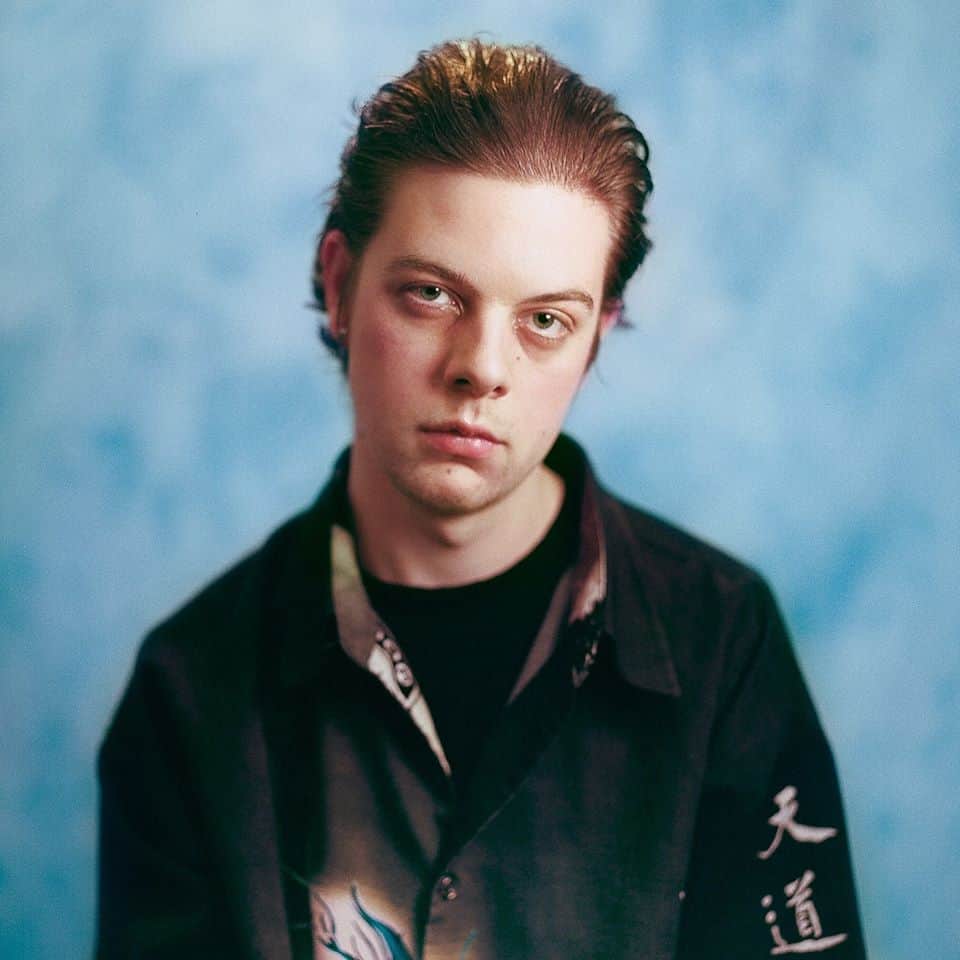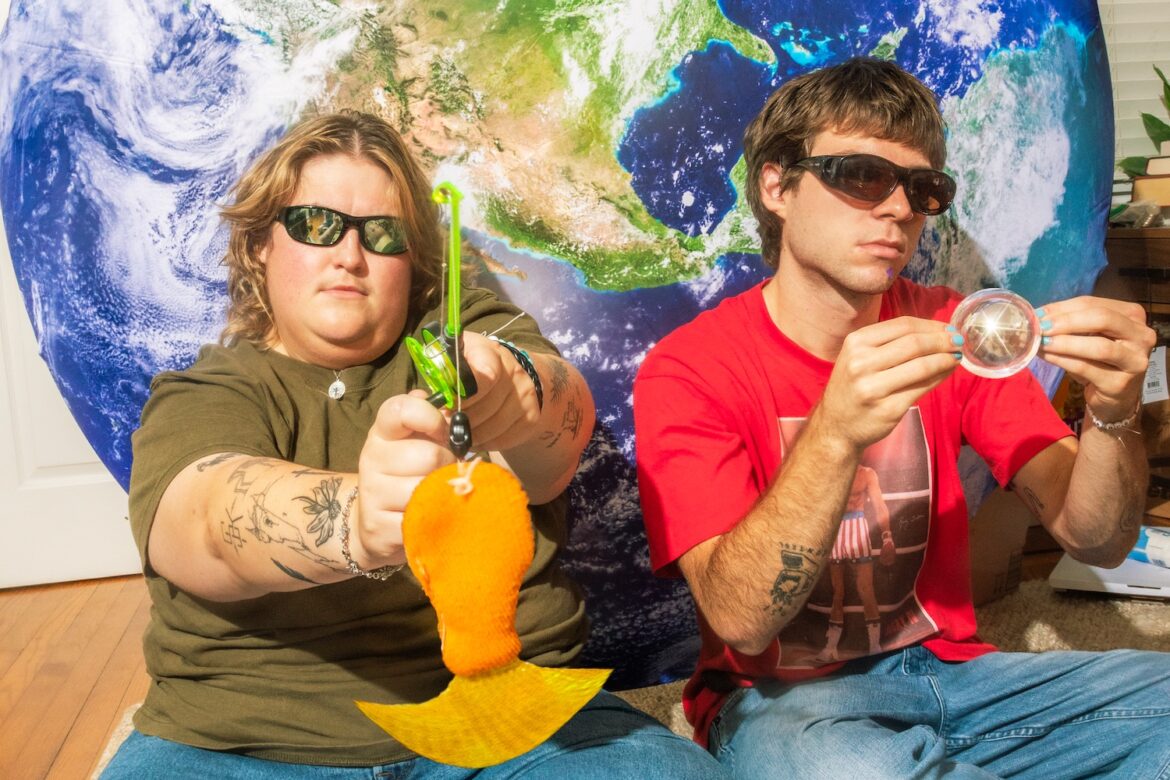
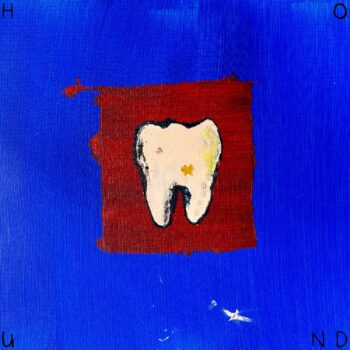
On their emotionally charged, cathartic debut album ‘Hound,’ Tyler Mabry and Harlow Phillips reckon with codependency, burnout, grief, and what it takes to protect the enduring friendship at the heart of hey, nothing.
Stream: ‘Hound’ – hey, nothing
Tyler Mabry and Harlow Phillips have known each other since middle school, long before hey, nothing became the project it is today.
Asked what they would tell those younger versions of themselves now, they initially joke about going for walks and laying off the fried food. Then they arrive at the same answer: Absolutely nothing. They would leave those kids alone and let them figure it out, knowing everything that happened along the way eventually brought them here.
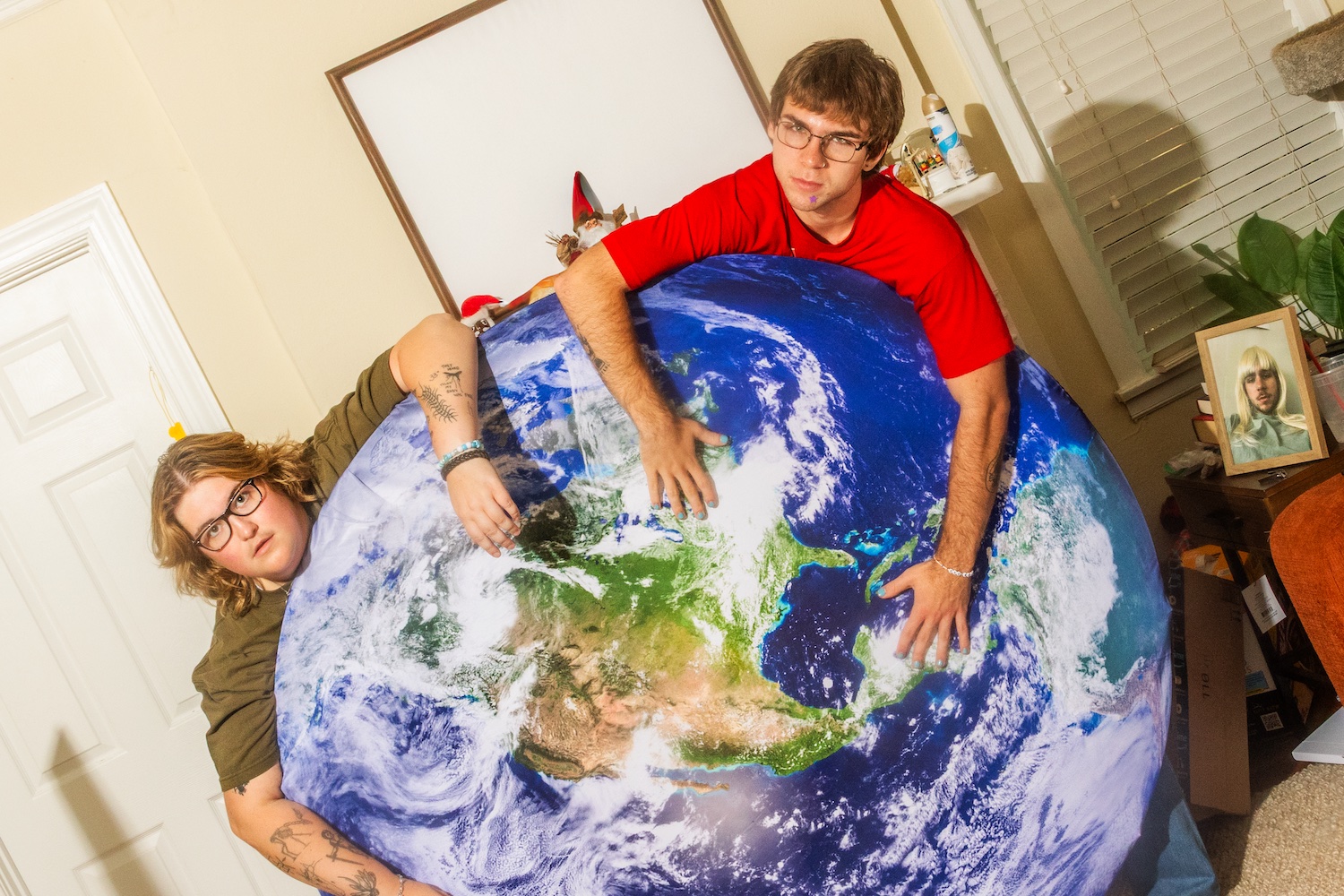
Their friendship has remained at the center of the band, but the years spent writing and touring together eventually forced them to reconsider what that closeness looked like. After recognizing that their relationship had become codependent, the two began giving each other more independence and learning how to separate their friendship from the work surrounding hey, nothing.
Those changes became part of the world surrounding Hound, an album informed by grief, family, growing older and a period when Mabry and Phillips were asking difficult questions about whether the band could continue in a healthier way. At the same time, they found themselves surrounded by a community in Athens that became inseparable from their memories of making the record.
Speaking with Atwood Magazine, Mabry and Phillips talked about growing up together, learning to be independent, taking productivity out of their friendship, the making of Hound, the people and places that surrounded it, and how they hope to make hey, nothing sustainable for whatever comes next.
— —
:: stream/purchase Hound here ::
:: connect with hey, nothing here ::
— —
A CONVERSATION WITH HEY, NOTHING
Atwood Magazine: For anybody who’s just discovering you through this interview, what would you want them to know about this project?
Tyler Mabry: Super gay. [laughs]
Harlow Phillips: Yeah. Gay. Fun. Cool.
Mabry & Phillips: Sad.
Mabry: If I had to pick one word, probably…
Phillips: Dramatic
Mabry: Yeah, dramatic.
You’ve known each other since middle school. Do you remember the first song you ever wrote or played together?
Mabry: [laughs] Yeah, oh I remember.
Phillips: Yeah. The first song we ever played together was “House of Gold” by Twenty One Pilots.
Mabry: We played it at a school talent show. We were, I think, 11 years old, maybe 12 at that point.
Phillips: Yeah, and what was the first song that we ever wrote together?
Mabry: I don’t even want to say the name.
Phillips: Oh, that one. The first official song we wrote was “Maine,” though.
Mabry: Yeah, the first song we ever officially wrote – actually wrote from start to finish in the same room, in the same session, was “Maine.”
You’ve talked about realizing that your friendship had become codependent after spending so much time together. Since giving each other more independence, what have you learned about who you are outside of the band?
Mabry: I feel like I learned a lot, actually. I learned that I needed glasses. [laughs]
Phillips: I think I learned so much about my ability to be independent. Before, I didn’t really have the confidence to say that I was comfortable being on my own. I think I was always a little bit scared of being on my own, and I really proved to myself that I can do it, which was really good for me.
Phillips: I think it was very much exposure therapy. Like, we need to force ourselves to be in a different room for an entire month, in a different place for an entire month. Nothing in the world is going to explode.
Mabry: Yeah. Nothing is going to explode.
You’ve said you haven’t really written together since finishing Hound, and that taking productivity out of your friendship has been healthy. Has simply getting to be friends again changed the way you see each other?
Phillips: I think the way we see each other is constantly changing, whether that be day by day or year by year. I think we see each other so differently when it’s in the context of working together.
Mabry: My love for Harlow is always going to be consistent, and it has been consistent since very early on. That’s never changed. But sometimes, in the deeper codependent moments, it’s easy to get frustrated over small things. Now that we’ve stepped back from that and realized it and worked on it, we don’t harbor any sort of petty anger.
Phillips: Or annoyance.
Mabry: Yeah.
Phillips: I think just removing the work aspect from the equation really changed our relationship. And then also finding a balance between our working relationship and just our friendship. I feel like we have a really good balance now.
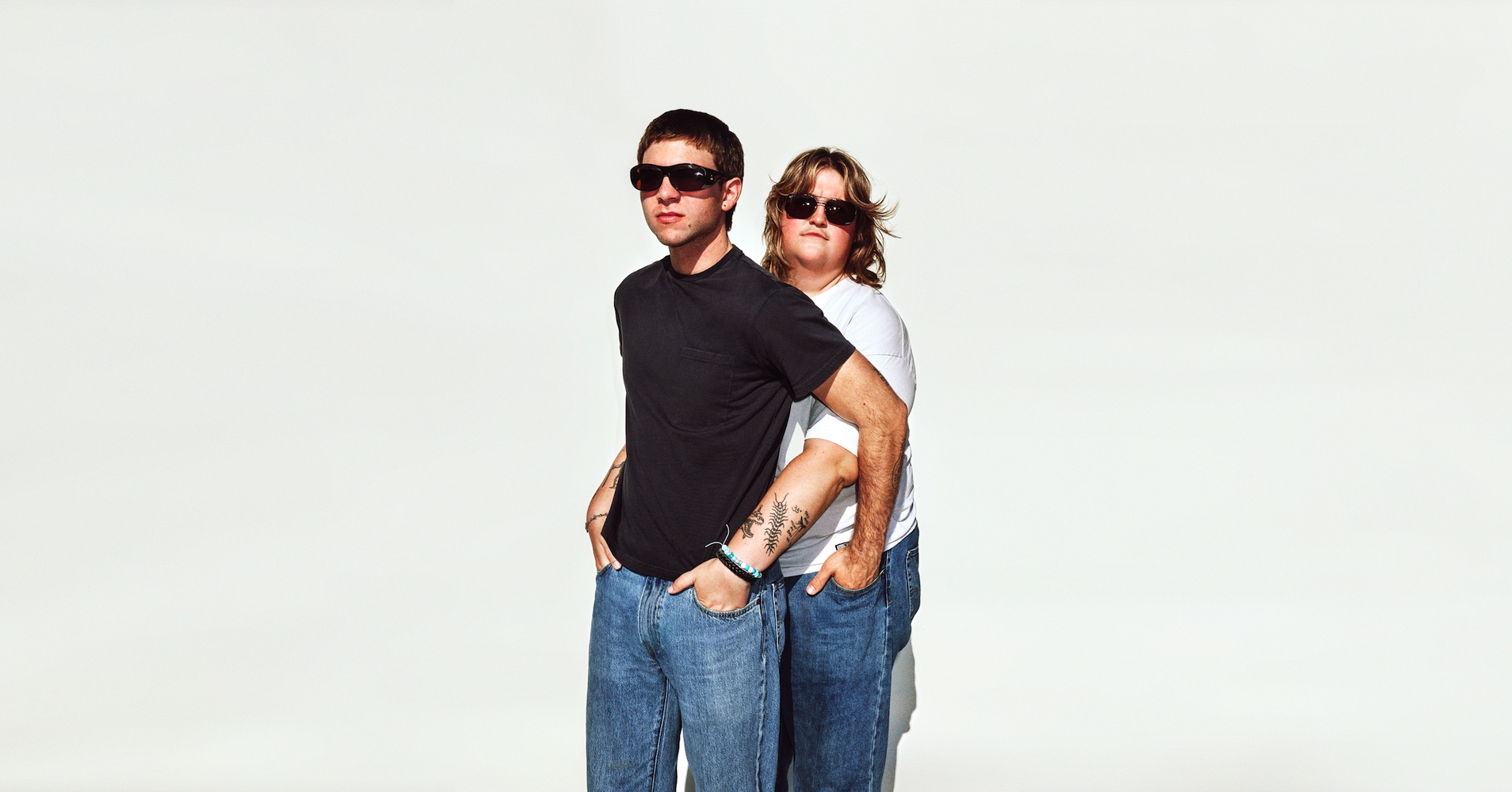
Hound has been described as an album that almost never happened. How close did you actually come to walking away from the band?
Phillips: I think both of us have so much love for each other and this project. This project is kind of like our baby. I don’t know if we were ever like, “For sure, I’m going to put this down. I can’t do it anymore.”
I think it was more like, “The work has to stop.”
Mabry: The work has to stop, yeah, it was more like, what happens if one of us can’t physically or mentally handle Hey, Nothing? What happens if it doesn’t exist? Those were a lot of thoughts that were happening, but I don’t think there were ever thoughts, or if there were, they were very brief, of, “Hey, Nothing is over.” It was more like, we need to figure something else out because this obviously isn’t working.
Phillips: After a big conversation, we both were like, if that’s what needs to happen for the other person, I think both of us were willing to do that.
Mabry: Our mental health will always come before the band.
But at the end of the day, we love it so much that the idea of abandoning it was very distant and hard to actually want to do.
So it was always more of a break?
Mabry: Yeah, for sure.
Phillips: I see a world where we take a really long break from Hey, Nothing in the future, but I feel like Hey, Nothing for me is going to be something that we’ll always want to return to.
Mabry: We’ll be doing this until we’re 80.
Phillips: As long as we keep going back to each other.
Mabry: Exactly. Then there will be a Hey, Nothing.
A lot of people found you through incredibly vulnerable songs, and you’ve talked about feeling pressure to keep making emotionally heavy music because that was what listeners responded to. Was it difficult having that pressure on you?
Mabry: I’d say so, yeah. Yeah, it was pretty difficult. It made the actual writing of Hound a lot harder than it should have been. We’re both very particular with how the songs come out, and when there’s that kind of pressure, sometimes they come out bad. Then when they come out bad, it’s very discouraging.
I feel like that was something we were running into a lot already on Hound. But it was something we had to really come to terms with and find a corrective path. I think we did find that path and made it happen, and we made an album that we’re really proud of and love.
There’s a different perspective on family throughout Hound, where you’re old enough now to understand some of the adults in your childhood differently. How has getting older impacted the way you remember the things you grew up with?
Phillips: That’s a really good question. I think it’s similar for a lot of people where you’re in your 20s and things start to click as you get older. It’s like, “man, I’m a couple years away from where my mom was when she was giving birth.”
You get the perspective of, man, we’re all just kind of growing up and we’re all learning. It’s okay to make mistakes. Your parents are human. They’re not faultless, but they also deserve grace just like us. I think a lot of people have that realization at our age, but we’re just lucky enough that we get to make art about it.
“Drywall” came from grief, but it looks at loss partly through another family member’s experience. What made you want to write about how somebody else was carrying that same loss?
Mabry: I think at the time we weren’t super distant from the loss, but we were always looking to explore grief in unique ways and trying to find new perspective. I feel like the writing process for “Drywall” was a way for us to look through the eyes specifically of Harlow’s great-grandmother, which I don’t think we’d ever really done before.
It was just a way for us to gain a new perspective and really think deeply about that.
Phillips: That was exactly what I was going to say. It was getting out of the quote-unquote normal way you would process grief and just giving it new life.
“Hound” came together in around 45 minutes, while “Drywall” took more than a year. Why do you think some songs seem to tell you exactly what they need while others take longer to figure out?
Mabry: That’s a really good question. “Drywall” specifically is very interesting. I started that song probably a year before “Hound” was written, before the entire song was written. I definitely connected with it, but I didn’t know what to do with it.
Then it just so happened that in a writing session, we were at a dead end and needed something, and I pulled it out. It became a way for us to explore grief.
I feel very superstitious about the fact that a year before we wrote it, I’d come up with that first line so we could write that song a year later. I think it’s kind of the same superstition for how a song like “Hound” can be written in 45 minutes. It’s what we’re able to do with the tools that we have. At the time we were writing “Hound,” we had the tools to write it that quickly.
Phillips: Yeah, totally. I think it’s definitely time and place when it comes to writing. If it is the right time and everybody’s showing up 100%, then it’s very easy to write something in 20 minutes and get it out and be super happy with the product.
But somebody might have something else on their mind, or they’re a little bit distant. Maybe it’s not the right place, or somebody’s not showing up 100% to a writing session, and things just aren’t flowing out the way they should be or the way you want them to be. It varies from time to time and situation to situation.
But it’s kind of beautiful because then the product is the direct product of that writing session, which is really beautiful.
You’ve joked that sometimes one of you thinks you’re writing a folk song while the other thinks you’re writing a rock song. When you hear two completely different versions of the same song, how do you figure out where it should go?
Mabry: We usually abandon it if something like that is happening. When you’re having a direct collaboration like Hey, Nothing I think it’s really important for both parties to be on the same creative page and have the same vision for it. I think that’s what makes it difficult sometimes. Because no matter what, you’re thinking about the end result of your songs, which, at least for me, isn’t a super healthy process.
Writing songs is very mystical, but when we are writing them, it’s really important for us to know what we want out of it from the jump.
Phillips: Yeah, I think we actually don’t compromise often. Usually, if we have two opposing ideas, then we scrap both ideas and come up with something new.
Tyler, you’ve talked about reading Stephen King and Japanese literature, and Harlow, you’ve mentioned listening to lesbian romance audiobooks. Has reading fiction changed anything about the way you write stories or people into your songs?
Mabry: Yeah, absolutely.
Phillips: Absolutely.
Mabry: Something we have to relearn over and over is that when we’re reading, the songs come out easier. I think Hound was written right as I was reading The Ring. I started reading that book again, and “Hound” came out around the same time.
I was reading something about books versus watching movies and how, when you’re reading books, even though it doesn’t really feel like work on your mind, you’re forced to be imaginative and imagine every single situation. Even if it’s a book that became a movie you’ve already seen, going back and reading the book, you’re still activating your imagination.
For me, reading is honestly a good practice to keep that side of my brain constantly working and improving.
Phillips: I think that’s a great answer. I also think in terms of inspiration for songs, we’re constantly inspired by so many things, whether that’s film, TV, books, nature. Anything to make us feel inspired is always a good thing, and books are just one of them.
Bea Porges came in to work on “Long Time Leaver.” How did that collaboration come about, and what do you think she brought to the song that helped it finally come together?
Phillips: The last 99% of the song. [laughs] I had started “Long Time Leaver,” and I really liked it. It was really catchy, but I could not figure out where I was going with it.
Bea Porges is one of our really good friends, so I called her and was like, “Hey, what do you think about maybe writing something to this?” Within 30 minutes, she sent me back the rest of “Long Time Leaver,” and it was perfect. It was exactly what the song needed.
I’m so happy that we get to have a collaboration with somebody like Bea. She’s such a great writer and such a great person.
Mabry: What a force to have in the room.
Phillips: We’re super grateful that she’s part of this album.
You’ve talked about Athens becoming a real community for you and about wanting Hound to someday remind you of your house and the people around you during this time. What are some of the things about your life there right now that you hope to remember years from now?
Mabry: My friend Tommy’s basement.
Phillips: Yeah.
Mabry: Our friend Tommy’s basement is where we made the entire album. I know that he’s not going to be there forever. I feel like his time there is actually fairly brief. I know that in 10 years, I’m going to look back and be like, “Wow, if I could just go and sit in that basement one more time,” it would make my life.
Phillips: It’s a special place.
Mabry: His backyard is like a Zen garden. There are stone sculptures and ponds and lily pads, and there are so many bugs back there. There’s this path that leads to this river in Athens. When we were recording, a lot of the time we would take breaks and go back there. You would smoke weed, and we would pick blueberries and eat them. I remember that very vividly.
Athens in general. 1000 Faces Coffee Shop is a place that we frequent. Everything about our life right now is what I’m going to associate with it. And just our friends.
Phillips: Yeah, literally all of our friends. Playing games and going and watching our friends’ games.
Mabry: I just want to list all of our friends: Jason, Jess, Jade, Aaron, Gideon, Bea, Tommy, Hannah, Rowan, Claire. I feel bad. I’m blanking. I’m nervous.
Phillips: All of them.
Mabry: They made it come to life, honestly. They gave us so much inspiration, so much fuel while we were making it, and so much support.
After realizing how much constant touring contributed to your burnout, what are you doing differently this time to keep yourselves from ending up in the same place?
Phillips: Definitely going to make mental health a big priority and be in that constant communication of truly how we’re feeling, and not sugarcoating anything for anybody else’s feelings. Prioritizing physical and mental health.
Mabry: We’re coming up with new techniques to not get ill. We bought a bag yesterday to hold all of our vitamin C and all of our Liquid I.V.s. We’re going to try not to talk over loud music as much.
That was a big thing for me. I feel like a big contributor on the last couple tours was getting sick. By the end of three or four tours, every single tour, I’d gotten very ill. It makes it hurt to sing, and it makes it hurt to just be in the van. All you need is rest, but all you get is a 6 a.m. lobby call and a show at 7 that night. It’s just not conducive for music to be sustainable.
Signing with Music Soup/Interscope means there are a lot more people involved with Hey, Nothing now. What has that transition been like?
Mabry: They’ve given us complete creative freedom over the project. We have a great team that really helps with the more visual side of things and the social media side of things. They help and brainstorm, and everything is super collaborative.
We talk with everybody about what we want Hey, Nothing to look like, and they’ve been super receptive and super helpful. It’s been a breeze.
Phillips: We take every opportunity we can to brag about our team because I think we’re the luckiest guys in the world to be in the music industry in this age and really enjoy the people we work with.
Mabry: I love them. And we got so lucky with the first people we ever worked with, too. It’s the same team, and they’ve been nothing but loyal and sweet and empathetic and compassionate toward us, and so passionate about the art that we want to make. It hasn’t wavered a bit. We got so freaking lucky.
If you could sit down with the two middle school kids who first started making music together, what do you think you would tell them now?
Mabry: Lay off the fried catfish.
Phillips: Yeah! Stop deep-frying everything. Maybe go on a walk.
Mabry: Honestly, I’d say, “Don’t change.” I’d hide behind a bush and not even talk to them because they figure it out. We’re here.
We get to do what we’ve wanted to do since we were that age. It’s the biggest dream come true, so I don’t think I would change anything.
Phillips: Everything that we’ve experienced up until now has informed what we do and how we do it, and our situation now.
Mabry: Exactly. I’d hide in the bushes. I would go see IT chapter 1 in the theaters and just leave us alone. [laughs]
Are there any songs on this album that you’re particularly excited for people to hear?
Phillips: Yeah, for sure. Hound is definitely our number one.
Mabry: Yeah. It’s the one that I think we want people to hear the most and want to play the most.
At the end of making Hound, Tyler described the big question as basically, “What now? Who are we?” Do you feel any closer to knowing the answer?
Phillips: [laughs] No.
Mabry: Really? I feel like we’re figuring it out.
Phillips: Oh, yeah as in Hey, Nothing?
Mabry: Hey, Nothing, yeah.
Phillips: As people? No. Still figuring that out. But definitely on the right track with Hey, Nothing. That’s the most confident I feel right now. It’s the most confident I’ve ever felt about something that we put out and something that we’re about to tour, and just the future of our career. I feel really, really positively about it.
Mabry: Personally, I’m just trying to find the right pills.
Phillips: Yeah, trying to find the right pill, the right combination of doctors and medicines, elixirs.
Mabry: That make you want to be in the sun.
You've both been open about protecting your mental health, even when it means putting the band on hold. Do you have a message for anyone reading this who might be struggling right now?
Phillips: Yeah, I think, for me, my message would be: You are so much more loved than you know.
Mabry: More than you currently think… And that all will be revealed in due time. Seriously though, all will be revealed. And even when one week feels like it’s going to take 10 years, it’s worth it to live.
— —
:: stream/purchase Hound here ::
:: connect with hey, nothing here ::
— —
— — — —
Connect to hey, nothing on
Facebook, 𝕏, TikTok, Instagram
Discover new music on Atwood Magazine
© Trent Wayne
 © Trent Wayne
Hound
an album by hey, nothing