
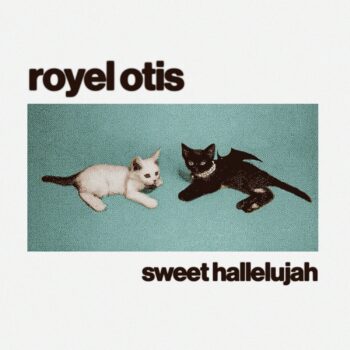
Aussie indie pop duo Royel Otis bare their hearts on “Sweet Hallelujah,” a cinematic, achingly beautiful ballad that holds love and loss in the same breath, carrying the fragile grace of letting go while revealing a deeper, more vulnerable side of the band.
Stream: “Sweet Hallelujah” – Royel Otis
Love doesn’t always unravel all at once; sometimes it lingers in the in-between, caught between holding on and letting go, where distance sharpens every feeling and nothing quite settles the way you want it to.
And sometimes, it gets one hell of a soundtrack on the way out. Ascendant Aussie indie rock duo Royel Otis tap into that tender feeling on “Sweet Hallelujah,” their first new music since last year’s hickey – a three-minute rush of heat and heart that feels both immediate and all-encompassing, intimate and widescreen all at once.
She’s so cool it blows
my mind all the time
It tastes like pain
I was born a clown
but now I’m known to cry
Some days change
Only fools say love is blind
Have you seen her face?
She’s so fine it blows
my mind all the time
And shakes my brain
Released April 9 via Ourness / Capitol Records, “Sweet Hallelujah” arrives as a swelling, heart-on-sleeve confession – a song that leans into love’s most delicate moments and lets them bloom without restraint, carried by a sense of emotional immediacy that lingers long after the final note. It’s also a soul-stirring step forward from the Sydney duo of Royel Maddell and Otis Pavlovic, who have steadily carved out a space in the indie pop world with their breezy charm and undeniable chemistry, earning a global following off the back of their sophomore album hickey and a recent string of breakout singles.
Built on a dreamily propulsive indie pop foundation, “Sweet Hallelujah” pulses forward with raw, visceral fervor, but it’s the orchestral flourishes – sweeping cello, aching violin – that give it its emotional gravity. Those textures deepen the track, adding warmth, color, tension, and a cinematic glow that elevates every moment. As the arrangement unfolds, the strings don’t just decorate the song – they rise and recede in waves, mirroring the emotional push and pull at its core.
“Sweet Hallelujah” builds without ever fully bursting, holding itself just on the edge of release. Every cello swell and violin accent feels earned rather than overwhelming. There’s a touch of Sgt. Pepper-era The Beatles in this playful grandeur, a hint of Vampire Weekend’s most mellifluous leanings in the way it expands and contracts, but Royel Otis make it undeniably, unmistakably their own – a sound that feels both classic and completely current.
At the center of it all is Otis Pavlovic, delivering one of his most tender vocal performances to date. He sings close, almost confessional, letting every word land with a sense of fragile sincerity as the song circles around love, distance, and the fear of losing something you’re not ready to let go of. “Only fools say love is blind / Have you seen her face?” he asks, cutting through any cynicism with a line that feels disarmingly direct. And when the chorus hits – “Will I ever lose you when I’m home / It’s always oh sweet hallelujah when I’m gone” – it lands like a realization you didn’t see coming, equal parts devotion and doubt.
So many chances I give people
Well, I fear the end I’m at a door
I’ll let my guard down while on tour
Oh, let the sunset burn inside of you
That tension – between presence and absence, certainty and unraveling – is what gives “Sweet Hallelujah” its staying power. As the band themselves put it, it’s “a love letter of goodbye to someone you want to know that no matter what happens things won’t change the way you feel about them.” And in that space between staying and slipping away, Royel Otis find something quietly transcendent – a song that aches, glows, and lingers long after it fades.
Will I ever lose you when I’m home?
It’s always oh sweet hallelujah when I’m gone
Oh, will I ever lose you when I’m home?
It’s always sing sweet hallelujah when I’m gone
The chorus reframes distance not as loss, but as a strange kind of clarity. When Pavlovic asks, “Will I ever lose you when I’m home?” there’s an unease in the idea that closeness doesn’t guarantee permanence – that even in presence, love can feel fragile, uncertain, at risk of slipping away. And yet, “it’s always oh sweet hallelujah when I’m gone” suggests the opposite: That absence sharpens feeling, turning memory sacred. It’s a contradiction that never quite resolves – love felt most vividly in the spaces where it isn’t, where distance transforms doubt into devotion and longing into emotions worth holding onto.
There’s something striking, too, about the choice of “hallelujah” itself – a word rooted in praise, relief, even reverence. Here, it doesn’t arrive at a moment of resolution, but in absence, in distance, in the space left behind. That tension gives the song an added emotional depth, reframing goodbye not as an ending, but as a quiet recognition of what still remains.
“Sweet Hallelujah” resonates so deeply because it meets listeners exactly where they are – in that suspended space between holding on and letting go, where clarity feels just out of reach and every emotion carries a little more weight. Royel Otis don’t rush that feeling or try to resolve it; they let it unfold in real time, giving shape to a kind of love that doesn’t end cleanly, but lingers, evolves, and stays with you. It’s a song that finds you when you need it most, offering not answers, but recognition – a reminder that even in uncertainty, even in distance, there’s still beauty in what remains.

What makes “Sweet Hallelujah” hit even harder is what it reveals about Royel Otis at this moment.
Where hickey often carried an easygoing nonchalance – a looseness that made its highs feel effortless – this song leans more soulful, deliberate, intentional, and exposed. It’s not just that they’ve written a ballad; it’s that they commit to it fully, deftly commanding every moment in the room such that the emotion swells and stretches without ever pulling back. In doing so, they step into a more serious light, proving they can hold that weight and deliver it with the conviction and control that feels like a true turning point.
In the end, “Sweet Hallelujah” endures because it refuses to simplify what love actually feels like when it begins to slip out of reach. There’s no clean resolution, no easy release – just a deep, unwavering sense of care that persists even as circumstances change. Royel Otis capture that complexity with striking grace, letting the music breathe, ache, and unfold without ever forcing it into being smaller than it is. It’s a rare kind of honesty, one that doesn’t try to fix the feeling, but honors it fully – and in doing so, leaves behind a moment that feels both fleeting and lasting all at once.
She’s so cool it blows my mind
all the time
It shakes my brain
— —
:: stream/purchase Sweet Hallelujah here ::
:: connect with Royel Otis here ::
— —
Stream: “Sweet Hallelujah” – Royel Otis
— — — —

Connect to Royel Otis on
Facebook, 𝕏, TikTok, Instagram
Discover new music on Atwood Magazine
© Isaac Brown
 © Isaac Brown
:: Stream Royel Otis ::