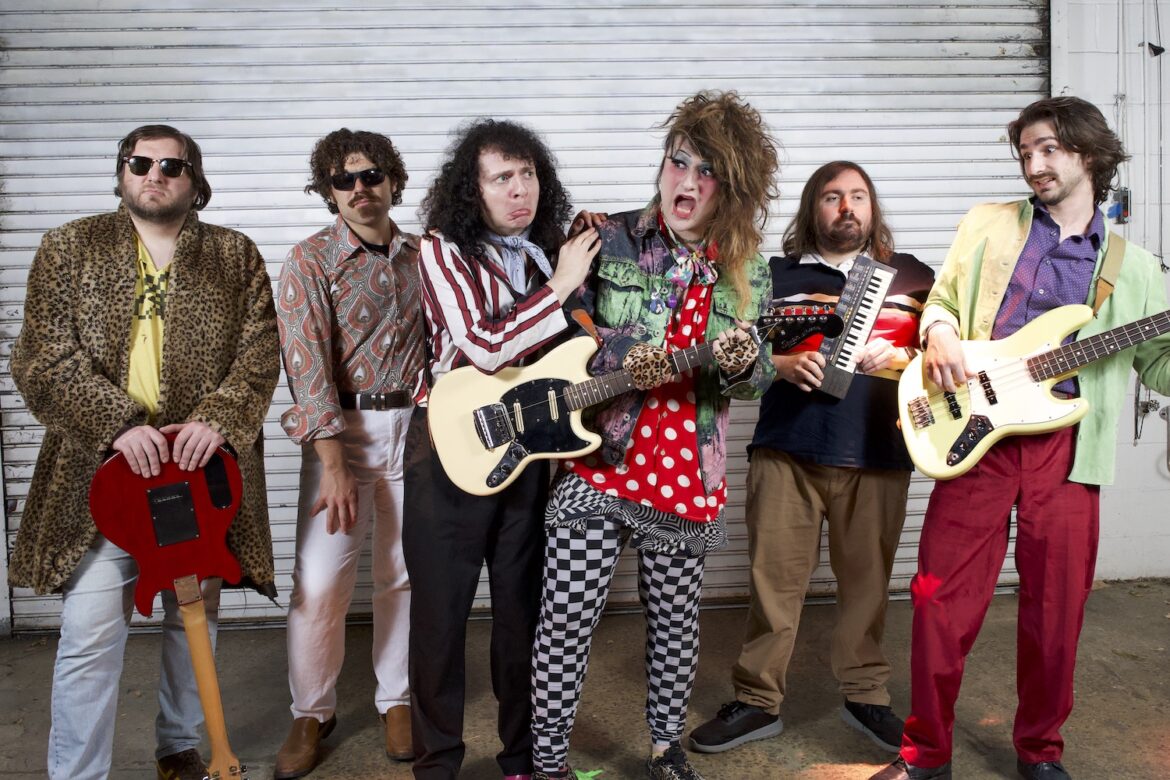
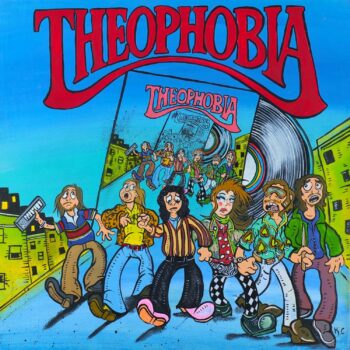
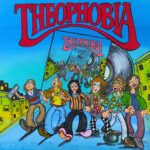
Brooklyn art rock sextet Theophobia channel boundless creativity through ‘Theophobia,’ a gleefully theatrical debut where bold pop hooks, prog grandeur, and a genuine love of camp share the same stage. Recorded on 16-track analog tape and driven by a refusal to be boxed in by genre or the fear of looking uncool, the album restores possibility to rock music – and invites listeners to make art without apology.
Stream: ‘Theophobia’ – Theophobia
I’d love for people, first and foremost, to know we aren’t being ironic. Everything we are creating is because we love it…. It’s just genuine, loving camp.
* * *
Theophobia threw the rulebook out a long time ago.
In its place, they built a band around unabashed creativity, theatricality, and the raw power of imagination. Their self-titled debut album throws open the curtain on a Brooklyn band enthralled by glam-rock spectacle and the glorious instability of a song that can change direction without warning. Baroque strings brush against analog synthesizers; guitar heroes share space with kazoos, slide whistles, and an instrument credited as an “artificial banjo.” Characters fall in love, fear death, lose their bearings, confront false kings, sell fish in alleys, and promise astonishment from behind a carnival curtain.
Every flourish serves Theophobia’s larger argument: That our imagination deserves to be indulged. They embrace comedy without surrendering emotional consequence, and they treat theatricality as a way of revealing themselves rather than concealing who they are. Anxiety becomes a pop hook. Existential dread arrives dressed for the stage. The band pursue silliness with the rigor other artists reserve for solemnity, trusting that a joke delivered with total conviction can carry as much truth as a confession.
The result is Theophobia, a gleefully unguarded debut whose unflinching creative freedom feels like an act of rebellion – and an invitation to make art without apology.
Searching for mercy,
I chuck all my dreams
to the sewer pipes
They’ll do much better
to wither through weather
extreme and foreboding to me
Find a desk job in formal clothes
One I’d probably loathe
I could work at a restaurant
Whatever you want
– “Mumphrey’s Alley,” Theophobia
Released July 31, 2026 via Insecurity Hits (US) and HX Records (UK), Theophobia is a spectacle, a funhouse, and a declaration of intent – a long-awaited first full-length statement from a band who believe music should still surprise us.
The 13-track album was produced by Theophobia and Paul D. Millar, whose work with The Lemon Twigs, cumgirl8, and Ariel Pink’s Haunted Graffiti made him a natural collaborator for their technicolor ambitions. Recorded on 16-track analog tape at Daisy Chain and Bug Sound East in New York City, the record stretches its physical limitations through sharp arrangements, committed performances, and a cast of guest musicians adding strings, accordion, trumpet, and choral voices to the spectacle.
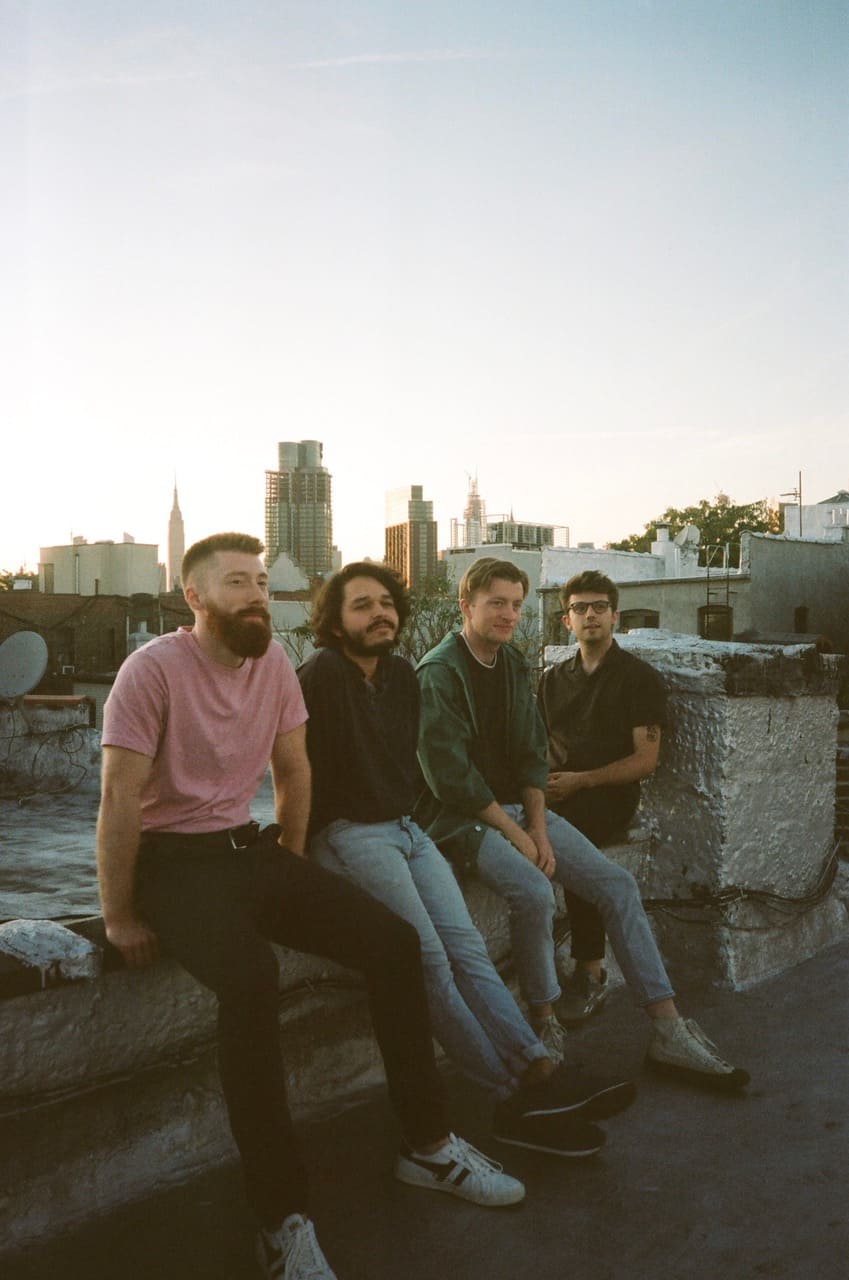
Theophobia began in 2019 as the meeting point between singer-songwriters Dylan Mars Greenberg and Matt Ellin, childhood friends who had bonded as teenagers over Sparks, Meat Loaf, Devo, Todd Rundgren, and comedy that gleefully dismantled the boundaries of good taste. Their earliest incarnation consisted of Greenberg and Ellin singing over electronic backing tracks built in GarageBand and Logic, with Ellin accompanying them on guitar. Those recordings gave their songs a life beyond the stage, though the grand operatic scale in their heads remained out of reach.
The arrival of guitarist Alan Worm, pianist and keyboardist Michael Butterly, bassist Nick Cereola, and drummer Chris Michaels in 2023 changed the project’s possibilities. Theophobia became a full six-piece ensemble capable of carrying rapid theatrical exchanges, prog-rock pivots, vintage pop melodies, and extended instrumental fireworks in the same set. Years of writing and performance had finally met the musicianship required to realize them.
Greenberg’s work as an independent filmmaker and music video director further shapes the band’s visual and dramatic language. Known for absurdist camp surrealism across films including Spirit Riser and Dark Prism, Greenberg directs Theophobia’s videos and brings homemade props, projections, performance art, and elaborate comic banter into their concerts. Their live show draws from rock clubs, experimental theater, sketch comedy, Coney Island sideshows, and the thrill of watching a carefully prepared spectacle threaten to fly off its hinges.
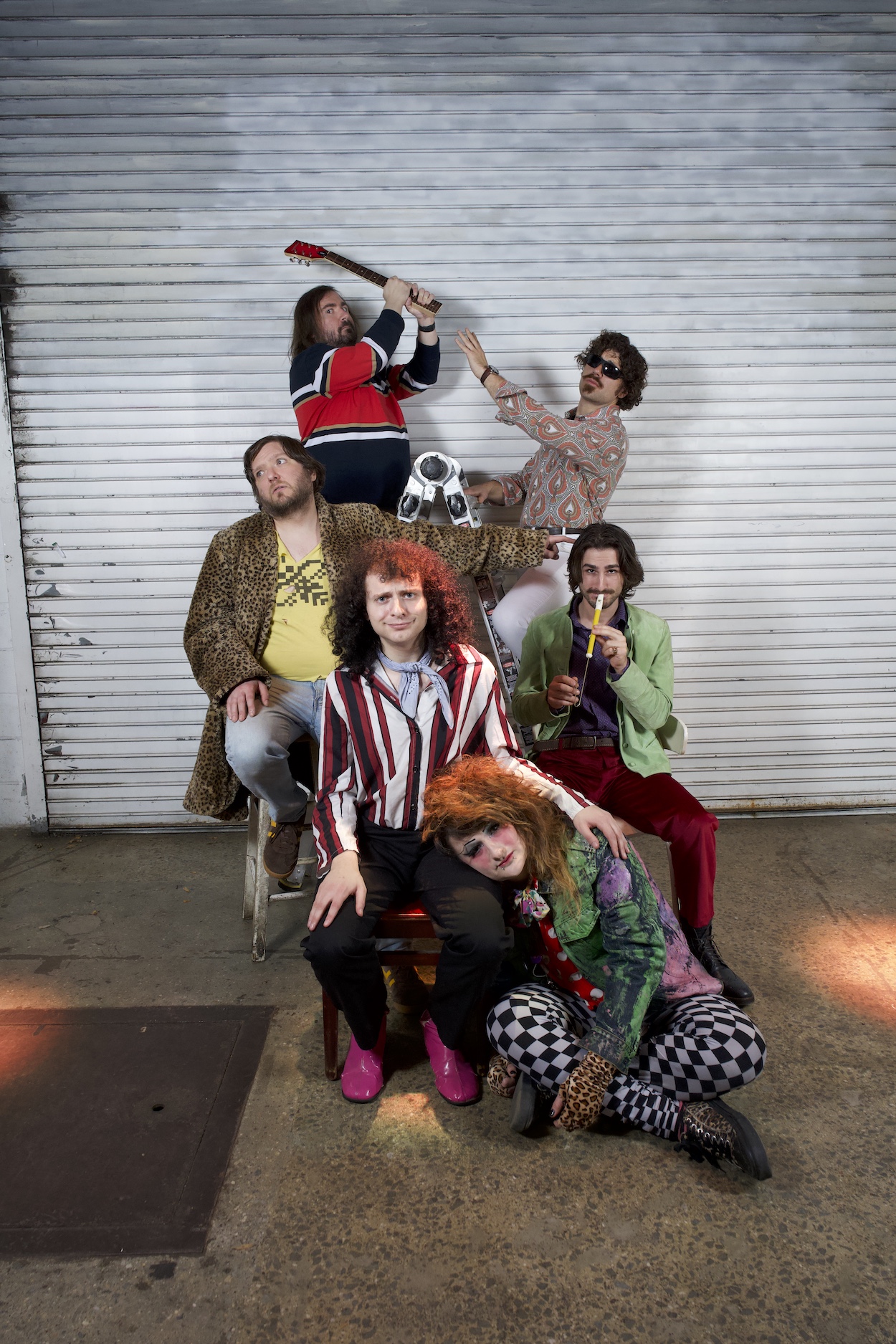
That devotion to performance could easily invite comparisons to the artists who inspired them – and yet, there is no one quite like them.
Especially not in 2026. Theophobia acknowledge their musical lineage while using it to confront a present-day musical culture that often rewards reserve, consistency, and easy categorization. Matt Ellin sees the band’s relationship with the past as a way of recovering possibilities that contemporary rock has abandoned:
“I hope it is apparent that even though we are open about our influences, we are doing something that stands out and feels very different in the current moment,” they tell Atwood Magazine. “We don’t want to be viewed as derivative or a nostalgia act, but when I watch videos of my favorite older bands, I think ‘Wow, the world could use a little bit of that right now. What happened to that?’ There’s a certain breed of musical eccentricity that seems to be missing much of the time. I hope we can help to fill that void a little.”
Theophobia pursue that mission without the protective distance of a wink. Camp can become an empty pose when the artist stands outside it, inviting the audience to laugh at the material rather than enter its world. Greenberg draws a firm distinction between mockery and the genuine pleasure driving every costume, prop, arrangement, and outrageous melodic leap:
“I’d love for people, first and foremost, to know we aren’t being ironic. Everything we are creating is because we love it. We sometimes take inspiration from things deemed ‘cheesy’ or ‘kitsch,’ and I think what unites this band is that we all genuinely love that stuff. It’s just genuine, loving camp.”
Will you love me when
my soul’s no longer sentient?
Will you love me when I’m dead?
Will you love me when I’m
buried underneath the ground?
Will you love me when I’m dead?
– “Will You Love Me When I’m Dead,” Theophobia
Love is the load-bearing structure of Theophobia’s excess.
It gives the band permission to chase an idea past the limits of decorum and allows humor, fear, fantasy, and earnest pop craft to occupy the same song. Their rebellion lies in refusing embarrassment – the social pressure that teaches artists which pleasures require an apology and which ambitions should be scaled down before anyone can call them uncool.
The band’s name carries the darker current running beneath the spectacle. Death, faith, isolation, unstable identity, and existential panic appear throughout the album, even when the arrangements grin around them. For Greenberg, the self-titled record offered the clearest possible introduction:
“Theophobia means fear of god. I think I always had an idea that our first LP would be self titled. We went through a few titles, back and forth between me and Matt, but finally we settled on just the name of the band. I think it makes sense.”
A debut bearing its creator’s name has to establish the terms of entry. Ellin heard those terms already compressed into a single word – ominous, memorable, and slightly misleading in precisely the right way: “I love our band name. I think it’s unique but succinct and speaks to shared feelings of existential dread between us, which is also a theme in many of the songs. There’s also something about it that feels like a metal band name, and we’re not a metal band, but I enjoy that kind of ironic juxtaposition. I think of this album as an introductory statement, a sort of ‘here we are.’ It’s very eclectic and shows several different sides of what we can do. I think calling it anything outside of the band name would have overcomplicated it; there’s already a lot of information on this record.”
The name opens the door; the album gleefully crowds the space behind it. Realizing that vision would take a six-piece band, a sympathetic engineer, two years of work, and the clarifying pressure of sixteen analog tracks.
You’re like the inside of a lava lamp
Always burning, always turning
You’re the god of war
What are you fighting for?
What are you fighting for, my love?
– “God of War,” Theophobia
Theophobia entered the studio with maximalist instincts shaped by years of working in GarageBand and Logic, where another synth, vocal, or effect was always within reach. Recording to 16-track reel-to-reel tape changed the terms of that freedom. To achieve the 1970s sound they had long chased, the band had to make every part count – and discover that scale could come from the strength of the songs themselves.
“I think one notable thing is that Dylan and I were both used to making our music on DAWs, which basically have no limitations,” Ellin explains. “You can go ham and stack a hundred different synth or vocal layers on a song if you want to. Still, we kept making music on DAWs and wondering why it didn’t sound like our favorite albums from the ‘70s – and it eventually became clear that it was important to record to reel-to-reel tape because of the quality of analog sound.”
“So we committed to recording to tape, but there was a bit of a learning curve when we came up against the fact that we didn’t have the ability to do hundreds upon hundreds of layers anymore because we only had sixteen tracks. It turned music into a sort of essentialist exercise; we had to contend with the fact that there didn’t necessarily need to be excessive sonic layering in order to make things sound ‘huge,’ but rather the songs just needed to sound good. There’s nothing wrong with the former approach, but there is much about the workflow and straightforwardness of tape that I prefer.”
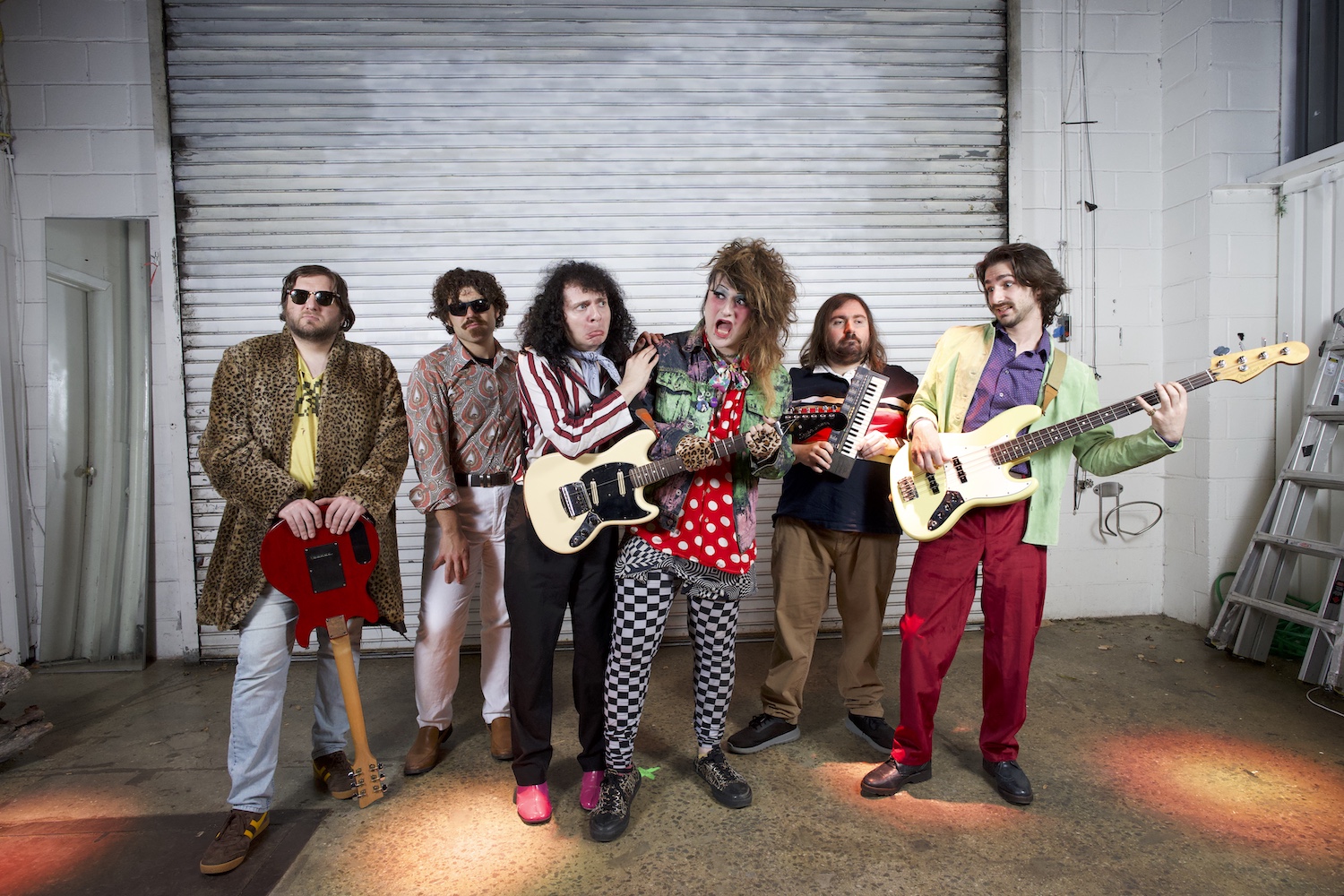
The analog process gave the band’s maximalist tendencies both a limit and a challenge, forcing them to build scale through arrangement and performance, rather than endless accumulation.
While Millar shared the band’s appetite for experimentation, he also acted as a bulwark – protecting the finished songs from embellishment for its own sake.
“I think we had just never experienced recording with analog tape. I was admittedly worried that the workflow was going to be slow, or involve a lot of back and forth over the course of months, but everything just clicked,” Greenberg says. “Paul really understood what we wanted, and also wasn’t afraid to tell us, ‘no, the song is done now. There’s nothing more we can do for it.’ I had wanted a few gimmicky things on the album, like a few audio ‘skits’ in between the songs, like we do in our live shows, and we ended up not doing that, but that’s okay; it was all about the music.”
The skits may have fallen away, but the spirit of their live shows remains embedded in the record. Songs make sudden entrances, characters seize the spotlight, and arrangements behave like scenes with their own dramatic stakes. Ellin had imagined an album this unruly for years:
“For a long time, I’ve wanted to make an album that takes an ‘everything but the kitchen sink’ approach; just a very grandiose maximalist collection of songs where you never know exactly what you’re going to get, and the main unifying aspect is that everything is different,” they share. “I think the record showcases us as a group that is capable of a wide variety of different styles of music and isn’t comfortable staying in any one stylistic lane for too long. I think it shows that we are inventive and eager to experiment, but also not afraid to write pop songs.”
Theophobia’s personalities, melodic instincts, and commitment to the bit hold the album together as its music repeatedly changes costume. Greenberg offers the most immediate description of what they accomplished: “I think it’s the perfect way to introduce us. It feels like you’re at a Theophobia show, but the best sounding Theophobia show in the world.”
Ellin calls the album “funhouse mirror rock,” a reflection of familiar rock traditions warped into stranger, more playful shapes. Meanwhile, Greenberg calls it “crazy, genuine, pop,” three words that capture the band’s unpredictability, sincerity, and instinct for a hook.
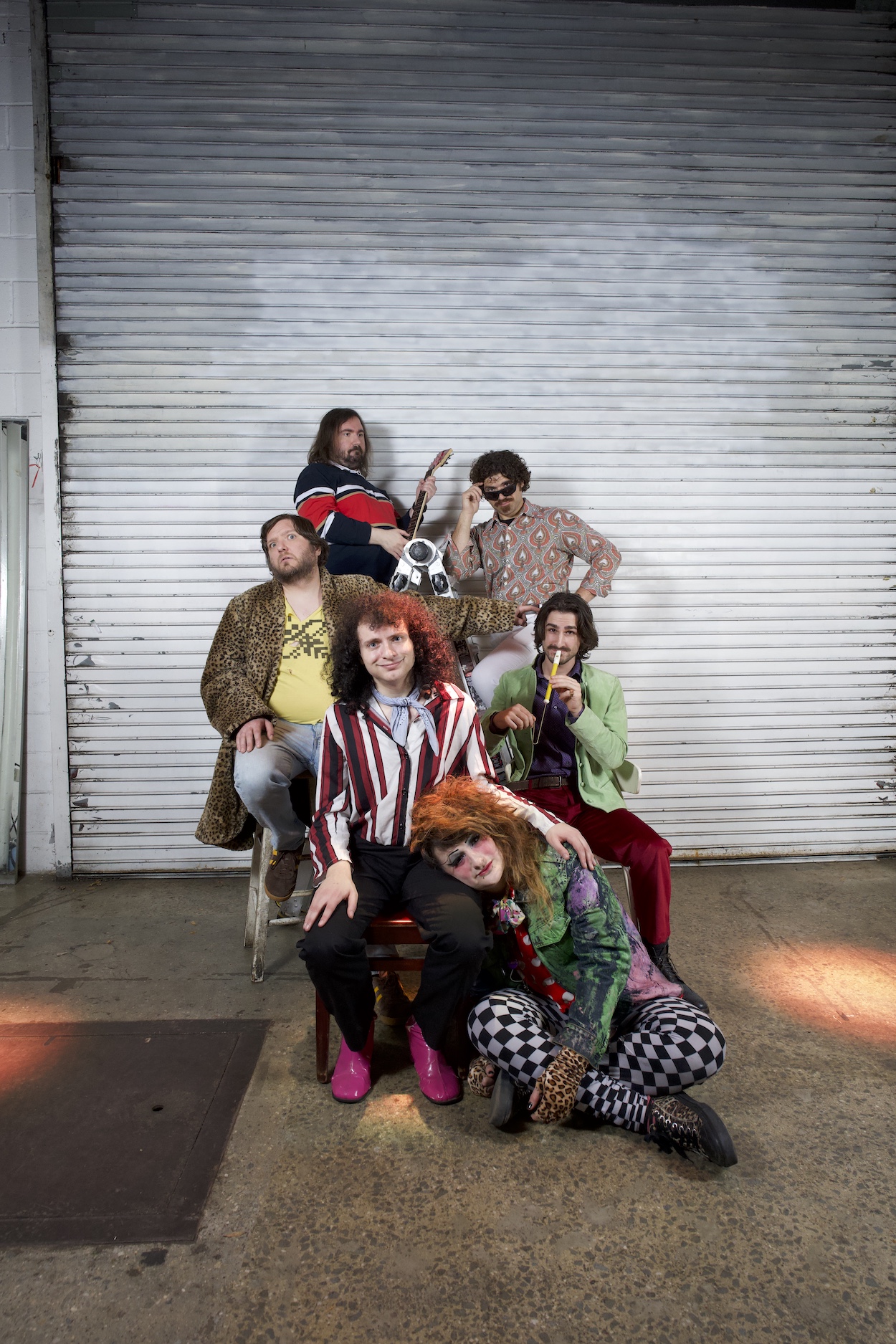
Theophobia build the album around one promise: No two songs will ever take the same path.
The drama begins immediately. “A Happy Man” raises the curtain with a deceptively simple chant about a devout man and a girl whose song spreads beyond her control. The choir cannot stop singing; the entire town joins in, smashing “every cup, plate, and mirror” in a futile attempt to drown out music that has crawled into their ears. By the time the voices lock into the repeated cry of “you’re dead,” Greenberg’s cult induction has become inescapable.
As they sang, they smashed
every cup, plate, and mirror
In a fruitless attempt to drown out the terror
Which emerges from music
that crawls in your ears
And it will not stop
’til that jam in your gears when you’re dead
– “A Happy Man,” Theophobia
“Will You Love Me When I’m Dead” follows with an intoxicating, glistening disco pull, asking whether devotion can survive a soul that is no longer sentient, a body buried underground, and a lover rendered anonymous. Vocoder, analog synthesizers, congas, and the sudden cheerleader cry of “2, 4, 6, 8, can I take you on a date?” keep its fear of death buoyant and irresistibly strange.
The feverish, Meat Loaf-esque drama of “God of War” pushes the record into full operatic combat, swerving through damaged fathers, criminal accusations, an identity crisis, and lovers screaming themselves hoarse. Greenberg and Ellin’s rapid call-and-response keeps returning to the disarmingly tender question, “What are you fighting for, my love?” before the song offers one final command: “Love thy neighbor and you’ll be loved.”
The minute-long instrumental “Anhedonia Tsardas” briefly suspends the action through Michael Butterly’s ornate piano and Kaitlin Wolfberg’s strings, interpolating the melody of “Go Left My Son” (track 9) while serving as a stately, Franz Liszt-inspired overture to “The Most Wanted Woman in Estonia.” The latter exerts an immediate melodic pull as it follows a woman loved by every man and understood by none. Her admirers dismiss her unhappiness as being “out to lunch,” while she closes the curtain, withdraws from the people projecting their fantasies onto her, and mourns the pride and pleasure she can no longer access.
The most wanted woman in Estonia
Crying over by the Baltic Sea
And no, she wouldn’t wanna know ya
Because her life is a catastrophe
– “The Most Wanted Woman in Estonia,” Theophobia
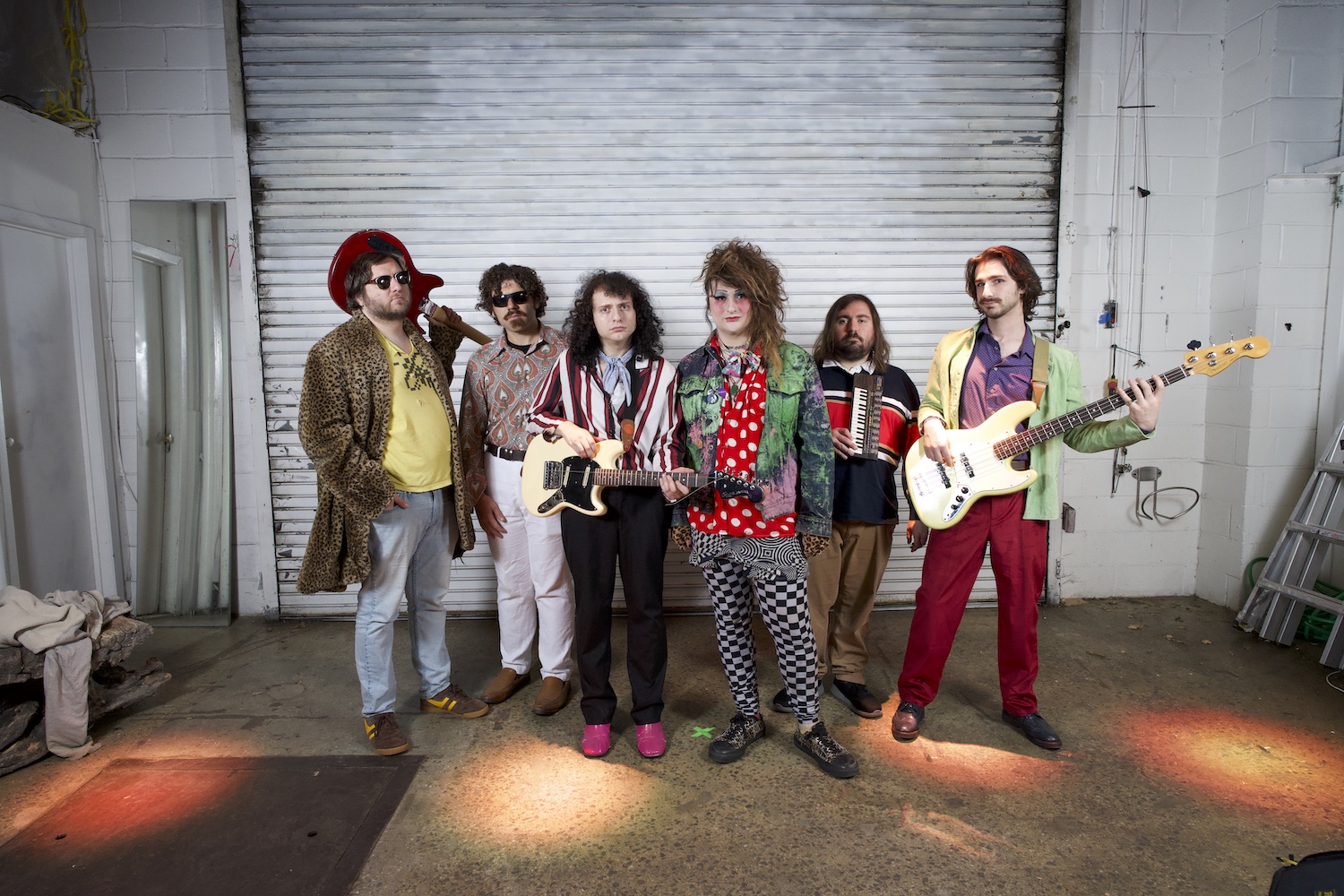
“Chili Dog Incarnate” barrels in with rinky-dink whimsy and a country quickstep, contrasting a penniless man stumbling around Wall Street with a wealthy narrator who lands in jail after striking his father with a champagne glass; by the end, the prisoner envies the pauper’s freedom to wander, fail, and remain answerable only to himself.
The album’s middle stretch moves quickly through three radically different worlds. “Love of Ages” remakes an old acoustic anti-love song as wiry synth-pop, “Whittler and the King” stages a medieval prog revolt against false authority, and “Go Left My Son” lets bad directions spiral into a comic crisis of identity.
Greenberg’s favorite lyric from Ellin arrives near the beginning of that song: “I thought I knew what holy mackerel meant – I thought our space was not for rent.”
“Honestly Matt’s lyrics are my favorite,” she says. “Matt is so good at telling stories.”
Their strangest images are rarely jokes alone. Ellin uses absurdity to write about embarrassment, isolation, artistic obsession, and the pressure to abandon the ideas that make life bearable.
“All the World Is Hanging on a String” brings the album’s pop instincts into their clearest focus. Over sleek new-wave momentum, Greenberg places a narrator inside a collapsing film production, writing, producing, directing, editing, and dubbing the lines they hope will make another person stay. The technical language cannot disguise the panic underneath: “Maybe I should trash the script instead.”
I write, produce, direct about 16 of these a day
While all the world is falling on my head
I shoot, and light, and dub
the words you might want me to say
But maybe I should trash the script instead
– “All the World Is Hanging on a String,” Theophobia
“Seems Like Evil” gives that panic the scale of a midnight horror film. Dogs howl beneath a blood-red moon, a laugh becomes a shriek, flames rise from hot concrete, and two eyes blink beneath an empty bed as Greenberg drives one of the album’s most commanding melodies toward full-throated release.
“I personally tend to be prouder of my melodies when songwriting, and I feel like ‘Seems like Evil’ is my best work on the album as a melody maker,” Greenberg says. “It’s my favorite to sing because I wrote it in my key, so I can hit notes that sound kind of impressive without straining too hard. It makes me feel like Bonnie Tyler!”
“Mumphrey’s Alley” gives the album’s wildest ideas their greatest emotional weight. Ellin’s six-minute prog epic begins as a comic fable about an armless, legless mule who gets rich selling canned fish, then gives way to a narrator imagining their dreams thrown into the sewer, a desk job in formal clothes, and a life spent doing work they would loathe. By the final ascent – “On the brink of good cheer and insanity / In a bid to embrace my humanity” – the song has become a defense of the inner life and everything the adult world asks us to surrender.
Though the fable remains still confounding me
How does the mule get around as an amputee?
Now I shoot through the stratosphere aimlessly
On the brink of good cheer and insanity
In a bid to embrace my humanity
Life as it’s meant to be
Mumphrey’s Reality
– “Mumphrey’s Alley,” Theophobia
“Of course I love ‘Mumphreys Alley,’” Greenberg adds. “Matt worked for over a decade refining that song – it’s so cool that there’s finally this finished version on the album.”
Ellin connects “Mumphrey’s Alley” directly to “All the World Is Hanging on a String,” identifying the two songs as the record’s most personal expressions of their respective writers: “For my own lyrics, I’m just really proud of all of ‘Mumphrey’s Alley.’ It’s sort of this ode to creative insanity and dreams and it almost feels referential to the creation of the song itself. I know it may seem silly to people at first, but it is actually very personal to me. There isn’t really one particular lyric in it that stands out to me, it’s more the collective assembly of them all. My favorite Dylan lyrics on the album are on ‘All The World Is Hanging on A String.’ I think both those songs are the ones that are closest to each of us respectively.”
One considers trashing the script; the other nearly throws every dream away. Together, they expose the fear beneath Theophobia’s excess: That imagination may be dismissed as childish, impractical, or embarrassing until its creator learns to silence it.
Those songs also sit at the center of Ellin’s personal highlights, though their favorites extend back to the record’s opening stretch: “Definitely ‘Mumphrey’s’ and ‘All The World,’ as I said. I still think ‘A Happy Man’ is the perfect intro track, and I’m happy with how that arrangement and mix came out. The mix on ‘Chili Dog Incarnate’ is really excellent and clean, too. I like all of the songs though.”
“The Amazing Disappearing Man” closes the album exactly where Theophobia belong: Beneath the lights, with a carnival barker offering relief to anyone who is depressed, obsessed, or brokenhearted. For a dime, he sells “the spectacle of dreams” and guides his audience through the caravan toward a man who will vanish before their eyes. Chris Michaels and Nick Cereola drive the three-chord finale forward until the showman’s certainty begins to crack and the curtain closes on his own fate. After an album spent testing how much a pop song can hold, Theophobia leave us with the promise of a spectacle – and the possibility that the magic may be real after all.
So open wide and brace your mind for the surprise
For what I sell you is the spectacle of dreams
And just a dime, sir, for such a jewel
To refuse, you would surely be such a fool
And your life, well, ain’t it cruel
So cruel
– “The Amazing Disappearing Man,” Theophobia
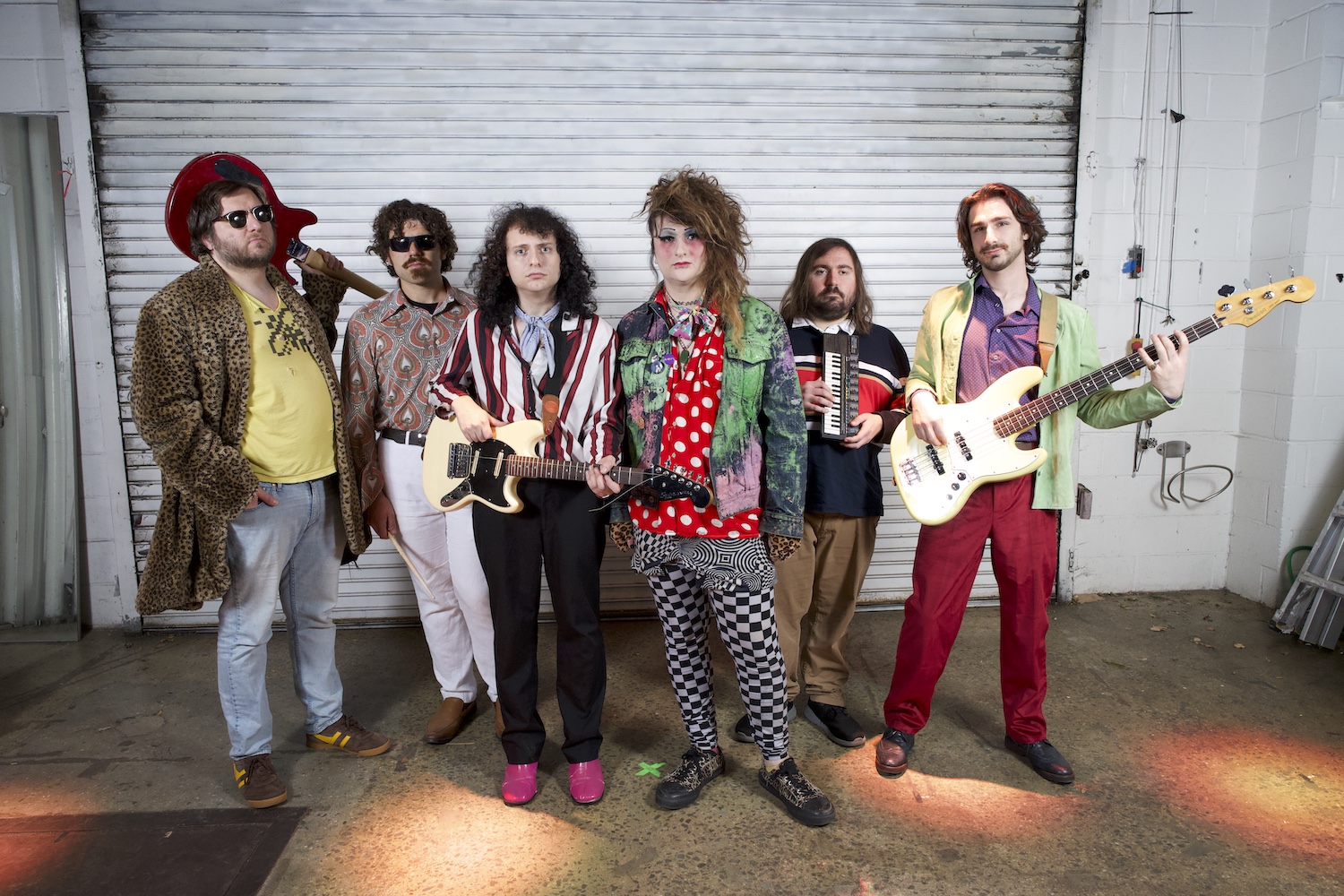
Rock music has always evolved through artists who refused to accept its existing boundaries.
Prog pioneers stretched songs beyond familiar forms. Glam artists made spectacle, identity, and reinvention central to the music itself. David Bowie repeatedly shed one version of himself before it could become a cage, treating transformation as an artistic principle and proving that consistency mattered far less than curiosity.
Theophobia belong to that rule-breaking tradition, yet their debut never treats the past as a costume to be copied. Theophobia restores possibility to rock music. Its songs can be absurd, emotionally exposed, melodically immediate, or structurally unhinged – and the band never ask those qualities to compete. Their range is their identity. This album does not confine Theophobia to one identity, one style, one genre, or one box of any kind; it establishes their right to pursue any and every sound that excites them.
Come out and face the sun
Come out and face the big one
Come out, the mouth to gun
Come out and chew the big gum
Come out and beat the drum
Beat on the drum the hardest
Come out and play the song
Come and avenge the artist
– “Whittler and the King,” Theophobia
For Ellin, that openness carries its own rebellious charge. “I hope people hear this as a subversion of other modern rock music that is maybe a bit more reserved or ambient in its presentation,” they smile. “We understand that there are elements of our music that might register as too silly or ‘uncool’ to some people, but that is kind of our brand of rebellion. Why shouldn’t music be silly and wacky and fun? I love punk rock; it’s the music I grew up on and the genre that made me a music freak in the first place, but there’s such an oversaturation of really samey contemporary punk music right now. Much of it takes itself super seriously and doesn’t really explore other styles. It can feel like the punkest thing one can do at this stage in time is to not be all that punk and sort of laugh in the face of that stuff, which is what I feel we are doing in a way.”
Their rebellion is rooted in pleasure, curiosity, and the courage to follow an idea beyond the point where otherwise rational minds might advise turning back. That refusal to close off possibility is what makes Theophobia special. Every strange detour, oversized melody, comic character, and moment of genuine emotional exposure expands what the band might attempt next.
Greenberg hopes that permission travels beyond the album itself. “I hope people come away with the idea that weird rock isn’t dead; that there are still fresh sounds and ideas out there,” she shares. “We made this because it’s music we want to hear – I hope someone hears this and it makes them make something they want to.”
Theophobia proves this band can go anywhere from here. The most exciting part is knowing they have only just begun. Experience the full record via our below stream, and peek inside Theophobia’s self-titled with Atwood Magazine as the band take us track-by-track through the music and lyrics of their debut album!
— —
:: stream/purchase Theophobia here ::
:: connect with Theophobia here ::
— —
Stream: ‘Theophobia’ – Theophobia
:: Inside Theophobia ::
— —
A Happy Man
Dylan Greenberg: I wrote this song as part of a musical that I still haven’t finished, that’s basically an induction into a cult. Cults use repetition to sort of numb the mind. I feel like that’s the perfect way to start this record – sort of inducting someone into this new world.
Matt Ellin: This is a song written by Dylan which we have used as an opener to our live set since the beginning of Theophobia back in 2019. I think we both always imagined the album would start this way; it feels very much like the opening of the storybook or the curtain going up to reveal this whimsical world you’re about to explore. The original demo had some tricky dynamics that were tough to recreate as a live rock band, so when we first began working with our current six-piece lineup in 2023, we stopped playing it for a while. Still, I don’t think there was ever any doubt that we would learn it when we felt more broken in as a band and that it would be the intro track for the record.
Will You Love Me When I’m Dead
Matt Ellin: The first song I wrote with the explicit intention of using it for Theophobia. Dylan wrote her verse here, hip hop raps style. It’s funny because it doesn’t sound like it at all, but I think of the lyrical approach here as being sort of Phil Spector or Brill Building-like: it’s a very general concept of a guy loving a girl to the point of anxiety. That sounds grim on paper, but it’s expressed in a fun poppy way, and it’s also an easy feeling for most people to understand on some level.
Dylan Greenberg: This is an amazing song written by Matt. I think it’s the first song they wrote for the band when we were a duo. I told Matt, “wow, this sounds kind of like Now That I Own the BBC by Sparks!” Matt’s solo music had sounded so different before (see: All Is Not Lost, their solo album from 2017) and it was really surprising to hear something that sounded like that. It’s so cool that we got to re record it with the full band, because the bass from Nick, the analog synths played by Michael, the congas from Chris, the guitar licks by Alan, and the real vocoder stuff really brought this into an amazing sonic realm. It’s the best version of the song.
God of War
Dylan Greenberg: This is the first song I wrote for the band! I tried to write this song before called I Want to Live in an Italian Restaurant, which I still want to finish, but I didn’t. This was the perfect song to start with, because it quickly became apparent it was the perfect duet for me and Matt. What’s funny is I wasn’t fully immersed in the world of Jim Steinman’s writing yet, I was probably more familiar with it than the average non-nerd, but it was artwork after writing it that I was like, “clearly the stuff I like to write is sort of aligned with that kind of music, I need to really do a deep dive and see if I can glean more inspiration from his work.” And that lead me to write stuff like Seems like Evil and the non album track “The Loop.”
Matt Ellin: This is the first song Dylan wrote for Theophobia. It was very fleshed out when she showed it to me for the first time, with all of the rapid call-and-response stuff written out exactly the way it is now. An extremely melodic character-driven showstopper of a song with tons of guts, and I became very excited about what our new project could become as soon as I heard it.
Anhedonia Tsardas
Matt Ellin: This is a short solo piece composed by our virtuosically talented keyboardist/pianist, Michael Butterly. He interpolated the melody of a later song, “Go Left My Son,” into this. It foreshadows the song quite nicely. Shoutout to Kaitlin Wolfberg who recorded wonderful strings here and elsewhere on the record!
Michael Butterly: The band suggested me doing a piano intro for “Estonia.” They suggested Liszt, who’s Hungarian, not Estonian. At the time, we weren’t playing “Go Left” live, so I thought to combine Liszt and “Go Left” for the first live performance, and it stuck.
Dylan Greenberg: Michael basically was doing these intros before some of the songs, he actually had one he was doing for god of war too, that he sort of just started doing cause music just flows out of this guys fingers. I think this one in particular really stuck out and we were like, this basically has to just become part of the song now. We had Kaitlin Wolfberg do strings on it, which is funny because the song it’s essentially an intro to, Estonia, doesn’t have strings. But this is the best intro to a song of mine ever. It’s crazy how Michael wrote something to compliment my work, and it’s better than what I wrote – and it deserved strings of course.
The Most Wanted Woman in Estonia
Dylan Greenberg: Frankly I don’t know jack about Estonia. I was sort of just searching for a location. I always loved Brian Enos song the Fat Lady of Limbourg. Stuff like that really knocks me out and I wanted to write something like that. I was thinking of it like this tragic operetta, about this woman who’s wanted by everyone, but she doesn’t want them. When everyone wants you they create their own ideas of you that they become obsessed with – I’ve been on both sides of that – and it’s nice to be wanted but it becomes a drag. So if everyone wanted you, you’d probably start to feel like moving into a cave.
Matt Ellin: We’re huge fans of the band Sparks and make no secret of it. The interesting thing about this song is that I believe we discussed it being influenced by later Sparks rather than their 70s stuff while demoing it. I’m talking about albums like Hippopotamus and A Steady Drip Drip Drip. A lot of people seem to hear something vaguely Eastern or even Klezmery in this one, which I find fascinating because we didn’t arrange it with that in mind; we were just thinking about Sparks.
Chili Dog Incarnate
Matt Ellin: Speaking of Sparks…this song isn’t *solely* influenced by them, as my obsession with them sent me down a rabbithole of rock and pop music that borrowed heavily from British music hall and vaudeville. The Beatles and The Kinks are probably the most famous examples of that, but there’s also things like The Bonzo Dog Doo Dah Band and The New Vaudeville Band. That style of silly rinky dink music was strangely ubiquitous in pop throughout the sixties and some of the seventies. You almost never hear new stuff that sounds like it. I wonder why?
Dylan Greenberg: This is another song Matt wrote that went through a lot of incarnations, and I always loved it. Matt recorded this demo of it that was so good, it basically sounded like a finished recording to my untrained ear. It’s got this upbeat country tempo, but the lyrics are really dark. There’s this scene in NYC where people dress like clowns, like this party Clown Cult, and it goes over really well when we play it there. Everyone goes nuts, and it’s well deserved
Love of Ages
Matt Ellin: I originally wrote and released this song in 2018 as part of a solo singer-songwriter EP called Spares. It was initially much slower, and performed in a lowkey acoustic manner with a sort of deadpan vocal inflection akin to Lou Reed or David Berman. Dylan wanted to cover the song and she ended up making a demo instrumental that pretty brilliantly reworked it as an uptempo new wave number. We decided to use it for the band and I changed the vocal to be more like an 80s pop singer with an asymmetrical haircut who sounds like he is using his hands to mime a box around his head. I believe this version of the song is significantly better than the acoustic ballad.
Dylan Greenberg: Matt wrote this song for their EP Spares, and I created this new arrangement for it to take it from an acoustic song to a synth pop song. A lot of people have connected to it, and no wonder, because it’s so lyrically dense. It’s the best anti love song ever written. My mom loves this song and plays it a lot on guitar. I was originally imagining the new arrangement sounding kind of like Erasure, but it became its own thing. This is another song we had an original recording of, but the new version is so, so much better.
Whittler and the King
Dylan Greenberg: I wrote this a while back as basically a vehicle for Matt’s guitar solos – obviously with the full band that became Matt and Alan’s guitar solos, which is even better because they do this thing where the guitars harmonize with each other. The lyrics are this accusatory sort of adolescent rebellion against authority – “you think you’re like us, a Whittler, but you’re a king. You’re covered in jewels and wearing robes, your hands are uncalloused, you couldn’t whittle squat if you tried. You’ve never broken a sweat.” And then these long guitar solos and these chorus vocals we did with Teresa Hui, Alle Norton and Jay Henry really drive it home. At the end I had everyone in the studio do these gang vocals, even our engineer Paul, Alan, Matt, we all sang at the same time into these directional mics. “Come out and face the sun.”
Matt Ellin: This song has sort of a medieval progressive rock fantasy energy about it that I really love. I have always played guitar in this very quintessentially classic rock boomer way. I love playing leads and improvising but I’m not someone who knows a ton of unique scales or modes; I like my pentatonic scales and blues bends. I sometimes get mild shit from people for it because it’s not hip, but the truth is that it is probably the easiest way to play guitar solos, so does that not make it kind of punk? Anyway, I’m lucky that my band indulges my desire to play these kinds of solos, and that I have an extremely formidable melodic foil in our lead guitarist Alan Worm.
Go Left My Son
Matt Ellin: It’s a song about how I’m bad at following navigational directions and knowing where to go. Sometimes when I go to a place, no matter how many times I’ve been there before, it can feel like a giant hand came down from the sky and moved everything around in my absence. Nothing is familiar and I’m totally lost. The spoken word monologue in this is sort of my homage to the Frank Zappa live album “Just Another Band from LA”, which I recommend.
Dylan Greenberg: This started out as this crazy track Matt wrote. It was only like half a song but we were performing it as a duo. And one day me and Matt decided to have this day where we developed it further and I came over and added all this extra crazy stuff to it, and then Matt added more on top of that. I think the stuff I added was sort of my own homage to Smile a little bit, and then Matt added stuff that reminds me of Zappa.
All the World Is Hanging on a String
Dylan Greenberg: I think this is one of the last things I wrote for the album – I wanted to get in one more really solid sounding pop track. It’s funny because I almost feel like it’s so poppy it might trick someone into thinking the whole album is like this and Love of Ages – and then they hear some wild shit like Go Left and I don’t know what they’ll think, but hopefully they stay. The chorus came to me in a dream, and I woke up and the lyrics sort of just poured out of me. I think I wrote the demo in a single night. It just felt right. The way I sing the verses is inspired by our friend Adam Green.
Matt Ellin: Just an extraordinary song and vocal performance from Dylan. Perhaps the emotional centerpiece of the album. While there’s obviously new wave influence, I think this is interesting as a more “modern” sounding cut from the album. There’s something about the production and arrangement that doesn’t feel totally out of step with the music world today, which contrasts nicely with the rest of what we’re doing here.
Seems Like Evil
Dylan Greenberg: I wrote this starting out with this almost Brian Wilson or Roky Erickson idea of just singing “it seems like evil tonight” over and over again in my mind. But then the rest that came out felt increasingly more like a lost Bat out of Hell track or something. I started drawing from the movie Night of the Hunter, the movie by Charles Laughton and the book by David Grubb just immediately conjure up so much in my head. I’m thinking about that movie constantly.
Matt Ellin: Another great vocal from Dylan in what I see as sort of our stylistic ode to Jim Steinman. We both became deeply obsessed with Jim Steinman and all of his work around the time we started the band. I think as an artist, he is often misunderstood. His music, like much of the best, blurs the line between satire and sincerity in a really thrilling devil-may-care way. He should be seen with John Waters as one of the kings of camp and excess.
Mumphrey’s Alley
Matt Ellin: I wrote the first minute and a half of this song something like ten years ago. It was just an exercise in writing the most stream of consciousness thing I could with little regard for musical conventions. It feels much longer than a minute and a half because the form of the song changes so fast and so frequently in such a short span of time. For years I walked around with just that minute and a half in my head, terrified of continuing the song because I didn’t know if whatever came next would be any good. I was finally able to write a couple more parts and began a long laborious process of recording the song, first at a studio and then on my laptop using Logic in a bunch of different locations with a bunch of different musicians. Then several of the stems got lost/became corrupted. Then I willed myself into finishing writing the song, taught it to Theophobia, and put it to tape for this album. I feel like if Ahab caught Moby Dick, if Moby Dick was a six minute prog song. Shoutout to Nate McManus for his terrific trumpet.
Dylan Greenberg: I mean what can I say? Matt spent over a decade making this. It’s a masterpiece. I don’t even know if I can do it justice by talking about it. It’s one of those things you just have to hear for yourself. It’s like if Bohemian Rhapsody was written by Fritz the Cat.
The Amazing Disappearing Man
Matt Ellin: Our great big rock and roll finale! A very dynamic three chord song. I want to use this opportunity to shout out our drummer Chris Michaels and bassist Nick Cereola, who are so solid, so dedicated to the band and so passionate in their performances. They have amazing playing all over this record. They are both masters of feel and know exactly when to serve the songs and when to step out into the limelight, as they do explosively here.
Dylan Greenberg: This song is basically just a celebration of ballyhoo. There’s this circus aspect to the band and we close every set with this song for a reason. My dad taught me about Carny when I was a kid. He’s a wrestling historian, basically, he wrote for WWE magazine for decades, he wrote a great book about Freddy Blassie. Carny is this language that people who work at carnivals and in wrestling use, so that “marks” can’t understand their jive. I grew up going to Coney Island and we’ve ended up playing shows at the sideshow. I grew up watching William Castle and Tod Browning movies – those guys were the king of the showmen, Castle would promise you something like “EMERGO” in the trailers for his films, and a big plastic skeleton would shoot out of a box into the audience. The Tingler had buzzers under the seats to make you feel like this creature was wiggling under the seats and was about to bite you. Stuff like that has always really fascinated me. I like being on both sides of it – being a performer is fun, but being a mark, getting fooled, mystified, and confused, is even better. I like to believe that magic is real.
— —
— —
:: stream/purchase Theophobia here ::
:: connect with Theophobia here ::
— — — —
Connect to Theophobia on
TikTok, Instagram
Discover new music on Atwood Magazine
 © Dillon Edlin
art © Kelly Campanile
 © Dillon Edlin
art © Kelly Campanile
© Dillon Edlin
art © Kelly CampanileTheophobia
an album by Theophobia