
A portrait of presence rather than performance, Whitney Fenimore’s debut album ‘State of Being’ traces faith, mental health, love, sexuality, memory, and self-trust through warm, intimate indie folk songs built to hold the complexity of our own humanity. Rather than offering resolution, the record sits with uncertainty, letting us feel seen, steadied, and a little less alone inside our own becoming.
Stream: “Better Than Lonely” – Whitney Fenimore
Everybody keeps askin if I’m saved / It doesn’t really matter, they got their minds made up anyway…
* * *
Learning who you are doesn’t happen all at once – it happens in fragments, contradictions, and long stretches of living with questions you can’t immediately resolve.
On State of Being, singer/songwriter Whitney Fenimore turns that ongoing, often uncomfortable work into an album that documents presence rather than performance: A clear-eyed look at what it means to exist honestly inside a life still in motion. Drawing from the past decade of her own experience – faith and doubt, mental health, love, sexuality, childhood memory, self-worth, and social responsibility – Fenimore resists rushing toward conclusions, letting each song hold a specific moment in time. The result is a warm, intimate indie folk record rooted in acceptance rather than arrival, one that suggests peace doesn’t come from having everything figured out, but from learning how to stay with yourself while you’re still becoming.
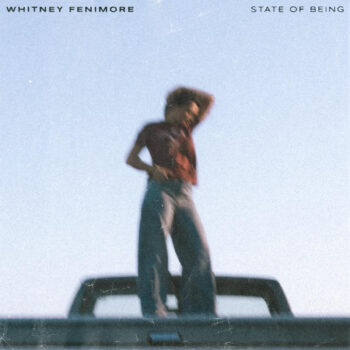
Released October 3rd, 2025, State of Being marks Fenimore’s first full-length album and her most expansive project to date – both in scope and in emotional range. A Nashville-based independent artist, Fenimore first began peeling back the layers of her story on her 2022 debut Leaving Ashwood, a seven-track EP that helped her grow more confident in her voice and more willing to speak up for what she wanted as a songwriter. This time, that self-trust runs deeper. Recorded across Nashville, New York City, and Toronto with a close-knit circle of collaborators, State of Being captures an artist no longer editing herself down, writing without fear of who might hear it, and allowing the songs to take up the space they need. It’s not a reinvention so much as a widening – the sound opening outward, the stories digging inward, and the throughline becoming clearer with every step.
As Fenimore tells Atwood Magazine, she didn’t set out to make a full-length album. She was writing steadily, building toward something smaller, and originally envisioned a more contained release. But the songs kept coming, and at a certain point the math became emotional. As the tracklist grew, it became clear they belonged together – not just as individual statements, but as a larger body of work capable of holding the breadth of what she wanted to say. “I ended up with more songs than an EP could hold, and it felt right to put them together as a full-length record that shared the stories I wanted to tell,” Fenimore explains. “I’m an independent artist, meaning I’m not on a label, so it’s always a little (extremely) daunting thinking of doing a full-length record.” For an independent artist, releasing an LP carries real weight: Financial risk, creative pressure, and the vulnerability of committing to a long-form statement rather than delivering songs in piecemeal. “It’s not the most cost effective,” she continues. “It was scary taking the leap, but I’m so glad we did. Before State of Being, I hadn’t released any project with more than seven songs. I also truly felt like there was a shit ton I wanted to say, and so we went for it!”

That leap is State of Being – an 11-track, decade-spanning look back and look forward, built around the work of becoming.
As Fenimore puts it, “For me, the title ‘State of Being’ encapsulates the idea of learning to be ok and at peace with who I am and who I’m becoming.” It’s not a slogan, or a clean “era” – it’s a lived inventory. “The album is a giant look back at the last decade of my life… where I’m at now and where I’m headed. I really love this quote beautifully explaining the phrase ‘state of being’: ‘The quiet hum beneath the noise – the essence of how we exist in any given moment. It is the soul’s posture, the weather of the heart, the stillness or stirring within. More than action, it is presence. More than thought, it’s truth-felt.’”
For Fenimore, this album is a mission statement. Its songs trace the big internal subjects that shape a person in private – questioning one’s faith, exploring love and sexuality, unpacking mental health and social justice – and it does so with the three words Fenimore uses to define the entire project: “Raw, unapologetic, and hopeful.”
If 2022’s Leaving Ashwood was the start of the curtain lifting, State of Being represents the moment Fenimore stopped holding anything back. “I think both records capture my artistry, but in different ways,” she reflects. “In Leaving Ashwood, I started getting more comfortable as a songwriter and musician, trying to lean into what I felt like was ‘my sound’ or ‘my genre.’ I was fortunate to work with James Bunton from Toronto, who encouraged me and genuinely helped shape the way I approach my work as an artist today. I learned to get less afraid with speaking up, with what I wanted with that record. Leaving Ashwood marked the beginning of me peeling back the layers – finally touching the parts of my story I’d always been too afraid to share.”
This time, she went deeper. “State of Being really felt like I was digging in even further, writing lyrics without fear of ‘what if so-and-so hears this.’ I tried to tap into making the songs I wanted (and needed) to hear. I went for more of an indie folk/alternative full band sound on this record. Leaving Ashwood was pretty stripped for the most part. ‘Wrong About Jesus’ has a full woodwind section! I took some chances sonically with State of Being, and I’m so glad we did.” In that shift, the album finds its center – a body of work about learning peace without erasing complexity, and about telling the truth in full sentences, even when it’s messy, even when it’s brave.

If State of Being is about presence – “how we exist in that moment, physically, emotionally, and mentally” – then the album’s songs unfold like interior monologues finally spoken out loud.
Fenimore writes from the place where the outer world quiets down and the inner one takes over, letting feeling dictate form. Across a blend of acoustic and electric guitars, lived-in drums, and arrangements that feel close enough to touch, her voice becomes the constant: Warm, intimate, and aching in the way only a performance rooted in truth can be.
“Come Around” opens that door with a weary, searching gaze turned outward. It’s a song that wrestles with the state of the world without pretending to have answers, carried by lines that feel both resigned and quietly defiant: “Man on the TV says there’s freedom / But I just don’t believe him.” Fenimore sings with a steadiness that makes the doubt land harder, circling questions of meaning, belief, and belonging until they settle into something gentler and more human. “We all want something to believe in,” she admits, before offering the song’s quiet moral center: “Sitting at the table / We all deserve a place.” It’s not a protest song so much as a plea for shared ground – justice and hope braided together in a voice that sounds tired, but not defeated.
That inward turn sharpens on “Thin Line,” one of the album’s most unguarded reckonings with anxiety and depression. Fenimore doesn’t dramatize the struggle; she names it in plain language and lets repetition do the work. “It’s been takin all I have / To get myself up outta bed,” she sings, the line returning like a thought you can’t shake. The arrangement stays restrained, giving her vocal space to hover between exhaustion and resolve, until the ache of “losin what I never had” hits with devastating clarity. It’s a song about survival in the smallest units – getting up, staying present, holding on – and it sounds exactly as heavy as that work feels.
On “New Normal,” Fenimore brings that same honesty to her relationship with faith, writing from the unsettled space of deconstruction without bitterness or apology. “Everybody keeps askin if I’m saved / It doesn’t really matter,” she sings, dismantling expectation with calm certainty. The song reframes belief as something lived rather than prescribed, especially in its most cutting admission: “Used to think I was crazy / For taking antidepressants.” Instead of shame, Fenimore offers grace – toward herself and toward those who may never understand. “I’m done runnin in circles / I’m finding a new normal,” she declares, not as a victory lap, but as a boundary set with care.
That sense of grounding finds its softest expression on “Thank God for You,” a love song that understands devotion as attention. Fenimore lingers on the quiet details – “good coffee in the morning,” “breakfast in bed,” “sunlight hits your blue eyes” – and lets them stand in for something larger. Her vocal here is especially tender, almost conversational, as if she’s afraid to break the moment by singing too loud. In the context of State of Being, the song feels less like escapism and more like refuge: proof that steadiness, too, can be sacred.
“Wrong About Jesus” is where the album’s private reckoning becomes openly confrontational. Fenimore flips the language of the church back on itself, asking to be seen as a person rather than a verdict: “What if you just looked me in the eyes / Instead of reading scripture ’bout where I’ll go when I die.” The ache in her voice sharpens into resolve as she names the contradiction at the heart of conditional love – “You’re preaching love that feels like hate.” When she lands on the line “You were wrong about Jesus,” it doesn’t feel like provocation for its own sake, but reclamation: a refusal to let anyone else define the meaning of compassion, faith, or belonging.
That reckoning softens into something quieter, but no less painful, on “Better Than Lonely,” a song about staying too long because the unknown feels worse than dissatisfaction. Fenimore captures the slow erosion of self with devastating simplicity: “Pacing laps around myself / Turning into someone else for you.” The chorus circles its central lie – “it’s better than lonely” – until the cracks show, and the final verses reckon with the cost: “I sold all of my things / Now I can’t get them back.” It’s a song about choosing yourself late, but honestly, delivered with the kind of restraint that makes the truth hit harder.
Taken together, these songs show State of Being doing exactly what Fenimore set out to do: Creating space where the inner world can speak without interruption. Each track holds a moment, a feeling, a question – not to resolve it, but to honor it. In that stillness, the album finds its power.

Even within that emotional breadth, Fenimore resists canonizing any single moment as definitive.
“It’s hard to pick a favorite,” she admits. “I feel like it’s constantly changing!” Still, a few songs rise to the surface depending on where she is. “Right now, my favorite would be ‘Worst Thing For Me’ (written with Addison Agen / produced by Will Honaker). I just love the feel/vibe and message of that song.” She also points to “Wrong About Jesus” as a particularly meaningful experience – not just for what it says, but for how it came together. “I got to record ‘Wrong About Jesus’ in New York City with my friend David Gungor. There were so many different lovely people that played a part in that song, it was super special to make.”
When it comes to lyrics, her attachment turns instinctive and personal. “My favorite lyric from the record is tough. Right now, it’s probably the opening stanza from ‘Cowboy Sweetheart’ because it takes me right back to being 7 years old hanging with my grandma at her kitchen table.” She quotes it without embellishment, letting the image speak for itself: “I can see grandma in the kitchen. Singin’ I wanna be a cowboy sweetheart. Cigarettes and a pot of coffee. Grandpa’s truck burnin’ red in the yard.” It’s a moment of memory rendered with such specificity that it becomes universal – proof of how deeply place, family, and feeling are braided throughout the record.
Stepping back, what makes State of Being resonate isn’t just its honesty, but its patience. Fenimore isn’t chasing catharsis or closure; she’s allowing complexity to remain intact. She allows the full scope of her interior life to exist without hierarchy or simplification, tracing questions of faith alongside mental health, sexuality, and healing; sitting with emotional baggage, self-worth, anxiety, depression, and overthinking; reckoning with childhood memory, rejection, love, insecurity, and death; and holding space for social justice, acceptance, and the slow work of trusting herself. Rather than treating these experiences as chapters to be closed, the album lets them overlap and inform one another, mirroring the way life actually unfolds. It makes room for faith and doubt to coexist, for love to feel grounding and uncertain, for self-trust to be something learned slowly rather than declared outright.

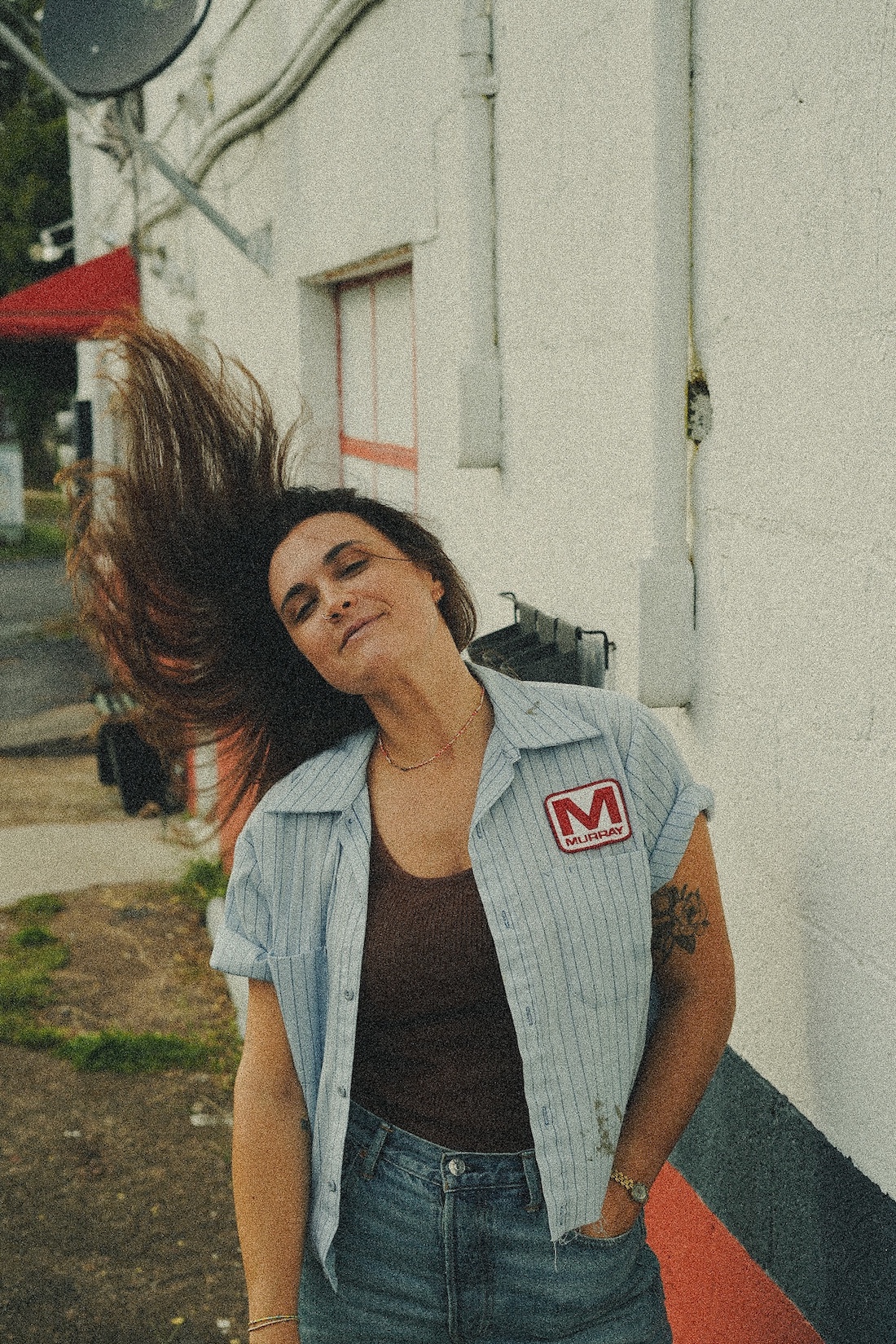
In a landscape that often rewards certainty and spectacle, State of Being chooses something quieter and harder: Presence.
It’s an album that listens as much as it speaks, that understands peace not as resolution but as attention – to memory, to feeling, to the small truths we carry before we’re ready to name them, that shape who we are over time. In inviting listeners into that space, Fenimore offers something rare: Not answers, but companionship in the work of becoming.
“The record dives into everything,” she shares. “I hope listeners are able to listen with open hearts and minds. I hope they can see themselves in the songs and stories. I hope they learn to find a place of peace in their hearts with who they are and who they are becoming. I hope, in listening to the record, each listener feels a little less alone.” For her part, Fenimore is choosing wholeness over comfort – telling the stories she once edited down, expanding the sound to match the scope, and trusting her own compass as she goes. “I’m learning to trust myself more. To trust my gut, to trust my intuition – in regards to music, lyrics, life – in everything. For me, making this record was a leap of faith in so many ways, and I’m just so damn thankful it’s out.”
What stays with you about State of Being is how patiently it meets you where you are. Fenimore’s songs don’t demand attention so much as they earn it, revealing themselves slowly through texture and tone – the warmth of her voice brushing up against acoustic strings, the quiet ache in the electric lines, the steady thrum of drums that feel more like breath than backbeat. It’s a record you can return to in future seasons and hear differently each time, because it’s built around the truth that presence isn’t fixed. Some days, these songs feel like companions for heavy moments; other days, they simply sit beside you, offering comfort without commentary. In letting the music remain open – unresolved, tender, human – State of Being becomes less something to finish and more something to live with, ready whenever you are to step back inside its stories and melodies.
Experience the full record via our stream below, and peek inside Whitney Fenimore’s State of Being with Atwood Magazine as she goes track-by-track through the music and lyrics of her debut album. “Each song is a reflection of a moment in time, a feeling, or a story that shaped me, and this is me inviting you into my world, one track at a time!”
— —
:: stream/purchase State of Being here ::
:: connect with Whitney Fenimore here ::
— —
Stream: ‘State of Being’ – Whitney Fenimore

:: Inside State of Being ::
— —
“Come Around”
This is my cry for justice and hope in a time of uncertainty.
“Thin Line”
This song is about my struggles with anxiety and depression. I had never written about that season of my life until a friend encouraged me to. Back then, something as simple as getting out of bed often felt like the hardest thing.
“New Normal”
I wrote this about learning to exist outside the confines of a religious upbringing. It’s centered on mental health and the difficult process of grappling with the feeling that God had left.
“Thank God For You”
A good ol’ upbeat love song. For me, the little things are the best things — quiet mornings, coffee on the couch, breakfast in bed.
“Punching Bag”
Sometimes therapy really is cheaper than unloading your emotional baggage on your partner. I first heard the phrase “punching bag” on a podcast, and it stuck with me. In a writing session with Addison Agen, we ran with it. I’ve been in relationships where I let my own baggage get the best of me instead of facing it, and this song came out of that honesty.
“Wrong About Jesus”
This one is a cathartic reclaiming of my story — growing up queer in a conservative community. It blends gospel-style vocals and horns with lyrics that flip a traditional “church song” into something completely different. I co-wrote it with Nell Maynard (Brooke Eden), and David Gungor (The Brilliance) produced it. I often feel unseen, and this song is my way of pushing back.
“Worst Thing For Me”
Here I ask myself: is it okay to embrace something that’s been labeled “bad” for us if it actually makes us happy?
“Cowboy Sweetheart”
This song grew out of my favorite childhood memories in Oklahoma. It’s nostalgic, longing for that carefree time when all my loved ones were still alive and the world felt peaceful. Sometimes I catch the smell of coffee and cigarettes, and I’m instantly back in my grandma’s kitchen, listening to her sing “I Wanna Be a Cowboy Sweetheart” and nail the little yodel at the end (at least I always thought she did).
“Better Than Lonely”
This song is about realizing you may have stayed in something too long just because the alternative was unknown. It’s about finally coming to terms with second-guessing yourself and knowing when to let go. We wrote it with relationships, locations, and work in mind, since it’s something we’ve both experienced. The unknown can be scary, but there’s also beauty and freedom waiting there.
“Am I Doing This Wrong?”
An introspective look at the back-and-forth in my head. Self-doubt creeps in even when I think I’ve got it handled. At its heart, this song is about anxiety, overthinking, and second-guessing myself.
— —
:: stream/purchase State of Being here ::
:: connect with Whitney Fenimore here ::
— — — —
Connect to Whitney Fenimore on
Facebook, TikTok, Instagram
Discover new music on Atwood Magazine
© Alysse Gafkjen
 © Alysse Gafkjen
State of Being
an album by Whitney Fenimore