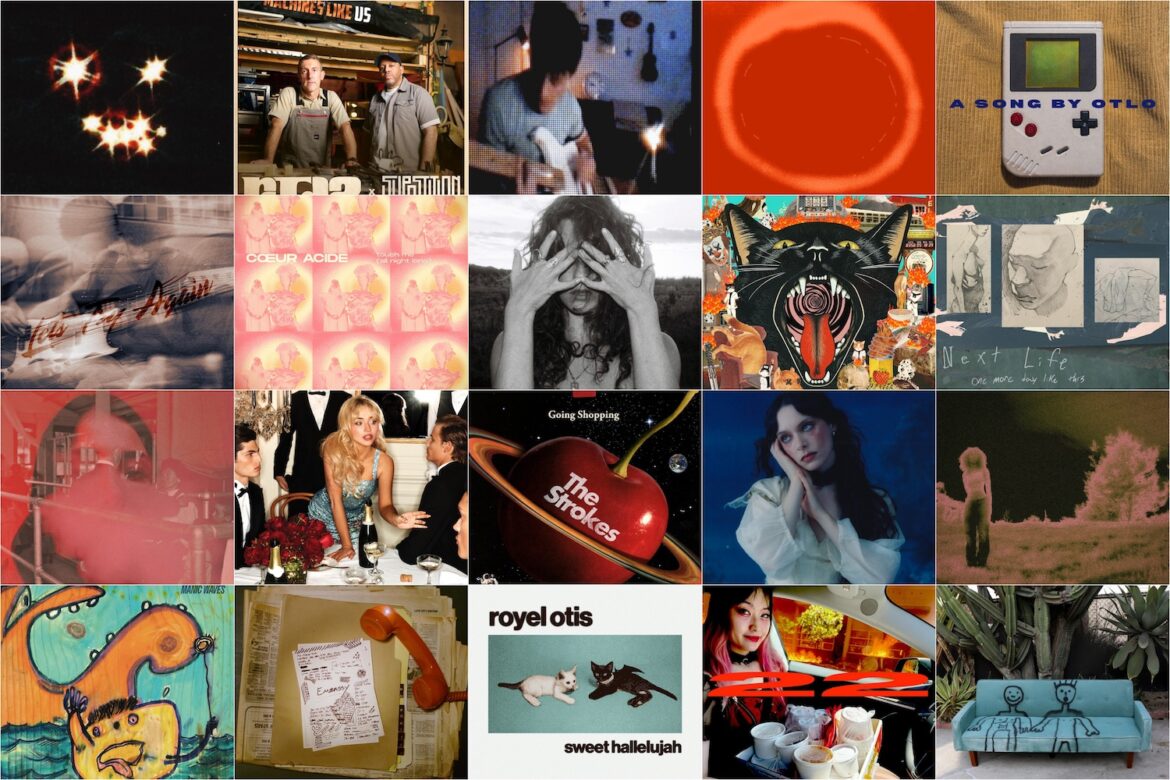
Every Friday, Atwood Magazine’s staff share what they’ve been listening to that week – a song, an album, an artist – whatever’s been having an impact on them, in the moment.
This week’s weekly roundup features music by The Strokes, Sabrina Carpenter, Holly Humberstone, Luke Beling, Fantastic Cat, Will Foulke, Luc Letourneau, Parlour Magic, Brian Jaims, The Moss, RJD2 & Supastition, Royel Otis, EVRO, Billy Peake, Max Nemo, Otlo, CŒUR ACIDE, Heidi Curtis, 2heart2crash, & Satya!
•• •• •• ••
 follow WEEKLY ROUNDUP on Spotify


•• ••
:: “Going Shopping” – The Strokes ::
Mitch Mosk, Beacon, New York
Falling back into a band you’ve loved for years rewires something in you – old songs snap back into focus, guitar lines hit harder, and suddenly you remember exactly why it all mattered in the first place. I’ve been deep in a Strokes spiral lately, so the arrival of “Going Shopping” feels less like a coincidence and more like perfect timing – a reminder that some connections never really fade, they just wait for the right moment to come rushing back.
Like a tiger, they will chase you down
With words instead of claws
They will seduce you ’til you reach the point
To let yourself get mauled, oh
The worse reality gets,
the less you wanna hear about it
Solidarity can be difficult
When you got cool stuff to lose
Their first release since 2020’s The New Abnormal, and the lead single off the newly announced Reality Awaits, “Going Shopping” is a tight, kinetic burst of indie rock that leans into everything The Strokes have always done best, while quietly stretching their edges. The guitars are wiry, angular, and playful, full of bright, zig-zagging licks that give the song a buoyant, almost carefree momentum, while Julian Casablancas threads it all together with Auto-Tuned vocal flourishes that feel surprisingly natural – not a gimmick, but an evolution. It’s sleek, a little strange, and undeniably alive.
I wanna be a 7-foot zombie
The pay is low, but I gotta do somethin’
I’m at the mall and the song is bumpin’
There goes my future wife
in the little red jumpsuit
I’m goin’ away to the country
Don’t wander off too far
I’m goin’ out my mind
Throwin’ all my plans out the window
Don’t wanna waste my life
I’ll see you on the other side
Beneath that glossy, danceable surface, though, the song plays with tension between escape and entanglement – consumerism, identity, and the quiet dread of watching your own life take shape in ways you’re not sure you chose. Lines like “The worse reality gets, the less you wanna hear about it” cut through the shimmer, grounding the track in more uneasy territory, while the chorus – “I’m goin’ out my mind / Throwin’ all my plans out the window / Don’t wanna waste my life” – turns that anxiety into motion. It’s restless, impulsive, a little absurd in its imagery, but that’s the point: a world spinning faster than it makes sense, met with a shrug and a sprint toward whatever comes next.
And maybe that’s why “Going Shopping” lands the way it does – not as a grand reinvention, but as a band fully in tune with their instincts, embracing the chaos instead of trying to outrun it. There’s a lightness here that doesn’t ignore the weight underneath, just carries it differently, turning uncertainty into a groove you can move to, shout along with, live inside for a few minutes at a time. For a band that helped define a generation, it’s a thrilling reminder that they’re still finding new ways to make that feeling hit.
:: “House Tour” – Sabrina Carpenter ::
Emily Weatherhead, Toronto, Canada

With the release of the “House Tour” music video, what better time to revisit the sparkling penultimate track from Carpenter’s Man’s Best Friend? With plenty of witty lyrics (of course, none of them are metaphors) and a bright, catchy chorus, “House Tour” is one of the most re-playable songs of the album.
Carpenter’s foray into more risqué lyrics really took off with her signature “Nonsense” outros during her emails i can’t send Tour, a tradition she kept up throughout her time as an opener for Taylor Swift’s Eras Tour. Whether you love it or hate it, Sabrina Carpenter has taken that momentum and turned it into a niche for herself that allows her to showcase her witty writing and vocal prowess.
“House Tour” is a shining example of this career-making pivot. The witty lyrics are packed with double entendres, and it’ll likely take a few listens to catch them all. Carpenter’s vocals never disappoint, and she showcases her impressive range throughout the song. A layered, synthesizer-driven production from Jack Antonoff fills out the sonic landscape. While there’s often a lot of pressure put on female artists to create music with deep emotional meanings or strong messages, it can be just as refreshing to listen to a pop song that is simply fun.
:: Cruel World – Holly Humberstone ::
Mitch Mosk, Beacon, New York

A rush of feeling, a flood of color, a heart wide open – Cruel World doesn’t just pick up where Holly Humberstone left off; it expands her world in every direction, turning intimacy into something cinematic, something all-consuming. Bigger, bolder, and more fearless than Paint My Bedroom Black, her sophomore album feels like a deep breath and a leap at the same time – a record that embraces risk, chases it, and lands every single one.
Across these twelve songs, Humberstone leans fully into her strengths: that diaristic, deeply human songwriting, and a voice that aches, swells, and shimmers with every word she sings. From the effervescent lift of “Die Happy” and the tear-streaked glow of “To Love Somebody” to the sweet, open-armed warmth of “Cruel World,” she builds a landscape that feels at once dreamy and grounded, euphoric and unraveling. This is pop music at its most alive – pulsing, propulsive, and brimming with feeling.
What makes Cruel World hit as hard as it does is how seamlessly it moves through those emotional extremes. The hypnotic momentum of “White Noise” hums with restless energy, while “Lucy” strips everything back to a tender, quietly devastating moment of heart-to-heart connection. “Red Chevy” surges with fire and urgency, and by the time we reach “Beauty Pageant,” Humberstone pulls the curtain back completely – offering a final, aching moment of clarity by-way-of breathtaking piano ballad, where performance gives way to raw, haunting truth: “So it starts with a girl in a bar, and she’s singing from the heart, glitter curtain, sticky floors, she would die for the applause… I’m too young, too sad, too numb to give a damn. I’ll strike a pose, I’m ready, come on and make me pretty.” As she shared upon release, “This album encapsulates two years of loving, learning, yearning, growing up, embracing changes and navigating being a young woman in the modern world. I feel so privileged to have been able to grow and learn so much about myself and those closest to me through its creation.”
There’s a confidence running through Cruel World that feels hard-earned – not just in its scale, but in its perspective. Where her debut wrestled with displacement and longing, this album feels more rooted, more self-assured, even as it continues to explore love, identity, and the fragile line between euphoria and collapse. It’s messy in the way real life is messy, full of contradictions and questions that don’t always resolve cleanly.
And that’s what makes it linger. Cruel World doesn’t try to tie everything up neatly – it lets the highs soar, the lows ache, and the in-betweens breathe. In doing so, Holly Humberstone delivers a record that feels as expansive as it is intimate – a no-skips, soul-stirring reminder that growing up isn’t about finding the answers, but learning how to live inside the questions.
:: “Just Like Your Mama” – Luke Beling ::
Mitch Mosk, Beacon, New York

A pair of flashing blue lights, a question you can’t answer fast enough, and suddenly your whole life is no longer your own. “You heard the president – people like you are a national threat.” Luke Beling’s “Just Like Your Mama” drops you into a reality where identity is reduced to perception – where being “just a little shorter, just a little darker” can determine how you’re seen, how you’re treated, and whether you get to stay.
Released February 27 via MDDN Records, the song unfolds as a stark, unflinching narrative – a haunting folk ballad that trades spectacle for stillness, letting its story do the heavy lifting. There’s a quiet gravity in its arrangement, each note placed with intention, allowing the weight of the lyrics to land without distraction. It’s cathartic, aching, and deeply human, capturing a moment that feels both singular and painfully widespread.
Beling is no stranger to telling stories that sit at the intersection of personal reckoning and larger human truth. A South Africa-born, Hawaii-based songwriter, he’s long carved out a space in the alt-folk world through songs that wrestle with faith, fragility, and what it means to be human – work that Atwood has previously highlighted for its raw, unfiltered emotional depth and philosophical weight. Whether exploring spirituality or sorrow, his music has always leaned toward empathy, toward understanding – which makes “Just Like Your Mama” feel like a natural, if more pointed, extension of that voice.
That perspective comes from lived experience, and Beling doesn’t shy away from it. “It was almost 23 years ago that I left South Africa to chase the American dream,” he tells Atwood Magazine. “As an immigrant arriving with nothing but lint in my pockets, I could’ve never imagined the opportunities handed to me by a people as generous as the land is vast. Lately, I’ve been reminded that no dream of mine has ever been bigger than the dream of family. This is what I’ve come to love most about the USA: You can arrive from a far-off land, get married, build a home, and raise kids with real hope for a better future. It’s what these 23 years bouncing from the South, to the Midwest, to the U.S. Pacific Islands have shown me. Today, I find it hard not to empathize with the current plight of immigrants. I know firsthand how good this country has been to me. That’s why I wrote, ‘Just Like Your Mama.’”
That empathy is sharpened by memory – and by what he’s seen firsthand in moments that mirror the song itself. From the moment the narrator is stopped, detained, and deported without recourse, Beling paints a picture of a system stripped of empathy, where due process disappears and humanity becomes secondary. Lines like “He puts the shackles on my ankles, puts the cuffs on my wrists / I say officer please, I’ve got little kids” aren’t dramatized – they’re direct, unembellished, and all the more devastating for it. And when he repeats “Just like your daughter, just like your father… just like your mama,” the message cuts through with devastating clarity: This isn’t about “others” – it’s about us.
That connection between story and reality isn’t abstract – it’s lived. “I never set out to write a ‘protest’ song,” he says. “As an immigrant, I’ve stayed politically agnostic these past few years, watching the US two-party divide seemingly grow unbridgeable. But when aggressive ICE enforcement began disrupting lives in immigrant communities, an old memory resurfaced, and I had to write. I was in the car with my best friend (who isn’t white), driving in the South. Blue lights flashed. He handed over his legal (US-approved) international driver’s license. The officer pulled him out, cuffed and shackled him, then transported him to county jail. For no discernible reason.”
“That incident happened twenty years ago. But it doesn’t feel so distant from the stories we’re hearing today. Most common-sense folks protesting ICE aren’t arguing for open borders. Rules matter. You can believe in law and order and still believe ICE raids aren’t working. This issue has less to do with legislation than it does with denying basic human rights. I wrote ‘Just Like Your Mama’ because it’s an ugly old trick to view ‘different’ as dangerous; because the color of your skin shouldn’t determine how you’re treated in any country, let alone the USA.”
This isn’t about politics as much as it is about people. It’s about dignity, empathy, and refusing to let fear dictate who gets to belong.
In the end, “Just Like Your Mama” doesn’t offer resolution or easy answers. It doesn’t try to soften the blow or dress the truth up in metaphor. It simply asks you to listen, to sit with the story, and to recognize the humanity at its center. And in doing so, Luke Beling delivers one of the most arresting and necessary songs of the week – a reminder that the line between “us” and “them” is thinner than we’d like to believe.
:: Let’s Try Again – Will Foulke ::
Danielle Holian, Galway, Ireland

Producer and singer-songwriter Will Foulke returns with his third studio album, Let’s Try Again, a 13-track, 40-minute exploration of rock, pop, and blues that solidifies his reputation as a deft storyteller and expressive musician. From the opening chords of “Before The Start” to the reflective closing of “Jam #1,” Foulke demonstrates a command of melody and narrative, pairing heartfelt lyrics with layered instrumentation that never feels overproduced. His ability to merge emotional transparency with approachable hooks gives the album a warmth and immediacy, inviting listeners into a world that is at once personal and universally resonant.
Foulke’s early immersion in guitar, inspired by the likes of Jimi Hendrix and Stevie Ray Vaughan, continues to inform his playing, with expressive leads and nuanced phrasing woven throughout the record. While the album leans heavily into rock and pop production, traces of blues and classic songwriting influences, Paul McCartney, Jeff Lynne, Stevie Wonder, and The Beatles, surface in the arrangement choices and harmonic structure, giving the album a timeless quality. Collaborating with Elliott Elsey on production and Vlado Meller on mastering, Foulke achieves a polished yet organic sound, supported by Noah James on keys, Alex Brouwer on drums, and McCarthy Fitch on bass, each contribution enhancing the album’s dynamic range.
Let’s Try Again navigates themes of heartbreak, personal growth, and the complexities of moving on, while musically balancing introspective ballads like “When Your Love Runs Out” with more energetic tracks such as “Roll It To Me” and “Fresh Air.” The album’s strength lies in its ability to maintain emotional honesty across diverse sonic landscapes, creating a cohesive listening experience that reflects both Foulke’s evolution as an artist and his continued commitment to authentic storytelling. In its 40-minute runtime, Let’s Try Again is a compelling statement of artistic growth, offering both longtime fans and new listeners a nuanced portrait of an artist unafraid to explore the highs and lows of human emotion.
:: Next Life / One More Day Like This – Luc Letourneau ::
Danielle Holian, Galway, Ireland

Luc Letourneau’s debut album, Next Life / One More Day Like This, arrives like a quiet revelation, a ten-track meditation on the unpolished edges of life. Rooted in Boulder’s open skies and intimate performance spaces, Letourneau fuses Americana’s storytelling heart with the restless energy of indie rock, producing a sound that is at once raw and cinematic. His voice, simultaneously worn and tender, carries the weight of experience while inviting vulnerability, turning everyday observations into moments of stark reflection. From the opening strains of the title track to the layered textures of “7 Years Here, 8 Years Gone,” the album captures the tension between memory and presence, childhood and adulthood, the sacred and the mundane.
Tracks like “Awesomest Man” confront faith and expectation with blunt, conversational lyricism, while the title track balances poetic introspection with a gentle, pulsing momentum. Letourneau’s compositions are steeped in what he calls the “premature spark,” a philosophy privileging the raw, immediate truth of a song over studio polish. Acoustic strings, subtle percussion, and textured harmonies frame lyrics that probe the “pole of life,” the fragile tether to personal values amidst constant noise. His music inhabits the liminal spaces of the everyday: the quiet morning, the echoing halls of historic venues, and the fleeting clarity found in reflection.
There’s a timelessness to Next Life / One More Day Like This that feels both grounded and adventurous. Influences from Neil Young’s folk-protest honesty and Big Thief’s modern vulnerability surface throughout, yet Letourneau’s perspective is unmistakably his own. By weaving childhood recordings into the album’s finale, he constructs a literal bridge between past and present, underscoring a recurring theme: growth is neither linear nor neat, but full of unresolvement. With this debut, Luc Letourneau stakes a claim as an emerging voice in indie-Americana, a storyteller who celebrates imperfection, emotional honesty, and the small truths that make life resonate.
:: Cat Out of Hell – Fantastic Cat ::
Mitch Mosk, Beacon, New York

Like a Cat Out of Hell, they’ll be… purrrfectly in sync and using every one of those nine lives (and hopefully not sued in the near future). Fantastic Cat tear into their third studio album with a ragged, radiant, full-hearted folk rock spirit that aches, soars, swells, and stirs. The four-piece from New York City charge forward with endearing warmth, wit, and wild-eyed charm, turning every chorus into a communal shout and every verse into a story worth holding onto – all delivered with the kind of conviction that only comes from years of shared chemistry and hard-earned clarity.
Released April 10 via Missing Piece Records, Fantastic Cat’s third album captures more of this band’s beautiful lightning in a bottle – bigger, looser, and more alive than anything they’ve made before, while still holding tight to the warmth and wit that’s defined them from the start. Their brand of folk rock remains swaggering and spirited, hearty and human – endearing to the bone – whether they’re charging forward on “Donnie Takes the Bus,” digging in deep on “Nobody Better,” or letting their voices collide in gloriously rich harmony across the record’s 12-song run. There’s a sense of motion baked into every track, a charming ease that makes the whole thing feel less like a studio record and more like a band playing shoulder to shoulder, chasing something just out of reach and loving every second of it.
That energy takes on fresh dimensions across the album’s deeper cuts. “Mona Be Still” leans cinematic, its sweltering harmonies and orchestral-backed swells adding a dramatic weight that elevates it into a quietly breathtaking barnburner. “L U C Y” finds the band locked in cathartic reverie, roaring, stomping, and hollering in stunning tandem as the song surges forward with communal fire. Elsewhere, “No Goddamn Way” kicks the door back open – an emphatic, Brian Dunne-led rocker full of heat, grit, and those sweet, soaring vocal oohs that send shivers down the spine. A colorful, warbling lead guitar snakes its way through the track as Dunne digs in deep, delivering lines like “There ain’t no goddamn way I’m going home without you now / There ain’t no time to waste, there’s nothing left to talk about…” with a conviction that feels equal parts reckless and resolute. It’s messy, loud, and completely alive – exactly the kind of moment Fantastic Cat have built their name on.
Right now, it’s “The Waiting Room” that’s stealing the show for me – another Dunne-driven standout that swells and stirs with a kind of restless grace. Warm guitars churn beneath radiant, singalong-ready choruses, building toward something that feels both intimate and expansive, like a thought you’ve had a hundred times suddenly landing with new weight. It’s patient but pulsing, reflective but resolute, capturing that suspended space between where you are and where you’re trying to go.
That sense of movement – of living inside the in-between – has always been part of Fantastic Cat’s DNA. Comprised of Brian Dunne, Anthony D’Amato, Don DiLego, and Mike Montali, the New York–bred collective thrive on that balance between sincerity and smart-assery, between heartfelt reflection and wry, self-aware charm. Their songs feel communal, lived-in, and unmistakably human, rooted in storytelling that never loses sight of the bigger picture even as it zooms in on life’s smallest, most telling moments.
And that’s what makes Cat Out of Hell land the way it does. It’s not just a collection of great songs – though it is absolutely that – but a record that feels like it’s breathing, shifting, and reaching in real time. From start to finish, it carries a spirit that’s hard to fake and even harder to replicate, turning camaraderie into something tangible and deeply felt. In a year already full of standout releases, this one effortlessly earns its place among 2026’s very best.
:: “Embassy” – Parlour Magic ::
Josh Weiner, Washington DC

There’s a stereotype about New Yorkers – as personified by Rosamund Pike’s character in the movie Gone Girl – that they all think that “the world ends at Hudson.” Thankfully, there are other NYC residents who enjoy the many wondrous opportunities within their city, while also recognizing that there’s plenty to appreciate in other corners of the Earth.
Representing that more positive personality is Luc Bokor-Smith, who’s lived in Manhattan for much of the past decade and has made a second home for himself at Flux Studios in East Village. Yet he also managed to take a two-week trip to China recently, the purpose of which was simply to “get lost; explore with no pressure or destination.” It proved to be an incredible trip, one that generated tons of artistic inspiration. He made it all the way over to Berlin while all he’d seen was still fresh in his mind and molded a solid stash of new tracks out of his vision. Once that had been achieved, he completed his loop around the world and made it back to Flux Studios in New York, where he sealed the deal by recording another set of new songs until he finally had enough to produce a full-length album: The Embassy, due for release in two months’ time.
The album’s title track and first single is an early indication that all of that travel time has yielded some promising creative output. The song makes the most of the talents of Bokor-Smith’s new creative allies – sound engineers Bailey Kislak and Fab Dupont, plus a number of musicians on the strings and drums. Together, they’ve created an alluring synth-pop sonic texture, upon which Parlour Magic – as Bokor-Smith is known once he enters recording mode – lays his muffled vocals about becoming more intimate with his partner. “You and I, running in circles,” he imagines. “You’ll confess to me, I’ll confess to you.”
And here’s a confession from my part, while we’re at it: I quite enjoyed this track! I’m looking forward to hearing the rest of the dozen song-set that Parlour Magic have promised for us later on this spring.
:: “Listerine (spit me out)” – Brian Jaims ::
Miranda Urbanczyk, Michigan
 Inconsistency is key. While that may seem contradictory, it’s what inspired “Listerine (spit me out)” by Brian Jaims. Listerine may make your breath minty fresh, but in this rendition, it’s the portrayal of a person’s heart being played with. The song’s realistic metaphors take everyday things and reimagine them in terms of a heartbreak. These visual representations in the lyrics allow the listener to truly imagine the instability and emotional spiral described throughout the track. “You swish me around // and spit me out // How you go from missing me to treating me like listerine.”
:: “Your Way” – The Moss ::
Chloe Robinson, California

Songs like “My Life” by Billy Joel and “The Anthem” by Good Charlotte celebrate living life on your own terms, unapologetically and free from others’ expectations. The Moss’ new single “Your Way” depicts a similar message. The track is a bold assertion of independence, recognizing that while people are quick to offer their own blueprint for living, those perspectives don’t define your path, and don’t have to be followed. Lyrics like “Calling me a burnout, we don’t think the same” highlight that differing perspectives on life and success don’t make one viewpoint any less valid than another. A backdrop beating steadily like a heart in motion paired with warm, lulling vocals creates a sense of intimacy that pulls the listener deeper into the song’s emotional core.
Tyke James has never stayed in one place for long. From van life in Santa Cruz to surfing the French coast, working Montana ranches, and paragliding over Utah, he’s always chasing the next adventure. Along the way, he’s been shaping The Moss, his unique take on alternative rock, a project that started in his teenage years in O’ahu, Hawaii, and now thrives in Salt Lake City. The group exudes a genre-bending mix of ‘60s surf-rock, the melodic charm of the Beatles, reggae’s irresistible island beats, and the raw ’90s emo energy. It’s a track that doesn’t just play, it empowers, reminding everyone that life is yours to live…your way.
:: “Machines Like Us” – RJD2 & Supastition ::
Charlie Recksieck, San Diego, CA

I‘ve always liked RJD2, but who knew I’ve actually been waiting for him to get with a great hip-hop collaborator (Supastition) to be fully realized. “Machines Like Us” is giving me what I didn’t know I needed, and it’s at the top of my Spotify playlist this week.
If “progressive hip-hop” equates with video game sounds integrated with beats, count me in. That combination really comes through smoother than it has a right to; the start-stop beat and piano under the continuous rapping is way more rhythmic in your head than what’s on the record, it’s trippy. And I can’t get enough of the chord progression – it holds up while being put through a couple of styles over the course of the 3:32.
The last sunken low chord with the last “Don’t sleep, don’t sleep, don’t sleep” is the trigger that gets me to play this on repeat. “Machines like us don’t sleep, we gonna work you ’til you die, the workload’s never complete” – is simultaneously braggy, ominous, and awesome.
:: “Sweet Hallelujah” – Royel Otis ::
Mitch Mosk, Beacon, New York
Love doesn’t always unravel all at once; sometimes it lingers in the in-between, caught between holding on and letting go, where distance sharpens every feeling and nothing quite settles the way you want it to. And sometimes, it gets one hell of a soundtrack on the way out. Ascendant Aussie indie rock duo Royel Otis tap into that tender feeling on “Sweet Hallelujah,” their first new music since last year’s hickey – a three-minute rush of heat and heart that feels both immediate and all-encompassing, intimate and widescreen all at once.
Built on a dreamily propulsive indie pop foundation, the song pulses forward with raw, visceral fervor, but it’s the orchestral flourishes – sweeping cello, aching violin – that give it its emotional gravity. Those textures deepen the track, adding warmth, color, tension, and a cinematic glow that elevates every moment. There’s a touch of Sgt. Pepper-era The Beatles in its playful grandeur, a hint of Vampire Weekend’s most mellifluous leanings in the way it expands and contracts, but Royel Otis make it undeniably, unmistakably their own – a sound that feels both classic and completely current.
At the center of it all is Otis Pavlovic, delivering one of his most tender vocal performances to date. He sings close, almost confessional, letting every word land with a sense of fragile sincerity as the song circles around love, distance, and the fear of losing something you’re not ready to let go of. “Only fools say love is blind / Have you seen her face?” he asks, cutting through any cynicism with a line that feels disarmingly direct. And when the chorus hits – “Will I ever lose you when I’m home / It’s always oh sweet hallelujah when I’m gone” – it lands like a realization you didn’t see coming, equal parts devotion and doubt.
That tension – between presence and absence, certainty and unraveling – is what gives “Sweet Hallelujah” its staying power. As the band themselves put it, it’s “a love letter of goodbye to someone you want to know that no matter what happens things won’t change the way you feel about them.” And in that space between holding on and letting go, Royel Otis find something quietly transcendent – a song that aches, glows, and lingers long after it fades.
What makes “Sweet Hallelujah” hit even harder is what it reveals about Royel Otis at this moment. Where hickey often carried an easygoing nonchalance – a looseness that made its highs feel effortless – this song leans more soulful, deliberate, intentional, and exposed. It’s not just that they’ve written a ballad; it’s that they commit to it fully, deftly commanding every moment in the room such that the emotion swells and stretches without ever pulling back. In doing so, they step into a more serious light, proving they can hold that weight and deliver it with the conviction and control that feels like a true turning point.
:: “House in the Hills” – EVRO ::
Mitch Mosk, Beacon, New York

Success comes with a view – and sometimes, it comes with an emptiness you can’t quite shake. EVRO’s “House In The Hills” lives in that tension, where the outward markers of growth and achievement collide with the quiet, internal unraveling that lingers underneath. It’s a song about distance in every sense – emotional, physical, existential – and the realization that moving forward doesn’t always mean moving on.
Released February 27 as part of EVRO’s Romance In Saturn’s Return EP, “House In The Hills” surges with angular urgency and sleek momentum – a hard-hitting, electro-tinged indie rock track channeling the wiry instincts of The Strokes alongside the polished, electronic nuance of Joywave. But what makes it stand out is how fearlessly it blends those textures into something distinctly its own – sharp guitars cutting through shimmering synth layers, rhythms that feel both propulsive and unsettled, vocals that churn and charm at once. It’s controlled chaos, a sound that mirrors the emotional push-and-pull at the song’s core.
That emotional weight comes into sharper focus through EVRO’s writing, which feels both diaristic and disoriented in the best way. “I really wish that I could trade everything that I have gained / For a moment with you when I was your favorite person” he admits, grounding the song in a kind of longing that money, movement, and momentum can’t fix. The titular “house in the hills” becomes less a symbol of arrival and more a backdrop for absence – proof that no matter how far you go, some things don’t follow.
The project behind the song adds even more dimension. EVRO – the Los Angeles-based solo project of Matiss Evreoux – has spent years honing a sound that moves fluidly between electronic pop, indie rock, and alternative, all anchored in themes of impermanence, romance, and personal growth. His EP Romance In Saturn’s Return plays like a real-time diary, capturing a period of emotional volatility and transformation where attachment and clarity are constantly at odds, and where learning to let go becomes its own form of progress.
That sense of immediacy runs straight through “House In The Hills,” which, as EVRO shares, “came together very quickly… the melody and feeling felt very natural and just flowed through me.” You can hear that instinct in every moment – the way the song builds, releases, and spirals without overthinking itself. It’s raw, reflective, and strikingly self-aware, capturing a fleeting emotional state with clarity and conviction. In a world obsessed with what’s next, EVRO pauses to ask what it all actually means – and in doing so, delivers one of the most quietly affecting songs of the week.
:: Manic Waves – Billy Peakes ::
Danielle Holian, Galway, Ireland

Billy Peake’s Manic Waves arrives with the kind of quiet confidence that only comes from time well spent away. After decades orbiting the fringes of acclaim, his debut solo outing feels less like a reintroduction and more like a reckoning, an artist unbound from the compromises of collaboration, finally speaking in his own sharp, unfiltered voice. What’s striking is how alive it all feels: this is a record that bristles with intent, darting between wiry indie rock, power pop shimmer, and new wave gloss without ever losing its footing. There’s bite here, certainly, Peake skewers the absurdities of modern outrage cycles and inherited dogma with a wry, unsparing eye, but it’s delivered with melody, movement, and a sense of play that keeps things buoyant rather than bruising.
Opening gambit “Go Back to Where You Came From” is a delicious feint, all warped textures and skeletal rhythm before the hooks land, setting the tone for a record that thrives on tension. Elsewhere, the title track swells and recedes with emotional precision, while “Granddad Was a Demon” couches its cutting commentary in a groove that’s almost too infectious for comfort. There’s a deftness to Peake’s writing that elevates Manic Waves beyond polemic; even at its most pointed, it never forgets the human pulse underneath. “Inadvertent Trip” is a standout in that regard, what begins as a throwaway anecdote blooms into something disarmingly tender, a meditation on memory and reconciliation that lingers long after the final note.
For all its thematic weight, Manic Waves is ultimately defined by its warmth. Tracks like “Little Glow” and “Annie, You’re a Lightning Bolt” ground the record in love and legacy, offering moments of light that feel hard-earned rather than sentimental. By the time closer “There’s Not a Punk in the Universe…” rolls in, horns blazing, gratitude spilling over, it’s clear Peake isn’t interested in neat resolutions, but in honest ones. This is an album that understands contradiction: anger and humour, cynicism and hope, chaos and clarity. In embracing all of it, Billy Peake has crafted something that feels not only timely, but deeply, enduringly human.
:: Nexus – Max Nemo ::
Danielle Holian, Galway, Ireland

Max Nemo’s debut album, Nexus, is nothing short of a cinematic revelation, a work that bridges the intimate with the vast, turning personal upheaval into an expansive sonic tapestry. From the first notes of “Fool,” listeners are invited into a world shaped by reflection and transformation, where orchestral textures and ethereal soundscapes hover over delicate, introspective vocal lines. There’s a palpable sense of space throughout the record, a quiet room with a single window becoming a metaphorical vantage point for life’s fleeting moments, losses, and quiet victories. Each track feels deliberately placed, a brushstroke in a larger, luminous canvas that captures both vulnerability and resilience.
The album thrives in its emotional depth, pairing contemplative lyricism with lush, often experimental production. “Nyad” channels the endurance of oceanic journeys, while “Latter Love” unravels the nuanced pain and beauty of attachment, each track feeling simultaneously personal and universal. Instrumental interludes like “La La Land” offer breathing room, honoring the dreamlike and sometimes precarious nature of existence. Meanwhile, the layered textures of “Sisyphus Madness” and “O” convey cycles of struggle and rebirth, blending sonic experimentation with narrative storytelling. Max Nemo doesn’t just write songs; she constructs immersive emotional landscapes, inviting listeners to inhabit them fully.
What sets Nexus apart is its cohesion and cinematic sensibility. Across Alternative, Experimental, Indie, and Cinematic influences, Nemo evokes echoes of Bon Iver’s intimacy, Frank Ocean’s narrative depth, and Imogen Heap’s textural inventiveness, but in a voice unmistakably her own. The album moves with careful deliberation, balancing quiet reflection with moments of luminous grandeur, a meditation on grief, hope, and the fragile beauty of life. Nexus is both a debut and a declaration: Max Nemo emerges as a storyteller and sonic architect, capable of translating inner worlds into music that resonates far beyond the personal.
:: “Gameboy” – Otlo ::
Josh Weiner, Washington DC

Like many ‘90s babies, I was obsessed with Pokemon as a kid, but somehow, I never quite made it over to the Pokemon game on GameBoy – or anything on GameBoy, for that matter. I never owned one, but many of my friends did, and it remains a tangential part of my childhood all the same. For that reason, I was curious about the first song I can ever recall encountering that’s not just called “GameBoy,” but actually features lyrics about said device.
This song by Chattanooga, Tennessee native Preston Bearden, also known mononymously as Otlo, is a far cry from the music I associate most immediately with GameBoys– the Pokemon theme song, of course!– but that’s totally fine, as Otlo has managed to create a nice and peaceful indie-pop instrumental, delicately layered with drums and guitars. “Gameboy, just come and distract me,” he sings. “I want to live inside your screen for the rest of my life.” It’s a relevant commentary about how those electronic babysitters (as my dad termed them) took us outside of the real world back in the early 2000s. Or maybe it’s something more– a metaphor for how we’re still getting dazed and distracted by electronic babysitters of all sorts in the current age, decades after Game Boys hit their peak in popularity. “I don’t want to be alone for the rest of my life,” Otlo says, implying that hand-held video game consoles may be the solution– but is that really a genuine solution to the problem of loneliness?
There’s a lot of pondering to be done there. But hey: if Otlo’s goal as a musician is indeed “to be the very best, like no one ever was,” he’s at least taken a step in the right direction by producing this smooth-sailing and thought-provoking track right here.
:: “TOUCH ME (All Night Long)” – CŒUR ACIDE ::
Chloe Robinson, California

The ‘90s are making a comeback, with shows like Friends regaining popularity and hits like The Backstreet Boys’ “I Want It That Way” reappearing in TV ads. Riding a wave of nostalgic longing, CŒUR ACIDE pays tribute to the beloved decade with their rendition of Cathy Dennis’ 1990 hit “TOUCH ME (All Night Long).”
Built on a shimmering disco foundation, the piece pulses with sleek luminous synths and a tantalizing, techno dance beat. The track is the ultimate infectious anthem of passion and thirst, igniting a fire that lingers long after listening.
CŒUR ACIDE is an otherworldly musical universe imagined by Canadian producer Pat Lok and Haitian vocalist F-Mack. Riding the momentum of their recent track “Dirty Luv,” the duo now unleash a futuristic live experience indicative of Hercules and Love Affair. Hailing from a dystopian future where art and intimacy are banned, CŒUR ACIDE transcends the role of a band, becoming a manifesto of defiance.
:: “What Am I Missing?” – Heidi Curtis ::
Mitch Mosk, Beacon, New York

Frustration has a breaking point – and when it hits, it doesn’t whisper, it roars. Heidi Curtis channels that exact moment on “What Am I Missing?,” a song that doesn’t just ask the question in its title, but hurls it forward with force, urgency, and unrelenting conviction.
Released March 26 as the latest preview of her debut EP Hollow Heart, out May 29 via AWAL, “What Am I Missing?” surges with churning guitars and fiery, full-bodied drumming, pushing forward with a restless momentum that never lets up. There’s a sharpness to its indie rock core, but also a rawness that keeps it from ever feeling too polished – every note feels earned, every beat charged with intent. It’s the kind of song that grabs hold instantly and refuses to loosen its grip, running at full speed from start to finish.
At the center of that storm is Curtis’ voice – a dramatic, commanding presence that cuts clean through the noise. She doesn’t just sing these lines; she inhabits them, turning every phrase into a lightning rod of feeling, equal parts controlled and explosive. That intensity reflects her rapid rise: The Newcastle-born artist has quickly built a reputation for widescreen, emotionally charged indie rock, earning early acclaim and landing major support slots alongside artists like Holly Humberstone, Sam Fender, and Florence + The Machine contemporaries.
That emotional force comes from a very real place. As Curtis shares, “‘What Am I Missing?’ came from a place of deep frustration and burn out… In a moment of rage and honesty this song was birthed… This song is my own personal reminder that in order to know who you are, you have to have felt lost at some point.” You can hear that turning point in the music itself – the sound of someone pushing through confusion and coming out the other side with clarity, or at least the beginnings of it.
With Hollow Heart on the horizon, “What Am I Missing?” feels like a statement of intent. It’s bold, unfiltered, and alive with purpose – a song that doesn’t pretend to have all the answers, but burns with the need to find them. And in that fire, Heidi Curtis proves she’s not just asking the right questions – she’s turning them into something unforgettable.
:: 22 – 2heart2crash ::
Danielle Holian, Galway, Ireland

There’s a certain electricity that runs through 2heart2crash’s latest project, a tightly wound, 20-minute statement that feels both deeply introspective and wired for the dancefloor. Across eight tracks, Alessio Grancini distills post-punk tension, new-wave sheen, and synth-pop immediacy into something strikingly personal. The result is a record that doesn’t just nod to its influences, but refracts them through a modern, hyper-digital lens. From the opening pulse of “Acid” through to the fractured urgency of “Psycho,” there’s a sense of controlled chaos at play, melodies shimmer while shadows linger just beneath the surface.
What makes this release particularly compelling is its emotional duality. Tracks like “Friends” and “Help” lean into vulnerability with disarming honesty, pairing stark lyrical themes, isolation, miscommunication, quiet disillusionment, with irresistibly kinetic production. Meanwhile, “N1LikesU” and “Obsessed” flirt with darker, more obsessive textures, their glossy surfaces masking a deeper unease. It’s here that 2heart2crash thrives: in the tension between connection and detachment, humanity and technology. Written in the unlikely setting of a San Francisco hacker house, the album subtly absorbs its surroundings, echoing the sterile glow of screens and the emotional dissonance of always being “on.”
There’s also a strong sense of artistic cohesion that elevates the project beyond a simple collection of tracks. Grancini’s multidisciplinary background feeds into a fully realised vision, where sound and aesthetic move in lockstep. The crisp, immersive production, sharpened by Johnny Hits’ mastering, allows each moment to breathe while maintaining a forward momentum that never quite settles. It feels like a document of transition: between cities, identities, and creative phases. In that sense, this isn’t just a release, it’s a quietly powerful arrival. 2heart2crash emerges not only as a musician, but as a world-builder, crafting a sound that feels as intimate as it is expansive.
:: “Project 10” – Satya ::
Mitch Mosk, Beacon, New York
Some feelings are too big to hold in one place – they spill over, stretch outward, and take on a life of their own. Satya’s “Project 10” lives inside that aching expanse, a heart-on-sleeve surrender that holds both devotion and detachment at once, tracing the fragile line between loving life deeply and wanting to disappear from it.
Released March 27 as the lead single from her debut album Yellow House, out June 5, “Project 10” pulses with a steady, driving intensity – guitars smoldering over pounding, full-bodied drums, the whole track moving with a sense of purpose that feels both grounding and unmoored. There’s a warmth to its sonic palette, but also a weight, a push-and-pull that mirrors the emotional duality at its core. It’s a song that moves forward even as it looks inward, carried by a rhythm that never quite lets you settle.
At the center is Satya’s voice – fluid, expressive, and deeply human. It moves like honey, slow and deliberate, but never passive; every note feels intentional, every breath charged with meaning. She sings from inside the feeling rather than around it, letting lines like “Deep as the sea, dark as the night” echo and expand until they become something more than just lyrics – a mantra, a state of being. There’s a quiet power in that restraint, a sense that she’s holding something immense just beneath the surface.
That emotional depth comes from lived experience. As Satya shares, “I’ve always struggled with depression… ‘Project 10’ honors what it feels like to love it all and simultaneously want to leave it all.” It’s a striking admission, one that reframes the song not as contradiction, but as coexistence – the ability to hold beauty and heaviness in the same breath, without needing to resolve either.
Raised in Oakland and shaped by a wide-ranging musical journey, Satya blends soul, alt-R&B, and indie textures into something that feels both intimate and expansive. Her music often unfolds like a memory – layered, reflective, and deeply personal – and Yellow House pushes that instinct even further, drawing from childhood, trauma, and healing with unflinching honesty. “Project 10” is a powerful introduction to that world – not just a song, but a space to sit inside, where the darkness doesn’t overwhelm the light, but exists alongside it, shaping it into something fuller, more real.
— — — —

Connect to us on
Facebook, 𝕏, Instagram
Discover new music on Atwood Magazine
:: Weekly Roundup ::
follow WEEKLY ROUNDUP on Spotify
:: This Week’s Features ::