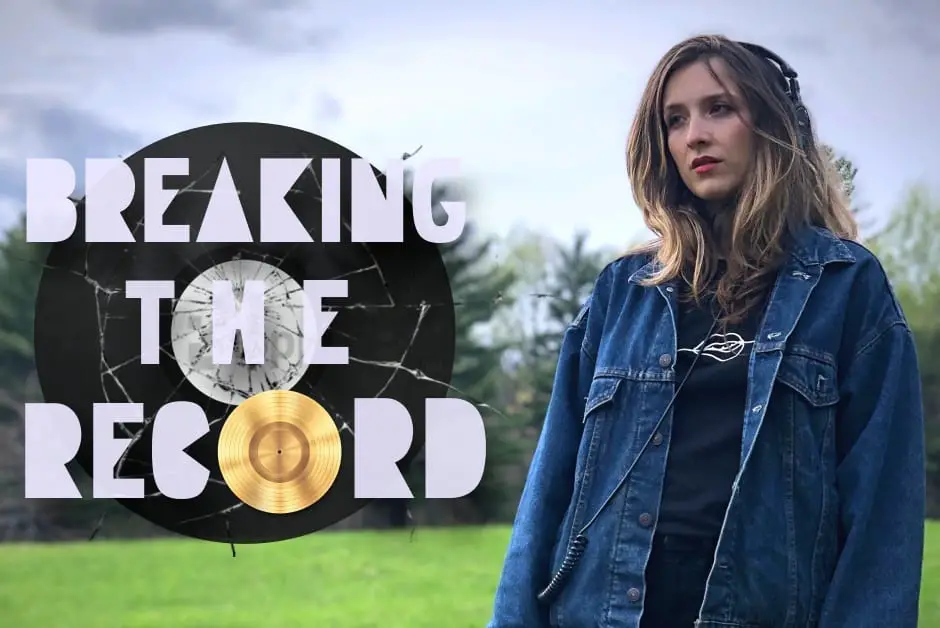
Brooklyn indie rock artist Wilby confronts the bruising contradictions of love on ‘Center of Affection,’ a soul-baring debut in which songwriter Maria Crawford revisits childhood wounds, complicated family ties, and the unsettling ways healing can hurt those closest to us. Disarmingly catchy melodies and unflinching, brutally raw lyrics carry fiercely personal confessions of fear, accountability, reckoning, and forgiveness, as Crawford discovers the courage to offer herself the same compassion she extends to others. An extraordinary act of self-discovery and hard-won tenderness, ‘Center of Affection’ is an undeniably triumphant first full-length statement – a powerful, achingly human portrait of learning to love, be loved, and recognize the worth of our own stories.
Stream: ‘Center of Affection’ – Wilby
Maria Crawford used to fear she might be incapable of falling in love.
Then came a more unsettling thought: What if she didn’t know how to let herself be loved?
On Center of Affection, the debut album from her indie rock project Wilby, that question leads her all the way back to childhood. Born of therapy sessions and unfiltered journaling, these songs bring years of old hurt into the present, where the instinct to protect yourself can collide with the desire to let somebody close. Fuzzed-out guitars, dreamy pop melodies, and flashes of sweet folk twang carry Crawford through anger, apology, and the difficult work of recognizing her own part in the pain. For a songwriter who admits she only likes things when they’re hard, the bravest possibility may be that love doesn’t always have to be.
Beautiful raw, achingly intimate, and full of hard-won tenderness, Center of Affection sees Wilby transforming years of disconnection and self-doubt into an extraordinary act of compassion – for the child she once was, the person she’s becoming, and everyone still learning how to love and be loved.

All I want is tenderness
Spilling out over everything
Put it in my pocket
Act like I never lost it
The center of affection
The object of your love
Still can’t get enough
– “Center of Affection,” Wilby
Released October 10, 2025 via Hit the North Records, Center of Affection represents a major milestone for Crawford, bringing twelve songs of personal reckoning and musical exploration together for her first full-length statement. Now, on the eve of its first anniversary, the album returns in an expanded deluxe edition, released October 9, 2026, featuring two new songs, “Real Truth” and “Anti Lullaby,” alongside reimagined versions of previous album tracks. These additions enrich an already multifaceted record, offering a fuller portrait of an artist whose relationship with herself, her music, and the people she loves continues to evolve.

Originally from Philadelphia, Crawford cut her teeth in Nashville, where she attended Belmont University and began developing her musical identity.
First performing under the name Mar, she introduced Wilby in 2020 with her debut single “Bad,” beginning a new chapter that would bring her folk roots together with a growing appetite for indie rock and pop. Her early songs already had a knack for exposing the absurdity of our own emotional defenses – “Mush” found her practically embarrassed by the messiness of being in love, while “Naive” wrestled with the pressure to be sweet and agreeable. Beneath the bright melodies and infectious hooks was a songwriter increasingly willing to look herself in the mirror, even when she didn’t particularly like what she saw. Now based in Brooklyn, Crawford has spent the past several years building a musical world around her candid storytelling and expressive, emotionally charged songwriting.
Even her moniker comes with a personal story and a mischievous sense of humor. “‘Wilby’ is a spin off of my paternal grandfather’s name ‘Wilbur’,” Crawford explains. Her grandfather hated his given name and went by Ray, which makes the tribute all the more amusing: “I like that it pays homage to him and would probably piss him off if he was still with us,” she laughs.
Atwood Magazine has followed Wilby’s evolution from the beginning, premiering her 2021 debut EP Translucent Beauty and celebrating its colorful indie pop and explorations of love, intimacy, and self-protection. “The EP primarily comes from my grappling with vulnerability and how beautiful it is when you give in to it,” Crawford told us at the time. By the following year, when we premiered “reach u” ahead of her sophomore EP happiest woman, that reflection had grown into a more pointed examination of personal responsibility. “‘reach u’ is about accountability, both for others and for myself,” she explained. “It’s about showing up for your people, but it’s also a reminder to not give yourself away.”
Those ideas have remained central to Wilby’s music, gaining greater nuance and urgency as Crawford has grown as a songwriter.
Center of Affection brings them together across an intensely personal collection that ultimately proves as catchy as it is cathartic. The songs themselves grew out of a particularly transformative period in Crawford’s life, when the work she was doing away from music began to reshape her relationship with it.
“This record is a by-product of re-connecting to my kid and current self – essentially, a coming-of-age story,” Crawford tells Atwood Magazine. “In 2022, I started doing some intense therapy in an effort to overcome my dissociation to my childhood and start to actually feel things. I was reading The Artist’s Way and would journal after therapy sessions, where a lot of these songs started from.”
“Once I realized I had an album on my hands, not just a group of songs, but songs that all felt so deeply correlated to each other, I knew I needed help to fund it,” she continues. “I launched a crowdfund campaign and was blown away by the support – it’s so f***ing scary to ask for help, but so humbling. I decided to produce the album with my constants: Aaron Hicks (guitar), Zach Bodman (drums), and Simeon Church (bass/keys), who already had helped arrange a few of the songs we had been playing on tour for the last year. My buddy Andrew Goldring co-produced and engineered the record. In January of 2024, we set up camp for five days in Gnome Studios in Nashville where we mostly live-tracked all of the main parts, dubbing here and there. It was important to me to try and capture my vocals on the live takes with the guys because of the energy and emotion playing with them gives. That week at Gnome was so special and surreal.”

All that work also changed Crawford’s sense of what belonged in a song.
The people and scenes she writes about arrive with their inconvenient specifics intact – a spin class dissolved into tears, a Thanksgiving she wishes had gone differently, the fear that her own healing might be hurting her partner. She’s increasingly willing to tell the parts of the story that cast her in an uncomfortable light, trusting listeners to recognize pieces of their own lives in hers.
“With this record, there is a newfound confidence I have in myself, both as songwriter and artist, with telling my experiences,” Crawford shares. “I think it’s my call as an artist to be daringly personal and my job as a songwriter to help people find themselves in it.”
There’s a musical counterpart to that openness. Across the album, the gritty churn of “Pleaser” sits alongside the slide-guitar twang of “Experiments” and the acoustic restraint and collective surge of “Body.” Together, they reflect an artist who has moved between folk, indie pop, and rock over the course of her career, now bringing those instincts together with the musicians who know her songs best.
“Sonically, I’ve never felt more myself than with this record,” she says. “There are moments of fuzzy lo-fi rock, glimmers of cleaner, ear candy pop, and sprinkles of folky twang. I feel like the production captures all of the ways I’ve explored with genres and styles. Ultimately though, the record sounds just like how you’d hear live.”

Crawford describes the record in three words: “powerful, soft, sincere.”
All three come together in the title track, where palm-muted guitars and aching vocals swell into a grunge-tinged eruption, carrying a longing that has followed her since childhood. “‘Center of Affection’ I think is the through line with all these songs and how I think that at the core of everything is our desire and need for love and connection,” she explains.
The song begins with the painful confession, “I played sick / To get you to notice,” before arriving at a plea that cuts straight to the album’s core: “All I want is tenderness / Spilling out over everything.” The distance between those two lines is profound: A child desperate to be seen grows into an adult determined to give the very love she’s spent so long searching for. Crawford holds both perspectives at once, allowing her earliest wounds to become the foundation for a more generous, compassionate understanding of herself and others.
“‘Center of Affection’ is my attempt to move through loneliness rather than around it. It’s both a cry and a promise – to embrace tenderness in pursuit of love and understanding,” she shares. “I wrote the first verse from the perspective of my kid self in a way to release some of the shame I’ve long carried. Verse two is from present-day, regarding my thoughts of God and religion, our interconnectedness, and my commitment to choosing that connectedness no matter personal differences, past hurt, space or time.”
This desire for love takes on messier, more complicated forms throughout the record. On the album’s vulnerable and volcanic opener “Pleaser,” dry, overdriven guitars churn beneath an unsettling portrait of devotion born of fear: “He only wants to make me happy / He doesn’t care what it costs.” Crawford examines how her own avoidance can feed a partner’s anxiety, and how easily two people can mistake meeting each other’s fears for meeting each other’s needs. The restless guitars and skittering hi-hat of “Spin” chase her stream of consciousness from crying in an exercise class to admitting she slept in a twin bed until she was 27, her wry observations revealing an almost compulsive relationship with difficulty.
And on the twangy, slide-guitar-laced “Experiments,” she confronts the uncomfortable possibility that her own growth might come at someone else’s expense. “Healing me is hurting you,” she sings, acknowledging the burden her partner bears as she learns new ways of responding to old wounds. The song’s most devastating moment comes when Crawford recalls staying awake through flashbacks, frightened by how her body responds to her partner’s touch, even when he’s “just trying to love me.” Against the slide guitar’s gentle country sweetness, her admission that “I wouldn’t blame you if you quit” lands with heartbreaking force – exposing how the fear of being hurt can become the fear of hurting, and ultimately losing, someone you love.

“Care” brings that accountability into sharper focus, building from gentle guitar and restrained vocals into a blistering scream of distortion as Crawford reckons with the people she’s hurt despite her best intentions. Its unvarnished details – family she rarely sees, a Thanksgiving prayer interrupted by overwhelming emotion, a relative watching reruns in the basement – give an ordinary apology extraordinary weight. “Even best intentions / Don’t show you always care,” she admits, recognizing the distance between loving someone and making them feel loved.
Few moments cut deeper, however, than “I Think You’re Beautiful When You’re Losing Your Mind,” a profoundly affecting portrait of her complicated relationship with her brother. Recalling painful family encounters and years of separation, Crawford delivers one of the album’s most devastating admissions: “I don’t think about you but I’m filled with jealousy / Cause I wish I loved you just as much as you love me.” The lyric holds affection, guilt, distance, and longing together, allowing her to acknowledge the limits of their relationship while still reaching toward him with love.
And then there’s “Hard to Be Loved,” the gut-wrenching acoustic song that closes the original album. Written just two weeks before recording, after Crawford had already settled on a tracklist, it distills the record’s many emotional contradictions into one disarming confession. “You can break an egg in one hand, but you still can’t crack me,” she sings, capturing the peculiar frustration of wanting to let someone close while remaining guarded against the very affection they’re offering. The repeated refrain, “I don’t know why it’s so hard to be loved,” is devastating in its simplicity. After an album spent examining where her defenses came from, whom they’ve hurt, and what it might take to lower them, Crawford arrives at an admission that demands no easy resolution. Sometimes recognizing the problem is its own extraordinary act of courage.
The deluxe edition offers a glimpse of what might come next. Written after the original recording sessions, the folk-leaning “Real Truth” is a sweet, wonderfully candid companion to “Hard to Be Loved,” finding Crawford singing about Chappell Roan in traffic, Aperol-fueled adventures, an argument in the car, and the freedom of offering love and forgiveness without hesitation. “When I tell you ‘I forgive you’ / It goes right through you,” she assures, embracing a simplicity she once found difficult to trust. “Anti Lullaby,” meanwhile, brings the album’s childhood themes into a new light, opening with an account of her brother’s child asking her to play the bad guy before confronting the harder question of how adults choose to protect children, and from what. “When the bough breaks / Will the baby survive,” Crawford asks, transforming a familiar nursery rhyme into a sobering reflection on the harm children inherit. Together, these additions extend Center of Affection beyond the wounds Crawford has spent years trying to understand, toward the love, responsibility, and compassion she now hopes to carry forward.

The great achievement of Center of Affection lies in Crawford’s willingness to embrace the contradictions of being human.
Love can be generous and selfish, healing can be painful, and the people we care for most can be the very people we struggle hardest to reach. Throughout these songs, she resists easy answers, finding extraordinary meaning in the ordinary details of everyday life and giving voice to emotions we often struggle to articulate ourselves. Her songwriting is fiercely observant, disarmingly candid, and full of personality, while the music surrounding it is every bit as expressive – capable of delivering both a searing, distortion-soaked outburst and a delicate acoustic confession with equal conviction.
For an artist whose earliest work grappled with the fear of letting her guard down, Center of Affection represents a remarkable evolution. Wilby has grown into a songwriter whose greatest strength lies in her willingness to confront herself, whose confidence allows her to be playful and furious, wounded and forgiving, sometimes all within the same breath. Across her debut album and its expanded deluxe edition, Crawford reveals just how much power there is in telling the truth, however uncomfortable, and how much beauty can emerge when we extend ourselves and one another a little more grace. It’s an intensely personal record with an immensely generous spirit, one that invites listeners to recognize their own struggles, relationships, and capacity for change within hers.
Experience the full record via our stream below, and peek inside Wilby’s Center of Affection with Atwood Magazine as Maria Crawford goes track-by-track through the music and lyrics of her soul-baring debut album.
“I want listeners to feel empowered and seen – you matter, your story matters,” Crawford shares.
And for an artist who once feared she might never know how to be loved, Center of Affection is a beautiful, open-armed act of love in its own right.
— —
:: stream/purchase Center of Affection here ::
:: connect with Wilby here ::
— —
Stream: ‘Center of Affection’ – Wilby

:: Inside Center of Affection ::

— —
Pleaser
“Pleaser” is the most digestible, daringly simplest in concept, song on the record. I think I wrote it in about 20 minutes and was excited to bring it to “my beautiful boys.” It’s about how someone can love you out of fear and working through that with building trust and security.
Spin
With “Spin,” I gave myself permission to be diaristic, the way I found writing in the first place. With that approach a sort of framework and guidelines came to be. I wanted everything to be factual and real and then match the rhyme scheme I had going. “Spin” is proof that you can make a song out of one big run on sentence.
I Don’t
I heard somewhere never write from a place of bitterness, so instead – I let my anger take over. “I Don’t” is the self-empowerment you feel when you give that ex the middle finger and get the power to say – actually I’m nothing like you. It’s rage and it is about taking your power back.
Protection
Coming off the tails of the rage of “I Don’t,” “Protection” steps into self-advocacy, while also allowing myself to grieve things for my kid self. Nothing is your fault when you’re a kid.
Experiments
I wrote “Experiments” after telling my partner I felt like he was a test subject for new behaviors I was learning as I went through some pretty intense therapy/trauma work. I wanted the melody to feel cathartic to sing. We messed around with a few various arrangements of this one (one that I think was a combo of dad/math rock?) but I remember coming back to the guys with the idea of having Aaron play slide and giving a sort of twang to the production, with a big reference “You” by Switchfoot for inspiration, lol.
Peripheral Vision
“Peripheral Vision” is the oldest song on the album. I wrote it as a sort of stream of consciousness back in 2021. It’s about the fear of getting hurt in a relationship and then the “I told you so” once you do.
Care
“Care” is the first song I wrote in my body – truly connected to myself. I never felt so empowered after writing it and wanted to write a whole record from the same place of self-awareness and vulnerability. One of my favorite verses on the album is its second verse, “I got a lot of family / Up north I never see / I want to be there for them but it’s weird when you’re the baby / And I lost it at thanksgiving / While we were praying holding hands / While Michael’s in the basement watching re-runs on On-Demand.” Yeah, it’s weird being the baby.
I Think You’re Beautiful When You’re Losing Your Mind
“I Think You’re Beautiful When You’re Losing Your Mind” is based on some events with my brother. I’m really proud of the lyric, “I don’t think about you but I’m filled with jealousy/cause I wish I loved you just as much as you love me.” I know that when it’s too hard for me to think about him and where he may be right now, he’s still thinking of me.
Body
I wrote “Body” after a conversation with a friend where we were highlighting shared experiences of narcissistic abuse. We both were in deep waters of unpacking, learning, and healing. I also was reading “The Body Keeps The Score” and how people with complex trauma disassociate and often don’t benefit from talk therapy. In the bridge, I list tools that help me re-connect to myself. “Body” is about self-trust and validating what you knew to be true all along.
Too Late to Save
“Too Late to Save” is about religion and the existentialism that comes with changing your beliefs. It’s about the grey area of religion, an afterlife, of God. I’ve come to think that religion is how we make sense of our own unique experiences and with that, I’m no longer threatened by someone else’s. One of my favorite lines on the record is in verse two, “I know I’m not the one you want / it’s not a walk around the park / but I don’t want to call it off.” I know I’ve lost friends from ways I’ve moved away from a belief system that we used to share, and there is a two-sided grief with that, but I want them to know I love them and will fight for any type of closeness we still can have. I grew up learning that to love people was to change or “convert” them and now more than anything, I want people to know that whoever they are (whatever they believe) is exactly who they should be – and doesn’t need saving.
Center of Affection
I had the working title for “Center of Affection” for a long time but this one was the hardest for me to get the verses right. I had brought it to a few friends but ultimately knew the subject was too personal not to come right from me. At the time, I had been doing a lot of EMDR around my first experiences with suicide ideation. In unpacking a lot of dark feelings that I’ve had since I was a kid, I began to stare my loneliness right in the face and move from a place of shame and isolation into a place of self-compassion. As the title track, this song encompasses the overarching theme of the record: relentless tenderness and loving compassion, for myself and the people around me.
Hard to Be Loved
“Hard to Be Loved” was the last song I wrote for the album. I already had a track list finalized and wasn’t really trying to add another, but about two weeks before we went into the studio it just spilled out in a cathartic way. I’ve had a deep fear most of my life that I’m unable to be in love, and in more recent years, that’s shifted to fearing I’m unable to receive it (love). I felt like this one put a bow on all of the themes in this record together as well as nodded to where I’m going and growing into, personally and creatively.
Real Truth
I wrote Real Truth off the heels of recording the album, and I was surprised by how cracked open I had become. It felt fitting to release this as a bonus track both thematically and sonically. It captures a lot the folk-leaning style of the album, while thematically, showed where I am headed. I see “Real Truth” as the other side of the coin to “Hard to Be Loved.” It is simple and sweet, which feels brave for me, and I think it serves as a little fruit dessert to the album.
Anti Lullaby
I wrote “Anti Lullaby” while writing the other songs on the record and when it was time to re-visit songs I had tucked away for the Deluxe, this one stood out to me, primarily because of the child themes on the record. I had originally written it as a piano ballad and re-wrote the chorus and second verse.
— —
:: stream/purchase Center of Affection here ::
:: connect with Wilby here ::
— —
— — — —

Connect to Wilby on
Facebook, 𝕏, TikTok, Instagram
Discover new music on Atwood Magazine
© Isaac Namias
 © Isaac Namias
Center of Affection
an album by Wilby