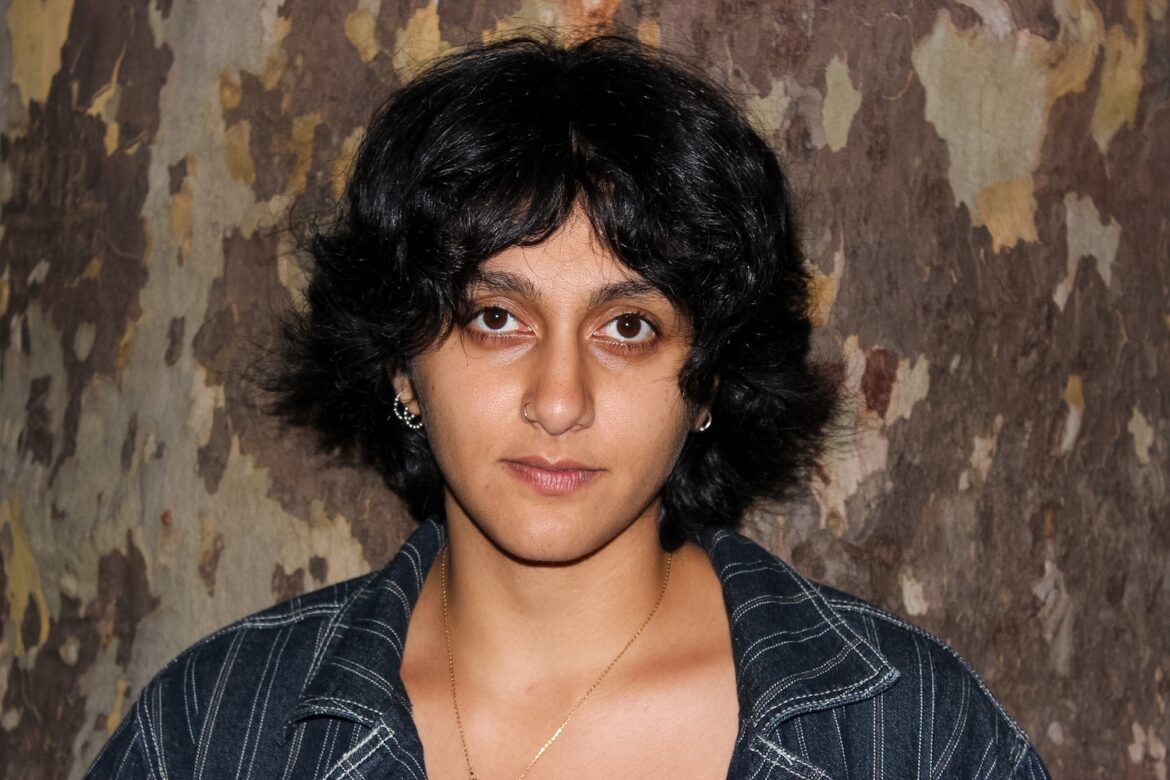
Kaamya Sharma fronts her brainchild Chammeili, backed by an ever-shifting cast of characters. The mosaic nature of the lineup mirrors Kaamya’s own upbringing across the world, from London to Delhi to New Mexico to Oakland to Brooklyn; her musical sensibilities, which range from alt-country to Hindustani classical; and her lyricism, which sets the breathtaking beside the ordinary, the childlike among the eldritch, and the imagined alongside the real.
by guest writer Katy Mayfield
Stream: “Gutterball” – Chammeili
27-year-old Kaamya Sharma is a web weaver.
Brooklyn-based these days, she tied together threads from a childhood, adolescence and early adulthood across London, Delhi, New Mexico, Oakland and Brooklyn to form I Love Big Old Dogs, the sophomore album from her project Chammeili.
Kaamya started writing as a middle schooler in Delhi, because “one day I just realized you can. You’re allowed. No one’s gonna tell you no.” After years of writing under her own name, she took on the altar ego “Chammeili,” the name of a famous Bollywood “item dancer,” as a joke with her friends. Did she externalize her writing into the Chammeili project to be able to write freely, without the expectation that the music perfectly represent the whole girl behind the guitar? “Well, no, because that’s what it ended up being anyway.” In her music Kaamya splices together childhood memories – or fantasies, it’s hard to tell the difference – daydreams, uncanny images, and studio crash-outs. Blunt diarism has no place here, where the line between the real, the remembered and the imagined is blurry.
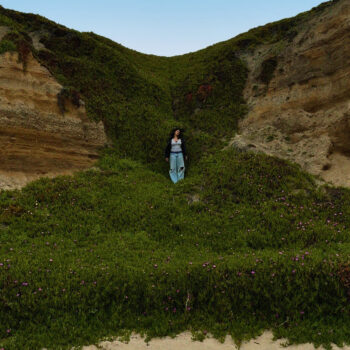
The most straight-shooting song on the record is a fuzzy memory of alienation – “Honey Pls” spawned from a band blow-up and drunken ill-fitting-ness in idyllic Northern California. It’s an absolute romp that showcases a juxtaposition it feels like indie rock is best poised to capture: Total rage and agony in the bright sunshine. “I don’t wanna be cool, I don’t wanna be rich, I don’t wanna be something that you wanna kiss, I don’t wanna have fun, I don’t wanna go out, I don’t wanna be the guy your friends talk about… I don’t wanna sit down, I don’t wanna stand up, I don’t wanna be the tall drink in your cup,” Kaamya insists over bright and springy guitars, fists seemingly balled at her sides. It’s an utter earworm that finds buoyant delight in flunking expectations.
The daylit clarity of “Honey Pls” is somewhat of a departure on Dogs, though. The record’s closest cousin might be Wednesday’s 2025 hit record Bleeds, another record concerned with the curious underbelly of coming of age. Dogs is an eerie, dreamy, at times “dank” (Sharma’s word) meandering through time, place, and genre. Kaamya lures listeners through a child’s unsettledness at an eldritch world; a teenager’s explosive rage at having to keep it together; and a city rat’s fetid race.
Perhaps because Chammeili tells stories from the comfort of the present, or perhaps because Kaamya is an ardent daydreamer, the narrator of Dogs has no fear for the big wide world they’ve found themself in, only openhearted fascination. So the damp, dark, trembling instrumentation – incorporating both traditional Hindustani and alt-country elements – enthralls, edges the listener onward, rather than marooning.
We spoke with Kaamya this month about touring Dogs and meandering back to bedroom producing on the new Chammeili demo and music video “hahaha.”
— —
:: stream/purchase I Love Big Old Dogs here ::
:: stream/purchase Hahaha (demo) here ::
:: connect with Chammeili here ::
— —
A CONVERSATION WITH CHAMMEILI
Atwood Magazine: Fill us in on the last year of Chammeili since releasing I Love Big Old Dogs.
Chammeili (Kaamya Sharma): It has looked like a lot of writing, honestly, and a lot of kind of reevaluating how I want to approach the band and centering making things I love to make, because, I think for a lot of small artists, when you’re putting out your first big project, you can tend to get caught up in how it’s going to be received. And then once I finished all of that, I was like, “actually, you know what? I started making music because I enjoy being in my room and making demos and writing stuff that’s a little funny. And a little sad. And so I’m just gonna do that and see what happens.” And my guitarist Dave [Strawn] and I have been spending many, many a day in the rehearsal studio where we just essentially crash out, but to the guitar. And so I’m yelling and he’s squealing and it’s awesome. And we’ve written a bunch of cool new stuff through that process.
In your new demo, “hahaha,” I really love the image of the ice skater skating under the sun in Arizona. Where did you get that image?
Chammeili: I was just talking to someone who mentioned that they grew up in Phoenix and did professional ice skating in Phoenix. And she didn’t like mention all too much, but like she said it in passing and then it kind of like stuck in my head. I was like, no way you were ice skating in the fucking desert. It just seemed so counterintuitive. And yet so beautiful and blissful, like the visual that came to my mind was literally like the brown desert rocks and bright sun, big, big sky. And then like in the center of it, like at the bottom of the Grand Canyon, there’s a nice ice skating rink and there’s this beautiful girl in the middle just spinning, spinning, spinning, spinning. It’s such a precarious thing to be, to be ice skating under the sun, and it just reminded me of a certain type of girl who’s just living and everyone’s in awe of how she’s living and a little scared by it. And also just enraptured at the same time.
What about the chorus and title of “hahaha.” Where did that come from?
Chammeili: I was at my parents’ house in Dallas. I had a few days of quiet and I was kind of just reflecting on this. It was towards the end of my [Cozy Royale, the restaurant in Williamsburg, Brooklyn] stint and I was about to put the album out and so the world that I was in in New York was extremely hectic. And then all of a sudden I was in Dallas, and there’s nothing to do, and it’s quiet, and, so I was in my bedroom in my parents’ house and wrote and recorded this whole thing in one day, and the ha ha ha, is kind of like, you know, when there’s like residual anxiety from like the place that you’re in, and you go somewhere else, and it kind of follows you.
But it’s just like, you feel dissociated from it at the same time. And it’s kind of like what the ha ha ha’s were. It’s like, I’m here. I’m making this demo. I don’t know where it’s going to go. I wasn’t thinking too much about it, but I was just like, [laughs bleakly] you know? And then that’s basically what it was. Like everything that’s on there is, is 1st take. I like how it feels, it feels very honest.
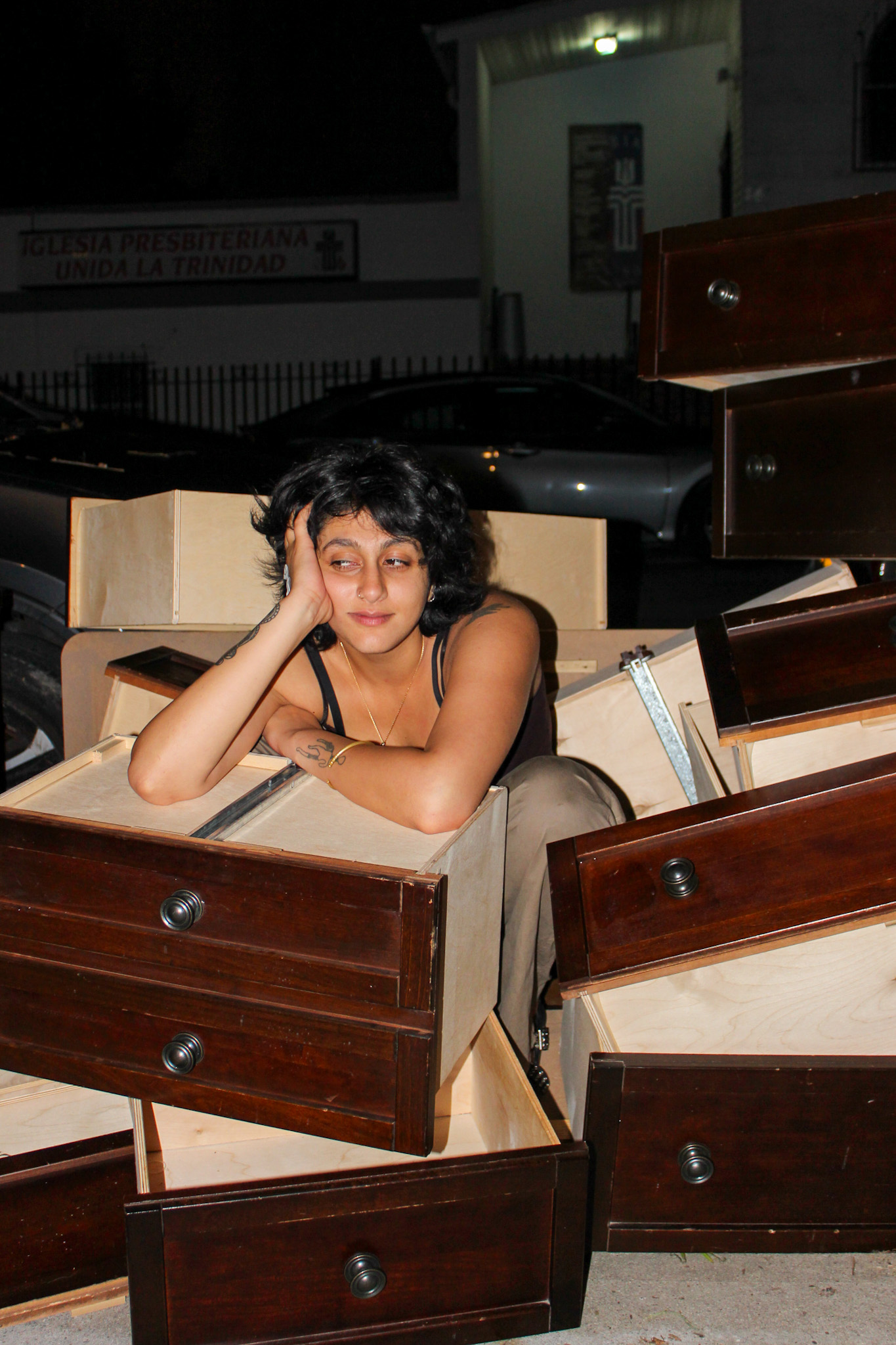
Okay, so you and Dave are cooking up in the studio. Someone's yelling. Someone’s shrieking. What’s cooking up? Is the yelling and shrieking cohering into an album?
Chammeili: Honestly, for me and Dave, a lot of the yelling and shrieking is just necessary. I think both of us have had like a crash out year and it’s been a safe way to work through all of that crash out, to be in a room for five hours with one of your best friends just yelling and shrieking into the void that is your guitar. A lot of it has come out to be stuff that we’re actually proud of, and it looks like it could be either an EP or an album. But it’s still pretty in the process.
As for the “hahaha” music video, it’s interesting that you’re like, “it’s not really produced, everything is first take. Also, we’re gonna do a music video.”
Chammeili: Because why not?
Last fall, we sat down with Sharma after the release of I Love Big Old Dogs for a longer conversation about the album, dislocation, imagination, and playing “how many beers can you drink?” the catalyst for the standout sunny-fury ripper “Honey Pls.”
You've grown up in lots of different places. Your upbringing moved you around a lot, from London to Delhi to New Mexico, to the Bay, to New York. Is I Love Big Old Dogs a record about dislocation?
Chammeili: Oh, yes. It is a record about dislocation in many, many, many ways. In many ways it’s a record of acknowledgement. It’s like, “I see who you were then, let me acknowledge you as you were then. I see what you’ve experienced. Then, let me tell that for you.” Writing “Fly Dragonfly” felt like giving my five-or-six-year-old self a voice. “Honey Pls” is giving my 21-year-old self, who got in a car crash after a bad show, a voice. “Found A Rock” is giving the version of me now, who sees their siblings have grown into full-on adults. I have a younger cousin who was always the little baby to me, she was two when I was six. In child world, that’s, like, “you’re tiny.” But, at 24, 23, seeing her as the same as me, and being like, “wow, you’re so beautiful, you’re so cool.” But in “Found A Rock,” it’s, like, “found a rock for you, do you want it? Do you want this rock I found?” It’s current me, channeling little me, toward my cousin. Dislocation, acknowledgement. Channeling. Puzzle pieces through time. The truth is I’m a shaman and I’m guiding my child selves through the world.
Where in there did Chammeili germinate?
Chammeili: I started writing songs when I was 11, because one day I just realized you can. You’re allowed. No one’s gonna tell you no. Chammeili was my nickname. It was a bit. This guy, I changed his Instagram to “munna,” which is “little boy.” [in Hindi] And he changed my Instagram to “chammeili” which is “young woman.” And it was a bit, because, do you know about item numbers in Bollywood? The “item” is a really hot woman. And the really hot woman comes for an item number, and she dances to a song that’s there exclusively because she’s there. And Chammeili is a really famous one of those, where it’s a super sexy woman who just comes in. And then when I was looking for a new name, I wanted something that was still me, but a little bit of an alter ego. It had been my Instagram handle since I was 14 years old.
My friends in Delhi already joked around by calling me Chammeili, and I always liked how it felt. And so, it became a project name here, but it’s really funny because the name does not hold the same context here at all. I explain it to people as “Chammeili is the Hindi word for jasmine.” Because that is the truth. But it’s also used as a name. And it’s getting mispronounced, like, “oh, it’s spelled kind of weird. How do I say it? What does that mean?” And then I try to explain. But when I got the name, it was a very not-needing-explanation thing. I should have foreseen that picking that name here would lead to a lot of … it speaks to a lot of how I feel about my identity here. Of like, “this is going to need translation.”
There’s currently an advent of TikTok lyrics – very straightforward, very literal. It’s so welcome when songwriters like Samia write almost in code. On this record, you tend toward the abstract side. “Honey Pls” is literal, but then “Rat Song” and “Gutterball” exist in a dream world with childlike lyrics. Are you sitting down and thinking, “I want to abstract these things, I want to make these things literal”?
Chammeili: I’m very inspired by writers who use imagery that conveys energy more than it does conversation or situation. Have you read Italo Calvino’s “The Distance of the Moon”? It’s about this family that harvests moon juice, and so the moon comes close to the earth every night, and they climb onto the moon, and they harvest the moon juice, and they come down. So when I was starting to write lyrics, that was the world I was in. I was in this very surreal understanding of day-to-day, and as I’ve gotten older, I’ve realized that I’m still very much in that space. I think it’s easiest to convey my own feelings in that way, because when it’s super literal, then I feel way too vulnerable, and like I’m oversimplifying things.
Right, pinning the butterfly to the wall. On this album you have so much range and bop from style to style, but it’s so coherent in this Alice in Wonderland dark surrealism, like a child wandering through a dark, unfamiliar, exciting, spooky space. Do you feel like that’s your mode of moving through the world? This pure being moving through unfamiliar terrain?
Chammeili: That’s a really good read of it. I’ve moved around a shit ton, and as such there’s been a lot of fragmentation of my understanding of myself, and I often find myself thinking – I think a lot of people feel this way – maybe the most real version of myself is me as a child. But that’s not something I can quite access anymore in the same way, but they’re definitely still there, and so a lot of my music in the last five years has been trying to harvest and understand that part of myself. I’m wracked by nostalgia all the time and I don’t know why … actually, I do know why. Everybody is. The writing of this album… mapped the period of me actually self-actualizing as the combination of these different fragments, whereas in the past I was only able to see the different identities as they were happening.
You know, me as a six-year-old in the UK; me as a middle schooler in New Delhi, being made fun of for my British accent even though I’m brown; me as a 16-year-old trying to get the fuck out of Delhi but loving it a lot and feeling really confident in myself; me at 18 in New Mexico, and everything has shifted and I don’t understand why; then I’m in the Bay Area and I’m like, is this right? And each time I sort of reinvented myself based on who I was around and what social things were expected of me. So yeah, this album and moving to New York have been big moments because I guess I didn’t realize I could just be a sandwich. As opposed to multiple ingredients. It can just all be. And somehow for me [I Love Big Old Dogs] is how that translates.
When you talk about childlike inspiration, what does that mean to you?
Chammeili: Oh, man, just leaning into imagination. The opening lyric of “Fly, Dragonfly” is, “when I was a girl, I fell in a lake.” Just a literal recollection of something that happened in my childhood. I have a very, very vivid memory of stepping into what I thought was green grass, but it’s actually algae over the lake, and I fall in, and I’m covered in algae, and I’m like “oh fuck, that’s not ground, that’s lake.” But whatever, I get out, I dry off, and in my head it finishes with a picnic. But I have, on multiple occasions, asked multiple people in my family, “remember when I fell in that lake?” Nobody remembers it. Which is kind of crazy, because if your five-year-old fell in a lake, you would remember that. Nobody remembers it. It has many times been written off as “you just had an insane imagination from that age. Everything that you were imagining felt so real to you.” And that’s true of me now as well.
I don’t like that in adulthood it has been branded as a dissociative tendency. It’s pathologized to be imaginative. Like, okay, yeah, maybe your imagination is causing you stress. Fine. Fair enough. But that’s the childlike inspiration. You walk through a street, you see berries on the ground. The berries on the ground are not just berries on the ground. They’re ingredients for a potion, obviously, that were left behind by a witch, obviously. You’re in a garden, and you’re convinced that there are woodland creatures. You can’t see them, but you’re going to write a letter to them in spiral letters. Because obviously, that’s how they’re going to read it. Naturally. And then you have to fold it in a circle and put it at the base of a tree.
It’s lending meaning to the world the same way that “adult” structures do. Someone having a nightly routine lends meaning and grounds them in the earth the same way that you writing this note to a fairy does.
Chammeili: And it’s just, like, we lose the whimsy. We lose the whimsy, man. There’s a lot of focus on whimsy nowadays. On Twitter and shit. Like, yeah, bring it back. Bring back whimsy. But also the brandification of whimsy also pisses me off in a crazy way, though. Because it’s, like, whimsigoth means, like, dark purple, like, dark academia aesthetics. And, like, soup. But yeah, the real world, adult world versus childhood imagination world are just so dramatically different. And it makes sense that people feel like they have to just segment from that version of themselves. Because it makes it so hard to function.
Continuing to talk about location. So, you write about the record that you're using Hindustani instruments, you're doing alt-country. Starting with the Hindustani elements, where on the record is that influence?
Chammeili: So, it’s most obviously present in “Fumes” and “Fly, Dragonfly” with the bansuri solos and inflections. That’s Pranav Shikharpur. Incredible bansuri player. Shout out. We kind of just asked him to hop on and follow the music with his classical Hindustani style of playing. I, in India, never learned how to sing, never learned how to play any of the classical instruments, never did any of those things, but it was always around me. Like, in school, we had Indian music and Western music. Both classes would happen. For talent shows or whatever, it was, like, somebody was playing the tabla and somebody was singing “Zombie” by the Cranberries. Both were happening. And I think that’s kind of how I aim to utilize those sounds in my music as well, because on “Gutterball” for example, we have the harmonium playing, but it just sounds kind of like an organ or an accordion. But it’s there, the specific timbre of the keys. The wind wheezing through the reeds is present to me. Or there’s hand taals, which are a specific type of cymbal that is used in Hindustani music. They’re two small cymbals that you hit against each other in your hand.
They’re small elements. Elements that you probably wouldn’t pick out if you didn’t know they were there. Or even the inflection of my voice on “go on and fly dragonfly,” that’s a very Hindustani inflection, but, like, it also could not be. That’s my intention with the Hindustani instrumentation. It’s present, I don’t want it to necessarily be a gimmick, because I think that happens a lot with diasporic art. The cultural thing, the ethnic thing becomes the gimmick. Becomes the hook. I almost feel like it would be audacious to even try and do that, because like I said, it’s not my practice necessarily, it’s just environment. So that’s kind of how I treated it in the music too. I’m one of those people who thinks that songs know who they are. “Fumes,” “Fly Dragonfly,” will these songs flourish with these aspects? Yeah, they will, so they should be in this. Does “Honey Pls” want that? “Honey Pls” is in the Bay Area, and “Honey Pls” is mad and doesn’t give a fuck about, like, identity right now.
Will you tell me about the car accident after a show that inspired that track?
Chammeili: We had a show at a bar. A Chammeili show in Oakland at a bar. The bar did not have a rider, but they did give us a mini fridge full of PBRs. Like, maybe like 50 PBRs. We started playing the game “how many beers can you drink?” And eventually had some trouble with the venue. Like, they didn’t soundcheck us when they said they would soundcheck us. We went on stage without any blah blah blah. Like, sounded shite in the house, sounded shite onstage. And then at the end of the show, we all walked off with this massive dejection because you spend months and months and months, like, hours and hours and hours of collective time trying to polish shit and sound good and be taken seriously, and then you go and play, and it’s not your fault that it all sounds like shit, but it all sounds like shit anyway. And to console me, my friends bought me more drinks.
And then we had to drive home with all of our equipment, so all five of us piled into the car, and we drove, and then we started arguing as a band in the car and then crash into a median, car flies up, hits the thing, totaled, we all get out, everyone’s agitated, we’re fighting on the sidewalk, someone gets a chipped tooth, my dress rips, my car is totaled, and then it all just sort of snowballs, and we go home, and everybody goes to sleep and wakes up feeling brittle. And then after that, we gotta go to the dentist, I have to get my car fixed, my car can’t be fixed, my car is totaled, I have to do insurance, na-na-na, and this is all in the backdrop of Berkeley. Quiet, beautiful, fog, gorgeous, sunny California. Massive pine trees, redwoods, beautiful. It’s literally, like, let me be evil. Let me be jealous. Let me be petty. Let me be mad at you. Let me scoff at the city in which it all happened. But in a childish way as well. It’s your 17-year-old self who’s panicking about so-and-so wearing your crush’s sweater. It’s that level of, like, my brain is breaking.
Circling back to place and genre – the record has some alt-country influence too.
Chammeili: I didn’t know that I was into country until I went to New Orleans and saw the Hobo Gadget Junk Band. Seven-piece street band, washboard, everyone’s yelling. On “Gutterball” it’s not washboard, but we wanted it to sound like that. I watched [Hobo Gadget Junk Band], and I was completely enthralled. The lead guy’s name was Badger. You know what I mean? And after that, I realized that a lot of my musical influences and leanings before have been influenced by country. Country folk, like, Joni Mitchell. Kurt Vile. Blake Mills. I’m a fingerstyle guitarist. I’m mostly fingerpicking – very, very country. I think there’s also such a stigma against country. And, to be fair, a lot of pop country is, like, deplorable. But everything else gets such a bad rap. Like, Appalachian country, my god. My god. What the fuck is going on? It’s beautiful.
What was the process of arranging these songs, especially in coordination with your band members?
Chammeili: I like lyrics, but in process, it kind of all happens simultaneously. So when it’s just me and the guitar and I’m writing the song, or like writing at least the parts, then I have melodies that I will then insert words into. And then the band comes into it, mostly for sonic arrangement. I’ll take them a bare bones guitar and vocal thing. Which is why Chammeili is like such a collaborative thing. I can’t take credit for the face of Chammeili completely because so much of the sonic identity has been defined by the people I’ve collaborated with.
How do you know that a collaborator sees the vision?
Chammeili: You show them the song and they hear what you hear. You communicate a feeling like in words or like in a hum or in like a bodily expression or in a metaphor and they’re able to be like, oh yeah, we can do that with this sound. Or like, “you mean like this”? And then you’re like, no, no, no, not exactly like that, but do it with the end rising instead of descending and maybe take it a couple of steps higher than you had it before. Me communicating to a collaborator, that is how I communicate. [I Love Big Old Dogs collaborator Eden Marsh] would communicate to a producer, to a collaborator, by being like, “take it to the F sharp instead.” But I’m like, “let me sing you the note I want to take you to.” And if someone can follow that and hears what I’m hearing without me necessarily having to play it, that’s how I know.
It feels like a mind meld. Which is why it’s also very different when you have mindmelded with someone over creative shit, and then they disagree with you: earth shattering. When you can be so in harmony on something and then on other things, you’re just completely in opposition. It’s like how, wait, so who’s right? What is the truth? And it’s a very interesting tightrope to walk. And really fun. Really exhilarating. Probably my favorite parts of my last two years here have been in the studio with my band.
“Rat Song” is sort of a dark anchor of the record – its darkest, wettest point, a kind of South Node. And it should be known that at your album release show at Cassette (the music venue in Ridgewood, Queens), you had a team of puppeteers puppeting enormous and sometimes papier-mâché puppets, including a rat that slithered around the audience during “Rat Song.” From whence does “Rat Song” spring?
Chammeili: That was actually specifically a me and Eden thing. Because we, when we first became friends – we both moved here around the same time – one of our points of meeting was, “I feel like vermin in this city.” Like, I’m just scurrying around doing whatever I can, but it’s still pretty ruthless as an environment. And so “Rat Song” is literally just, like, “POV: rat.” “POV: subway rat.” I had the guitar riff and we were at the studio for [Eden’s] birthday. And me, Eden, Gabriel [Gianmarco], and Varun [Jhunjhunwalla] were at the studio, just because it was open at the time, and we just had a couple hours, so we went to the studio, and then I had this riff, and then Eden was on double bass, drums, they played everything else. And Varun was like “here, Kaamya, take the mic and do some shit.” And I was, like, okay, “POV: Rat.” And that’s the take [on the album]. I’m in the control room, and he hands me a shitty SM7 [microphone]. We didn’t think the song would even necessarily make it on the album, but it was kind of a throwaway fun experiment. But as we listened back, it was really cool.

You did your album release show at Cassette. It was sick. There were puppets. And then you did a couple of other shows that same month. How was the reception at those shows?
Chammeili: They were so fun. There was, like, a college basement show. It was so funny. They were playing Call of Duty in the living room. But here’s the reception: the gamers came downstairs. They came downstairs for a couple of songs. They left their game to come see a couple of songs. Because they heard it from upstairs. Huge.
Okay, last question. In five years, what will make you feel satisfied, fulfilled as an artist in the world? Especially considering the tensions between, as we've been talking about, making art and staying alive.
Chammeili: I want to go on sold out tours. I just want to know that people want to listen to my music, and they care enough to come out and see it. The rest I would like, too. Like, I would love to be able to pay for my life with my music, but at this point, I think putting that kind of pressure on it, in this economy, is a disservice to music. It’s so tough. It’s tough out here. A lot of people are finally talking about it. There’s a musicians union. I wish that the cost of living wasn’t so offensive. Because a lot of people are deterred from making art because they need to make a living. It’s a horrible reality. Extremely bleak. I wish it were a more accessible thing. Make music if you’re not a man. Don’t be scared. If you’re not a man and you’re scared, don’t be. You’re powerful. It’s as simple as that. Just do it. Just fucking do it.
* * *
Katy is a Georgia-born, Brooklyn-based writer. Her work has been published in Paste, McSweeney’s, MXDWN, and Ms. Magazine, and covered in Jezebel and Teen Vogue.
— —
:: stream/purchase I Love Big Old Dogs here ::
:: stream/purchase Hahaha (demo) here ::
:: connect with Chammeili here ::
— —
— — — —
Connect to Chammeili on
Facebook, TikTok, Instagram
Discover new music on Atwood Magazine
© courtesy of the artist
 © courtesy of the artist
:: Stream Chammeili ::