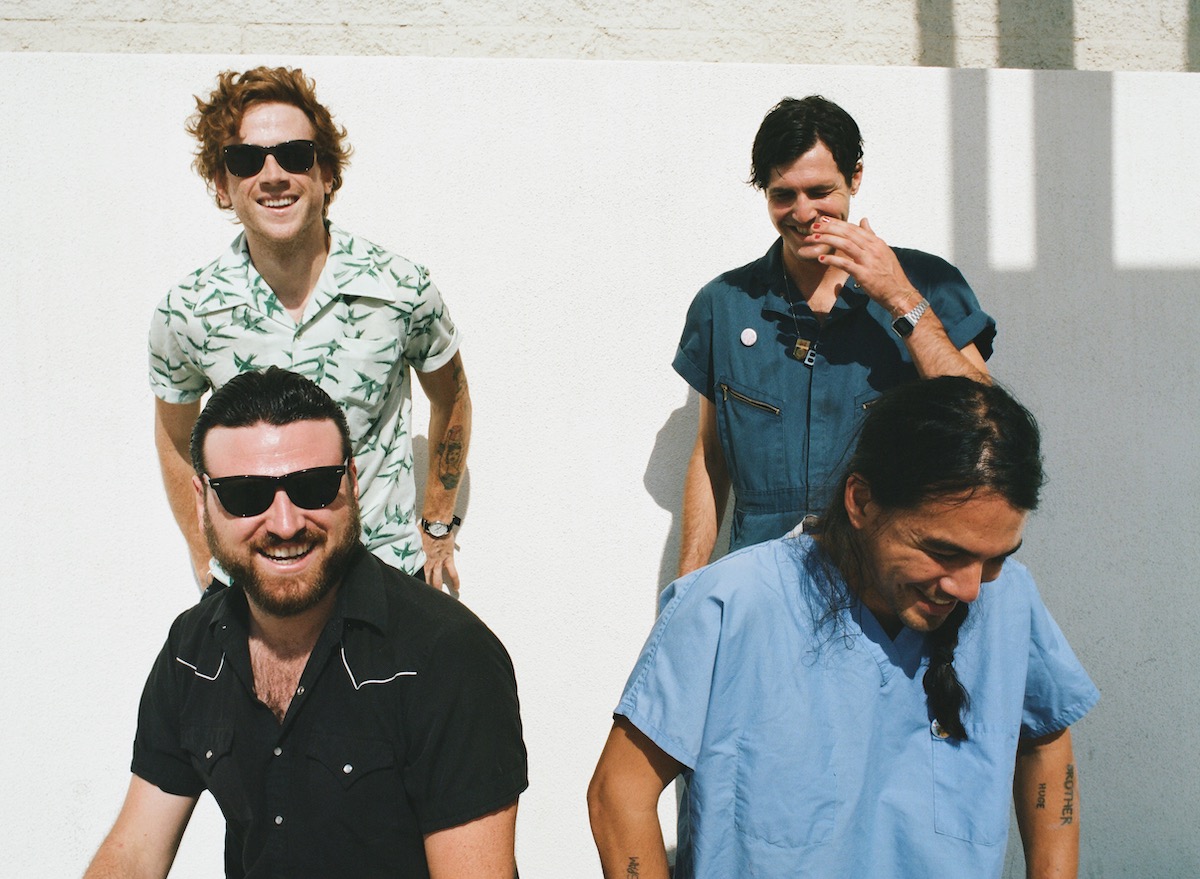
Medium Build’s Nick Carpenter barrels through intrusive thoughts and lifelong defense mechanisms on “Armor,” an exhilarating rush of panic and dark humor that transforms self-interrogation into a communal, cathartic, and all-consuming release. As the first glimpse of his sixth studio album ‘King of Having Fun,’ “Armor” sets the terms for a record that scrapes joy from the wreckage without pretending the wound has healed.
 follow our Today’s Song(s) playlist


Stream: “Armor” – Medium Build
Okay we think we’re in control ‘til we’re not then we’re helpless…
* * *
Every wall Medium Build’s Nick Carpenter ever built sounds like it’s shaking loose on “Armor.”
Feverish, unfiltered, and fully exposed, the singer/songwriter returns this summer with a song that barrels forward like a release valve blown open: Fun enough to shout along to, brutal enough to leave a mark, and breathtaking because it refuses to hide.
The first single from Medium Build’s upcoming sixth album King of Having Fun, out September 4 via slowplay/Island Records, “Armor” is one hell of a reintroduction: Exhilarating, anxious, and achingly brutal in the same breath, an emotionally charged reckoning that pairs arena-sized release with lyrics that won’t look away from the mess. After the soul-searching of Country, the intimate recalibration of takeaways, and a year marked by private turmoil, “Armor” feels like a fuse being lit – not a clean new beginning, but a door kicked open.

“‘Armor’ is the first song I knew was on the album,” Carpenter tells Atwood Magazine. “The most transparent look into my no filter stream of consciousness. The lyrics and the music pair up to imprint the feeling of unease and awareness that comes with being alive nowadays. If you listen to the lyrics there’s a lot to chew on, if you just vibe the music there’s a lot to bop to. I hope it leaves you better than it found you.”
Okay we think we’re in control
‘til we’re not
Then we’re helpless
You turn your head
The big empty comes along,
I don’t wanna know
how much money I got left, I-I-I,
I don’t wanna see my phone
or read my messages
I wanna starve myself ‘til I’m beautiful
Hey what the f*** is that?
Thought I could fix myself
without the dysphoria
Paul heard some philosopher
said “hope is fear and fear is hope”
I’m Sisyphus and you’re
the rock I’m pushin’
When Atwood Magazine last spoke with Carpenter at the end of 2025, he was newly sober, deliberately “decommissioned,” and trying to slow the machine after what he called a “violent upheaval of self.” He also offered a glimpse of what was coming: a “f*ing dark” and “excavatory” album about healing and grieving that would nevertheless be “really fun to sing live.” Seven months later, “Armor” arrives as the first public proof that those impulses were never in conflict.
Carpenter’s hope that “Armor” might leave us better than it found us gets right to the heart of King of Having Fun.
He sees his new album as “a letter from rehab,” even though he never went, and “a post-mortem” of the person he spent the past decade becoming. To him, it marks both the closing of that chapter and the opening of a new one – a record about killing off old selves, processing the pain that made Medium Build possible, and rediscovering joy without dressing it up as denial. Here, having fun is not a dodge or a disguise; it’s what becomes possible after the post-mortem: A little joy scraped out of the wreckage, still messy, still moving. In that light, “Armor” is not just a jolt back into motion; it’s the perfect entry point into an album where fun, fear, healing, and self-destruction all keep colliding with one another.
Carpenter calls “Armor” a natural doorway into the record precisely because it comes in fast, weird, and wide-open. “This entire album has some of my favorite, proudest lyrics,” he shares. “But this song is just so what it’s like being in my head some days: Endless, run-on, intrusive thought. The way it starts – ‘Okay, we think we’re in control until we’re not / Then we’re helpless’ – you think you’re doing great, and then ‘you turn your head and the big empty comes.’ It literally reads like a conversation with yourself.”
And that conversation is relentless. “Armor” builds its emotional world through pure collision: Money panic slams into phone avoidance, body dysmorphia into self-help exhaustion, philosophical dread into a joke sharp enough to draw blood. “I wanted everyone to know the level, the sharpness of the pen, and how insane and serious I am about this record,” Carpenter says. “This song is crazy… I just wanted people to start with something a little nutty. And fast.”
“Armor” races because the mind inside it is racing – because the thoughts are arriving faster than shame can organize them, faster than a polished hook can smooth them into easier shape. Carpenter has always been a conversational writer, but here his bluntness becomes its own kind of virtuosity: Panic becomes poetic because he refuses to tidy it up. “I wanna starve myself ‘til I’m beautiful / Hey what the f*** is that?” may be one of the year’s most arresting couplets because it catches the thought and the recoil in the same breath. He catches the thought, then catches himself having it. The craft is staggering: Carpenter makes an interior monologue hit with the inevitability of a pop standard.

That’s the thrill of “Armor”: It moves like a banger and bleeds like a confession.
Crashing through his own intrusive thoughts and rawest emotions with that classic charismatic, gut-wrenching intensity, Carpenter rattles through spirals of money anxiety, body dysmorphia, avoidance, fear, faith, self-hate, and love until the chorus arrives less as relief than reflex: “There I go again, projecting on you / And I hate myself, so I turn it into art / Or something dumb, put my armor on / No one can hurt me when I put my armor on.” It’s funny because it’s true, and absolutely devastating for the same reason.
There I go again
Projecting on you
And I hate myself
So I turn it into art
Or something dumb
Put my armor on
No one can hurt me when I,
I put my armor on
“The armor, what I’m talking about is humor, all the defense mechanisms that I’ve used my whole life,” Carpenter says. “I’ll use being agreeable as an armory of one to protect myself from people knowing me. Knowing enough psychoanalytic buzzwords to project onto people – ‘There I go again, projecting on you’ – like, ‘You hate me, you want me to leave,’ and they’re like, ‘No, I don’t. You want to leave. You’re being a pill.’ And then I’m like, ‘Oh, I’m the problem.’ I think my armor, historically, has been me being a problem and making it seem like it was someone else’s idea. But now my armor is trying to remember that nothing matters, and it’s not that serious. If it flops, I can still go home and make a good sandwich and live in a house.”
That last turn is classic Carpenter: Absurd, grounded, and sneakily profound. A joke, a sandwich, a house, and somehow a whole worldview tucked inside the shrug. Armor, in his hands, is not only toughness. It’s charm, it’s agreeability, it’s self-awareness used as a shield. It’s the joke before the question, the diagnosis before the apology, the messy little performance that lets a person be seen without actually letting anyone all the way in. “Armor” hits so hard because Carpenter understands the paradox: Sometimes the very tools we use to survive become the walls that keep us from being loved.
The song keeps returning to control, too – and to the terror of realizing control was never the thing we thought it was. “Okay we think we’re in control ‘til we’re not / Then we’re helpless” is a brutal opening statement, but it’s also the philosophical nerve running underneath the whole track. Carpenter sings like someone trying to inventory every impulse before it outruns him: The missed calls, the empty bank-account dread, the body shame, the self-sabotage, the old reflex to turn pain into content before it can become intimacy.
“We’re never in control,” Carpenter says. “The [idea that] we’re in control is the illusion. And that’s why people freak the f*** out. You see people break down because they think they have it. My big acceptance of this era is I don’t have it, and I’m excited and happy to be on the ride as long as I can.”

Carpenter’s ‘acceptance’ – itself a form of surrender – doesn’t make “Armor” any calmer; if anything, it makes the song burn that much brighter.
The guitars hit like exposed wiring; the drums rush forward with no patience for self-pity; Carpenter’s voice sounds half-possessed by the need to get the thought out before it curdles. For all its speed and sweat, though, the song is never careless. Its chaos has shape. Its bluntness has craft. The lines keep landing because Carpenter knows exactly where to place the knife: “How come I only wanna fix it once the truck breaks down?” “If hell is real, how do I know for sure / I ain’t living in it already right damn now?” “I bet there’s gotta be a peace that you get / When you finally know the ride’s gonna end.”
How come I only wanna fix it
once the truck breaks down?
Ends up in the gutter
begging for forgiveness
If hell is real,
how do I know for sure?
I ain’t living in it
already right damn now?
All around history is repeating itself
I’m on a plane
kinda hoping that it goes down
I bet there’s gotta be a peace that you get
When you finally know the ride’s gonna end
Those lines push “Armor” past self-deprecation and into existential panic, but Carpenter never lets the song become a full-on spiral. He keeps undercutting the darkness with motion, melody, humor, and that unmistakable Medium Build instinct for turning the most private thought in the room into the thing everyone can scream together. That is where he sounds newly powerful as a songwriter: Not because he has become cleaner or more controlled, but because he has learned how to let the mess move at full speed without losing the thread.
For all its speed and sweat, “Armor” is ultimately about the terror of being known. Carpenter spends the song building walls, naming the walls, laughing at the walls, and still wondering what happens if he lets someone get close enough to touch the tender part underneath: “If I take my armor off would you put that blade through my side?” That line is the real bruise beneath the bop, the question hiding inside every joke, every chorus, every defense mechanism dressed up as personality.
It f***s with my head when I need you
So I build a wall, baby brick by brick
I need new ways to outrun you
But ain’t nothing changing,
something’s gotta take a break here quick
Then comes the late-song revelation, one of those Medium Build passages that sounds tossed-off until it lodges itself somewhere deep: “Love is time / Love is looking for your keys in your couch / Love is knowing you gonna say some dumb shit, run your mouth.” It is funny, domestic, imperfect, and enormous – a definition of love that lives not in grand declarations, but in patience, inconvenience, familiarity, and the strange mercy of being allowed to be human in front of somebody else. That’s what makes the next line hurt so much. The song spends three minutes charging forward, but here it finally turns around and shows us the wound.
Okay, I guess we just go until we die
I had my shift drink,
now I’m just dancing down the starting line
You’re so aware that your time is running out
I said time is love,
what I’m scared of is an empty mouth
Love is time
Love is looking for your keys in your couch
Love is knowing you gonna say
some dumb shit, run your mouth
Love is time, time is love,
Love is pride
If I take my armor off
would you put that
blade through my side?

More than anything, “Armor” proves Carpenter is writing from a new kind of freedom – not freedom from fear, but freedom from pretending fear is not in the room.
He sounds bigger because he is letting the ugly thought stay ugly, letting the joke stay funny, letting the banger bang, and trusting that a song can leave us better than it found us without pretending to have solved the ache that made it. Few songs this year – if ever – have carried their own damage so boldly and fearlessly. “Armor” is one of 2026’s best, and one of the greatest songs Carpenter has ever written – a charged, headlong rush of hooks and exposed nerve, all scars and scabs, broken beauty and unvarnished ache, charming enough to pull listeners close and unapologetic enough to never look away.
As cathartic as it is captivating, “Armor” is Medium Build at full tilt: Reckless, self-aware, hilarious, wounded, and gloriously alive. It’s the sound of Nick Carpenter turning self-interrogation into a communal release without sanding down its roughest edges, a song that knows healing can still look like panic, and joy can still come with teeth. As the first glimpse of King of Having Fun, it doesn’t promise ease. It promises honesty, motion, and one hell of a reckoning.
“There I go again,” he sings, but this time, going again sounds like more than survival – it sounds like self-awareness, like a comeback, like an artist kicking the door open with his armor on and his heart on full display.
There I go again
Projecting on you
I hate myself
So I turn it into art
It’s something dumb
Put my armor on
No one can hurt me
when I put my armor on
— —
:: read more about Medium Build here ::
— —
:: stream/purchase Armor here ::
:: pre-order King of Having Fun here ::
:: connect with Medium Build here ::
— —
Stream: “Armor” – Medium Build
— — — —

Connect to Medium Build on
Facebook, 𝕏, TikTok, Instagram
Discover new music on Atwood Magazine
© Beth Garrabrant
 © Beth Garrabrant
:: Today’s Song(s) ::
follow our daily playlist on Spotify
:: Stream Medium Build ::