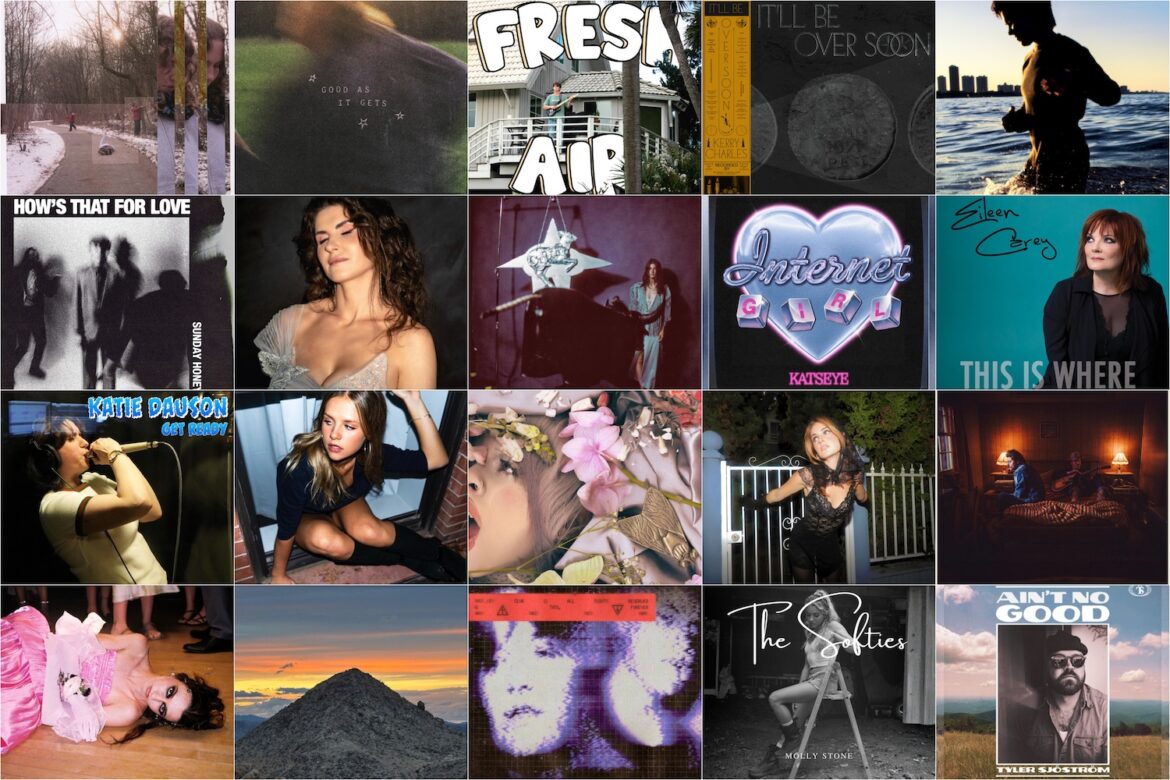
Every Friday, Atwood Magazine’s staff share what they’ve been listening to that week – a song, an album, an artist – whatever’s been having an impact on them, in the moment.
This week’s weekly roundup features music by Melanie Martinez, Annabelle Dinda, KATSEYE, Will Foulke, Sydney Ross Mitchell, Evann McIntosh, Avery Cochrane, Cry Club, Beatrix, Sophia Tice, Tyler Sjöström, Sunday Honey, The Vincenzos, Dace Silina, Katie Dauson, Molly Stone & Nathan Thomas, Marfa, Christian Hayes, Eileen Carey, & Kerry Charles!
•• •• •• ••
 follow WEEKLY ROUNDUP on Spotify


•• ••
:: “POSSESSION” – Melanie Martinez ::
Cassandra Fong, United Kingdom

“POSSESSION” arrives like a lullaby played with a switchblade. Melanie Martinez sings most of the song in a near-whisper, flattening emotion rather than inflating it, and that restraint is the point: Control, after all, rarely announces itself. Built on a muted pop-ballad frame with flecks of rock grit, the track treats submission as choreography, letting porcelain imagery and domestic rituals stack up until they feel less like metaphors and more like furniture you keep tripping over. It’s deliberately claustrophobic, a song that never quite opens its windows.
What ultimately elevates “POSSESSION” is its cinematic quality. It feels like it could score a Spaghetti Western or a warped fairy tale, especially as the song moves toward its darkly ironic conclusion, where a concussion becomes a twisted form of liberation. At just over three minutes, the track wastes no time, leaving a lingering unease rather than neat resolution. “Possession” stands as a haunting, satirical, and socially sharp piece of pop – proof that Martinez’s strength lies in making the uncomfortable feel unforgettable.
:: Some Things Never Leave – Annabelle Dinda ::
Mitch Mosk, Beacon, New York

Annabelle Dinda’s debut album Some Things Never Leave grabbed me instantly. I’d never heard her before pressing play, but from the moment “Big News Day” bursts open with spirited acoustic guitars, big, driving drums, and her radiant vocals, I was locked in. There’s an invigorating energy to the record – sprightly, raw, and emotionally charged – that rarely lets go, carrying you all the way to the intimate closing moments of “London Plane Trees Grow In Philly.” Few artists pull me in that fast, and I’m still unpacking why she hits as hard as she does, but part of it is the way Dinda’s folk melodies feel both catchy and urgent, paired with a voice that’s dramatic, dynamic, and deeply alive.
In the spirit of Joni Mitchell and Tracy Chapman, Dinda is a modern folk artist through and through, telling contemporary stories of humanity through an achingly intimate, contemplative lens. The New York-based singer/songwriter creates closeness even as she layers rich harmonies and builds depth, charm, and churn into her arrangements. Across ten tracks, the album highlights her gift for pairing thought-provoking observation with melodic warmth, moving fluidly between guitar- and piano-driven songs. Each one reveals a different facet of her songwriting – the conversational momentum of “Big News Day,” the emotional sprawl of “Gunpoint, Headlock,” the restraint and tenderness of “To Reconcile,” where piano and voice are given the space to quietly devastate anyone who listens.
One of the album’s most arresting moments is “The Hand,” which went viral last year and remains an undeniable standout. It’s visceral and urgent, driven by a forward-pushing beat and lyrics that critically examine gender roles and representation with striking precision. Lines like “This isn’t rage, it’s worth a mention / This is a fake internal tension” and “This isn’t rage, it’s too specific / I like to hate symbolic limits” cut deep, not as broad statements but as self-aware reckonings. The song’s power comes from that specificity, its refusal to simplify or soften its point, and its willingness to implicate the speaker alongside the systems she’s naming. It’s emphatic without being performative, vivid without flattening itself into a slogan.
That same clarity animates tracks like “Cosmic Microwave Background,” “The Body Remembers,” and “Everyone Likes to Be Forgiven,” another of the album’s musical, emotional, and philosophical centers. Here, Dinda turns inward, examining shame, self-knowledge, and the complicated desire to be understood without being fully seen. Lyrics like “You can write your brain down / And then pray someone reads it / All while saying ‘no one sees it’” capture the record’s central tension – the ache of articulation paired with the fear of exposure. Paired with other songs like “Doesn’t Matter” and “Satellites,” it reinforces how Some Things Never Leave is preoccupied not with grand events, but with interior shifts, small realizations, and the ways people try – and fail – to reach one another.
What ultimately sets Some Things Never Leave apart is how instinctively it balances intimacy with scale. These songs feel deeply close – full of interior monologue, self-questioning, and modern detail – yet they still swell with stacked harmonies, raw heat, and emotional release. There’s bite and wit alongside the catharsis, a not-so-quiet cheekiness that sharpens the heaviness instead of softening it. Recorded quickly – written in the fall and tracked in just two weeks – the album feels remarkably alive and lived-in, a body of work you can return to again and again and find something new waiting.
With songs that offer real food for thought and melodies that linger long after they fade, Annabelle Dinda announces herself here not just as a compelling new voice, but as an artist whose journey you can’t help but want to follow.
:: “Internet Girl” – KATSEYE ::
Julia Dzurillay, New Jersey

An undeniable pop music trend (and KATSEYE signature) is ridiculous, captionable, nonsense lyrics, particularly exemplified by the success of “Gnarly.” Fans were frothing at the mouth when this girl group started performing “Internet Girl” live, only to be overwhelmingly disappointed by the finalized recording. To that I say… eat zucchini.
Katseye is doing something that is, at its core, fun. It’s unserious in a way that seems effortless. With painstakingly chosen costumes and perfectly synced choreography, it’s clear tons of hard work goes into being eyekonic. Now with a Grammy Awards performance and Best New Artist nomination under their belt, it’s never been a better time to stan these Internet Girls.
:: “Fresh Air” – Will Foulke ::
Danielle Holian, Galway, Ireland

Will Foulke’s “Fresh Air” is a delightful reminder of how music can feel both effortlessly fun and thoughtfully crafted. From the very first note, the track exudes a confidence that comes from a musician completely in tune with his voice and vision. Blending indie rock with funky undertones, the song carries an infectious groove that makes it impossible not to move along. The guitar tone, reminiscent of funk legends like The Isley Brothers, adds a warm, nostalgic shimmer, while a subtle distortion on the vocals lends the track a dreamy, almost weightless quality that floats above the rhythm section.
The interplay between bass and guitar is tight and playful, forming a groove that feels both grounded and dynamic, inviting listeners into its easy charm. Foulke’s mastery shines in the way technical skill never overshadows the emotional resonance of the song; instead, it serves the joy and energy of the music. “Fresh Air” is a track that lingers long after it ends, leaving a smile in its wake and cementing Foulke as a musician capable of blending precision, soul, and sheer musicality in a way that feels wholly his own.
:: “Queen of Homecoming” – Sydney Ross Mitchell ::
Nicolle Knapová, Czechia

Sydney Ross Mitchell returned late last year with “Queen of Homecoming,” a nostalgic track from her upcoming EP Cynthia, where she talks about themes such as identity, homesickness in all its forms, loss and wishful thinking. It´s a song about her tenuous relationship with her hometown of Lubbock, Texas and her longing for validation and acknowledgement from the place and people she’s outgrown. Told through the lens of a dinner party scene. Her storyteller skills are as always brilliant and you find yourself nodding along and relating maybe a little too much to her.
:: “Mull It Over” – Evann McIntosh ::
Josh Weiner, Washington DC

It’s great to be able to ease into the new year with some lighthearted pop fun – or, at least, that’s what Evann McIntosh’s new single “Mull It Over” seems like at first until you hear what it’s actually about: “doom spiraling, spending too much time trying to right past wrongs instead of moving forward, and how addictive that cycle can be,” in the author’s own words. If this is indeed “doom spiraling,” though, it seems pleasant enough, largely thanks to the uplifting beat by McIntosh’s past collaborator, Australian producer Abraham Rounds.
They’re only 21, but McIntosh has already been making music for a good number of years, having released a debut LP, MOJO, back in 2019. The singer took a few years off following the 2021’s Character Development EP, but resurfaced last year with a pair of new singles, “Blue Movie Magic” and “Free Ride.” All the while, things seem to be going well enough in McIntosh’s world, judging by all of the playful dancing taking place in the music video to “Mull It Over” and the high spirits in which the song feels like it was produced. The lyrics suggest the author has some troubling thoughts in their mind – “That feeling creeping in… I can’t determine where it comes from or what it wants from me. Burdened by its company, I wish it would quit” – but as long as listeners don’t pay too much attention to all that, they’ll probably be able to enjoy this good-natured single just fine. I sure did!
:: “Griever” – Avery Cochrane ::
Chloe Robinson, California

Ever felt the emotional whiplash of crossing paths with a ghost you thought you’d left behind? That is the message of Avery Cochrane’s indie pop bop, “Griever.” A shiny, upbeat backdrop gleams against the weight of its mournful meaning. The singer shares, “The lyrics capture the retroactive rage and sorrow you feel after an unexpected encounter with someone from your past who has wronged you.” The majority of us know what it feels like to be seriously slighted, which makes the track instantly relatable for listeners. Lines such as, “You used to be my leader and I was your believer. 3 years gone, but I’m 10 years weaker,” hit hard as you sense her utter fury and regret.
Cochrane, a Seattle-based singer/songwriter, is known for her emotionally charged lyrics, lush cinematic sound, and captivating stage presence. She has graced the stage at Bumbershoot alongside acts like Weezer, Tennis and Janelle Monáe, opened for AJR, and is slated to perform at SXSW. Her previous release “Shapeshifting on a Saturday Night” swiftly became a viral sensation, garnering over 15 million TikTok views. With the release of “Griever,” Cochrane aims to build on that momentum and keep it growing.
:: “This, Forever” – Cry Club ::
Mitch Mosk, Beacon, New York

As glittering as it is gut-wrenching, Cry Club’s “This, Forever” hits like the split second after the worst feeling passes – when your chest still hurts, your pulse is still racing, and suddenly you remember that nothing, not even this, lasts forever. It arrives fast and feverish, a rush of dreamy indie pop that doesn’t ask permission before flooding the room, all glowing synths and unrelenting momentum. There’s something intoxicating about the way it moves – invigorating, energizing, impossible to shake – like apologizing at the exact moment someone else does, like standing in a venue that no longer exists and still feeling the echo of the best night of your life. It’s the sound of friction giving way to connection, of loving people through disagreement, of choosing to stay even when everything feels on edge.
Beneath that rush sits a striking clarity of purpose. Cry Club’s vocalist Heather Riley describes the song as living in the push and pull “of disagreeing with people you love about something you all care extremely deeply about,” a space where conviction and compassion collide. “Nobody is going to have the 100% perfect answer,” they explain, especially when facing “this overwhelming tide of conservative backlash against people like us.” Instead, “This, Forever” argues for solidarity over certainty, landing on a radical kind of tenderness: “I hear you, I know you’re scared, I’m scared too. I love you even when I’m mad at you, we’ll survive together because we have each other.” That ethos courses through the song’s lyrics – “don’t have it figured it out, but every step is one solution” – turning doubt into momentum and disagreement into something survivable.
There’s also nostalgia baked into its glow. Guitarist Jonathan Tooke notes that “This, Forever” reaches back toward the sounds and textures of Cry Club’s 2020 debut God I’m Such A Mess, shaped by memories of bands, venues, and plans lost to time, especially after 2020 wiped so many futures clean. Rather than mourning what didn’t happen, the song feels at peace with what remains – a rallying cry that insists nothing has to be ‘perfect’ to be worth fighting for. In that way, “This, Forever” doesn’t promise permanence; it promises presence – a reminder that the good moments are temporary, the bad ones are too, and what endures is the choice to keep showing up for each other anyway. That choice is what gives the song its irresistible rush – a shared, seductive release that lifts you mid-motion, heart still racing, suddenly certain that staying, loving, and trying again can feel this exhilarating.
:: “Dead Dog” – Beatrix ::
Nicolle Knapová, Czechia

“Dead Dog,” released in November 2025, is the second single from Beatrix’s hopefully soon revealed album. “Dead Dog” was inspired by being compared to a dead dog during a conversation with her ex-partner after he cheated. She leans into the metaphor, providing a much needed cathartic moment and making people think twice before they speak. The visuals of the song happen at a high school prom as she processes the heartbreak during what was supposed to be a joyful night.
:: “WAY OUT” – Sophia Tice ::
Danielle Holian, Galway, Ireland

Sophia Tice continues to stretch the borders of her sound with “WAY OUT,” a single that wears its emotional complexity with quiet confidence. Written from the perspective of a friend watching a toxic relationship unravel, the song captures a delicate balance of fear, confusion, and hard-won empowerment. Tice’s vocals are the emotional anchor, fluid and expressive, they glide through the track’s tension with moments of softness that feel almost protective, even as darker undertones simmer beneath the surface. There’s a sense of restraint in her delivery that makes the narrative feel more intimate, as though the listener is being trusted with something fragile and unresolved.
Co-produced with Jackson Lowe, the production amplifies that intimacy without sanding down its edges. Live piano lines introduce warmth and vulnerability, grounding the track in something human and immediate, while layered indie-pop textures ripple outward, adding an experimental sheen that keeps the song in constant motion. The result is a soundscape that feels simultaneously polished and exposed, allowing the emotion to breathe while maintaining a firm sense of purpose. “WAY OUT” not only expands Tice’s sonic palette but reinforces her position as an artist unafraid to sit with discomfort and transform vulnerability into a quietly powerful statement.
:: “Ain’t No Good” – Tyler Sjöström ::
Mitch Mosk, Beacon, New York
“Ain’t No Good” arrives quietly, face to face and heart to heart, a warm and worn piece of raw folk that feels less like a performance than a confession offered in trust. Tyler Sjöström’s voice carries the weight of lived-in years, tender and unguarded over acoustic guitar, with soft background textures and subtle instrumentation filling the space just enough to let the song breathe. It’s dramatic without being larger than life, meeting us cheek to cheek rather than reaching for the rafters – the sound of someone sitting with themselves, letting the silence speak, and choosing honesty over escape.
That intimacy mirrors the song’s origin. Written after a long stretch away from releasing music – spent raising children, surviving the isolation of COVID, and rebuilding life in the Blue Ridge Mountains – “Ain’t No Good” was born from a season of deep self-interrogation. Sjöström traces it back to wrestling with negative self-talk and imposter syndrome, the looping belief that he’s undeserving of love or even the simple joys right in front of him. When that voice grows loud, distraction becomes a defense; music, podcasts, TV – anything to avoid the quiet where doubt waits. But eventually the noise fades, and the song settles into what happens next: the messy, healing conversations with his wife, who helps name the lies and remind him of what’s true. It’s love as witness, as mirror, as gentle intervention.
You can hear that shift etched directly into the song’s bones. Lines like “I’m honestly fake, I ain’t no good” soften as the chorus evolves, answered by the simple, sustaining truth “When I’m feeling fake / You say I’m good.” In that tension – between shame and reassurance, solitude and partnership – “Ain’t No Good” finds its quiet power. It doesn’t offer a clean resolution or a grand transformation, only the hard-earned grace of being seen and still accepted. In returning with this first song of the decade, Sjöström reminds us that the real work isn’t fixing ourselves – it’s finding the people who help us tend to what’s already good and let it grow.
:: How’s That for Love – Sunday Honey ::
Mitch Mosk, Beacon, New York
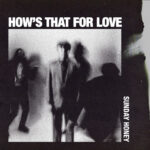
Sunday Honey’s How’s That For Love EP burns hot and fast, a 16-minute surge of dreamy, emphatic indie rock that sears on impact and refuses to cool down. Loud guitars churn and shimmer, vocals arrive charged with urgency, and every track pulses with raw sonic heat and lived-in feeling. It’s electric and uncompromising, but never careless – sweet melodies cut through the distortion, hooks land hard and stay lodged, and the band’s chemistry radiates from every turn. The bookends, “How’s That For Love” and “Folk Like Us,” are instant standouts, but the whole EP plays like a bite-sized journey worth taking again and again, especially when “Red Pelican” hits its intoxicating final stretch and everything feels airborne.
That sense of momentum is rooted in how naturally these songs came together. The band describe the EP’s beginnings as “a few beers around a table in Fox or CJ’s backyard playing a bunch of random stuff until something sticks,” a loose, communal process that mirrors the music’s open-hearted intensity. While there wasn’t a single unifying concept, themes of mental health, betrayal, love, and friendship run through the project, binding it together with emotional clarity. The title track, in particular, dives headfirst into the anxious dread of wanting something to work while fear looms large, pairing surging guitars with lyrics that admit vulnerability without flinching. It’s dramatic, yes, but grounded in honesty – the kind that feels shouted into the wind and immediately echoed back.
What makes How’s That For Love hit so hard is the balance it strikes between volatility and warmth. “Red Pelican” channels pure summer motion, all windows down and road stretching forward (come for the rich vocal harmonies and stay for the smoldering guitar solo), while “Folk Like Us” closes the EP with a yearning sense of escape and self-definition, capturing what it means to want more than the place you’re from will allow. Across all four tracks, Sunday Honey sound locked in, fueled by friendship and a shared emotional charge that never dulls. It’s the sound of a band playing loud, feeling deeply, and trusting that raw connection – how’s that for love, indeed.
:: “Lay Down” – The Vincenzos ::
Chloe Robinson, California

A blistering new rock single, The Vincenzos’ “Lay Down” is the ultimate track of true resistance. The bold anthem is all about allowing yourself to be vulnerable and embrace love in the face of a world that feels ever more violent. Through thrashing guitars, punchy drums and gravelly vocals, a piercing and powerful atmosphere is created. Lead singer/songwriter and frontman Vincent Brue reveals, “‘Lay Down’ was one of those magical songwriting experiences that felt more like an exorcism than a conscious effort at creativity. Going through old voice memos on my phone out in Joshua Tree one night in early November, I found a recording of the main riff and instantly started laying down (no pun intended) tracks, improvising the vocal melody and lyrics on the first take.” The dark, psychedelic accompanying visuals of the band seamlessly mirror the song’s energy.
With a genre-bending sound that fuses indie, Americana, and punk rock, they are rapidly gaining attention for their high-energy shows and deeply resonant lyrics. After connecting at Culver City’s legendary Cinema Bar during its Wednesday open mic, The Vincenzos have quickly become a must-see act throughout the city. The group has headlined iconic Los Angeles spots such as Viper Room and The Troubadour. Since dropping their debut album To Live and Chenz in L.A. in May 2025, the Vincenzos have recorded two full albums at Gatos Trail Studios in Joshua Tree, both expected to arrive in 2026. With “Lay Down” The Vincenzos prove that when passion meets intensity, rock music doesn’t just survive, it thrives.
:: “Love Sound” – Dace Silina ::
Danielle Holian, Galway, Ireland

Emerging pop sensation Dace Silina’s latest single “Love Sound” is a poised and heartfelt tune that feels both intimate and assured. Entirely self-written, the track marks a defining moment in Silina’s artistic evolution, distilling a lifelong devotion to music into a refined pop statement. Her journey, which began in childhood with singing as instinctive as breathing and nature as her first audience, has matured into a distinctive vocal identity shaped by professional training and an intuitive sense of melody.
“Love Sound” is especially significant as Silina’s first English-language composition, a creative leap that underscores her ambition and global outlook. Written in early 2025 and brought to life in collaboration with producer Gints Stankevics, the song unfolds with emotional clarity and organic warmth, consciously crafted without the use of AI. Sonically rooted in contemporary pop, it echoes the sleek confidence of artists like Dua Lipa, Tate McRae, Rihanna, and Ariana Grande, yet remains unmistakably her own – carried by a vocal presence that signals not just promise, but arrival.
:: “Get Ready” – Katie Dauson ::
Danielle Holian, Galway, Ireland

Versatile and genre-blurring, Katie Dauson’s “Get Ready” arrives with a strut that feels both timeworn and immediate, folding rock, blues, and rockabilly into a single, swaggering statement of intent. The rhythm guitar chugs forward with infectious momentum, anchoring the track as the harmonica slices through the mix with grit and bite, recalling the raw electricity of classic blues while never lapsing into pastiche. Produced and engineered by James Nickle, the song is perpetually in motion, driven by a sense of forward thrust that mirrors its lyrical resolve. There’s an unshakeable determination baked into the arrangement, one that refuses to sit still or soften its edges.
Lyrically and emotionally, “Get Ready” frames self-doubt not as an obstacle, but as a necessary spark for transformation. Duason turns uncertainty into propulsion, embracing a defiance that feels almost celebratory in its insistence on growth. Inspired by blues greats Junior Wells and James Cotton, and sparked by the restless energy of Bob Seger’s Katmandu, the harmonica solos carry a road-ready urgency that elevates the track beyond homage. Matching that energy is Dauson’s vocal performance, lived-in, assured, and grounded in everyday experience, a reminder that confidence is rarely innate, but instead something earned through persistence, grit, and motion.
:: The Softies – Molly Stone ::
Danielle Holian, Galway, Ireland

Molly Stone’s The Softies is a study in subtlety and emotional precision, a concise four-track EP that demonstrates the power of restraint in contemporary songwriting. Across just over 13 minutes, Stone strips back production to foreground her crystalline vocals and finely wrought melodies, allowing the listener to inhabit the space between vulnerability and reflection. Each song feels carefully curated, from the wry self-awareness of “Maybe I’m a Handful” to the delicate shimmer of “Glitter,” revealing an artist attuned to the nuances of tonal color, phrasing, and emotional cadence. The EP eschews grandiosity, instead privileging intimacy and lyrical economy, a choice that accentuates the sophistication of Stone’s craft.
Yet beneath its quiet surface, The Softies possesses a subtle emotional potency. “You Left So Suddenly” navigates the contours of grief with restraint, offering poignancy without indulgence, while the closing duet “I Just Wanna Give You Love,” featuring Nathan Thomas, radiates warmth and relational resonance. Stone’s ability to inhabit multiple emotional registers within such a brief runtime underscores her maturity as a songwriter. In its delicate execution and reflective temperament, The Softies emerges not merely as a collection of songs but as an understated, artful statement on the enduring power of tender, thoughtfully rendered music.
:: “A Million Ways” – Marfa ::
Mitch Mosk, Beacon, New York

Marfa’s smile-inducing “A Million Ways” drifts in like golden-hour light through an open window, a sun-soaked soft rock reverie that feels suspended in time. The Colorado-bred Americana-rock duo – Bryce Menchaca and Kellen Wall – build the song on folk warmth, gentle acoustic sway, and sweet, soulful vocal harmonies, carrying a lived-in ease that instantly recalls the ‘70s without feeling like cosplay. There’s a familiar glow here – the kind that fans of The Eagles or Jackson Browne will recognize immediately – but it also slots effortlessly alongside modern acts like Hovvdy or Wild Pink, filled with tenderness and texture, nothing rushed, nothing forced.
Released December 5th, “A Million Ways” is a slow-burn love song that lingers between longing and devotion, circling the idea that there may be countless ways to say “I love you,” but only one that feels truly right. That sentiment plays out in the song’s unguarded intimacy, where every harmony feels close enough to touch and every line lands softly, without drama or grand declarations. It’s love rendered in small, human moments – a song less interested in spectacle than in the quiet gravity of choosing someone, again and again.
As Menchaca shares, the track came from a desire to move away from heartbreak narratives and write something rooted in steadiness and real connection – a love song born not from chaos, but from calm, clarity, and commitment. “Kellen and I were tired of writing about ex-girlfriends and hard times,” he says. “It’s a real love song with the sounds of ‘70s storytelling. I’m going steady in my relationship and it’s going well, so we thought we’d sing about love for once.”
That quiet confidence is what makes “A Million Ways” so affecting: It doesn’t chase urgency or intensity, trusting patience, melody, and mood to do the heavy lifting. Wrapped in Marfa’s warm, Laurel Canyon–tinged glow, the song feels intimate, dreamy, and quietly addictive – music that slips into your life and stays there, ready to soundtrack whatever moments come to pass. In a world that often confuses loudness for depth, Marfa gently remind us how powerful it can be to simply let love unfold in soft motion.
:: “Good As It Gets” – Christian Hayes ::
Mitch Mosk, Beacon, New York

Christian Hayes’ “Good As It Gets” feels like a late-night drive with the windows down, headlights cutting through quiet roads as something tender settles into your chest. Built on passionate acoustic guitar and banjo, the song glows with folk warmth and rich emotion, carried by evocative vocals that feel close enough to hear the breath between lines. It’s intimate and sunlit, dramatic without ever reaching beyond itself – a reverie that holds nothing back in its pursuit of honesty, contentment, and heart.
That sense of closeness is written into the song’s story. Hayes explains, “I wrote ‘Good As It Gets’ as a reminder to myself to enjoy where I am and to just let love do its thing. I used to want to rush the dating phase so bad and be ‘official’ to take away any chance that things wouldn’t work. I quickly realized as I’ve matured that those first several dates are such sweet moments that I spent so many years rushing through.” Rather than chasing certainty, the song lingers in that early in-between – the fragile, hopeful space where nothing is promised, but everything feels possible.
Hayes continues, “I think it’s also okay for things not to work out but still enjoy the time you had with someone. A few dates might be all you get but being able to look back and say those were moments and memories you’re glad you have is something I used to never be able to do. Which brings us to the hook of the song – if this is as good as it gets, I’m good with it.” There’s something quietly radical in that acceptance, a willingness to honor connection without needing it to become something permanent to be meaningful.
That perspective gives “Good As It Gets” its aching power. Hayes sings with unguarded sincerity, embracing patience, presence, and the beauty of not knowing what comes next. “This song truly is one of reaching the contentment in life I’ve spent so many years searching for,” he adds. “I hope it serves as a reminder to everyone to sit in the present and enjoy where they are and to not rush love – cause this is as good as it gets…” In a world obsessed with outcomes and arrivals, “Good As It Gets” offers something gentler and far more lasting – permission to stay right where you are, and to mean it.
:: “This Is Where” – Eileen Carey ::
Chloe Robinson, California

Eileen Carey’s cathartic country/pop single “This Is Where” is a poignant and powerful breakup song. The track tells a tale of two people parting ways, but carrying the love and lessons they have shared. Her radiant, raspy vocals skate atop a wistful, sweeping soundscape and we are instantaneously pulled in. The chorus declares, “It had to end we always knew, this is where we both begin.” As the expression goes…”when one door closes another one opens.” Sometimes one must let go in order to gain something new. This piece perfectly displays that profound sentiment.
Based in Altadena, California, Carey is a talented singer-songwriter with a knack for crafting memorable releases. She has appeared on stage with renowned artists including Don McLean, Rita Coolidge and Jefferson Starship. Characterized as “West Coast Pop-Country,” her songs are both infectious and emotionally compelling. Beyond her music career, she serves as a beauty ambassador for Joe Blasco Cosmetics and is the founder of The Music Mom blog, further highlighting her creativity.
:: “It’ll Be Over Soon” – Kerry Charles ::
Mitch Mosk, Beacon, New York

Kerry Charles’ “It’ll Be Over Soon” moves like heat in low light – a smoldering, slow-burn groove that settles into your body before you even realize it’s there. The title track to his sophomore album of the same name (released in August 2025), the song is dreamy and soulful, steeped in warm R&B pulse, intoxicating effected guitars, and a voice that feels hot to the touch – all sizzle and sway, like a stovetop left on just a little too long. It’s seductive without trying to be, effortlessly drawing you into a world that feels lush, lively, and quietly overwhelming.
Beneath that silky exterior, “It’ll Be Over Soon” is wrestling with something heavier. Charles uses the song to catalog the small rituals and coping mechanisms of adulthood – supplements, prescriptions, moderation, maintenance – tracing the physical, emotional, and existential wear and tear that accumulates over time. Lines like “Take your supplements and exercise / Have another ibuprofen” and “I’ve been maintaining every minute of my life / And I’m so tired of being good” land with a weary clarity, capturing the strange exhaustion of trying to keep everything in line as life presses forward. The groove may be hypnotic, but the tension underneath is real, simmering just below the surface.
That contrast is what makes the song so compelling. As Charles puts it, “This whole record is a meditation on getting old. It was my way of working through all my petty, first-world problems and trying to get the poison out. I’m not sure if it worked – but I love the way the songs turned out.” In that context, the refrain “It’ll be over soon” hangs in the air with deliberate ambiguity – equal parts comfort and confrontation, memento mori and whispered reassurance. It’s a stunning thesis statement for an album that finds beauty, humor, and sensuality in the slow, surreal process of aging – proof that even the weightiest truths can sound this smooth when delivered by someone who knows how to build a world and let it glow.
— — — —

Connect to us on
Facebook, 𝕏, Instagram
Discover new music on Atwood Magazine
:: Weekly Roundup ::
follow WEEKLY ROUNDUP on Spotify
:: This Week’s Features ::
dddddd