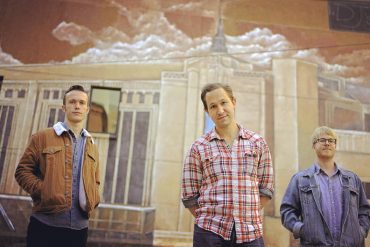
Singer/songwriter Peter Stone finds wonder in the daily work of loving and being changed by another person on “Dust Motes,” a lilting, sun-soaked indie folk reverie that gently illuminates the romance, friction, and transformative grace of building a life together.
Stream: “Dust Motes” – Peter Stone
To love someone deeply is to let them change you.
It means opening yourself wide enough for another person to leave a lasting imprint, trusting them with the parts of you that are still taking shape. Their presence works its way into how you imagine a future, and even how you meet the old wounds you once carried alone. Over time, love becomes a kind of shared authorship, each person leaving traces of themselves in the life they are creating together.
Lilting, wistful, and richly textured, Peter Stone’s “Dust Motes” gathers that intertwined existence into a beautifully gentle indie folk reverie, tracing intimacy as a force that can steady us while slowly reshaping who we are. Bathed in the golden light of late afternoon, the song holds romance close enough to see both its beauty and its friction – the work of knowing another person deeply, growing alongside them, and building a home in one another.
It’s a love song for the life two people make in each other – and Stone renders that devotion with breathtaking grace, revealing just how much wonder can live inside the everyday.

You can find me in the field
under the full moon
You can find me in the deepening
We will trace lines
on our faces on a film screen
We will laugh until the morning
When the foxes dart
across the rainy pavement
When the firmament is feeble
I will race over the
Church Walk to my angel
Where with grace you will see me
Atwood Magazine is proud to be premiering “Dust Motes,” the sweetly sun-soaked new single from New York City-based singer/songwriter Peter Stone. The second single off Stone’s forthcoming sophomore album Hearth, out November 13, it follows “Loveseat” into a more settled chapter for the once-nomadic artist, whose latest record was self-produced and recorded in a tiny spare bedroom in Brooklyn. Across its ten tracks, Hearth stretches Stone’s alt-folk roots into fuller arrangements, psychedelia, bedroom pop, and rock, all while retaining the instinctive, handmade character at the center of their work.
Peter Stone is no stranger to Atwood Magazine. We’ve followed the singer/songwriter’s solo work since their 2020 debut “Fells Reservoir,” watching an artistry rooted in nature, intimacy, memory, and place gradually take on a world of its own. By the time “Cogs” arrived in 2022, we called it “the quintessential Peter Stone song: An acoustic, dreamy wonder dwelling in a space of intimacy, love, and serene contemplation.” Four years later, those instincts remain unmistakable, but the life surrounding them has changed.
Stone’s path has rarely stayed still.
A co-founder and former guitarist of The Rare Occasions, they spent years moving between cities, landscapes, relationships, and creative chapters, building a solo catalog out of the places and people that left their mark along the way. Hearth arrives from the other side of that restlessness: A record created after Stone landed in New York City and began imagining permanence as less of an abstraction and more of a life they could actually inhabit.
“I’ve spent most of my life torn between keeping moving and wanting to be held in one place,” Stone says. “Between independence and solitude and wanting a close-knit crew and warm home. So much of what I’ve made comes out of that.”
That tension gives Hearth both its title and its emotional center. Where 2024’s debut album Altar invoked one kind of sacred space, Stone sees its follow-up as another – closer to the body, closer to daily life, and grounded in a newfound sense of stability. “I felt it was a suitable follow to Altar,” they tell Atwood Magazine. “Another sacred space in the home. More warm and steady and familiar compared to the sometimes brutal associations of an altar. I’m moving in a more settled, more in the home, more stable moment in my life, which is wonderful, and I believe that’s reflected in the sound and the writing.”
That settling has opened Stone’s music outward rather than narrowing it. They describe Hearth as “a big step sonically” in their self-production, with fuller arrangements and a wider palette of synths, drums, and other textures entering the frame. The devastation that once ran closer to the surface has receded without disappearing altogether; in its place is a record drawn more toward connection, steadiness, and the complicated beauty of building a life with other people. “The record definitely comes from a less devastated and more wholesome place in terms of the lyrical themes,” Stone says, “though of course that devastation is still a thread of the tapestry.”

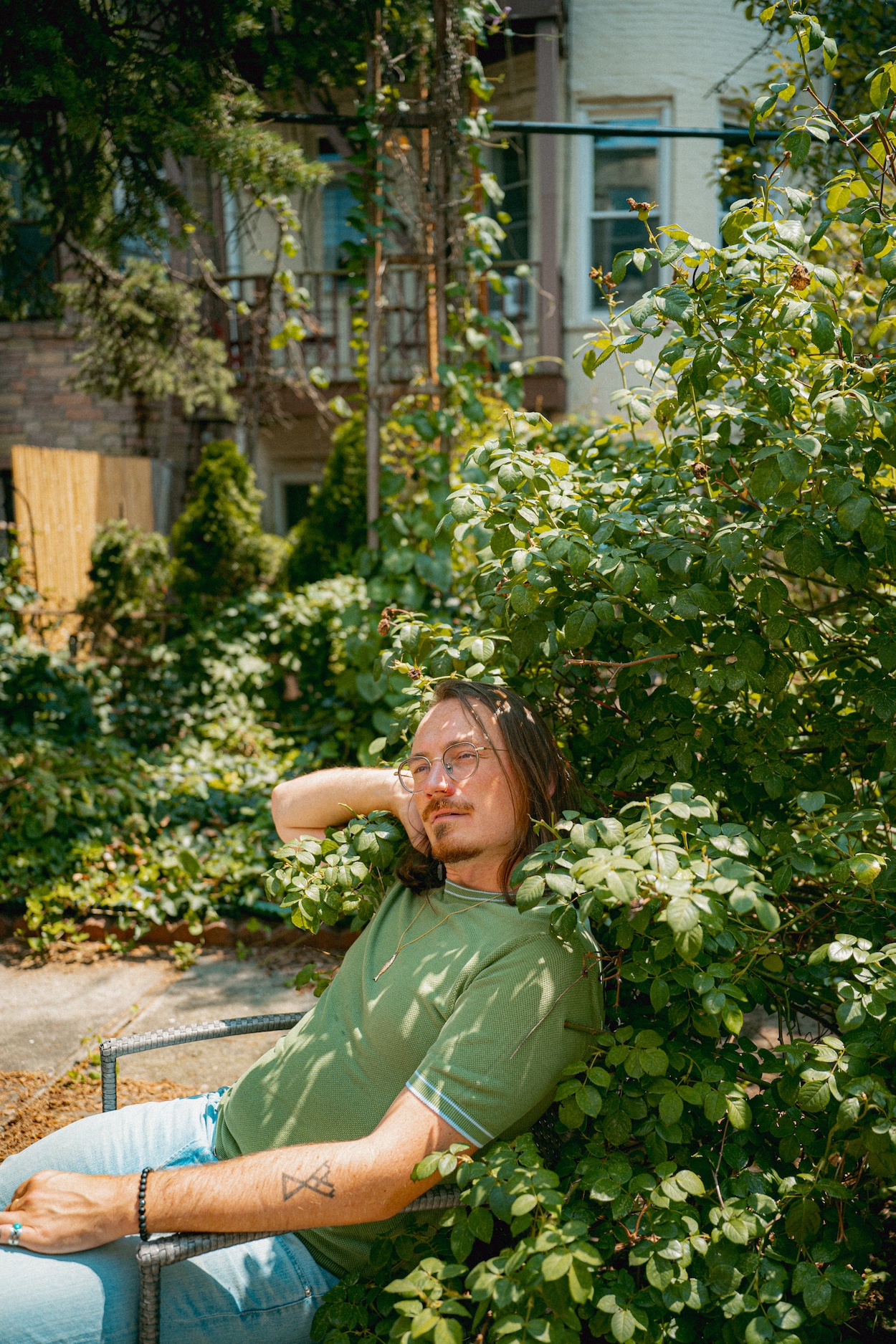
“Dust Motes” makes that new sense of rootedness audible from its first moments.
Stone’s acoustic guitar moves in a gently patterned cycle, each figure catching the light as their delicate vocal drifts above it with an almost weightless intimacy. Electric guitar, light piano, and other atmospheric details enter around the edges rather than crowding the center, adding depth and color while preserving the song’s graceful sway. The result is immersive without ever becoming ornate: a softly radiant world built around voice, wood, strings, and air.
I have faith you will save me from the danger
Of bleeding to the street in vain
And together we’ll erase the final trace of
Shame at our animal nature
And you will fold right into me
We’ll form a whole
Fill it and release
Fill it and release
Fill it and release
The song itself arrived with similar ease. “I just came home from wandering around London, performing at little singer songwriter nights, and sat with my guitar and it poured out,” Stone tells Atwood Magazine. “It was one of those songs that arrives complete. Those tend to end up being my favorites. It is a real time capsule of that moment in my life. From the state of the house, the foxes on the streets of London, the Church Walk alley I would take home… I tried to capture the intertwining of love, romance, death, sex, doom, home-iness, awe that is inherit in a truly deep appreciation of the wonders of intimate love. I wanted to bring the beauty of Anterra and the depth of my feeling towards her alive in a song.”
Those details give “Dust Motes” its pulse. Stone writes love through evidence rather than abstraction: a note on the fridge, folded clothes, dirty plates in the kitchen, foxes cutting across wet pavement, the familiar route home. The romance lives precisely because the mess does too. Nothing has been polished into fantasy; affection and imperfection occupy the same room.
There’s a note up on the fridge that I wrote for you
There’s your clothes clean and folded
There’s a stack of dirty plates in the kitchen
We both know no one’s perfect
But I’m working on it sure as adaptation
And I’m working hard for it
I would grind myself to bone just to ensure it
And my last breath would be a poem for you
“Love and lifelong relationships are built on just these everyday moments,” Stone says. “Most of life is these seemingly unimportant day to day experiences. It takes real spirit to see the everyday with the child eyes of importance and seriousness and play that let magic into your heart.”

The song keeps digging beneath that domestic surface.
“And together we’ll erase the final trace of / shame at our animal nature,” Stone sings, pushing intimacy beyond companionship and toward the difficult work of being fully seen. Desire, embarrassment, inherited shame, and self-acceptance all enter the same frame. Love becomes a place where another person can expose the defenses we’ve carried for years and, with enough trust, help loosen their hold.
“We’re raised with a lot of shame – not being good enough, pretty enough, clean enough, rich enough, strong enough … being wrong or dirty or bad for being the animals that we are,” Stone explains. “I try hard to remember as often as possible that I’m just an ape like any of the others traipsing through what’s left of their forests.”
Nature answers that thought in the song’s most luminous image. Stone compares Anterra to a forest illuminated by fading sunlight, with dust motes suspended among birdsong and wind before the pair “take flight.” Her own voice enters the recording in the background, folding the person who inspired the song directly into its fabric. “I knew her angelic tones would bring that moment of the song to where it needed to be,” Stone smiles. “Having the subject of the song appear vocally also feels so fun and meaningful and special.”
It’d be something about how you are like a forest
Glowing with the beams of fading light
With the dust motes and the songbirds and the noise of
The wind and we take flight
And you will soar right over me
We’ll form a whole
Fill it and release
Fill it and release
Fill it and release
By then, “Dust Motes” has moved from a room full of dirty dishes to a vision almost mythic in scale without ever losing sight of the two people at its center. Stone lets the sacred emerge from the familiar, allowing a fridge note, a rain-soaked street, a lover’s voice, and a shaft of fading light to carry the same emotional weight. In their hands, intimacy becomes less about escaping ordinary life than learning to recognize how much of life’s wonder was already waiting there.
The accompanying music video carries that same affection into motion. Stone and Anterra run hand-in-hand through woods, fields, and along the beach, their ease together radiating through every frame; Stone plays guitar while Anterra dances, they dance with each other, and the whole thing glows with the honeysweet lightness of two people plainly delighted to be side by side. There is no grand performance to sell the romance because the romance is already there in the clasped hands, the movement, the laughter, and the way they inhabit the world together. Watching them, you understand immediately why Stone wanted Anterra’s presence inside the song itself.

“Dust Motes” is ultimately as stirring as it is lovely: Intimate without closing itself off, dreamy without drifting away from the life that inspired it.
Stone gives devotion texture and weight, allowing sweetness to coexist with imperfection and wonder to emerge from dishes, pavement, fading sunlight, and the person waiting at the end of the walk home. Few love songs make permanence sound this alive. “Dust Motes” does so with extraordinary delicacy, capturing romance as an ongoing act of attention – toward another person, toward ourselves, and toward the fleeting beauty surrounding both.
Stream “Dust Motes” exclusively on Atwood Magazine, and dive into our full conversation with Peter Stone below as they take us deeper into the song, the making of Hearth, and the life that has grown around this new chapter. If loving someone deeply means letting them change you, “Dust Motes” catches that change in motion – two lives leaving their traces on one another, and becoming richer for it.
— —
:: stream/purchase Dust Motes here ::
:: connect with Peter Stone here ::
— —
Stream: “Dust Motes” – Peter Stone

A CONVERSATION WITH PETER STONE

Atwood Magazine: Peter, it’s great to catch up! For those who are just discovering you today, what do you want them to know about you and your music?
Peter Stone: I made this myself with my own hands! Me – a real flesh and blood, sweating and struggling, yearning and hoping human. I’ve been on this musical journey for so many years now and I hope you will take time to really listen and open yourself to the sounds and words. I try to encapsulate a lot – where I’m from, the people in my life, the culture I’ve inherited, our duty to nature, the magic of the world… and weave it all together into these songs.
With us being several years into your career, can you recommend a couple deeper cuts or personal highlights from the Peter Stone catalog for Atwood’s crate-digging audience to sink their teeth into?
Peter Stone: I love “Cogs/Twigs.” I feel like “Drying Flowers” is a good one. “Seabreeze” is a must. “Fells Reservoir” is a deep cut – literally written so long ago. Like in 2014.
Who are some of your musical north stars, and what are you most excited about the music you’re making now?
Peter Stone: I’ve been lovvving Charlotte Cornfield recently. In the local NYC scene been really digging Bloomsday and Hiding Places and Helenor and Rebecca McCartney and Purser and Beche and Eliza Edens and sooo many I couldn’t possibly list them all. I have an extensive NYC Music Scene Spotify Playlist for the curious! I love love love Twain and Leif Vollebekk and The Weakerthans and Anna Tivel. My partner Anterra’s music is a constant inspiration.
Your sophomore album Hearth follows 2024’s Altar and arrives after settling into a new homebase in New York City. How do you feel this record compares to Altar, and what does it capture about where you are in your life today?
Peter Stone: I see the record as a big step sonically in terms of what I’m doing with my self-production. More full arrangements and varied sounds. Synth and drums and all that. The record definitely comes from a less devastated and more wholesome place in terms of the lyrical themes – though of course that devastation is still a thread of the tapestry.
What does the title ‘Hearth’ mean to you?
Peter Stone: I felt it was a suitable follow to Altar. Another sacred space in the home. More warm and steady and familiar compared to the sometimes brutal associations of an altar. I’m moving in a more settled, more in the home, more stable moment in my life, which is wonderful, and I believe that’s reflected in the sound and the writing.
“Loveseat” opens Hearth and was the first song you chose to share from the record. Why did that feel like the right introduction to this album?
Peter Stone: It’s the actual first track of the album so I guess I felt this pretty strongly! I just love how it brings a more energetic bombastic attitude compared to some of my other recordings. I think the themes of forgiveness and lasting love and alienation and moving on serve well to bring people into everything the album has to offer. I just felt it was right.
Today we’re premiering “Dust Motes,” which picks up where “Loveseat” left off: Moving from wanting deep, enduring love to actually finding yourself inside that kind of partnership. What’s the story behind this song?
Peter Stone: I just came home from wandering around London, performing at little singer songwriter nights, and sat with my guitar and it poured out. It was one of those songs that arrives complete. Those tend to end up being my favorites. It is a real time capsule of that moment in my life. From the state of the house, the foxes on the streets of London, the Church Walk alley I would take home… I tried to capture the intertwining of love, romance, death, sex, doom, home-iness, awe that is inherit in a truly deep appreciation of the wonders of intimate love. I wanted to bring the beauty of Anterra and the depth of my feeling towards her alive in a song.
I love how much of “Dust Motes” lives in the everyday details: “There’s a note up on the fridge that I wrote for you / there’s your clothes clean and folded / there’s a stack of dirty plates in the kitchen / we both know no one’s perfect.” Why did you want the song’s idea of love to live in those ordinary moments?
Peter Stone: Love and lifelong relationships are built on just these everyday moments. Most of life is these seemingly unimportant day to day experiences. It takes real spirit to see the everyday with the child eyes of importance and seriousness and play that let magic into your heart.
There’s also this much deeper idea in the song of helping one another “erase the final trace of / shame at our animal nature.” What does that line mean to you?
Peter Stone: We’re raised with a lot of shame – not being good enough, pretty enough, clean enough, rich enough, strong enough … being wrong or dirty or bad for being the animals that we are. I try hard to remember as often as possible that I’m just an ape like any of the others traipsing through what’s left of their forests.

The title arrives inside one of the song’s most beautiful images: “you are like a forest / glowing with the beams of fading light / with the dust motes and the songbirds and the noise of / the wind.” Why “Dust Motes,” and what does that image hold for you?
Peter Stone: It is a visible embodiment of an impossible to grasp but essential and beautiful and magical part of life – sunlight. Those moments in late afternoon in a peaceful forest have got to be some of my favorites, one of the experiences in which I feel most at home and at peace.
Anterra sings background vocals on “Dust Motes.” What did her voice bring to the song?
Peter Stone: Anterra’s voice is so lovely! I knew her angelic tones would bring that moment of the song to where it needed to be. Having the subject of the song appear vocally also feels so fun and meaningful and special.
How do you feel the “Dust Motes” music video adds to the song’s experience?
Peter Stone: If people want a little window into the visual world of my life, it’s there for them. It was fun to make – I hope it adds something extra personal for anyone who wants to take a look.

You’ve said you tried to prioritize spontaneity over perfection while making Hearth. What did learning to trust that instinct change about the music?
Peter Stone: It’s easy to accidentally use the computer to remove the organic humanity from music. I find that those rough edges are such a wonderful and intrinsic aspect of what I enjoy about my favorite recordings, so I want to make sure that I leave them in.
What can fans expect from the rest of the album, and what are you most excited for people to hear?
Peter Stone: They can expect to hear a journey through a family of sounds that keeps each moment of album feeling alive and fresh and surprising. I’m excited for folks to listen in full and take in the whole journey.
What do you hope listeners take away from “Dust Motes” and Hearth, and what have you taken away from creating this music and now putting it out?
Peter Stone: I hope listeners can have Hearth as a piece of art that can help them feel deeply, appreciate the wonder in their own life experiences, and make them feel a little more at home in this sometimes unforgiving world. With my creation of and sharing of this work I’ve definitely gotten the chance to deepen my own appreciation of what’s important to me. And I have created some songs that as I carry them with me in my live performances will bring me some of that comfort and catharsis each time.
— —
:: stream/purchase Dust Motes here ::
:: connect with Peter Stone here ::
— —
Stream: “Dust Motes” – Peter Stone
— — — —
Connect to Peter Stone on
Facebook, TikTok, Instagram
Discover new music on Atwood Magazine
© Brooke Banister
 © Brooke Banister
:: Stream Peter Stone ::