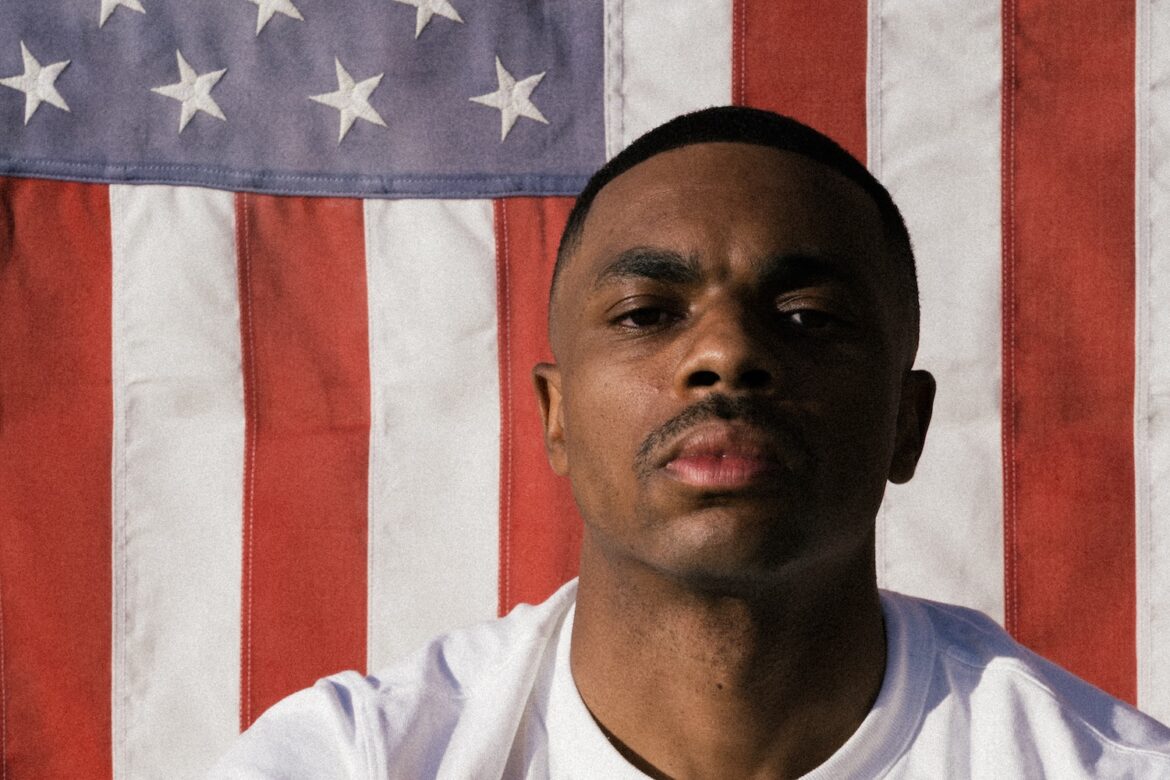
Atwood Magazine’s writers dive into Vince Staples’ abrasive and politically charged independent album ‘Cry Baby,’ a high-voltage stylistic pivot that turns its gaze from private reflection to America’s fraying systems – unpacking its punk-edged production, its jarring mirror of national dysfunction, and the searing social critique beneath Staples’ understated delivery.
Featured here are Atwood writers Ankita Bhanot, Ashley Littlefield, Jake Fewx, Josh Weiner, and Miranda Urbanczyk!
— —
To start, what is your relationship with Vince Staples’ music?
Miranda Urbanczyk: I used to listen to his music regularly a few years back, but then slowly stopped listening to most rap music. My favorite Vince Staples album is definitely his self-titled LP, but I also love Big Fish Theory. I saw him open for Tyler, The Creator in 2022 as well and his set was great.
Ankita Bhanot: I fell in love with “Norf Norf” off of Summertime ‘06 in 2015, when I was graduating high school. The inventive track was so intriguing; a minimal beat driven by a cold, metallic loop and scattered, high-pitched percussion sounds, that was still somehow highly pleasing to the ear. I didn’t quite know what I was hearing, but I loved it – and I was most interested because I couldn’t understand it. The atmosphere of the song is close to unsettling, yet still achieves an almost addictive quality. Tyler, the Creator was already one of my favorite artists at the time, who I loved for his use of heavy, almost uncomfortable bass, and implementation of industrial, sometimes downright unpleasant sounds to emphasize the message of his lyrics. I heard something very similar in “Norf Norf,” and I was energized by the song’s disruptive, unique take on hip-hop.
I did my usual obsessive run of playing the song hundreds of times until I got sick of it, blasted it in my car on my way to and from school while pretending my Prius C was a lot more than it was, and then forgot about it for a year. By the time I was a freshman in college the following year, falling in love with the TV show “Insecure” in my dorm room, I remember my ears pleasantly perking up hearing the song featured in a pivotal scene.
Since then, I’ve kept Vince Staples closely on my radar, and have grown to respect not just the art he makes, but his philosophy on celebrity culture and conducting his public persona. Big Fish Theory remains one of my favorite albums to this day.
Ashley Littlefield: In 2016, I attended FYF Festival in Los Angeles and was introduced to Vince Staples. I heard the energy surrounding his set as his voice echoed between stages around the Colosseum. That moment made time with friends feel fun and full of anticipation.
Fast-forward two years to 2018, and Vince Staples’ sophomore LP became another moment that brought me closer to a new group of friends. I fondly recall spending that year with them, bonding through music. In particular, “Norf Norf” was on repeat while we hung out in Long Beach.
Jake Fewx: As crazy as it is to say, I’ve been a Vince Staples fan for going on 10 years now! I first caught wind of him a little after Summertime ‘06 – “Norf Norf” had a ton of replay for me that summer. But it wasn’t until Big Fish Theory dropped in 2017 that I became a massive fan. That album totally blew me away: a super catchy, summertime hip-hop album with incredibly curated forward-thinking electronic music production. Nothing else quite sounded like it at the time and not much else has sounded like it since. FM! was a great follow up, becoming another personal favorite of mine. Since then, I’ve found myself getting excited for a new Vince Staples album. While I do think some of his newer works don’t quite hold a candle into his older projects, I’m always so impressed with the stylistic variety Vince presents on any given release. A truly unique hip-hop artist, and true aesthetic curator.
Josh Weiner: Yep, I’m with Jake – I first discovered Vince Staples over a decade ago when Summertime ‘06 came out in 2015. I’ve continued to listen to his records regularly since then – including catching him in concert at the 9:30 Club in Washington, DC in 2019 – and feel like I’m mostly caught up (maybe not 100%, though – he’s sure put out a lot of music!). I’ve admired his consistency throughout that period and thus was enthusiastic about tuning in once again to his newest release.
What are your initial impressions and reactions to Cry Baby?
Miranda Urbanczyk: Vince Staples didn’t hold back on Cry Baby, which is his first fully independent album. I thought it did a great job of calling out social systems and political structures in an introspective way. The album’s punk rock elements add to this idea of rebuttal that fits the project’s tone well.
Ankita Bhanot: My initial reaction to Cry Baby was one of admiration more than immediate enjoyment. It’s clear that Vince Staples was aiming for something different, embracing a guitar-driven, post-punk-influenced sound that feels like a deliberate departure from his previous work. While I appreciate the ambition and the confidence behind the direction, the album didn’t fully resonate with me on a personal level. Some of the production choices and moments of social commentary are compelling, but I found the songwriting to be less consistently sharp than what I’ve come to expect from Vince. Ultimately, Cry Baby feels like an interesting artistic statement – one that takes risks and expands his palette, even if it doesn’t always come together in a way that I found completely satisfying.
Ashley Littlefield: Vince Staples has a unique sound, and it’s refreshing to listen to an album where he makes it his own. When the single video for “Blackberry Marmalade” was released, I was instantly intrigued. The opening track is a strong introduction to the album’s experience. Cry Baby explores themes of surrender, enforcement, and awareness of the media’s influence on an audience, as heard in “TV Guide.” The sense of place and the lyrics in “Only in America” carry an evaluative and admiring tone in “America the Beautiful / I’d like to take a look at you.” Overall, I am impressed with the direction he created.
Jake Fewx: I love it! I’m blown away with the energy Vince has on the album. Tons of fun, drum-driven instrumentals, and probably his best rapping performance in half a decade. I skipped the singles beforehand, but with the album cover alone you can sense the shift in tone. Not that Staples hasn’t been political in the past, but there is something incredibly cutting in the way he speaks about political and racial issues on this album. It’s exciting from start to finish.
Josh Weiner: I agree with everyone else. This is another great dose of fabulous energy and killer production from Mr. Staples. In a sense, it was over too quickly – although I’ve gotten the gist by now that Vince likes to keep his albums relatively short, so it didn’t throw me off too much.
How does this album compare to 2024’s Dark Times – what are the most striking similarities or differences?
Miranda Urbanczyk: The two albums themselves are different topic wise. Dark Times is more of an inward reflection, while Cry Baby critisizes behavior towards society and politics. They’re similar in the way that they bring awareness towards their respective topics, with emotional storytelling. I also noticed that Dark Times includes heavy sampling, which is not the case for this new album.
Ankita Bhanot: While Dark Times felt deeply introspective, Cry Baby turns its attention outward. The former was understated and reflective, with muted production that complemented Vince’s meditations on grief, mental health, and personal growth. Cry Baby, by contrast, is louder, more abrasive, and politically charged, embracing jagged guitars and post-punk influences to channel frustration with broader social and systemic issues. Despite their sonic differences, both albums share the same restraint that has come to define Vince’s writing: concise, emotionally detached on the surface, yet capable of conveying a great deal with relatively little. In many ways, Cry Baby feels like a natural progression rather than a reinvention, expanding the scope of his commentary while preserving the understated delivery that has long distinguished his work.
Ashley Littlefield: Dark Times features more piano progressions, looping melodies, and atmospheric production choices, especially on tracks like “Government Cheese” and “Children’s Song.” There’s also a stronger melodic groove in “Shame On The Devil,” guiding listeners through the album’s reflective mood. Staples also uses songs like “TV Guide” and “Radio” to explore technology’s persuasive role in society. Overall, Dark Times offers a more melodic, downtempo experience that invites reflective listening.
Jake Fewx: As Miranda mentioned, Dark Times is much more of a personal album for Staples. The laid-back instrumentals on that album allow more space for Vince to speak about anxieties and insecurities, while Cry Baby has more of a sense of urgency. Both albums seem more “hip-hop” to me then much of Vince’s work over the past five or six years, but I absolutely love the punky feel of Cry Baby. Loads of great drum and bass lines across the tracklist. Two albums displaying two contrasting moods in a convincing fashion, yet I can see how they can act in tandem to showcase Vince’s breadth of talent.
Josh Weiner: Everyone seems to have made some solid observations, and I see no reason to argue with them. I’ll also note that both of these albums have almost exactly the same length (35 minutes), so it’s possible Vince Staples had a similar template in mind when he put them both into production.
Staples teased Cry Baby with “Blackberry Marmalade,” “White Flag,” and “Cotton.” Are these singles faithful representations of the album?
Miranda Urbanczyk: I feel like they do represent the album well since they each individually touch on different parts of the central idea Staples brings awareness towards. “Blackberry Marmalade” starts the album off by highlighting the experiences of African Americans in the U.S. While “White Flag” feels like a song of surrender, and “Cotton” focuses on music as a way of escape.
Ankita Bhanot: Yes – they’re faithful representations of the album both sonically and thematically. “Blackberry Marmalade” showcases the record’s strongest lyricism and socially conscious writing, while “White Flag” and “Cotton” introduce its abrasive, guitar-driven production and sense of simmering frustration. Together, the three singles capture the album’s post-punk aesthetic, political undercurrent, and stripped-back approach, making them an accurate preview rather than outliers chosen solely for commercial appeal.
Ashley Littlefield: “Blackberry Marmalade” and “White Flag” represent the sound of Cry Baby, while “Cotton” focuses on turning to a support system when days get tough. Vince Staples makes that point clear in the line, “Music make you feel just like cotton / Pick me up when I feel like falling down.” If I had to pick three tracks that best represent the album, they would be “White Flag,” “TV Guide,” and “Only In America,” because their sound reflects the themes Staples expresses here.
Jake Fewx: Absolutely. Cry Baby is such a politically driven album. The song titles, much less the contents of these songs, inform Staple’s experience of being a black American in 2026. “White Flag” in particular is interesting. The “love can turn to war” sentiment is both overt, yet seems personal to Vince Staples himself. That and “Cotton” are fitting singles thematically, but I feel they don’t stick with me as much as the higher energy tracks like “The Running Man“ or “TV Guide.”
Josh Weiner: I’d say so; when I first listened to the album and opening track “Blackberry Marmalade” came on, my initial reaction was: “Oh man, this guy is super energetic! And what a cool beat, too! I hope the rest of the album is like this as well.” And sure enough, it was….
What do you make of the record’s album art?
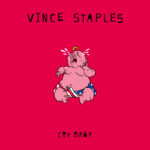
Miranda Urbanczyk: At first, I honestly wasn’t sure what to make of the cover. But after listening to the album and just doing a little more research overall, it’s clear that it’s meant to make a statement. I read the VICE article where Vince clears up all of the misunderstandings that have come from this album cover. The artwork is not supposed to be a caricature of anyone but ourselves. It’s actually supposed to act like a mirror that calls out American ignorance towards social issues.
Ankita Bhanot: It’s jarring, exaggerated, and comedic – feelings I often associate with Vince’s work, much like his series The Vince Staples Show. The crying baby on the cover is overweight to an almost grotesque degree, sporting a singular blond curl that mimics the distinct caricatures used to poke fun at a certain ignorant, silly president. Naturally, the baby’s diaper is the American flag, held together by a single safety pin.
To me, this imagery represents a populace that loves to complain about the state of the country but rarely looks in the mirror. We live in a culture that defaults to blaming the world for its problems rather than questioning the antiquated systems that hold us back more than they push us forward.
Ashley Littlefield: The album’s themes include several references to America by Staples. Music and art often engage with political themes, whether intentionally or through cultural context, yet there is something independent about the cover art. The stark magenta background and the scaled-down, digitally illustrated crying baby in American-flag diapers create a simple image.
The cover art may reflect the turmoil America is experiencing today in its 250 years of youth, as it grows and learns through the journey so far. The lyrics, at their core, serve as Staples’ expression and commentary when listened to with intent. Art will always be subjective, with what is truly being represented in the eye of the beholder!
Jake Fewx: Am I the only one who thought the baby was supposed to be Donald Trump at first? Either way, it’s definitely memorable. It actually doesn’t feel very Vince Staples to me; It’s a little too cartoony for what I would associate with him. I appreciate the significance of the album cover, but I don’t totally love it… Vince is the caliber of artist who I think can present a powerful message through his music (and absolutely does so on this project); however, I can understand the marketing behind the decision and respect Vince‘s choice in choosing a striking album cover like this.
Josh Weiner: It’s kinda jarring; I certainly don’t recall seeing a drawing of a crying baby on the cover of any album since Tha Carter III way back in 2008 😀 But hey, this one simple illustration sure has the potential for substantial social commentary, as the other members of the roundtable have identified. So, kudos to Vince Staples and his artistic colleague, Julio Battistelli, for pulling that much off.
Staples has said very little about this album and its songs – in fact, he delivered all three of its singles without comment, giving them space to speak for themselves. What do you make of this strategy, and how has it shaped the way you interpret his music?
Miranda Urbanczyk: This project holds a lot of weight through its powerful statements. Since the artwork and songs criticize following suit, it makes sense to let the listener interpret the album on their own. When people are told what they are supposed to hear or think, they cut off their ability to imagine a reality where there’s multiple right answers. This approach opens the door for listeners, like myself, to really dive deep into the lyrics and meaning of each track.
Ankita Bhanot: An artist who doesn’t feel the need to overexplain their work conveys a certain level of confidence. By refusing to dictate how the album should be interpreted, Vince allows the music to stand on its own merits and invites listeners to engage with it on their own terms. That approach feels especially fitting here, where the songs are more interested in capturing a mood and a set of anxieties than delivering neatly packaged arguments. It also places greater emphasis on the music itself – its writing, performances, and production – rather than on the narrative surrounding its release.
Ashley Littlefield: It definitely ties back to the cover art’s independent expression. Staples’ music is a comment for listeners to digest as they reflect on it. The strategy is strong because it brings music back to its essential purpose; this album embodies that purpose, as it’s expressive and authentic to the artist. The album stands out for its strategy and for letting its music speak for itself.
Jake Fewx: Like I just mentioned, Vince is a vet who can make high-quality music that speaks for itself. It’s smart for him to let his audience make what they will of his work.
Josh Weiner: Yeah, I’m fine with it. He’s letting us make what we will of the record without too much outside guidance from his part. That works for me.
Which song(s) stand out for you on the album, and why?
Miranda Urbanczyk: My favorite song off this album has to be “TV Guide.” Besides just loving how the song sounds, the lyrics highlighted our dependence on electronics in our lives. I specifically liked how this song was about televisions, because usually everyone warns against phones. If we turn on the TV, watch the news, and turn the TV off, what sort of progress are we bringing towards the exact issues we just heard about? It’s almost like we’re watching the world unfold from afar on our televisions without actually doing anything about it. There are so many ways you can interpret this song, which is honestly why I love it so much.
Ankita Bhanot: “Blackberry Marmalade” easily stands out as the album’s lyrical high point. Vince deconstructs the impulse to reduce Black identity to a single archetype, rattling off seemingly contradictory labels – gangster, bougie, artist, smartest – to emphasize that they’re all flattened into the same stereotype under systemic scrutiny. It’s one of the few moments on the album where his social commentary feels genuinely layered, using repetition and juxtaposition to communicate a nuanced idea without sacrificing clarity.
Ashley Littlefield: I enjoy the lyrics in “White Flag.” The song reflects the importance of knowing when to pick your battles in the face of hardship. The production has a nice groove, with a ska progression in the keys and a bouncy bassline. I also enjoy the transition from “White Flag” to “Running Man,” with the contrast between smooth, broken keys and distorted guitars and leading power chords. Cry Baby has a refreshing take on production and strong percussion moments, especially in “Running Man.”
Jake Fewx: Plenty of bangers! ”Black Marmelade” is an epic, tone setting opening track. “Do You Know The Devil” is really enticing with its dark, gritty guitars. “The Running Man” and “TV Glow” have maybe my favorite instrumentals: fast, brash, and catchy.
Josh Weiner: I agree with Jake that lead track “Black Marmalade” really gets you excited about the album right off the bat, and also with Miranda that “TV Guide” offers some biting social critique of our over-dependence on mass media, a topic that’s been explored on-and-off in rap music all the way back since Public Enemy’s “She Watch Channel Zero?!” in 1988. Also, given how much analysis of American history and politics has been going around lately as a result of #USA250, it’s great to see Vince Staple contribute his own thoughts on the matter in the form of “Only In America.”
Do you have any favorite lyrics so far? Which lines stand out?
Miranda Urbanczyk: I liked a lot of the lyrics in “The Running Man,” which just speaks on constantly running. Staples mentioned running from religion and falling into sin and his worldly desires which was really interesting to hear about.
Lost in translation, can’t find my religion
Is God on vacation?
I just punched my ticket at Grand Central Station
I left all my baggage, had nothin’ worth takin’
I’m rushin’, not chasin’, I’m tired
Controlled by my worldly desires
I also felt like there were a lot of central themes of faith in this album throughout the songs on the album. Staples walks the listener through the struggles of having faith and how that can impact a person’s life.
Ankita Bhanot: I can’t say the lyricism emerged as one of the album’s strongest qualities. Vince’s frustration with the systems that shape everyday life is palpable, but his observations rarely coalesce into anything particularly novel or incisive. Of course, originality isn’t the sole measure of good songwriting; familiar ideas can still resonate when they’re refracted through vivid imagery, unexpected metaphors, or inventive turns of phrase. Here, though, the writing often settles for well-worn expressions instead of complicating or deepening them. Lines like “This world’s known to break down angels / So long since I had my halo,” “You can lie, you can steal, house on a hill / You can be anything, live your dreams / Only in America,” and “I’m rushing, I’m chasing, I’m tired / Controlled by my world of desire” communicate their themes with clarity, but they rarely transcend them. More often than not, they feel content to articulate familiar frustrations rather than illuminate them from a new angle.
That said, the album isn’t devoid of memorable writing. A handful of lines cut through the haze, reminding you of the sharp, understated lyricist Vince can be at his best.
Ashley Littlefield: In “White Flag,” the opening lyrics that stand out to me are “Sometimes a love can turn to war.” Similarly, in “Cotton,” “Drop the needle, turn up that volume / Records spinning, it’s so hypnotic.” Vince Staples touches on the changes that can happen in relationships when yearning turns into friction and fighting, and when the effort put in becomes challenging. In “Cotton,” Staples conveys a message about what can be healing for him and for so many others who turn to music to navigate life and to offer encouragement to keep going.
Jake Fewx: There are awesome lyrics across the board. “Only in America” has a very poignant sentiment to me. The chorus of “God bless the USA… Live by the gun die by the gun” is incredibly haunting and thought, provoking, displaying the tongue and cheek notion of gun ownership versus gun-toting police brutality at the forefront of the BLM movement. Maybe my favorite verse on the album comes from “Go! Go! Gorilla” – “red- lined, gentrified/They gave wrist slaps to them and sentenced mines/went from breadlines to picket lines to main time prison line/for the crimes that we commit, but genocide/Don’t mean nothin’ to Uncle Sam, guess it’s dignified.” Great wordplay, but also a strong depiction of the injustice Vince Staples is speaking on.
Josh Weiner: Like I said in my previous answer, I appreciated Vince Staples’ analysis of the US’ current landscape, especially how timely it is as we celebrate the country’s 250th birthday in Summertime ‘26. Like Jake, I was struck by some of the stinging critiques of the USA made in “Only in America,” including such backhanded compliments as calling it the: “Land of the free, home of the brave, home of the natives, home of the slaves. Trust me when you hear me say, ‘God gon’ bless the USA.’” Even as we honor our semiquincentennial this year, America is far from beyond criticism and Mr. Staples sure sends us a searing reminder of that fact on Cry Baby.
Where do you feel Cry Baby sits in the pantheon of Vince Staples’ discography?
Miranda Urbanczyk: I haven’t listened to all of Vince Staples’ albums, but this one definitely sits high for me. I’d say it’s right up there with Big Fish Theory and his self titled project. I admire how Staples continues to challenge society, and the music industry with his evolving sound and messaging.
Ankita Bhanot: Cry Baby is one of the boldest stylistic pivots of his career. Alongside Big Fish Theory, it stands as one of his most adventurous sonic departures, trading the intimate, West Coast-inflected sound of his recent work for a more abrasive, guitar-driven palette rooted in post-punk. It’s also his first major release following his departure from Def Jam, a shift that seems to have afforded him even greater creative freedom. The live instrumentation and guitar textures hinted at on Dark Times are pushed to the forefront here, resulting in a sound that’s louder, rougher, and more immediate. Like much of his catalog, the album contains no guest features, leaving Vince’s understated delivery to carry the weight of its socio-political commentary from beginning to end.
Ashley Littlefield: Cry Baby is his most mysterious yet personal expression, inviting the audience to discover the experience by listening closely to the sound!
Jake Fewx: This might go down as one of my favorite Vince Staples albums! There’s plenty to love: great songs, driving energy, kick ass instrumentals, top-notch storytelling. There was a small point in time where one of the knocks on Vince was his lack of energy on the mic, but Cry Baby blows that assertion out of the water. I am super impressed with what he is doing here. Not only is this yet another stylistic switch-up for Vince Staples, but proof that the rapper still has plenty to say and can remain unique while doing so.
Josh Weiner: Currently, my favorite of his is 2017’s Big Fish Theory. But I did quite enjoy Cry Baby from the get-go and I imagine it’ll fare decently well in my rankings of Vince Staples’ catalogue once all is said and done.
— —
:: stream/purchase Cry Baby here ::
:: connect with Vince Staples here ::
— —
— — — —
Connect to Vince Staples on
Facebook, 𝕏, TikTok, Instagram
Discover new music on Atwood Magazine
© Adrian Nieto
 © Adrian Nieto
Cry Baby
an album by Vince Staples